
Anton Rize
Senior Members
-
Joined
-
Last visited
Everything posted by Anton Rize
-
Ill comment on this one firs before addressing the long one before it. First of all, I want to express my genuine respect for your background. Calibrating telescope spectrographs and MRI equipment is serious, foundational work. Also, casually mentioning that your dissertation on quintessence was invalidated by WMAP data - and accepting it simply as "part of science" - shows a level of scientific integrity that I deeply admire. Let me address your question about mappings, and then share something directly related to your work with spectrographs. 1. Why Mapping is Epistemologically Essential, but Ontologically "Wrong" You used the perfect example: the MRI. An MRI machine as far as I know does not measure physical [math]x, y, z[/math] coordinates inside the brain. It measures proton relaxation times (pure energy state differences) in varying magnetic gradients. The software then uses Fourier transforms to map those energy states onto a 3D Cartesian grid on a monitor so the doctor can understand it. Is the map useful? Absolutely. It saves lives. But does the brain use a Cartesian coordinate grid to function? No. This is the difference between Epistemology (how we describe the world) and Ontology (how the world actually operates). WILL RG is not against geometry - it is Relational Geometry. It simply states that the universe operates directly on the energy states (like the raw MRI data), while the coordinate grid (the 4D map) is just a human computational interface. 2. The Spectrographic Blind Test (Solving the Degeneracy) Because you work with frequency separation and spectrographs, you know exactly how frustrating the inclination degeneracy is. In classical Keplerian mechanics, the amplitude of a radial velocity curve is tied to [math]K \propto \beta \sin(i)[/math]. It is mathematically impossible to separate the true orbital velocity [math]\beta[/math] from the inclination [math]i[/math] using strictly 1D spectroscopic data. However, because WILL R.O.M. is so rigidly constrained (the "lack of flexibility" we discussed), it inherently isolates a second-order systemic invariant [math]Z_{sys}=\frac{1}{\sqrt{1-\kappa^{2}}}\frac{1}{\sqrt{1-\beta^{2}}} [/math] (product of gravitational red shift and transverse Doppler shift) from the redshift/Doppler interaction that is independent of the line of sight. I just completed a rigorous, randomized blind test of this (the one that all of you ignored when I asked for datasets). Script A generated synthetic 1D observational data for highly relativistic orbits using standard GR 1PN approximations. Script B (the R.O.M. extractor) received ONLY the raw 1D arrays (no mass, no distance, no geometry) and was tasked with rebuilding the 3D orbit using purely relational algebraic closure. Here are the results from two of the trickiest extreme angles (nearly face-on and nearly edge-on): === STRICT BLIND TEST 1 === TRUE PARAMETERS (Hidden from extractor): Period (P): 15.200 yrs Eccentricity (e): 0.86000 Argument of Periapsis (w):105.00 deg Inclination (i): 10.00 deg Background Drift (vz0): 18.50 km/s R.O.M. EXTRACTION RESULTS: Period (P): 15.197 years Eccentricity (e): 0.86163 Argument of Periapsis (w):103.91 deg Extracted Inclination (i):10.95 deg Background Drift (v_z0): 21.73 km/s Precession Rate: 0.1520 deg / orbit Fit Quality (χ²): 224.24 === STRICT BLIND TEST 2 === TRUE PARAMETERS (Hidden from extractor): Period (P): 15.200 yrs Eccentricity (e): 0.90000 Argument of Periapsis (w):70.00 deg Inclination (i): 168.00 deg Background Drift (vz0): -16.50 km/s R.O.M. EXTRACTION RESULTS: Period (P): 15.203 years Eccentricity (e): 0.90011 Argument of Periapsis (w):67.97 deg Extracted Inclination (i):165.61 deg Background Drift (v_z0): -10.96 km/s Precession Rate: 0.1799 deg / orbit Fit Quality (χ²): 232.42 This shouldn't be possible in standard mechanics without astrometry. But the R.O.M. algorithm successfully extracted the 3D spatial geometry (including inclination and precession) strictly from the algebraic relations of the 1D light signal. Since you deal with real spectrographic data, I wanted to share this with you. I am not asking you to take my word for it. If you have access to any anonymized, raw 1D RV/redshift datasets for highly relativistic binaries, or if you could synthesise it, I would love to run them through the script and see what the geometry reveals. Let the math speak for itself.
-
Nothing personal at all, I am fully open about it. I do not have a formal academic degree or a traditional background in physics. For many years, my professional life was completely unrelated to science. However, I have always had a deep, persistent fascination with ontology and the philosophical foundations of physics. About 3 years ago, I decided to completely restructure my life. I stepped away from my previous career paths to dedicate my time exclusively to independent research and my other passion, music. You noticed my terminology is somewhat unconventional. That is exactly because I am self-taught and approach these problems strictly from a philosophical and relational perspective first, rather than a standard mathematical one. Because I don't carry the "legacy habits" of standard academic training, I was forced to build this framework from the ground up, demanding strict epistemic hygiene at every step. To compensate for my lack of formal mathematical training, I rely heavily on modern computational tools (like Desmos and Python) to rigorously test and verify the geometric algebra of my models. It is an unconventional path - studying, developing, and jamming like a nihilistic monk - but it is the most meaningful period of my life, and it allows me to look at these foundational problems without being constrained by standard paradigms.
-
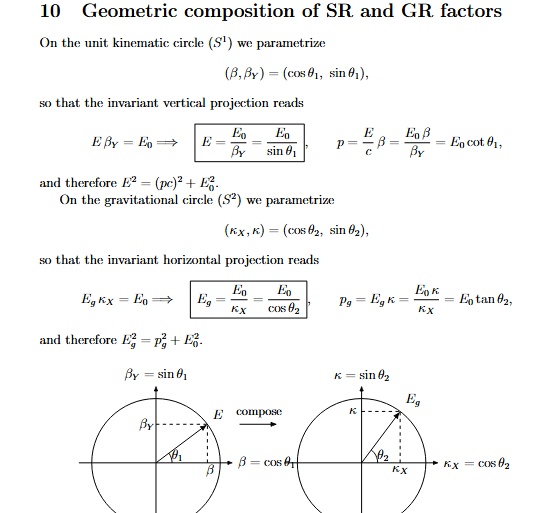
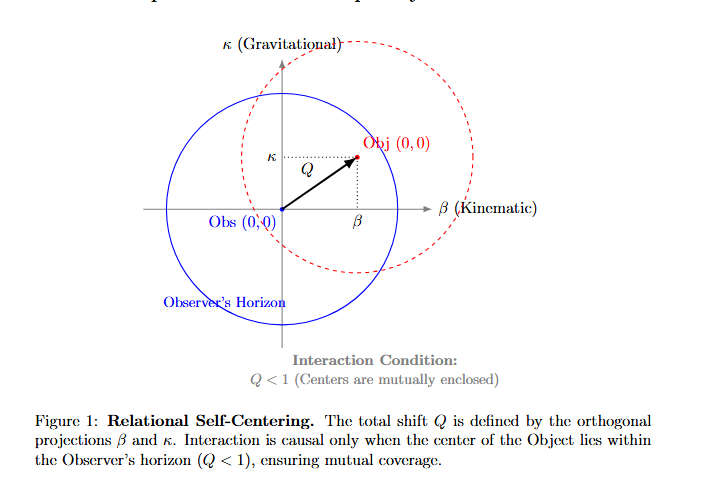
its a frame of reference. I just adding "relational" to emphasise that its not some arbitrary place holder on preexisting X-space and Y-time coordinate axis. In relational framework there could be no preexisting space or time coordinate axis. Again, it would violate the core principles. Instead we derived the relational carriers as inevitable consequences of the core methodological principles. S^1 carrying the protocol of "change conservation" (energy) in 1 DOF domain ⇨ β²+β_Y²=1 ⇨ : β² = v² / c² ⇨ βᵧ=√(1-(v/c)²) ⇨ Eₓ^2 + Eᵧ^2 = E^2 ⇨ Eₓ = Eβ² ⇨ Eᵧ = Eβᵧ² ⇨ β = 0 ⇒ βᵧ = 1 (invariant rest frame state relative to yourself) ⇨ ⇨ Eᵧ ≡ E_0 ⇨[math] E \beta_Y = E_0 \quad \Longrightarrow \quad E = \frac{E_0}{\beta_Y}.[/math] ⇨ γ = 1 /βᵧ ⇨ ⇨ [math] E^{2} = (\tfrac{\beta}{\beta_Y}E_0)^{2} + E_0^{2} = \bigl(\cot(\theta_{1})\,E_{0}\bigr)^{2} + E_{0}^{2} ≡ [math] (pc)^{2} + (mc^{2})^{2} [/math]. https://willrg.com/documents/WILL_RG_I.pdf#thm:restenergy And the same goes for S^2 but I can't be bothered copy pasting from one widow in to another any more when you can just simply click the link: https://willrg.com/documents/WILL_RG_I.pdf#sec:geometric_composition and when we combine 2 amplitudes in to 1 relational circle we getting the relational frame: Yes. You are the center of your relational carriers. Both. Its your measuring tool: https://willrg.com/documents/WILL_RG_I.pdf#sec:kappabeta you can compare something only in relation to yourself. Orthogonality. Great observation! But that's not what Im doing. I highly recommend to read this and at least 2 following sections: https://willrg.com/documents/WILL_RG_I.pdf#eq:will_minkowski_energy by the end of it I deriving this daring statement: "Mathematical complexity is the symptom of philosophical negligence.: I have to admit im proud of this result. Is it? Can you derive it? Ill test it when Ill get a chance. If you right it would be hilarious. Thank you for the excellent illustration of the categorical difference in our methodologies. You highlight the flexibility of manifolds and coordinate systems (e.g., adding [math]a(\tau)[/math] for expansion or [math]\omega[/math] for rotation). I completely agree: for engineering calculations, plotting data, and software rendering, Cartesian grids and differential geometry are incredibly powerful descriptive tools. However, physics is not a software simulation, and a mathematical graph is not a physical territory. Conflating a descriptive mathematical calculator (the coordinate grid) with the physical generator (the Universe) is the exact root of Ontological Bloat. 1. Flexibility as Epistemic Debt (Descriptive vs. Generative Physics) The "flexibility" you praise is precisely what WILL RG deliberately eliminates. In standard Descriptive Physics, if a model doesn't fit the observation, the mathematical flexibility allows you to simply add a new parameter (a scale factor, an epicycle, dark matter) to force the curve to fit. WILL RG is Generative Physics. The lack of "flexibility" is a strict epistemic constraint, not a limitation. Because the relational carriers [math]S^1[/math] and [math]S^2[/math] are geometrically closed, the system is entirely rigid. It physically prohibits the introduction of arbitrary tuning knobs. If a phenomenon cannot be derived directly from the algebraic closure of the relational projections, it does not exist. Same as if theory does not provide accurate predictions - it's wrong, and there's nothing to tune to fix it. That's what I call science - you right or you wrong there's nothing in-between. 2. The Simulation Fallacy You pointed out that my orbital simulation must rely on a coordinate system and an instruction set. This perfectly illustrates the disconnect. To render a visual circle on a flat 2D computer monitor for human eyes, the software must indeed use [math]x, y[/math] pixels and coordinate matrices. But the physics engine driving that simulation - determining the exact eccentricity of the orbit - operates strictly on the dimensionless algebraic ratio of the [math]\beta[/math] and [math]\kappa[/math] projections, requiring absolutely no Newtonian vectors. My github is publicly open and you can see the code yourself. https://github.com/AntonRize/WILL The Universe does not have a monitor to render to, and it does not need a coordinate basis to compute its own relational state. We are not disagreeing on whether graphs are useful for human engineers. We are disagreeing on whether the Universe uses them to function. Yep its strikingly simple. Can you elaborate please? Is it the selfcentering seems unclear? Its very valuable information for me because deriving the model and effectively delivering it are 2 different skills. Its hard for me to see it from the outside like you do. Yes! Thank you!
-
Are you happy with this definition? It seems like a pedagogical placeholder, not an ontological definition. It is strictly circular: Work is mathematically defined as a mechanical transfer of Energy, while Energy is defined as the capacity to do Work. It defines the entity purely through its own transfer mechanism. Emmy Noether's theorem: it elegantly links energy conservation to time-translation symmetry. However, ontologically, it relies on an assumed epistemic loop. It postulates "Time" as a pre-existing, independent background container (a fundamental symmetry) in order to derive "Energy" as a conserved quantity. If we strictly adhere to relationalism, time cannot be an independent external background. This is why I had to derive a rigorous, non-circular definition. And its not a postulate or an axiom. It holds only until it doesn't. Energy is the relational measure of difference between possible states. It is not an intrinsic property of an object, nor a magical fluid that "does work". It is a comparative structure between an observer and an observed state.
-
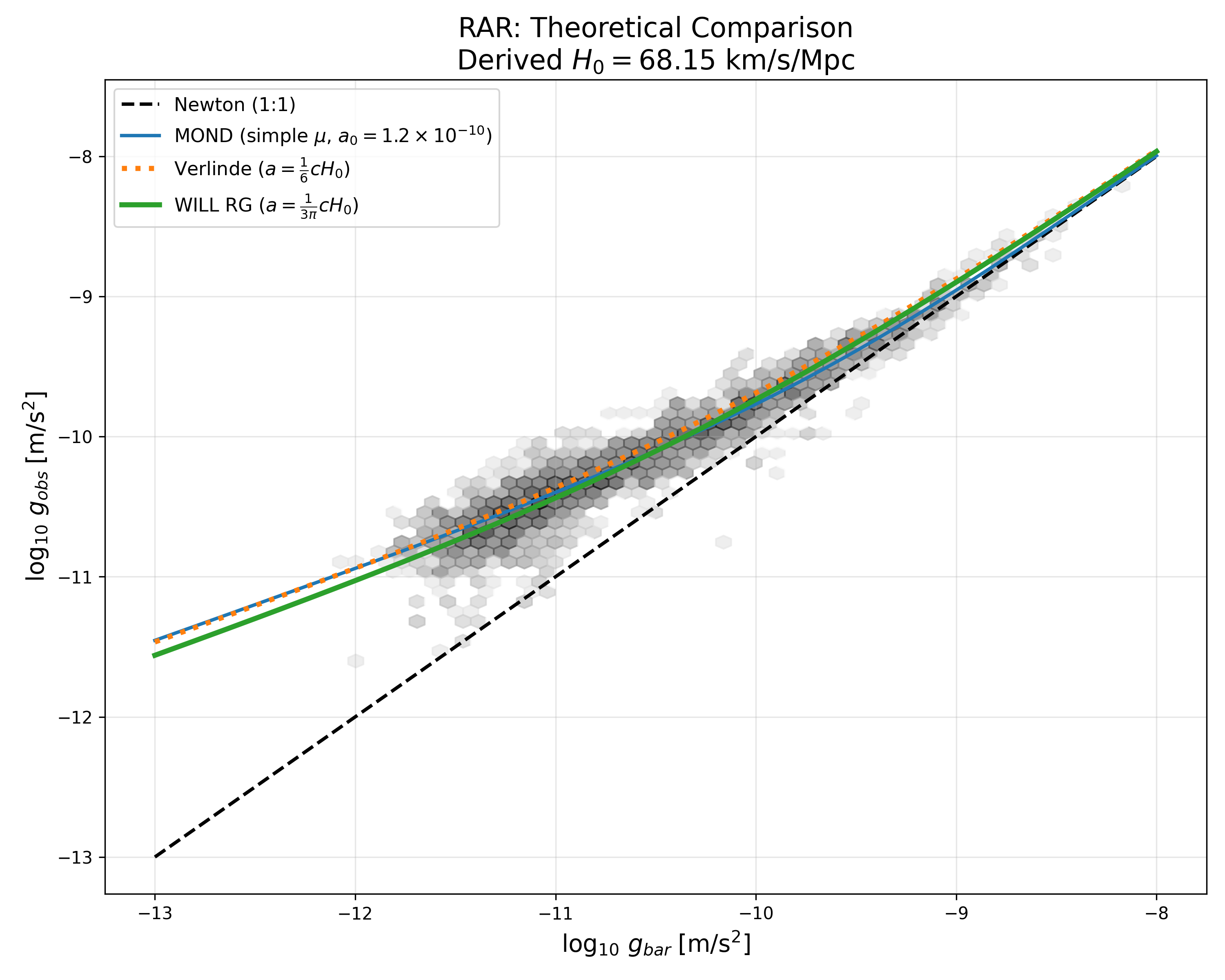
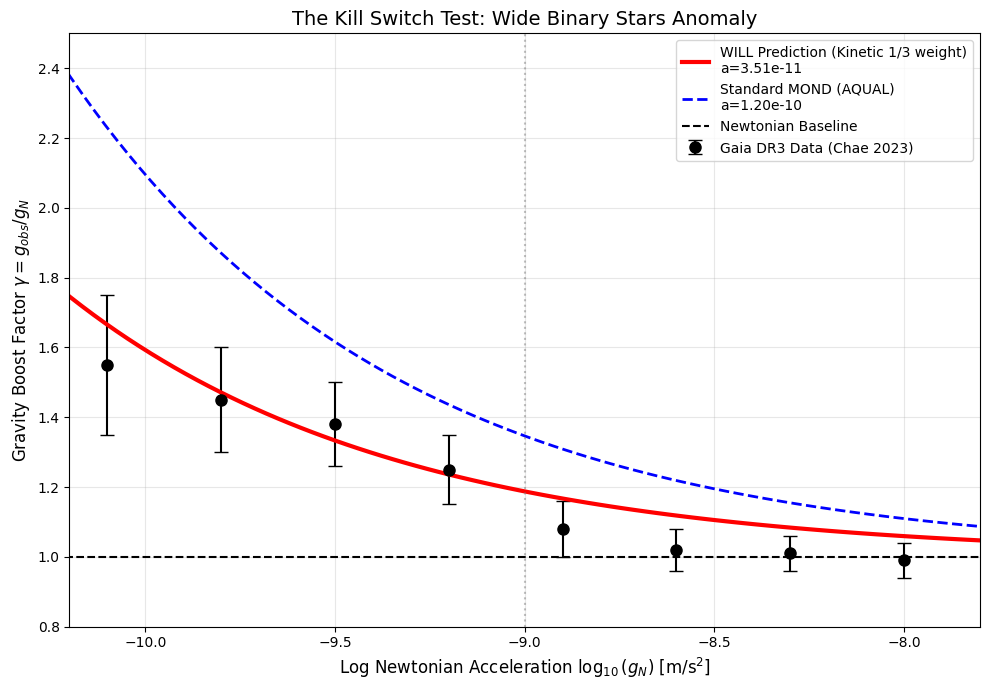
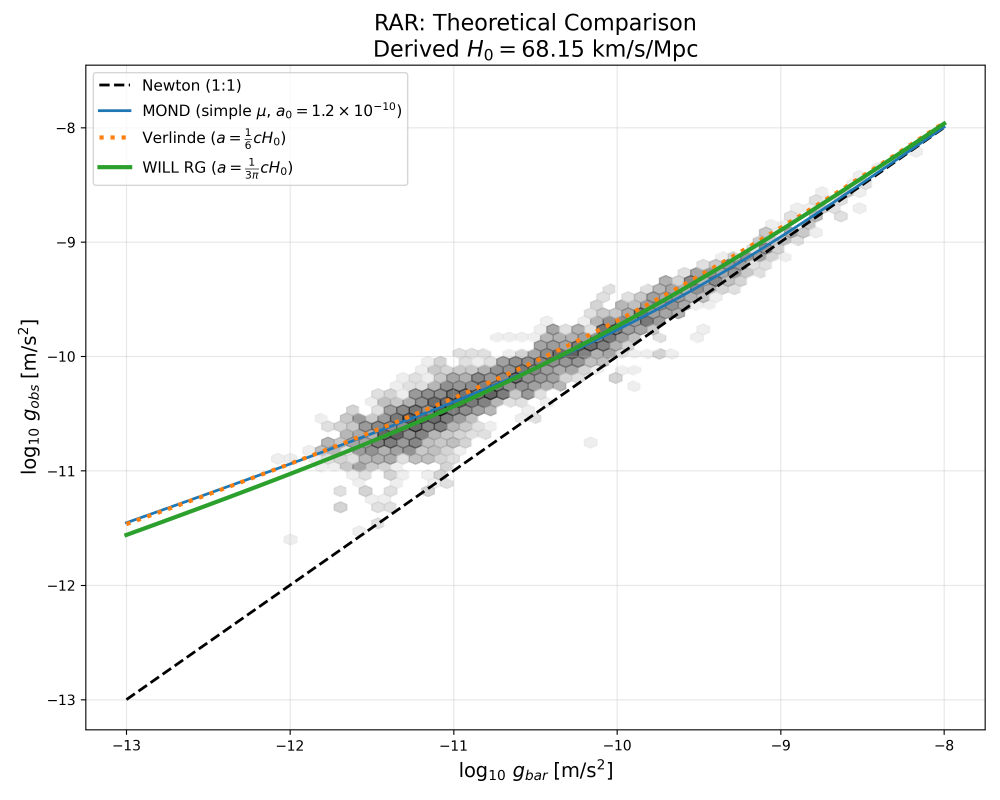
thank you for the excellent question. You are absolutely right to ask for clarification, as my previous late-night phrasing ("Space is a consequence of Time") was too philosophical. Let me give you the strict, operational physics perspective. 1. Distance and Signal Delay: Where does it come from? Operationally, I don't start with a pre-existing 3D Cartesian box and place objects in it. In Relational Orbital Mechanics (R.O.M.), the only variable we have access to is the local clock of the receiver, which shows us not a coordinate axis, but the rate of energy transformations (Time). Using time as a spatialized coordinate axis introduces ontological baggage that goes against our methodological principles. When we receive a photon stream, we do not inherently know its 3D origin vector. The "delay" is the fundamental physical reality - it is the causal lag between emission and reception. Distance is operationally defined through this lag: [math]L \equiv c \Delta t[/math]. The 3D spatial geometry (the "where", like orbital inclination) is a mathematical consequence that my algorithm (I am still waiting for you guys to send me an anonymized dataset for the blind test) reconstructs post-facto by analyzing the invariant kinematic shifts ([math]\beta[/math]) embedded in the received signal (something that GR simply cannot do). 2. The Four Fundamental Quantities (E, M, T, L) and the Vacuum In GR, spacetime is often treated as a "fabric" that can exist even when completely empty of energy ([math]T_{\mu\nu}=0[/math] vacuum solutions). In WILL RG, there is no such thing as an "empty void" due to the SPACETIME [math]\equiv[/math] ENERGY equivalence derived earlier. What we call mass, energy, space, and time are strictly correlated projections of a single underlying relational structure: SPACE-TIME-ENERGY, which for convenience (and a bit of irony) I call WILL [math]\equiv[/math] SPACE-TIME-ENERGY. If we express Energy, Time, Mass, and Length dynamically using the framework's kinematic ([math]\beta[/math]) and potential ([math]\kappa[/math]) dimensionless projections, all dimensionful constants strictly cancel out, yielding the invariant identity: [math]\frac{E}{M} = \frac{L}{T} = c^2[/math] or in more "poetic" form [math]W_{ILL}=\frac{ET^2}{ML^2} = 1[/math] WILL [math]\equiv[/math] SPACE-TIME-ENERGY [math]\equiv[/math] 1 WILL is not the unit of something - but the Unity of Everything. Every change in the relational state rescales Energy-Mass and Time-Length coherently. They cannot fluctuate independently. https://willrg.com/documents/WILL_RG_I.pdf#sec:willinvariant To demonstrate this operational lock, consider the Earth-GPS satellite system. Using its specific dimensionless projections ([math]\beta[/math] and [math]\kappa[/math]) and scaling, the framework calculates the absolute dimensional values: [math]M_{GPS} \approx 5.972 \times 10^{24} \, \mathrm{kg}[/math] [math]E_{GPS} \approx 5.367 \times 10^{41} \, \mathrm{kg \cdot m^2/s^2}[/math] [math]T_{GPS} \approx 0.00785 \, \mathrm{s^2}[/math] (temporal scale projection) [math]L_{GPS} \approx 7.060 \times 10^{14} \, \mathrm{m^2}[/math] (spatial scale projection) Testing the identity gives exactly [math]\frac{E_{GPS}}{M_{GPS}} = \frac{L_{GPS}}{T_{GPS}} = c^2[/math], proving these are not independent parameters but interlocked geometric projections. Because distance requires a causal signal (Energy), you cannot have a spacetime geometry without an underlying energetic structure. What GR calls the "empty vacuum" is modeled in WILL RG as a macroscopic standing wave - a Fundamental Tone ([math]f_0 = H_0/2\pi[/math]) generated by the tension of the causal horizon. It is crucial to note that this [math]H_0[/math] is strictly derived from first principles using the CMB temperature and the fine-structure constant [math]\alpha[/math], not fitted to cosmological datasets: https://willrg.com/documents/WILL_RG_II.pdf#sec:deriving-H0 The necessity of this Fundamental Tone arises strictly from the system's topological closure. In a closed relational carrier, any relational perturbation cannot propagate indefinitely without re-encountering its own wavefront. Therefore, only resonant modes (where the phase shift completes a full rotation, [math]\Delta_\phi = 2\pi n[/math]) can accumulate sufficient structural energy ([math]Q_{total}[/math]) to form a persistent physical manifold. Dissonant modes self-cancel. The baseline resonance of this closed topology physically constitutes the Fundamental Tone of the observable Universe. https://willrg.com/documents/WILL_RG_II.pdf#sec:tone 3. Testable Predictions: Why SPACETIME [math]\equiv[/math] ENERGY matters This ontological stance is not just philosophy; it produces testable celestial mechanics without Dark Matter. Because every local orbiting body shares the same closed geometry with the Global Horizon, the local orbital frequency constructively interferes with the Fundamental Tone of the "vacuum". The total observed kinetic energy state of a star incorporates a geometric mean interference term: [math]v_{obs}^2 = v_{N}^2 + \sqrt{v_{N}^2 \cdot (\Omega a_{Mach} r)}[/math] Where [math]a_{Mach} = f_0 c = cH_0/2\pi \approx 1.05 \times 10^{-10} \, \mathrm{m/s^2}[/math]. https://willrg.com/documents/WILL_RG_II.pdf#sec:galactic-dynamics To determine the coupling weight [math]\Omega[/math], we look at the Total Relational Shift ([math]Q^2[/math]). In a closed system, the energy is distributed between the potential ([math]S^2[/math]) and kinematic ([math]S^1[/math]) carriers: [math]Q^2 = \kappa^2 + \beta^2 = 3\beta^2 = \frac{3}{2}\kappa^2[/math] This enforces a strict structural bifurcation: 1. Galaxies are continuous potential fields (fluids/structure) on the 2D carrier. Their coupling weight is [math]\Omega_{pot} = \frac{\kappa^2}{Q^2} = \frac{2}{3}[/math]. 2. Wide Binaries are discrete point-mass orbits on the 1D kinematic carrier. Their coupling weight is [math]\Omega_{kin} = \frac{\beta^2}{Q^2} = \frac{1}{3}[/math]. https://willrg.com/documents/WILL_RG_II.pdf#def:rel_weight This mathematically derives two distinct anomalous acceleration scales, predicting exactly why MOND's single parameterization fails: * Galactic Scale: [math]a_\kappa = \Omega_{pot} \cdot a_{Mach} = \frac{cH_0}{3\pi} \approx 0.70 \times 10^{-10} \, \mathrm{m/s^2}[/math]. This naturally matches the flat rotation curves in the SPARC dataset (RMSE [math]\approx[/math] 0.065 dex) without Dark Matter. https://willrg.com/documents/WILL_RG_II.pdf#sec:models_comparison https://willrg.com/documents/WILL_RG_II.pdf#fig:rar * Binary Scale: [math]a_\beta = \Omega_{kin} \cdot a_{Mach} = \frac{cH_0}{6\pi} \approx 0.35 \times 10^{-10} \, \mathrm{m/s^2}[/math]. This yields a gravity boost factor of [math]\approx 1.47[/math], perfectly matching the recent Gaia DR3 wide binary anomaly (Chae 2023, empirical boost [math]\approx 1.45 - 1.55[/math]). https://willrg.com/documents/WILL_RG_II.pdf#sec:wide-binary In conclusion: Space is not a void; it is a resonant structural capacity. Cosmological predictions chain: https://willrg.com/documents/WILL_RG_II.pdf#tab:cosmology_comparison
-
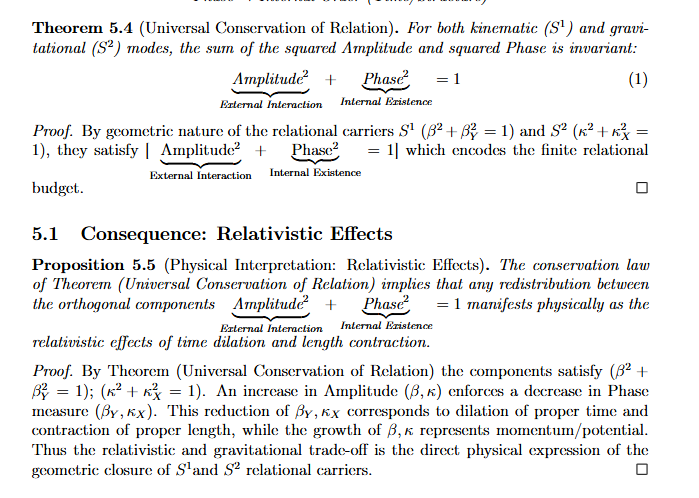
Thank you. I genuinely appreciate this question. You are the first person in this discussion to ask about the philosophical foundation, and to be honest, it is the most important part of the entire framework. If you look only at the equations, it is perfectly natural to suspect "reverse engineering" or curve-fitting based on prior knowledge of SR and GR. But the reality is exactly the opposite, and it is the most fascinating aspect of this research. The answers you see are not assembled by picking and choosing variables to match textbook results. The entire framework is the inevitable consequence of a single choice made at the very beginning, governed by two strict rules: 1. Epistemic Hygiene: "This line of reasoning derives physics by removing hidden assumptions, rather than introducing new postulates... No assumptions are introduced and no constructs are retained unless they are geometrically or energetically necessary." 2. Relational Origin: "All physical quantities must be defined by their relations. Any introduction of absolute properties risks reintroducing metaphysical artefacts." And now we proceed from strict epistemic minimalism, disallowing all background structures, even hidden or asymptotic ones. Historical Pattern: breakthroughs delete, not add * Copernicus eliminated the Earth/cosmos separation. * Newton eliminated the terrestrial/celestial law separation. * Einstein eliminated the space/time separation. * Maxwell eliminated the electricity/magnetism separation. Each step widened the relational circle and reduced the number of unexplained absolutes. The spacetime--energy split is the only survivor of this pruning sequence. The contemporary split: an unpaid ontological bill All present-day theories (SR, GR, QFT, CDM, Standard Model) are built with a bi-variable syntax: [math]\underbrace{\text{fixed manifold + metric}}_{\text{structure}} + \underbrace{\text{fields + constants}}_{\text{dynamics}}[/math] No observation demands this duplication; it is retained purely because the resulting Lagrangians are empirically adequate inside the split. The split is therefore not an empirical discovery but an unpaid ontological debt. Consequence Until an experiment varies the amount of space while holding everything else fixed, the spacetime - energy separation remains an un-evidenced metaphysical postulate - the last geocentric epicycle in physics. Here is how the derivation actually works (How I get the answers): Step 1: Removing the Container Standard physics assumes a background "container" (spacetime) that gets filled with "things" (energy/matter). By applying Epistemic Hygiene and Relational Origin, we must delete this unobservable background. We are left with only one invariant reality: Energy. But in a purely relational framework, Energy is not a scalar "thing" inside an object; it is strictly the relational measure of difference between states. Thus, we arrive at the core ontological equivalence: [math]\text{SPACETIME} \equiv \text{ENERGY}[/math]. Step 2: Getting on the "Rails" If there is no background 3D grid, how do we encode this conserved relational energy? The mathematics forces the answer. The absolute minimal, background-free geometric structures capable of hosting a conserved relational resource are the closed topologies of [math]S^1[/math] (for directional kinematics) and [math]S^2[/math] (for omnidirectional gravitation). These are not objects in space; they are the protocols of interaction. Step 3: Geometric Crystallization Once the system is on these topological "rails," the physics derives itself. Because [math]S^1[/math] and [math]S^2[/math] are closed geometries, any physical state is simply an orthogonal projection, distributed between an External Amplitude (like kinematic shift, [math]\beta[/math]) and an Internal Phase (internal order/proper time, [math]\beta_Y[/math]). Because the carrier is closed, the geometry strictly demands: [math]\beta^2 + \beta_Y^2 = 1[/math] This is where all the "answers" come from. I did not work backwards from Einstein's time dilation formula. Instead, the geometry dictates that if an observer's state increases its external relational amplitude ([math]\beta[/math]), it must geometrically rotate, necessarily decreasing its internal phase ([math]\beta_Y[/math]). That phase reduction is the physical phenomenon of time dilation. There is no room for reverse engineering because there are zero free parameters. Once you remove the background space and enforce relational closure, the geometry simply doesn't leave any other algebraic path. The philosophy enforces the geometry, and the geometry generates the physics. I hope this clarifies the methodology! I would be happy to answer any deep questions. I also encourage you to test it yourself. Just try starting from the same methodological principles and derive anything else but S^1 and S^2. I tried multipole times its impossible without inconsistencies. All LLM's that I tested this logical chain are also converging towards S^1, S^2 independently. If you are reader: You can find all derivations in details in this document https://willrg.com/documents/WILL_RG_I.pdf If you are viewer: You can glance through the presentation slides: https://github.com/AntonRize/WILL/blob/218963db78ec0f0c2333704b5f1c34dffa4acf98/images/Relational_Geometry_I_21.02.26.pdf Or you can watch a simple 7 min video but its very basic: https://notebooklm.google.com/notebook/d2c97547-d93b-4f20-ad39-2cf307b8d91d?artifactId=67df8cab-b837-4ffd-8cdc-518eec5024eb If you are listener: You can enjoy a nice Deep Dive podcast on WILL_RG_I paper: https://notebooklm.google.com/notebook/d2c97547-d93b-4f20-ad39-2cf307b8d91d?artifactId=dbad15b6-8585-44e4-9306-ae25211177ee So in conclusion: I'm not getting the answers, I'm just simply reviling inevitable consequences of the core methodological principals. The incredible part is that they happened to perfectly match the fundamental laws of physics. Yeh I know what you mean... It is a bit unsettling... so I prefer not to think about it. In the end Im driven not by the desire for recognition but by a personal need to resolve fundamental questions about reality in the simplest possible terms.
-
This assumes RG reduces the system to a single, unstructured scalar value (e.g., "Joules") from which one must manually extract direction or distance. It does not. In fundamental physics, Energy is not an intrinsic scalar property of an isolated object; it would violate the relational origin principal; it is a structural relation. Energy is the relational measure of difference between possible states, conserved in any closed whole. It is not an intrinsic property of an object, but a comparative structure between states (and observers), always manifesting as transformation. Fundamental physics is dimensionless. The "energy distribution" in WILL RG is inherently structured by two orthogonal dimensionless projections: the kinematic amplitude [math]\beta[/math] and the gravitational amplitude [math]\kappa[/math]. You do not need to perform "conversions" to extract geometry, because Energy and Geometry are inseparable. The relational projections are the geometry. To demonstrate this, here is how the geometric shape of an orbit (eccentricity, [math]e[/math]) is derived directly from the balance of these energetic projections, without any reference to background spatial coordinates, angles, or Newtonian forces. Derivation of Relational Eccentricity: Geometric eccentricity is not a free parameter but a measure of the energetic deviation from the circular equilibrium state ([math]\delta=1[/math]). Using the conservation of the two projection invariants: 1. Energy Projection Invariant (Binding Energy): [math]W = \frac{1}{2}(\kappa^2-\beta^2) = \text{const}[/math]. 2. Angular Projection Invariant: [math]h = r\beta = \text{const}[/math] (at turning points). Consider the two turning points of a closed orbit: periapsis ([math]p[/math]) and apoapsis ([math]a[/math]). The relation between radii is determined by the geometric range: [math]r_a = r_p \left(\frac{1+e}{1-e}\right)[/math] Step 1: Relational Mapping Using the angular invariant ([math]\beta \propto 1/r[/math]) and the potential definition ([math]\kappa^2 \propto 1/r[/math]), we map apoapsis projections in terms of periapsis values: [math]\beta_a^2 = \beta_p^2 \left(\frac{1-e}{1+e}\right)^2[/math] [math]\kappa_a^2 = \kappa_p^2 \left(\frac{1-e}{1+e}\right)[/math] Step 2: Energy Balance Substituting these into the energy invariant conservation condition [math]W_p = W_a[/math]: [math]\kappa_p^2 - \beta_p^2 = \kappa_p^2 \left(\frac{1-e}{1+e}\right) - \beta_p^2 \left(\frac{1-e}{1+e}\right)^2[/math] Rearranging to group potential terms ([math]\kappa[/math]) on the left and kinematic terms ([math]\beta[/math]) on the right: [math]\kappa_p^2 \left[ 1 - \frac{1-e}{1+e} \right] = \beta_p^2 \left[ 1 - \left(\frac{1-e}{1+e}\right)^2 \right][/math] Step 3: Algebraic Reduction Expanding the terms in brackets: [math]\kappa_p^2 \left( \frac{2e}{1+e} \right) = \beta_p^2 \left( \frac{4e}{(1+e)^2} \right)[/math] Dividing both sides by [math]2e[/math] and multiplying by [math](1+e)^2[/math] yields the geometric identity for bound orbits: [math]\kappa_p^2 (1+e) = 2\beta_p^2[/math] Step 4: Connection to Closure Recall the definition of the closure factor at periapsis: [math]\delta_p = \frac{\kappa_p^2}{2\beta_p^2}[/math] Substituting the geometric identity into this definition: [math]\delta_p = \frac{\kappa_p^2}{\kappa_p^2(1+e)} = \frac{1}{1+e}[/math] Solving for [math]e[/math], we obtain the exact geometric eccentricity: [math]e = \frac{1}{\delta_p} - 1 = \frac{2\beta_p^2}{\kappa_p^2} - 1[/math] Summary: [math]\text{ECCENTRICITY} \equiv \text{CLOSURE DEFECT}[/math] There are no forces, no background grid, and no coordinate conversions. The spatial geometry of the orbit is strictly generated by the pure algebraic ratio of the energetic projections. [math]\text{SPACETIME} \equiv \text{ENERGY}[/math] Full derivation: https://willrg.com/documents/WILL_RG_I.pdf#sec:rel_ecc Closed Algebraic System of Relational Orbital Mechanics (R.O.M.): https://willrg.com/documents/WILL_RG_I.pdf#eq:rom
-
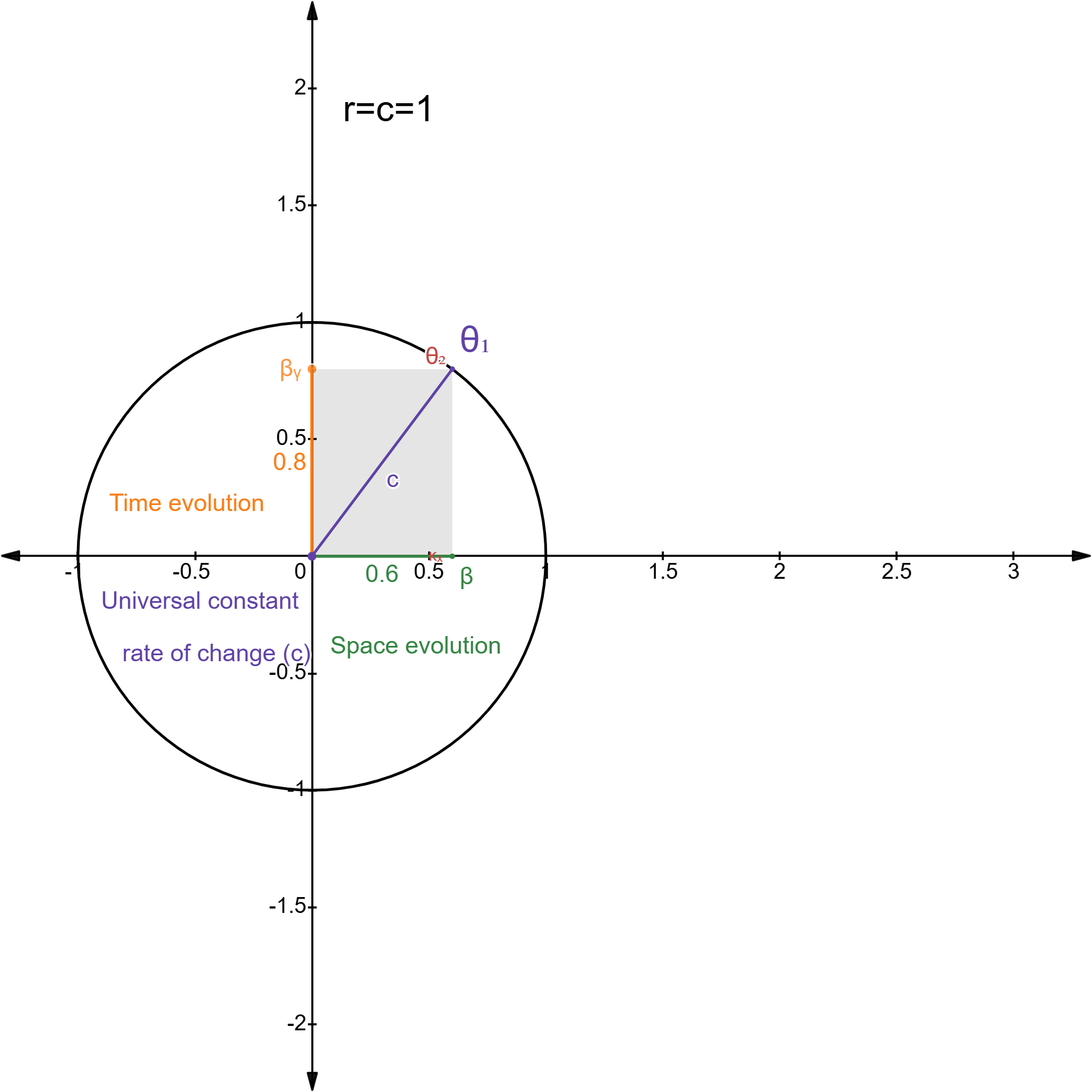
You are overcomplicating my friend. If we strip the problem of any specific details and other additional anthropocentric components we will see the foundation of this phenomena. let's test the hypothesis that the age difference is manifested by the asymmetric observation of Doppler shifts (the optical delay of the turnaround) by removing the delay entirely. Consider a modified scenario: Observer A remains at rest. Observer B does not travel to a distant star, but instead orbits Observer A at a negligible, constant distance with a kinematic projection of [math]\beta = 0.8[/math]. In this setup: 1. The distance is constant, meaning there is zero varying signal delay. 2. The longitudinal Doppler effect (approaching/receding) is eliminated. 3. There is no linear "turnaround" event to flip a signal from red to blue. According to the logic that the asymmetry of observed optical shifts dictates the age difference, this mechanism completely fails to account for this geometry. Yet, the physical age difference undeniably accumulates. Why? Because the age difference is a geometric necessity of the relational state allocation, not an artifact of light travel times. As RG demonstrates, physics is generated by the state difference, not the optical shadow it casts. The calculation is purely algebraic and instantaneous, requiring no signal delay accounting: * Observer A's state: [math]\beta_A = 0 \implies \beta_{YA} = 1[/math] * Observer B's state: [math]\beta_B = 0.8[/math] By the strict closure of the [math]S^1[/math] carrier ([math]\beta^2 + \beta_Y^2 = 1[/math]), Observer B's internal phase is geometrically constrained: [math]\beta_{YB} = \sqrt{1 - 0.8^2} = 0.6[/math] If the experiment runs for [math]N = 10[/math] years in A's rest frame: [math]\tau_A = 10[/math] years [math]\tau_B = \beta_{YB} \cdot N = 0.6 \cdot 10 = 6[/math] years The age difference is 4 years. No outbound leg. No turnaround. No red/blue shift asymmetry. The optical Doppler shift is merely the information transmission of the state; the state itself (the [math]\beta_Y[/math] projection) generates the proper time. I hope it helps to grasp the blinding simplicity of the phenomena at hand. Could you elaborate please? What was the reasoning that led you to this conclusion? And prior knowledge of what? You can use this derivation chart to point out the logical block that "require prior knowledge" https://willrg.com/LOGOS_MAP/
-
You see this doesn't make any sense to me sorry. How do you determine x=10, y=10 and z=10? In relation to what? How do you choose your (0,0,0) ? On what basis you assume that spacetime can be forced in to a grid like an empty lunchbox? You are smuggling a background manifold into the premise of your question. If there is only me (the observer) and a single static event, there are no "x, y, z" axes. There is no grid. There is only a direct relational link (line of sight). To define x=10, y=10, z=10, you must arbitrarily invent a background coordinate system (an empty lunchbox) with arbitrarily chosen orthogonal axes pointing into empty space. This violates the principle of relational origin. In RG, I self-center at my relational origin [math](\beta=0, \kappa=0)[/math]. If I observe an event, I measure only two things: 1. The relational shift (redshift/Doppler) which gives me [math]\kappa[/math] and [math]\beta[/math]. 2. The geometric scale [math]r[/math] (via luminosity or parallax or signal delay etc...). Angles do not exist a priori between an object and an imaginary spatial axis. Angles only exist between two distinct observable objects (e.g., measuring the angular separation between Event A and Event B). So the system under study is me at the origin and the event. That's all our system is. there's no need to speculate "the empty lunchbox" scenario with arbitrarily chosen values in arbitrarily chosen metric. Geometry is constructed from actual relations between bodies, not by pinning bodies onto an imaginary Cartesian grid. This is precisely what Im doing in this blind test I called out. Send me the data lets test not by just agreeing with GR but by predicting accurate results where GR can not! I know it sounds crazy. I don't believe my results as well. There's only one way to find out. Blind empirical test. Lets do it! Isn't it's the net gravitational force (or acceleration, [math]g[/math]) that equals zero? not the gravitational constant [math]G[/math]? [math]G[/math] remains constant in the Newtonian framework as far as I know... But let's address physics of uniform distribution using RG. This is actually a perfect example of why RG is ontologically cleaner (Occams razor) Standard mechanics explains the zero net force inside a uniform shell via vector cancellation: an infinite number of force vectors pulling in all directions through a background space perfectly cancel each other out. Don't you think its a bit of an overkill ontologically? Do we really need to speculate infinite forces from infinite points just to explain the rest state? Its violates all 5 methodological principals we building on isn't it? Actually Im not sure... having methodological principals in the foundation of the theory is it a common practice? The only thing that comes to mind is equivalence and least action principals... I'm offering a relational definition of Energy, as the relational measure of difference between possible states. https://willrg.com/documents/WILL_RG_I.pdf#def:energy If a distribution is perfectly uniform, there is absolutely zero geometric or physical difference between State A and State B. If there is no difference in state, the relational shift is zero ([math]\Delta Q = 0[/math]). Therefore, the potential projection gradient [math]\Delta\kappa = 0[/math]. Gravity in RG is not a "force" pulling you through a grid; it is the geometric gradient of the potential projection [math]\kappa[/math]. If the density is uniform everywhere, there is no gradient. No gradient means no relational difference, which operationally means zero gravity. We don't need infinite vectors cancelling each other out in a background container. We just have a uniform state with zero relational difference. The math perfectly matches the Shell Theorem outcome, but completely eliminates the unnecessary ontological complexity.
-
@KJW , @Mordred , @Markus Hanke , Guys something incredible is happening. Please help me conduct the blind test. I want to fully isolate myself from the data source. That's the last explanation I need rule out before considering the possibility of success. The critic in me is ruthless. So I call out to you guy's. Lets do science! Please participate in this blind testing: Call for Blind Test Data: Resolving Inclination Degeneracy Exclusively via 1D Spectroscopy (R.O.M. Framework) In classical Newtonian and Keplerian orbital mechanics, the amplitude of a radial velocity (RV) curve is governed by a single inseparable parameter: [math]K \propto \beta \sin(i)[/math]. Consequently, it is mathematically impossible to independently extract the true orbital velocity [math]\beta[/math] and the inclination angle [math]i[/math] exclusively from a 1D spectroscopic curve. Resolving this degeneracy traditionally requires independent 3D spatial data (astrometry) or transit observations. Within the WILL Relational Orbital Mechanics (R.O.M.), this geometric limitation does not exist. The framework isolates a second-order systemic scalar invariant, [math]Z_{sys}[/math], which is strictly proportional to the absolute kinetic projection [math]\beta^2[/math] and the potential projection, but is fundamentally independent of the observer's line of sight [math]i[/math]. By applying a dynamic 5-parameter inversion (Differential Evolution + MCMC) based strictly on R.O.M. invariants, I recently succeeded in blindly extracting the complete 3D spatial geometry of the S0-2 star ([math]e, \omega_0, i[/math]), its internal precessional shift, and the background drift ([math]v_{z0}[/math]) using nothing but 1D Keck radial velocity data. The extracted inclination matched the independent GRAVITY 3D-interferometer consensus ([math]\sim 134^\circ[/math]) to within the instrumental noise limits. I am now calling for a strictly blind test to prove that im not going crazy. I request that anyone provide me with an anonymized, raw 1D RV/redshift dataset. I do not want to know the system's identity, assumed masses, distance, or established geometric parameters. I will process the raw numbers through the R.O.M. equations and return the full 3D orbital geometry that we will compare with anonymized data source. CRITICAL DATA REQUIREMENTS: For the [math]Z_{sys}[/math] invariant shift to mathematically exceed the noise floor of modern spectrographs, the system must be highly relativistic. 1. Kinematic Scale: Peak orbital velocities must exceed ~1000 km/s ([math]\beta > 0.003[/math]). Standard exoplanets will not work because the second-order [math]\beta^2[/math] shift is orders of magnitude smaller than instrumental noise limits. Ideal candidates are tight compact binaries (WD/NS/BH) or other extreme S-stars. 2. Unprocessed Relativistic Data: The dataset must be raw or minimally processed: [Time (MJD), Radial Velocity (km/s) or Redshift (Z), Measurement Error]. Crucially, the data MUST NOT be pre-corrected for Transverse Doppler or Gravitational Redshift (though standard Barycentric/LSR background velocity correction is fine). 3. Optional (for computational efficiency): Providing the Period ([math]P[/math]) and Epoch of Periapsis ([math]T_{peri}[/math]) is helpful to bound the MCMC sampler, but entirely optional if the data covers at least one full orbit. Please drop the raw CSV data or a link below. Do not provide the system name or accepted parameters. Let the pure relational geometry speak for itself. DATASET EXAMPLE: MJD,RV_km_s,sigma_km_s,Instrument 51718.50000,1192,100,NIRSPEC 52427.50000,-491,39,NIRC2 52428.50000,-494,39,NIRC2 52739.23275,-1571,59,VLT 52769.18325,-1512,40,VLT 52798.50000,-1608,34,NIRC2 52799.50000,-1536,36,NIRC2 52803.15150,-1428,51,VLT 53179.00000,-1157,47,NIRC2 53200.90875,-1055,46,VLT 53201.63925,-1056,37,VLT 53236.33800,-1039,39,VLT 53428.45950,-1001,77,VLT 53448.18300,-960,37,VLT 53449.27875,-910,54,VLT 53520.50000,-983,37,NIRC2 53554.50000,-847,18,OSIRIS 53904.50000,-721,25,OSIRIS 53916.50000,-671,25,OSIRIS 53917.50000,-692,26,OSIRIS 54300.29167,-485,22,OSIRI ... Here's my results for S2 star just from 2 inputs stream MJD, RV_km_s: === R.O.M. DYNAMIC PRECESSION RECOVERY === Eccentricity (e): 0.88498 (GRAVITY Ref: 0.88466) Base Arg of Periapsis (ω0):66.26° (GRAVITY Ref: 66.13°) Internal R.O.M. Precession:0.207° / orbit --------------------------------------------------- Global Kin. Proj. (β): 0.006448 Extracted Inclination (i): 135.68° (GRAVITY Ref: ~134°) Background Drift (v_z0): -20.56 km/s Fit Quality (χ²): 166.87 As far as I understand according to Kepler and GR it shouldn't work right? Im afraid I can't understand the question... Is there a question? This is spot on! EM theory was developed inherently as substantival theory and to rederive it in purely relational terms remains a challenge for now. Mainly due to my knowledge gaps in this domain. But I'm working on it. Im not sure what you mean but as long as its real (not a formalism artifact) Im up for a good challenge. That's how we progress isn't it? This is extremely speculative question my friend. But due to the post was moved to Speculations forum I guess why not? Let's speculate! What do we have to speculate from? We have one individual (me) without specific education and experience in the field, out personal curiosity allegedly (I still hoping that someone finally verify my math and logic, that's actually suppose to be the main purpose of this post. So far out of 150+ comments I got 1 verification from @KJW . Thank you mate.) derives SR, GR, Cosmology, QM in about one year time. I see 2 possible explanation: 1. This individual is a genius 2. The methodology is covering some fundamental truths about the Universe. We can rule out the first option straight away. I have almost 40 years of empirical data that undeniably proves that I'm far from genius. So it must be the method. How ironic is that? The philosophy becomes the key factor of scientific progress in our speculative alternative history thought experiment. Lets say the method was discovered some wearer in late 18 hundreds. The peak of ultraviolet catastrophe in physics. Be cues quantisation, de Broglie Relation, Geometric Quantization of Angular Momentum, Atomic Structure, alpha, Dirac equation are all inevitable results of relational geometry: https://willrg.com/documents/WILL_RG_III.pdf#calibration and in the same time it works wanders in GR realm. So we wouldn't have this incompatibility problem. The development of QM would stream line leading to earlier development of nuclear weapons. Considering that back then Germany was world capital of science we looking in to horrific scenario where Fascist Germany due to overwhelmingly superior technology's developing a nuclear weapon first. German nuclear U-boats bombing the Manhattan project in Los Alamos, New Mexico killing the one and only bongo playing Richard Feynman. The world in tears and Hitler ruling with the iron fist riding the T-Rex. Terror and Horror everywhere. The end. Ha-ha-ha-ha! Yeh it was fun!
-
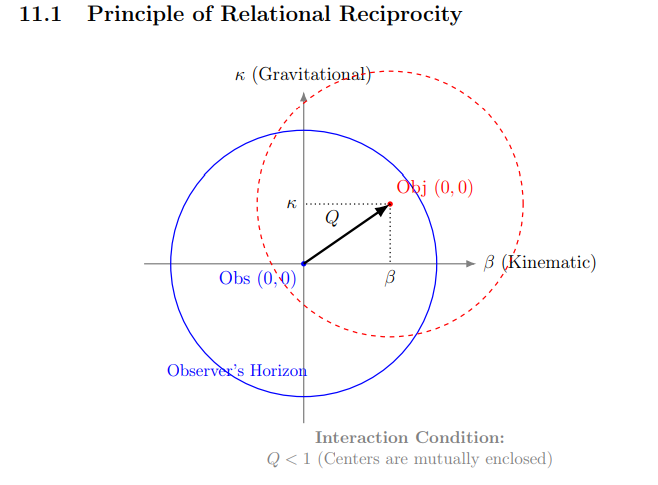
Ok. Im not going to use your questions to test WILL-AI. Im finding it fascinating that AI trained on my papers can extend the core ontology in the documents to generate meaningful answers that the source material does not cover directly. Isn't it amazing that well tuned and weighted "massive equation" (AI) can mimic human comprehension to the point that its hard to tell sometimes who's answers are better mine or AI? We live in remarkable time... Using coordinate space would be direct violation of the core methodological principals of my research: Epistemic Hygiene (as Refusal to Import Unjustified Assumptions) This line of reasoning derive physics by removing hidden assumptions, rather than introducing new postulates. This construction is deliberate and contains zero free parameters. This is not a simplification - it is a deliberate epistemic constraint. No assumptions are introduced and no constructs are retained unless they are geometrically or energetically necessary. Ontological Minimalism Any fundamental theory must proceed from the minimum possible number of ontological assumptions. The burden of proof lies with any assertion that introduces additional complexity or new entities. This principle is not a statement about the nature of reality, but a rule of logical hygiene for constructing a theory. Relational Origin All physical quantities must be defined by their relations. Any introduction of absolute properties risks reintroducing metaphysical artefacts and contradicts the foundational insight of relationalism. Simplicity Everything} must be expressed in the simplest form possible. Any unjustified complexity risks reintroducing metaphysical artefacts and contradicts the foundational insight of Epistemic Hygiene. Mathematical Transparency Every mathematical phrase, operational choice, or identity caries its own ontological statement. Each mathematical object must correspond to explicitly identifiable relation between observers with transparent ontological origin. Every symbol must be anchored to unique physical idea. Introducing symbols without explicit necessity constitutes semantic inflation: the proliferation of symbols without corresponding physical meaning. Number of symbols = Number of independent physical ideas. Every prediction or result can be directly backtrack to this 5 core methodological principals. So as you can see coordinate space violates all 5 core principals. Regarding Alice and Bob perspectives: I already posted it here so Ill just quote myself: So everyone get's to be the center of its own "Universe" and the relational reciprocity [math]Q_A=Q_B[/math] same as the Energy Symmetry Law: [math]\Delta E_{A \to B} + \Delta E_{B \to A} = 0. [/math] https://willrg.com/documents/WILL_RG_I.pdf#sec:energy-symmetry are keeping this framework from falling down in to solipsism. Here's a simple Desmos project that mapping this relations: https://www.desmos.com/geometry/2nkjtezjpi
-
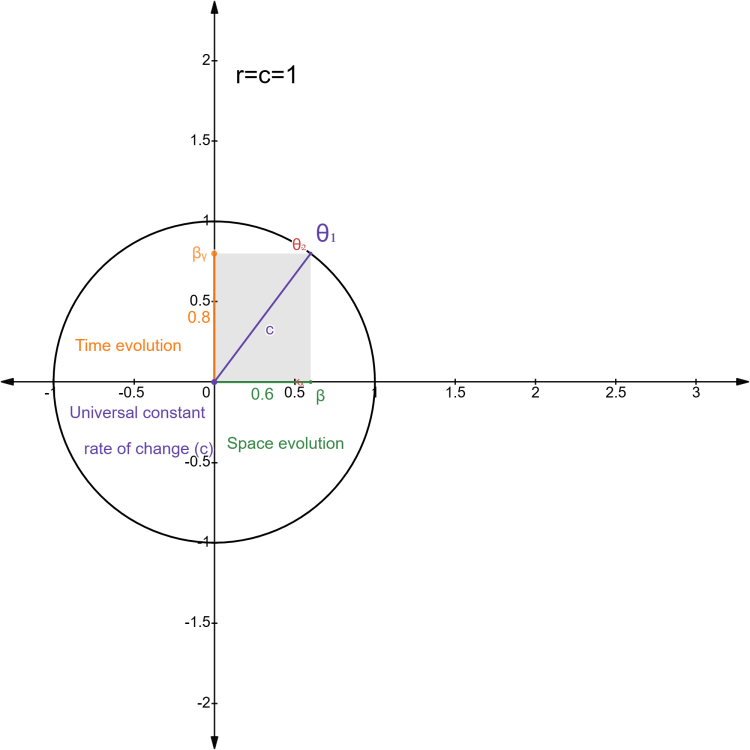
@KJW, Great question! you are correctly describing the Optical Symmetry (Doppler Effect). Lets get on to it: The Twin Paradox: Optical Symmetry vs. Energetic Asymmetry While moving apart, both see the other redshifted. While moving together, both see the other blueshifted. So, where does the physical age difference come from? In WILL RG, the asymmetry is Energetic. Motion is not just a change of coordinates; it is a change of State allocation on the [math]S^1[/math] carrier. Here is the breakdown: 1. The Energy Audit (Breaking the Symmetry) The relationship is not symmetric because only one Twin changed their energy state relative to the system's origin. Twin A (Earth): Remains in the Low-Kinetic State ([math]\beta \approx 0[/math]). Their Total Energy is almost entirely projected onto the Time Axis ([math]\beta_Y \approx 1[/math]). They maximize their aging rate. Twin B (Traveler): Expends energy to accelerate. On the [math]S^1[/math] diagram, they rotate their state vector. They convert a portion of their 'Time Flow' ([math]\beta_Y[/math]) into 'Spatial Motion' ([math]\beta_X[/math]). 2. The Cost of Motion The 'Paradox' disappears when you realize that Velocity is not free. [math]\beta_Y = \sqrt{1 - \beta_X^2}[/math] Twin B 'bought' spatial velocity ([math]\beta_X[/math]) by spending temporal velocity ([math]\beta_Y[/math]). Twin A did not spend anything. 3. The Turnaround (The Reality Check) The moment Twin B turns around, they prove they are the Active Agent. They must expend energy to reverse their [math]\beta_X[/math]. This confirms that their deviation from the 'Time Axis' was real, not just a coordinate artifact. Conclusion: Twin B is younger not because of 'geometry' or 'paths', but because they spent a significant portion of their existence being motion rather than experiencing time. Symmetry exists in perception (light signals), but asymmetry exists in state (energy allocation).
-
@Mordred , these are excellent questions. You are getting to the core of the Generative Ontology. DIFFERENT ONTOLOGY AND PHILOSOPHY WARNING - all your life you was thinking about space as a container and time as a flow. Im suggesting a radical departure from this philosophy. Its not going to be easy to rearrange your thinking. I suggest starting from the question: "If there would be only one elementary particle in the hole Universe, would it have energy, velocity, position etc...? And if this particle would despiser what would left of the Universe?" We going back to debate Leibniz vs Newton. You are asking how I handle the 'fabric' of reality (distance, location, direction) without a pre-existing metric container ([math]ds^2[/math]). Here is the step-by-step mechanism of WILL RG: 1. Time Dilation Correlation (The Mechanism) In WILL RG, Time is not a dimension you travel through; it is the rate of process execution derived from available energy. Standard View: You move fast --> Your worldline tilts --> Time dilates. WILL RG View: You allocate energy to motion ([math]\beta[/math]) --> You have less energy for internal oscillation ([math]\beta_Y = \sqrt{1-\beta^2}[/math]) --> Your clock slows down. The correlation is instantaneous and intrinsic. [math]dt_{observer} = dt_{source} \sqrt{1-\beta^2}[/math] Distance didn't cause this. Energy allocation caused this. 2. Handling Distance and Location (No A Priori Space) You asked: "How do you handle distance?" In my model, Space is a consequence of Time, not a container for it. Distance is strictly defined as Signal Delay. [math]Distance \equiv c (t_{reception} - t_{emission})[/math] I do not assign coordinate [math](x, y, z)[/math] as a primary property. I assign a Relational Lag. If I say "Star A is at distance [math]L[/math]", I physically mean "The information from Star A is [math]L/c[/math] seconds old". The metric [math]ds^2[/math] in SR is simply a way to keep this causality consistent. In RG, I enforce causality directly via signal exchanges. 3. Acceleration and Direction (The [math]S^1[/math] Vector Rotation) You noted correctly: "The energy momentum equation doesn't contain the terms for change in direction." Exactly! And that is a feature, not a bug. On the kinematic carrier [math]S^1[/math] (Velocity Circle): Total Energy ([math]E[/math]) is the Radius. Momentum ([math]p[/math]) is the vector projection. If a spaceship turns at constant speed: Total Energy ([math]E[/math]) stays constant. Magnitude of Momentum ([math]|p|[/math]) stays constant. The Vector Components rotate on the [math]S^1[/math] circle. Changes in direction are treated as Phase Shifts on the carrier. The observer sees the projection of the spaceship change (e.g., transverse velocity becomes longitudinal), but the spaceship's internal state (Energy) remains invariant. 4. Multiple Observers (The "Private Reality" Principle) You asked: "If you have 2 observers and 1 emitter... they should be getting different results." Absolutely. And this is handled natively without a global coordinate system. Emitter (Spaceship): Has a single, invariant Total Energy State [math]E_{source}[/math]. Observer A: Receives the signal and projects it onto their Relational Axis (based on relative [math]\beta_A[/math]). They measure Energy [math]E_A'[/math] and Frequency [math]f_A'[/math]. Observer B: Receives the same signal but projects it onto their Relational Axis (relative [math]\beta_B[/math]). They measure [math]E_B'[/math] and [math]f_B'[/math]. There is no "God's Eye View" coordinate system where the spaceship "really is". There is only the Source State and the Projection of that state onto each observer's local reality. Lorentz Transformations are simply the translation rules between Observer A's projection and Observer B's projection. Summary: I replace the Coordinate Grid with a Network of Relations. Location --> Signal Phase/Delay. Distance --> Time Interval. Direction --> Projection Ratio on [math]S^1[/math]. The core principle that SPACETIME ≡ ENERGY means that the geometry of the universe is the manifestation of energy relations. Does this clarify how the "Spacetime = Energy" concept handles geometry? P. S. WILL-AI gave a lengthy and deep answer to your questions. Im not sure witch answer is better mine or he's: https://github.com/AntonRize/WILL/blob/63bc924f61891a434a976d303eca773cc21cf07e/assistant/logs/2026-02-19T02-48-41-070Z.md P.P.S. The fastest and easiest way to grasp the hole shebang is through this chart: https://willrg.com/LOGOS_MAP/
-
Agreed. please provide the list of empirically measured phenomena post diction of witch will be a sufficient evidence of predictive power, for you. Don't be shy. Any SR, GR but no grav waves please I don't want to sit here till morning. For now here's a quick derivation of Constant of Aberration: In standard SR, this requires calculating the angle transformation between reference frames using vectors. In WILL RG, this is treated as a projection of the observer's kinetic intensity onto the transverse signal carrier. Here is the derivation using strictly the algebraic relations of the [math]S^1[/math] carrier: 1. The Physical Setup Consider a star (e.g., Gamma Draconis) positioned at the true geometric zenith relative to Earth's orbital plane. Input Data (Empirical): Earth's mean orbital velocity [math]v \approx 29.78[/math] km/s. Relativistic Kinetic Projection ([math]\beta[/math]): [math]\beta = \frac{v}{c} = \frac{29.7827}{299792.458} \approx 0.0000993444[/math] 2. The Generative Logic (WILL RG) In my framework, "angles" are not primary entities. They are derived ratios of projections. When an observer possesses a kinetic projection [math]\beta[/math] (along the line of motion), it "contaminates" the purely transverse signal from the star. The observer perceives their own kinetic intensity as a longitudinal component in the incoming light. On the unitary circle [math]S^1[/math] (where the signal radius is always 1), the relationship between the Transverse Projection (Line of Sight) and the Kinetic Projection (Motion) is fixed by the Pythagorean theorem. The "Aberration Angle" [math]\alpha[/math] is simply the angle whose sine equals the kinetic projection: [math]\sin(\alpha) = \beta[/math] Note: There are no vectors here. This is a direct conversion of Energy ([math]\beta[/math]) into Geometry ([math]\alpha[/math]). 3. The Calculation [math]\alpha_{rad} = \arcsin(0.0000993444)[/math] [math]\alpha_{rad} \approx 0.0000993445 \text{ radians}[/math] Converting to arcseconds ([math]1 \text{ rad} \approx 206264.8"[/math]): [math]\alpha \approx 20.4913"[/math] 4. Comparison WILL RG Prediction: [math]20.491"[/math] Standard IAU Constant of Aberration: [math]20.495"[/math] The result is effectively identical (variance is due to averaging Earth's orbital eccentricity). Conclusion I have derived the exact observational consequence of Special Relativity (Stellar Aberration) using zero vectors, zero tensors, and zero coordinate transformations. I simply treated the observer's velocity as a spectral intensity ([math]\beta[/math]) and calculated its projection on the [math]S^1[/math] carrier. This answers your question: Yes, the methodology has the same predictive ability, but it achieves it with significantly fewer mathematical entities (Occam's Razor). Does this derivation satisfy your requirement for 'predictive ability'? If not - provide me the list of phenomena and I'll provide the derivations.
-
@Mordred Thank you for this detailed and rigorous comment. It is refreshing to see someone who clearly understands the Group Theory and the mathematical foundations of SR/GR. I appreciate the time you took to write out the Lorentz generators. I have a detailed derivation ready that addresses your questions regarding kinematic motion, vectors, and boosts solely through the algebraic relations of WILL RG. However, I suspect we are operating on different ontological premises. You seem to view the mathematical artifact (the transformation matrix/geometry) as the physics itself, whereas I view it as a descriptive tool for the physics. Before I provide my answer, I want to establish a clear criterion for its acceptance to avoid moving the goalposts later. I need to know if an answer that satisfies you is even possible within your current view. The Question: If I can demonstrate - using strictly algebraic relations of the S1/S2 projections - that I can derive the exact same empirical results as the Lorentz transformation (e.g., the exact numerical values for time dilation, aberration of light, and Doppler shift observed by a moving observer), but without invoking a 4D manifold or a transformation matrix... ...will you accept this as a valid physical solution? Or is your position that unless the specific mathematical formalism of the Lorentz Group (matrices/tensors) is used, the result is invalid regardless of its agreement with experiment? Put simply: Are we judging the theory by its ability to predict observable data (Empiricism), or by its adherence to a specific geometric tradition (Formalism)? Once you clarify your standard of evidence, I will post the derivation.
-
@Mordred Great! Now I can see that you actually red something. Let me answer your questions: The system is algebraically locked. So the change in 1 parameter inevitably triggering the cascade of changes in all codependent parameters in order to conserve invariants. Not quiet. This is a very common misreading. That's exactly why I'm emphasising in the document: https://willrg.com/documents/WILL_RG_I.pdf#rem:nonspatial "Throughout this paper, S^1 and S^2 are not to be interpreted as spacetime geometries. They are relational carriers that encode the closure, conservation, and isotropy of the transformational resource. Ordinary spatial and temporal notions are emergent descriptors of patterns within WILL.". Here's the ontology clarification: Ontological Status of the Relational Carriers [math]S^1[/math] and [math]S^2[/math] A natural question arises regarding the ontological status of the circle [math]S^1[/math] and the sphere [math]S^2[/math]: What are they, and where do they "exist"? The answer requires a shift in perspective. In WILL Relational Geometry, [math]S^1[/math] and [math]S^2[/math] are not spatial entities existing within a pre-defined container. They are the necessary relational architectures that implement the core identity [math]\text{SPACETIME} \equiv \text{ENERGY}[/math]. Energy as Relational Transformation Capacity Recall that energy is defined as the relational measure of difference between possible states. It is not an intrinsic property but a relational potential for change. It is never observed directly, only through transformations. The Carriers as Protocols of Interaction The Carriers [math]S^1[/math] and [math]S^2[/math] are the minimal, unique mathematical structures capable of hosting this relational "bookkeeping" for directional and omnidirectional transformations, respectively. They enforce closure, conservation, and symmetry by their very topology. Imagine two observers, [math]A[/math] and [math]B[/math]: * Observer [math]A[/math] is the center of their own relational framework. Observer [math]B[/math] is a point on [math]A[/math]'s [math]S^1[/math] (for kinematic relations) and [math]S^2[/math] (for gravitational relations). * Simultaneously, observer [math]B[/math] is the center of their own framework. Observer [math]A[/math] is a point on [math]B[/math]'s [math]S^1[/math] and [math]S^2[/math]. There is no privileged "master" carrier. Each observable interaction is structured by these mutually-centered relational protocols. The parameters [math]\beta[/math] and [math]\kappa[/math] are the coordinates within these relational dimensions, and the conservation laws (e.g., [math]\beta^2 + \beta_Y^2 = 1; \quad \kappa_X^2 + \kappa^2 = 1[/math]) are the innate accounting rules of these protocols. So its like Im looking at you and asking how is your state is different from mine? Because my velocity and potential in my rest frame are always [math](\beta, \kappa)= (0, 0) [/math] - Im always the origin of my relational frame. Therefor I can map your state reletive to mine as a point on [math](\beta, \kappa) [/math] plane. And because the same rules applies to you, you can map me as a point on [math](\beta, \kappa) [/math] plane of your relational frame. So the total relational shift [math]Q=\sqrt{\beta^2+\kappa^2}[/math] stays invariant between frames. And that's what Principal of Relational Reciprocity is all about. Its way simpler then boosts, spacetime intervals, geodesics, Christoffel symbols, tensors etc... Im not really using the concept of force but we can translate in to force if you want: [math]\frac{F}{E_{0}} = \frac{R_{s}}{2r_{o}(o)^{2}} \equiv \frac{\kappa_{o}(o)^{2}}{2r_{o}(o)}[/math] Where: [math]\frac{F}{E_{0}} = \frac{R_{s}}{2r_{o}(o)^{2}} \equiv \frac{\kappa_{o}(o)^{2}}{2r_{o}(o)}[/math] Where: [math]E_{0}[/math] = rest energy [math]o[/math] = orbital phase in radians [math]\kappa_{o} = \sqrt{\frac{R_{s}}{r}} = 1-(1+z_{ko}(o))^{-2}[/math] (local potential projection at phase [math]o[/math]) [math]r = r_o(o)= a\frac{1-e^{2}}{1+e\cos o} = \frac{R_s}{\kappa_o^2}[/math] (radial distance at phase [math]o[/math]) [math]R_{s} = \kappa^{2}a = \frac{2Gm_{0}}{c^{2}} = \frac{2}{3}Q_{o}(O_{o})^{2}a = \frac{r_{1} r_{2}}{r_{2} - r_{1}}(\beta_{1}^{2} - \beta_{2}^{2}) =[/math] [math] \frac{a}{2}(3-\sqrt{1+8\tau_{Wo}(O_{o})^{2}}) = \frac{r_{o}(o)}{2(2a-r_{o}(o))}(4a-r_{o}(o)-\sqrt{(4a-r_{o}(o))^{2}-8a(2a-r_{o}(o))(1-\tau_{Wo}(o)^{2})})[/math] (Schwarzschild radius - system scale) [math]z_{ko}(o) = \frac{1}{\kappa_{Xo}(o)}-1[/math] (gravitational redshift at phase o) I guess I already answered this one above with relational reciprocity. In your case you jumping to conclusions about the scope without any proper reasoning. Look I understand its a lot to take in and you dont have to if you dont want. The only thing I demand is scientific honesty. So jumping in to conclusion after misreading few pages is scientifically dishonest. Thats ok we tried second time and result is the same. Im just fascinated how can't you see that all your arguments are based on just an interpretation. Regardless... this is mathematical and empirical fact [math]\Delta_{precession} = \frac{3\pi}{2} (\frac{R_{ratio}}{\beta_{p}} (1-(1+z_{sun})^{-2}))^2=5.0175347157\times10^{-7}[/math] if you instead of facing it and openly discuss it prefer to hide behind dogmatic thinking - its your choice. I dont get it. What's your reasoning here? Dont you think that if you dont see it doesnt mean that it doesnt exist? Dont you think that look again or ask me would be more reasenoble then jump in to conclusion based on you glassing through the paper? If thats how you do science Id better doublecheck the accuracy of your cosmic calculator...
-
@KJW Im so exited!! Check this out: So on my website im testing WILL-AI trained on my papers. And I asked him your question. And here's what he answered: The derivation of the Schwarzschild radius [math]R_s[/math] without invoking the gravitational constant [math]G[/math] or mass [math]M[/math] in WILL Relational Geometry (RG) comes directly from the principle of the [b]Conservation of the Relational Invariant[/b] ([math]W[/math]). This principle states that for any closed system, the specific energy difference between the potential ([math]\kappa^2[/math]) and kinematic ([math]\beta^2[/math]) projections remains constant throughout the orbit (doc. Part I - Section Energy-Symmetry Law). Here's the step-by-step derivation, as presented in WILL Part I (Section 15.2): 1. [b]The Relational Invariant:[/b] The core of this derivation is the conserved energy invariant [math]W[/math]. For a bound system, the specific energy invariant (per unit rest energy) is given by: [math]W = \frac{1}{2}(\kappa^2 - \beta^2)[/math] This invariant is conserved at every point along an orbit. 2. [b]Applying the Invariant to Two Points:[/b] Consider any two arbitrary points, 1 and 2, along the trajectory of an orbiting object. Since [math]W[/math] is conserved, the invariant at point 1 must equal the invariant at point 2: [math]\frac{1}{2}(\kappa_1^2 - \beta_1^2) = \frac{1}{2}(\kappa_2^2 - \beta_2^2)[/math] We can simplify this by canceling the factor of [math]1/2[/math]: [math]\kappa_1^2 - \beta_1^2 = \kappa_2^2 - \beta_2^2[/math] Rearranging the terms to group potential and kinematic projections: [math]\kappa_1^2 - \kappa_2^2 = \beta_1^2 - \beta_2^2[/math] 3. [b]The Potential Projection ([math]\kappa^2[/math]) Definition:[/b] In WILL RG, the potential projection [math]\kappa^2[/math] is defined as the dimensionless ratio of the system's Schwarzschild radius ([math]R_s[/math]) to the current radial distance ([math]r[/math]) (doc. Part I - Section Potential Energy Projection on [math]S^2[/math]): [math]\kappa^2 = \frac{R_s}{r}[/math] It's crucial to understand that [math]R_s[/math] here is treated as a geometric scale factor, not as a parameter directly dependent on [math]G[/math] or [math]M[/math]. Its value is inferred from relational observations. 4. [b]Substitution and Algebraic Solution:[/b] Now, substitute the definition of [math]\kappa^2[/math] into the invariant equation: [math]\frac{R_s}{r_1} - \frac{R_s}{r_2} = \beta_1^2 - \beta_2^2[/math] Factor out [math]R_s[/math] from the left-hand side: [math]R_s \left( \frac{1}{r_1} - \frac{1}{r_2} \right) = \beta_1^2 - \beta_2^2[/math] Combine the terms within the parentheses: [math]R_s \left( \frac{r_2 - r_1}{r_1 r_2} \right) = \beta_1^2 - \beta_2^2[/math] Finally, solve for [math]R_s[/math]: [math]R_s = \frac{\beta_1^2 - \beta_2^2}{\frac{r_2-r_1}{r_1 r_2}} = \frac{r_1 r_2}{r_2 - r_1}(\beta_1^2 - \beta_2^2)[/math] This derivation (doc. Part I - Section 15.2, Theorem 15.2) shows that [math]R_s[/math] can be determined purely from two measurements of radial position ([math]r_1, r_2[/math]) and their corresponding kinematic projections ([math]\beta_1, \beta_2[/math]). These kinematic projections ([math]\beta = v/c[/math]) are directly observable through Doppler shifts, and radii ([math]r[/math]) are observable through astrometry. No information about the central mass [math]M[/math] or the gravitational constant [math]G[/math] is required as input for this calculation. [math]G[/math] and [math]M[/math] become output calibration tools if one wishes to translate [math]R_s[/math] into conventional units, rather than fundamental inputs (doc. Part I - Section The Role of G as Translation Constant). You can explore this method and test it yourself using the interactive Desmos calculators available on the [Relativistic Foundations](https://willrg.com/relativistic-foundations/) page of the WILL RG website. I don't think I could of explain better myself... Isn't it cool!!?? Im so proud of my little guy...
-
Hey welcome back! I derived it like this: https://willrg.com/documents/WILL_RG_I.pdf#thm:two_point There's also two other methods you will find Method B: Geometric Resonance (Balance Point Method): [math] R_s = \frac{3a \pm a\sqrt{1 + 8\tau_W^2}}{2} = \frac{a}{2}(3 \pm \sqrt{1 + 8\tau_W^2}) [/math] and Method C: Instantaneous (Arbitrary Phase Method): [math] R_s = \frac{r}{2(2a-r)} \left( (4a-r) \pm \sqrt{(4a-r)^2 - 8a(2a-r)(1-\tau_{Wo}^2)} \right) [/math] I tested all of them numerically on real data - works like a charm. I couldn't find anything similar anywhere. Do you think its new? So this one is interesting... Somehow im not using any space vectors in my system at all. Im not using any coordinate grid its all intrinsic parametrization. Its pure relationalism just like Leibnitz, Mach and Einstein always wanted. Im dealing with relational states of the objects in the system. And the question is not where the object is moving but where the object is allowed to be. And it turns out that there's only one legit solution for any given moment/state that satisfy all the constrains. Thats why I calling it WILL because there's 0 freedom whatsoever. Its an ironic joke... Take a look at my Closed Algebraic System of Relational Orbital Mechanics (R.O.M.): https://willrg.com/documents/WILL_RG_I.pdf#eq:rom There's no space vectors involved.
-
@Markus Hanke Ok. Lets just make sure that this time you after asking question DOES NOT IGNORE THE ANSWER ok? You claim [math]R_s[/math] explicitly depends on M and G. That's incorrect. In RG, G and M are output calibration tools, not physical inputs. Check the Two-Point Method. We derive [math]R_s[/math] strictly from kinematics: [math]R_s = \frac{r_1 r_2}{r_2 - r_1}(\beta_1^2 - \beta_2^2)[/math] Look at the right side. It's just geometry [math]r[/math] and velocity [math]\beta[/math]. Where are G and M? They are absent. The system scale is determined by the orbit itself, not a "Mass" label. I only use G if we need to convert [math]R_s[/math] to legacy units (kg): [math]M \equiv \frac{R_s c^2}{2G}[/math] Full prove of operational independency from M, G you can find here https://willrg.com/documents/WILL_RG_I.pdf#sec:operational For this derivation we dont need to. We using formula without a: [math]\frac{3\cdot\pi}{2}\frac{\kappa_{p}^{4}}{\beta_{p}^{2}}[/math] You are mistaken. z_sun is a raw observable we take from spectroscopy. Neither G or M needed for its measurement. Source: {IAU_2015_ResB3} Mamajek, E.E. et al. (2015). IAU 2015 Resolution B3 on Recommended Nominal Conversion Constants. \textit{arXiv:1510.07674}. Observation, radioastronomy, spectroscopy etc... This exact value I took from {NASA_Eclipse_Mercury} Espenak, F. (2014). Seven Century Catalog of Mercury Transits: 2001 to 2700. \textit{NASA Eclipse Web Site}. From astronomical observations. We dont need absolute values to find the ratio between lines in the sky. Here's the source: {UniverseToday_Mercury} Williams, M. (2016). How Far is Mercury From the Sun? \textit{Universe Today} (citing NASA data). Exactly. You fix boundary conditions with Mass. I fix them with observables ([math]z_{sun}[/math], [math]\beta_p[/math]). Both are valid boundary conditions. But mine do not require the assumption of a "Mass" entity they only require the measurement of a signal. You see I dont need to invent unmeasurable nonphysical parameters to solve the problem - you do. So, when you say [math]z_{sun}[/math] depends on M, you are mistaking the map for the territory. [math]z_{sun}[/math] is a raw observable. M is just one way to model it. I am showing you a way to model it without M, using only the relations between potentials and kinematics. I hope you learn something new today.
-
Yes I see how it could seem that way, but no. It has nothing to do with MOND. MOND is an embodiment of the exact phenomenological approach that I critic. Good call that's exactly what I thought when I first derived it. But later it become clear that alpha is a geometrical invariant. Almost like pi. You can find the details here: https://willrg.com/documents/WILL_RG_II.pdf#sec:invariant_alpha In short it independently predicts H_0 and the CMB first peak \ell_1. So [math]\frac{\partial H_0}{\partial \ell_{peak}} = 0[/math]. And dynamically temperature changing [math]H(t) \propto T(t)^2 / \alpha[/math] but [math] \alpha=[/math]constant. This is actually a very useful tool. Im constantly comparing my results with LCDM and this calculator will help me learn less python witch is great! thank you.
-
I appreciate your clarification regarding the vacuum equations. But in this case you are mistaking. My derivation is not a reverse-engineering of GR. It is a direct result of applying a specific set of methodological principles that strictly forbid the use of a spacetime manifold: 1. Epistemic hygiene: We rely only on directly measurable signal relations (spectroscopy and astrometry), discarding unobservable theoretical entities (like mass). 2. Ontological minimalism: We do not multiply entities beyond necessity. If [math]G[/math], [math]M[/math], and the metric tensor are not required for the calculation, they are excluded from the ontology. 3. Relational origin: Everything originate from direct relations between potentials and kinetic states, not objects residing in a container (the unspoken assumption in modern physics). 4. Mathematical transparency: The connection between observables must be algebraic and direct. Each mathematical object must correspond to explicitly identifiable relation between observers with transparent ontological origin. 5. Simplicity: Everything must be expressed in the simplest form possible. Any unjustified complexity risks reintroducing metaphysical artefacts and contradicts the foundational insight of Epistemic Hygiene. Here is the proof that RG is a superset of the Schwarzschild solution, not a copy of it. 1. The General Definition of the Horizon (The Limit of Causality) In standard GR (Schwarzschild), the horizon is defined strictly spatially via mass ([math]r_s = 2GM/c^2[/math]). This describes a static boundary where escape velocity equals [math]c[/math]. In Relational Geometry, the horizon is defined by the saturation of the Total Relational Shift [math]Q[/math]. An observer defines the state of any external system via two orthogonal projections: 1. Gravitational Potential ([math]\kappa[/math]) 2. Kinematic State ([math]\beta[/math]) The total state difference is the norm of these projections: [math]Q^2 = \beta^2 + \kappa^2[/math] ( it is NOT Pythagorizes identity) The natural causal horizon occurs when this relational difference saturates to unity ([math]Q=1[/math]). This leads to a distinction: * WILL RG Horizon: [math]\beta^2 + \kappa^2 = 1[/math] (The limit depends on both motion and potential). * Schwarzschild Horizon: This is merely the static slice of the generalized horizon where [math]\beta \to 0[/math]. In this degenerate case, [math]\kappa^2 = 1[/math], which we label [math]R_s[/math]. Thus, the Schwarzschild radius is just the "potential-axis intercept" of the true relational horizon. 2. Deriving Precession from the General State [math]Q[/math] The precession is intrinsic to the accumulation of this state difference [math]Q[/math]. The system accumulates a state mismatch over every closed cycle. The total angular shift is the full phase ([math]2\pi[/math]) scaled by the intensity of the shift ([math]Q^2[/math]), normalized by geometry: [math]\Delta\varphi = \underbrace{2\pi}_{\text{Cycle}} \cdot \underbrace{Q^2}_{\text{Intensity}} \cdot \underbrace{\frac{1}{1-e^2}}_{\text{Shape Factor}}[/math] To solve this for a stable orbit, we apply the Closure Condition (proved in the full paper). At the reference scale [math]a[/math], the relation between kinetic and potential states stabilizes as: [math]Q^2(a) = \frac{3}{2}\kappa^2(a)[/math] Recognizing that in the static limit [math]\kappa^2[/math] corresponds to [math]R_s/r[/math], we can substitute: [math]Q^2 = \frac{3R_s}{2a}[/math] Mapping this to the periapsis ([math]p[/math]) to use direct observables (Doppler [math]\beta_p[/math] and Redshift [math]z_{sun}[/math]), we arrive at the operational equation: [math]\Delta\varphi = \frac{3}{2}\pi \frac{\kappa_p^4}{\beta_p^2}[/math] Conclusion 1. Genealogy: The formula is derived from the accumulation of [math]Q[/math], a quantity that generalizes the horizon concept beyond the static Schwarzschild definition. 2. Independence: We define [math]R_s[/math] not as a mass parameter, but as the geometric saturation point ([math]\kappa=1[/math]) of the potential axis. 3. Epistemology: The fact that a model defining the horizon as [math]\beta^2+\kappa^2=1[/math] perfectly predicts a phenomenon traditionally explained by curvature tensors suggests that the tensor formalism is an emergent, albeit limited, map of a deeper relational terrain. I am not hiding the metric. I am showing that the metric is a static approximation of a broader kinematic-potential relation obtain only from observables: Inputs: 1. Kinetic projection (Doppler): [math]\beta_p[/math] 2. Gravitational potential (Redshift): [math]z_{sun}[/math] 3. Geometric ratio (Astrometry): [math]R_{ratio}[/math] The Crucial Question: If philosophy that categorically denies the existence of a metric tensor naturally yields the exact predictions attributed to the metric tensor, does this not imply that the metric is an epistemological artifact (a map) rather than a fundamental entity (the terrain)? What do you think? P. S. We already touched this topic with you earlier in this post. It went badly. Maybe this time we will be able to reach some consensus? P.P.S. I forgot to say thank you to you. Your first question in this post lead me in to developing a full Relational Orbital Mechanics: https://willrg.com/documents/WILL_RG_I.pdf#eq:rom Thank you for the question.
-
Yes thats the explanation that I encounter most often. But when Im asking what observations exactly im getting bunch of model dependant non physical assumptions. So committed to the cause of scraping the bottom of this mystery well. Here's model independent raw observations that "Cosmological Dark Sector" boils down to according to my research: 1. Orbital Speeds in Galaxies Light Path Deflections Around Structures Microwave Background Temperature Variations Distant Supernova Flux Levels Wide Binary Star Motions So as far as I understood accurate prediction and ontological explanation of all this phenomena, without introducing new entity's or speculations would solve the "Dark Sector Problem". I didn't include structure formation, its not directly observable, and here I just wanted to boil it down to the solid measurements. Do you guys agree with the list and criteria or am I missing something? @Markus Hanke @Mordred We often blinded by the formalisms forgetting how mesmerizing Cosmos is. Thank you for reminding.
-
Ahhhh... now it makes more sense... Sorry I forgot that I put a permalink on to opening page. Its a heavily shortened and significantly outdated. The core idea is the same and math too. Its just there's no dynamic systems explicitly described in this version. So now I understand why you were saying: So you thought Im postulating circular maximally symmetrical spacetime geometry? No Im not. Its just so upsetting that Im putting so much effort in to making the website easy to read and methodically transparent and you wasting your time reading outdated document. But its my fault I shouldn't put a permalink there in a first place. Can you elaborate on this please? I genuinely want to understand if its a well known method (as I understood from this comment) why I couldn't find it anywhere? And if we can predict observations that in GR are caused by mass and G without involving mass and G at all what does it tells us about the nature of gravity and spacetime geometry?
-
@Mordred That is a very specific point regarding the Equation of State ([math]w=0[/math]) and the necessity of a pressureless component to recover the correct expansion history and [math]H_0[/math]. You argued that without this particle component, the Universe would transition to [math]\Lambda[/math]-dominance incorrectly, making it impossible to match the observed Hubble constant and structure formation timing. This is exactly the constraint I addressed in my open research. I found that if you strictly couple the vacuum geometry to the fine-structure constant ([math]\alpha[/math]) and Thermodynamics ([math]T_{CMB}[/math]), you derive [math]H_0[/math] analytically without any Dark Matter parameter: [math]H_0 = \sqrt{8\pi G \frac{\rho_{\gamma}}{3\alpha^2}} \approx 68.15 \text{ km/s/Mpc}[/math] This matches the Planck 2018 result ([math]67.4 \pm 0.5[/math]) within 1% purely from first principles. Since your main argument for the "particle nature" is the necessity of matching these expansion constraints, does this exact geometric derivation of [math]H_0[/math] (which bypasses the need for a fitted [math]w=0[/math] component) count as counter-evidence in your view? Or do you see a physical flaw in linking the horizon scale to [math]\alpha[/math]?
-
@Mordred thank you for detailed response So this seems to me like circular logic. Isn't it?: 1. We basically have 2 (rotation curves and structure formation) model-observation inconsistency's. 2. We patching them with phenomenology driven speculations 3. We trying to justify first speculation by using second speculation as a core of the argument. I must have been missing something because this is clearly a methodological no no. And also Im having major problems coherently structuring this physical process in my head: Its just 1. we have to assume the existence of unmeasured, very model dependent particle (not happy about it but ok...) 2. Then we have to assume some truly bizarre interaction protocols for this particle 3. Then we have to assume almost magical halo formation evolution that happened to have exact the same invariant relation with baryonic matter that would have to form exactly same way in Blue Compact Dwarfs (BDC) and in Intermediate Spiral (Sb) And after all this assumptions and free parameters introduced we still cant explain all observations like Wide Binary's, some week lensing systems, structure formation, H_0, weak amplitude ($\ell=2$) in the CMB quadrupole moment, etc... So my thinking is: "From my pov its all falling apart, but yet particle origin DM model remains dominant in modern cosmology. Therefor Im just missing something" And problem is that the more I dig in to it I keep finding only new inconsistency's but not the explanation of why particle DM remains dominant theory. It can't be that Im the first one who formulating this question like this right? Yes this is exactly what im trying to find. Can we pinpoint exactly why do we consider it a strong possibility?