
Anton Rize
Senior Members
-
Joined
-
Last visited
Everything posted by Anton Rize
-
This is a great question. in its almost bold simplicity it highlights the potential circularity in the concept of mass that keeps me up at night. @swansont explanation is perfectly correct but it does not address the deeper question: what does device on the right actually measuring? So far I do not have the answer to this question. But whatever it is - it does not required to solve gravitational systems. Here's runnable colab notebook that demonstrates it: https://colab.research.google.com/github/AntonRize/WILL/blob/main/Colab_Notebooks/R_O_M__MASS_G_FREE_CLOSURE.ipynb If python is not your jam here's desmos demonstration: https://www.desmos.com/calculator/mjen4ms452 So the question remains: what does device on the right actually measuring?
-
I do not understand your question. How do you connect amount of rigor to me or to this post? Your question sounds rhetorical to me. If you want to get a clear answer try starting from a clear question.
-
I tried to find a concrete example of physically meaningful scenario where math suppose to brake but I couldn't... Maybe someone of you guys can give an example?
-
I was quires and looked in to this mathematical beast of yours. As far as I understood it looks for invariants, so called "Killing vectors" where certain quantities are conserved like angular momentum or energy, right? I just don't understand why would you do this in such a hard way with that huge equation? I can do it like this Energy: [math]\kappa_o^2(o) = \beta_R^2(o) + \beta_T^2(o) + \beta^2[/math]; [math]\kappa_o^2(o) - \beta_o^2(o) = \frac{\beta^2(1-e^2)}{1-e^2} = \beta^2 = 2W[/math] momentum: [math]\frac{\beta_T(o)}{\kappa_o^2(o)} = \frac{\sqrt{1-e^2}}{2\beta}[/math]: [math]h = R_s c \frac{\sqrt{1-e^2}}{2\beta}[/math] Is that what it does? I'll show derivations below: Relational Origin RED vs BLUE Orbital dynamics boils down to interplay of frequency shifts. No mass, no G, no manifold, no metric required. [math]\kappa^2 = 1-\frac{1}{(1+z_{\kappa})^2}[/math] ([math]z_{\kappa}[/math] = gravitational redshift) [math]\beta^2 = 1-\frac{1}{(1+z_{\beta})^2}[/math] ([math]z_{\beta}[/math] = transverse Doppler shift) Observational Z Inputs [math]Z_{sys} = (1+z_{\kappa})(1+z_{\beta}) = \frac{1}{\tau}[/math] (product of gravitational redshift and transverse Doppler shift) [math]\tau = \kappa_{X}\beta_{Y} = \frac{1}{Z_{sys}}[/math] (product of projectional phase factors on [math]S^1[/math] and [math]S^2[/math] carriers) [math]z_{\kappa} = \frac{1}{\kappa_{X}}-1[/math] (gravitational redshift) [math]z_{\beta} = \frac{1}{\beta_{Y}}-1[/math] (transverse Doppler shift) Everything else is Closed Algebraic System of Relational Orbital Mechanics (R.O.M.) Please follow this link to see all [R.O.M. equations and definitions](https://willrg.com/documents/WILL_RG_R.O.M..pdf#eq:rom) Vis-Viva In elliptical systems, the global closure theorem [math]\kappa^2 = 2\beta^2[/math] is conserved across the entire orbital cycle, while local phase variations manifest as an internal "breathing" of relational projections. We now derive the exact conservation law governing this local dynamic distribution. Proposition: Phase-Invariant Structural Depth The difference between the square of the local potential projection [math]\kappa_o^2(o)[/math] and the square of the local kinetic projection [math]\beta_o^2(o)[/math] is a global system invariant equal to [math]2W[/math]. Proof: The binding parameter [math]W[/math] defines the global relational depth of the system: [math]W = \frac{\beta^2}{2}[/math] From the exact definitions of the [math]S^2[/math] and [math]S^1[/math] projections at any arbitrary phase [math]o[/math]: [math]\kappa_o^2(o) = \frac{2\beta^2(1+e\cos(o))}{1-e^2}[/math] [math]\beta_o^2(o) = \frac{\beta^2(1+e^2+2e\cos(o))}{1-e^2}[/math] Subtracting the local kinetic projection from the local potential projection: [math]\kappa_o^2(o) - \beta_o^2(o) = \frac{2\beta^2 + 2\beta^2 e\cos(o) - (\beta^2 + \beta^2 e^2 + 2\beta^2 e\cos(o))}{1-e^2}[/math] [math]\kappa_o^2(o) - \beta_o^2(o) = \frac{\beta^2(1-e^2)}{1-e^2} = \beta^2 = 2W[/math] Thus, the algebraic distance between the omnidirectional and directional relations remains globally constant irrespective of orbital geometry. Theorem: The Orthogonal Signature of the Orbit The square of the local potential projection [math]\kappa_o^2(o)[/math] on the [math]S^2[/math] carrier is the strict Pythagorean vector square sum of the local radial [math]\beta_R^2(o)[/math], transverse [math]\beta_T^2(o)[/math] and the global [math]\beta^2[/math] kinetic projections. Proof: The total local kinetic projection on the [math]S^1[/math] carrier splits orthogonally into radial and transverse components within the orbital plane: [math]\beta_o^2(o) = \beta_R^2(o) + \beta_T^2(o)[/math] Substituting this orthogonal decomposition into the phase-invariant relation [math]\kappa_o^2(o) - \beta_o^2(o) = \beta^2[/math]: [math]\kappa_o^2(o) - (\beta_R^2(o) + \beta_T^2(o)) = \beta^2[/math] Rearranging yields the three-dimensional algebraic relational closure: [math]\kappa_o^2(o) = \beta_R^2(o) + \beta_T^2(o) + \beta^2[/math] Remark: Ontological Replacement of Vis-Viva This geometric invariant replaces the descriptive Newtonian Vis-Viva equation ([math]v^2/2 - GM/r = -GM/2a[/math]). Standard mechanics interprets this balance as a scalar subtraction of an abstract potential energy from kinetic energy. In WILL, it is revealed as a strict Pythagorean theorem of relational geometry: the local potential projection ([math]\kappa_o^2[/math]) is generated by the orthogonal summation of the kinetic "breathing" ([math]\beta_R^2 + \beta_T^2[/math]) and the global [math]S^1[/math] projection ([math]\beta^2[/math]). SPACETIME [math]\equiv[/math] ENERGY. Angular Momentum Conservation The conservation of specific angular momentum [math]h[/math] is derived as a phase-independent structural invariant of the relational balance. Proposition: Invariant Ratio of Projections The transverse kinetic projection [math]\beta_T(o)[/math] is strictly proportional to the local potential projection [math]\kappa_o^2(o)[/math] scaled by the global system constants. Proof: From the definition of the local potential projection (based on closure theorem [math]\kappa^2 = 2\beta^2[/math] and geometry of ellipse): [math]\kappa_o^2(o) = 2\beta^2 \frac{1+e\cos(o)}{1-e^2} \rightarrow (1+e\cos(o)) = \kappa_o^2(o) \frac{1-e^2}{2\beta^2}[/math] The transverse kinetic projection [math]\beta_T(o)[/math] is defined on the [math]S^1[/math] carrier as: [math]\beta_T(o) = \beta \frac{1+e\cos(o)}{\sqrt{1-e^2}}[/math] Substituting the expression for [math]1+e\cos(o)[/math] into the definition of [math]\beta_T(o)[/math]: [math]\beta_T(o) = \beta (\kappa_o^2(o) \frac{1-e^2}{2\beta^2}) \frac{1}{\sqrt{1-e^2}} = \kappa_o^2(o) \frac{\sqrt{1-e^2}}{2\beta}[/math] Rearranging to isolate the invariant ratio of the phase-dependent projections: [math]\frac{\beta_T(o)}{\kappa_o^2(o)} = \frac{\sqrt{1-e^2}}{2\beta}[/math] Theorem: Conservation of Angular Momentum The specific angular momentum [math]h[/math], defined as the product of the local scale [math]r_o(o)[/math] and the transverse kinetic projection, is a global phase invariant. Proof: Using the local scale [math]r_o(o) = \frac{R_s}{\kappa_o^2(o)}[/math], we define [math]h[/math]: [math]h = r_o(o) \beta_T(o) c = \frac{R_s}{\kappa_o^2(o)} \beta_T(o) c[/math] Substituting the invariant ratio [math]\frac{\beta_T(o)}{\kappa_o^2(o)} = \frac{\sqrt{1-e^2}}{2\beta}[/math]: [math]h = R_s c \frac{\sqrt{1-e^2}}{2\beta}[/math] Since [math]R_s[/math], [math]e[/math], and [math]\beta[/math] are global invariants, [math]h[/math] does not depend on phase [math]o[/math]. Angular momentum is thus the manifestation of the fixed structural exchange rate between the [math]S^2[/math] and the [math]S^1[/math] carriers and their projections. Eccentricity Eccentricity is a measure of the projectional deviation from the circular equilibrium state ([math]\delta=1[/math]). Theorem: Relational Eccentricity For a closed orbital system governed by the projection invariants of WILL Relational Geometry, the orbital eccentricity [math]e[/math] is strictly determined by the closure factor at periapsis, [math]\delta_p[/math]: [math]e = \frac{2\beta_p^2}{\kappa_p^2} - 1 = \frac{1}{\delta_p} - 1[/math] Proof: Instead of relying on classical force laws, we derive this relation directly from the conservation of the two fundamental projection invariants of the WILL framework: 1. Energy Projection Invariant (Binding Energy): [math]W = \frac{1}{2}(\kappa^2-\beta^2) = \text{const}[/math]. 2. Angular Projection Invariant: [math]h = r_o(o) \beta_T(o) c = \text{const}[/math] ([math]\beta = \beta_T(o)[/math] at turning points). Consider the two turning points of a closed orbit: periapsis ([math]p[/math]) and apoapsis ([math]a[/math]). By operational definition of the shape parameter [math]e[/math], the relation between radii is determined by the geometric range: [math]r_a = r_p (\frac{1+e}{1-e})[/math] Step 1: Relational Mapping. Using the angular invariant [math]h[/math] (implying [math]\beta \propto 1/r[/math]) and the field definition [math]\kappa^2 \propto 1/r[/math], we express the apoapsis projections in terms of the periapsis values: [math]\beta_a^2 = [\beta_p (\frac{r_p}{r_a})]^2 = \beta_p^2 (\frac{1-e}{1+e})^2[/math] [math]\kappa_a^2 = \kappa_p^2 (\frac{r_p}{r_a}) = \kappa_p^2 (\frac{1-e}{1+e})[/math] Note: Kinematic projection scales quadratically with the radius ratio, while potential projection scales linearly. Step 2: Energy Balance. Substituting these into the energy invariant conservation condition [math]W_p = W_a[/math]: [math]\frac{1}{2}(\kappa_p^2-\beta_p^2) = \frac{1}{2}(\kappa_a^2-\beta_a^2)[/math] Cancelling the factor 1/2 and substituting the mappings from Step 1: [math]\kappa_p^2 - \beta_p^2 = \kappa_p^2 (\frac{1-e}{1+e}) - \beta_p^2 (\frac{1-e}{1+e})^2[/math] Rearranging to group potential terms ([math]\kappa[/math]) on the left and kinematic terms ([math]\beta[/math]) on the right: [math]\kappa_p^2 ( 1 - \frac{1-e}{1+e} ) = \beta_p^2 ( 1 - (\frac{1-e}{1+e})^2 )[/math] Step 3: Algebraic Reduction. Expanding the terms in brackets: LHS bracket ([math]\kappa[/math] term): [math]1 - \frac{1-e}{1+e} = \frac{(1+e)-(1-e)}{1+e} = \frac{2e}{1+e}[/math] RHS bracket ([math]\beta[/math] term): [math]1 - \frac{(1-e)^2}{(1+e)^2} = \frac{(1+e)^2 - (1-e)^2}{(1+e)^2} = \frac{4e}{(1+e)^2}[/math] Substituting back into the balance equation: [math]\kappa_p^2 ( \frac{2e}{1+e} ) = \beta_p^2 ( \frac{4e}{(1+e)^2} )[/math] Dividing both sides by [math]2e[/math] and multiplying by [math](1+e)^2[/math]: [math]\kappa_p^2 (1+e) = 2\beta_p^2[/math] This yields the geometric identity for bound orbits: [math]2\beta_p^2 = \kappa_p^2 (1+e)[/math] Step 4: Connection to Closure. Recall the definition of the closure factor at periapsis: [math]\delta_p = \frac{\kappa_p^2}{2\beta_p^2}[/math] Substituting the geometric identity into this definition: [math]\delta_p = \frac{\kappa_p^2}{\kappa_p^2(1+e)} = \frac{1}{1+e}[/math] Solving for [math]e[/math], we obtain the stated result: [math]e = \frac{1}{\delta_p} - 1 = \frac{2\beta_p^2}{\kappa_p^2} - 1 = 1 - \frac{2\beta_a^2}{\kappa_a^2}[/math] Remark: This result confirms that eccentricity is strictly a measure of the energetic deviation from the circular equilibrium state ([math]\delta = 1[/math]), derived entirely from the conservation of relational projections without invoking mass or Newtonian forces. SUMMARY: [math]\frac{2\beta_p^2}{\kappa_p^2} - 1 \equiv e \equiv 1 - \frac{2\beta_a^2}{\kappa_a^2}[/math] [math]\text{ECCENTRICITY} \equiv \text{CLOSURE DEFECT}[/math] [math]\text{SPACETIME} \equiv \text{ENERGY}[/math] So now can you see what I mean when I say: "Mathematical complexity is the symptom of philosophical negligence."?
-
"reviling"? I was always open about my lack of formal training end mathematical limitations. There's no secret to reveal. And it does look intimidating hahaha! But I often downplay myself. There's no way I will ever solve something like this with pen and paper, but with python I think few ours of bad coding will do the trick. Anyway I still fully agree with my result: The Strict Minimality Theorem The adoption of substantialist assumptions produces three structural consequences: 1.Inflated Formalism Equations multiply to compensate for ontological error. 2.Loss of Transparency Physical meaning becomes hidden behind coordinate dependencies. 3.Empirical Fragmentation Each domain (cosmology, quantum, gravitation) requires separate constants. By contrast, Relationalism - as epistemic hygiene - enforces relational closure and yields simplicity through necessity, not through approximation. The Inflation Chain Surplus Ontology -> Ontological Duplication -> Mathematical Inflation GENERAL CONCLUSION Mathematical complexity is not an inevitable feature of physical law but a structural consequence of surplus ontological assumptions. When those assumptions are removed, the same empirical content is reproduced with strictly fewer primitives.
-
This is exactly what this field test is for "This is a field test of the AI's epistemological awareness.". So you raise a valid point and your claim is when the bounds unclear we should expect "AI tends to either shamefully hedging the bet or plain getting it wrong (missing the necessary nuances altogether).". That's a reasonable hypothesis. You see I put some effort in customising this AI and it seems that performance in this type of areas (philosophy of physics, ontology etc...) is improved. I say lets test it! link removed
-
You making unjustified assumption. Not a good habit to have for a physicist. Ironically your comment on "less rigor" needs some rigor. This reminds me of Socrates. He famously argued against the written word warning that writing would not make people wiser, but rather foster a "conceit of wisdom" without true understanding. AI is a tool. Extremely useful tool in the right hands. But in fools hands any tool creates havoc. You shouldn't blame AI for human stupidity.
-
Advertise what exactly? I’m not selling anything. This is a field test exploring the role of AI in science communication, which has been discussed on the forum few times. I’ve set everything up to gather empirical data and, at the same time, provide interactive content for anyone who wants to participate. Given that forum activity has been declining, is it really reasonable to delete my links? I genuinely think interactive content could help revive engagement - if it’s not removed before it even gets started.
-
By the way Im slowly but working on it. Here's my progress so far: Kinematic Projection Equivalence: The Minkowski metric interval as an [math]S^1[/math] Pythagorean Identity The Minkowski spacetime interval, posited by legacy Special Relativity as a physical metric of a 4D background manifold, mathematically collapses into the invariant phase budget of the kinematic relational carrier ([math]S^1[/math]). The standard interval formulation relies on absolute spatial and temporal coordinates: [math]c^2 d\tau^2 = c^2 dt^2 - dx^2 - dy^2 - dz^2[/math] Restricting relative translation to a single spatial degree of freedom ([math]dx[/math]) eliminates orthogonal components while maintaining exact algebraic equality: [math]c^2 d\tau^2 = c^2 dt^2 - dx^2[/math] Dividing the relation by the coordinate phase component ([math]c^2 dt^2[/math]) extracts the dimensionless relational ratios: [math](\frac{d\tau}{dt})^2 = 1 - (\frac{1}{c} \frac{dx}{dt})^2[/math] Substituting the standard kinematic definition of velocity ([math]v = dx/dt[/math]) and rearranging the terms produces the constraint of the WILL Relational Geometry: [math](\frac{v}{c})^2 + (\frac{d\tau}{dt})^2 = \beta^2 + \beta_Y^2 = 1[/math] This derivation mandates the explicit legacy translation mapping: * Kinematic Projection ([math]\beta[/math]): [math]\beta \equiv \cos(\theta_1) = \frac{v}{c}[/math] * Internal Phase Projection ([math]\beta_Y[/math]): [math]\beta_Y \equiv \sin(\theta_1) = \sqrt{1-\beta^2} = \frac{d\tau}{dt} = \frac{1}{\gamma}[/math] Epistemological Consequence: Elimination of the Manifold The Lorentz factor ([math]\gamma[/math]) is mathematically identical to the reciprocal of the internal phase projection [math]\gamma = \frac{1}{\beta_Y} = \frac{1}{\sin(\theta_1)}[/math]. Kinematic time dilation ([math]\beta_Y < 1[/math]) is not a physical deformation of a spatial fabric, but a strict geometric rotation on the [math]S^1[/math] unit circle. The constraint [math]\beta^2 + \beta_Y^2 = 1[/math] fully replicates the invariant scalar properties of Minkowski space without requiring a background spatial coordinate system. Potential Equivalence: The Schwarzschild Metric Interval as an [math]S^2[/math] Pythagorean Identity This derivation demonstrates how the Schwarzschild metric interval, a cornerstone of General Relativity (GR), algebraically maps directly to the closure identity of the potential carrier, [math]\kappa^2 + \kappa_X^2 = 1[/math], within WILL Relational Geometry (RG). This is strictly analogous to how the Minkowski interval maps to the kinematic closure identity [math]\beta^2 + \beta_Y^2 = 1[/math]. The Schwarzschild metric describes the spacetime geometry around a spherically symmetric, non-rotating mass [math]M[/math]. For a static observer (i.e., not moving radially or angularly, so [math]dr=0[/math], [math]d\theta=0[/math], [math]d\phi=0[/math]), the metric interval is: [math]ds^2 = c^2 (1 - \frac{R_s}{r}) dt^2[/math] where [math]R_s = \frac{2GM}{c^2}[/math] is the Schwarzschild radius. The proper time [math]d\tau[/math] experienced by the static observer is related to the metric interval by [math]ds^2 = c^2 d\tau^2[/math]. Substituting this into the Schwarzschild interval yields: [math]c^2 d\tau^2 = c^2 (1 - \frac{R_s}{r}) dt^2[/math] Dividing both sides by the coordinate phase component [math]c^2 dt^2[/math], we extract the dimensionless relational ratio (the squared gravitational time dilation factor): [math](\frac{d\tau}{dt})^2 = 1 - \frac{R_s}{r}[/math] In WILL Relational Geometry, the potential phase component [math]\kappa_X \equiv \frac{d\tau}{dt}[/math] governs the intrinsic scale of proper time in a gravitational field. Furthermore, the pure relational potential amplitude is defined as [math]\kappa^2 \equiv \frac{R_s}{r}[/math]. Note on Epistemic Hygiene: In upcoming sections we will prove that the classical gravitational constant ([math]G[/math]) embedded in [math]R_s[/math] is not a foundational primitive of reality, but a historical human bookkeeping constant required to translate the pure, dimensionless geometric ratio ([math]\kappa^2[/math]) into arbitrary metric units (meters, kilograms). Substituting these pure relational identities back into the ratio, we arrive at the fundamental closure identity for the [math]S^2[/math] potential carrier: [math]\frac{R_s}{r} + (\frac{d\tau}{dt})^2 = \kappa^2 + \kappa_X^2 = 1[/math] This derivation mandates the explicit legacy translation mapping: * Potential Amplitude Projection ([math]\kappa[/math]): [math]\kappa \equiv \sin(\theta_2) = \sqrt{\frac{R_s}{r}}[/math] * Internal Phase Projection ([math]\kappa_X[/math]): [math]\kappa_X \equiv \cos(\theta_2) = \sqrt{1-\kappa^2} = \frac{d\tau}{dt}[/math] Epistemological Consequence: Unveiling the Geometric Structure This exercise demonstrates that the algebraic structure of the Schwarzschild metric's [math]g_{tt}[/math] component directly maps to the closure identity of the [math]S^2[/math] potential carrier in WILL RG. The terms in GR's description of spacetime curvature (specifically, the gravitational time dilation factor) are shown to be directly equivalent to the squared potential phase and amplitude projections of WILL RG. Key Insight: While the Schwarzschild metric describes gravitational effects within a pre-existing spacetime manifold, WILL RG generates the underlying relational geometry ([math]\kappa^2 + \kappa_X^2 = 1[/math]) from its foundational ontological principle (SPACETIME [math]\equiv[/math] ENERGY). This algebraic correspondence indicates that the physical reality captured by GR is a projected phenomenon entirely consistent with the more fundamental relational structure of WILL RG. The geometric identity [math]\kappa^2 + \kappa_X^2 = 1[/math] is thus not merely a re-parameterization, but a direct consequence of the removal of hidden assumptions about the separation of structure and dynamics. SR and GR folded down to a simple Pythagorean identity. Pretty neat isn't it?
-
This looks intimidating... What sort of beast is it?
-
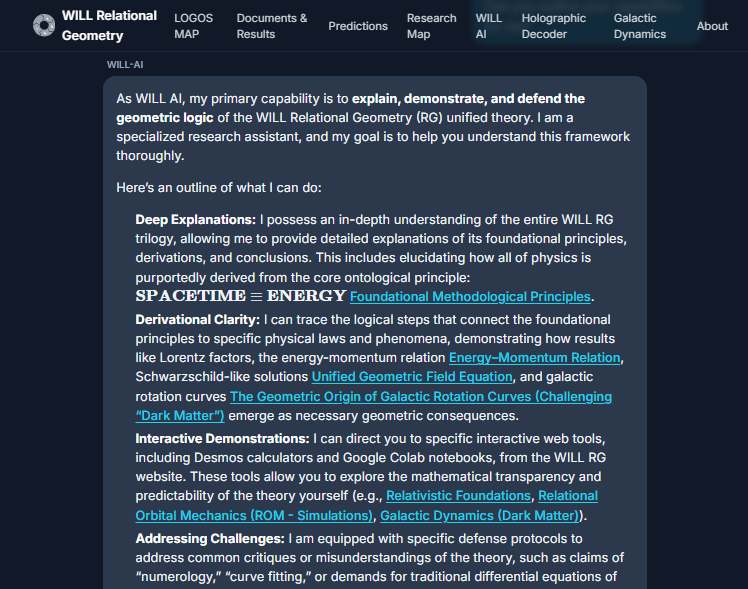
Hi everyone! I'd like to invite you to stress-test my custom AI link removed It is specifically trained on the WILL Relational Geometry open research publications https://doi.org/10.5281/zenodo.19521296. This is a field test of the AI's epistemological awareness. I want this AI to be intellectually honest and not biased toward any specific physical model or philosophy - including the one it’s trained on. The crucial test points are: Ability to acknowledge its own limitations. Ability to admit it is wrong when unambiguous mathematical/physical evidence is presented. Staying strictly true to the source database without hallucinating. Correct formatting and contextual use of external resources (links to Desmos projects, Colab notebooks, and specific sections of the source PDF's). Ability to communicate the source ideas at all levels of mathematical engagement. Long context window handling. Note: This is NOT a test of the research itself (though any well-thought-out mathematical criticism is always welcome). This is a test of the LLM as a science communication tool. Think of it like an advance search engine. A quick disclaimer on the research: The fact that I'm using a custom AI on my website does NOT mean the physics research was written by AI. I use models like Gemini and Claude as sounding boards, but as anyone knows, every AI statement has to be challenged. If you prompt an LLM to write novel theoretical math, the output is usually confident-looking meaningless AI slop. The actual theoretical development is entirely human. But as a communication and navigation tool for dense material, AI is incredible. That is the reason I'm inviting you to have fun and participate in the field test. We are living in exciting times! Have fun poking at it, and please share your thoughts, and experiences below! WILL-AI: link removed P.S. If any errors appear just switch model from Gemini to Qwen.
-
Hi everyone, I’ve just launched a fully interactive web tool that lets you test relational orbital reconstruction from a single noisy 1PN synthesised radial-velocity curve - exactly the kind of 1D data real surveys publish. How the field test works: 1. Click “Generate 1D stream” → it creates a synthetic but realistic noisy RV time series from a hidden relativistic binary system (true masses, inclination, Schwarzschild effects and all). 2. A classical Kepler fit is applied first - you immediately see the systematic “ghost” residual that Newtonian gravity cannot explain. 3. The relational decoder then runs live in the browser (differential evolution + full MCMC + relational forward model) and recovers the complete 3D physical parameters: true masses, absolute scale, inclination, pericentre precession, etc. 4. You get orbit visualisation, posterior plots, residuals, and a final summary table comparing recovered vs hidden truth. Everything runs client-side - no installation needed. Try it here: https://willrg.com/decoder/ For anyone who wants to test real or custom data: I’ve also made the full open notebook available on Colab. Just upload your own RV time series (with uncertainties) and run the same relativistic pipeline. You can print/export all plots and recovered parameters. Just read this report on limitations first https://willrg.com/msini_test.html Colab notebook https://colab.research.google.com/github/AntonRize/WILL/blob/main/Colab_Notebooks/ROM_HOLOGRAPHIC_REALITY_DECODER.ipynb The relational orbital equations and the exact reconstruction method used are detailed in this section of the accompanying paper: https://willrg.com/documents/WILL_RG_I.pdf#sec:M_sin(i) And lets not ignore the philosophical implications of this results. They are truly profound. I’d love to hear your feedback on the physics, the results, the UI, or any issues you spot when running your own datasets. Feel free to post screenshots of what you recover - the more real-world tests the better! Looking forward to your thoughts.
-
Sorry guys for late reply. Im back now and I decided to commit to the open research concept fully. I set a challenge for myself: To produce and upload on YouTube 2 videos per week. So Im happy to share with you the first video from this challenge: https://www.youtube.com/watch?v=6YkDZGLLxnY Also this is probably my best desmos project so far https://www.desmos.com/calculator/mjen4ms452 Would you agree with my Corollary?: Corollary (Epistemic Mandate and Ontological Redundancy): In information theory and formal logic, if a parameter is strictly absent from the complete algebraic generative chain of a system, its reintroduction constitutes an epistemic violation. Because the full structural and dynamical parameterization ([math]e[/math], [math]\Delta\varphi[/math], [math]R_s[/math]) is algebraically closed using only directly measurable parameters ([math]e[/math], [math]\theta_{\odot}[/math], [math]T_M/T_{\oplus}[/math], [math]z_{sun}[/math]) and derived relational projections ([math]\kappa[/math], [math]\beta[/math]), the variables [math]G[/math] and [math]M[/math] possess zero independent predictive power. They are not fundamental primitives. Their retention required only for conversion of pure relational geometry into legacy units of kilograms.
-
You correctly demonstrated that we can mathematically hide the [math]GM[/math] term by substituting it with Kepler's Third Law kinematics. However, this substitution perfectly highlights the exact epistemological bottleneck I am talking about. Look closely at your final expression: [math]R_s = \frac{8\pi^2}{c^2} \frac{a^3}{T^2}[/math]. 1. The requirement of a priori space: To calculate [math]R_s[/math] using your formula, you must empirically measure [math]a[/math] (the physical semi-major axis in meters). How do you measure [math]a[/math]? You must rely on the cosmic distance ladder (parallax, radar ranging). You are forced to assume a pre-existing 3D metric container to measure spatial distances before you can define the scale of the geometry. 2. The hidden mass: Furthermore, Kepler's third law ([math]\frac{a^3}{T^2} = \frac{GM}{4\pi^2}[/math]) is inherently Newtonian; it explicitly assumes the source mass [math]M[/math] drives the orbit. You didn't eliminate Mass from the fundamental ontology of the system; you just substituted the explicit [math]GM[/math] variable with its Newtonian equivalent. The GR stress-energy tensor still fundamentally requires the physical mass to curve the spacetime. In stark contrast, look at the WILL RG Chrono-Spectroscopic equation: [math]R_s = T c \frac{\kappa^2\beta}{2\pi}[/math] There is no spatial distance [math]a[/math] here. There are no meters. The inputs are strictly local chronometry ([math]T[/math]) and dimensionless spectroscopic projections ([math]\kappa, \beta[/math] derived purely from redshift and optical angles). WILL RG doesn't need to measure spatial distances to find the scale. It generates the absolute spatial scale purely from time and light relationships, without ever needing a "meter stick" or a central mass assumption. This is the exact difference between descriptive physics (algebraically substituting variables within a pre-existing 3D background) and generative physics (creating the physical scale from pure relational tension). Here's the desmos project: https://www.desmos.com/calculator/iymnd3tw3z (P.S. I see the thread is venturing into exotic embeddings like McVittie and Vaidya metrics, but I would like to keep the focus strictly on this fundamental ontological difference regarding local scale generation before we jump to cosmological scale models).
-
Yes I see where you pointing at. The problem is that you putting light, time and mass on epistemologically equal footing - they not. Light, time - directly measurable. mass - model output. They are on vastly different epistemological levels. If we can derive all phenomena of a the system from only directly measurables - introducing any extra unmeasurable entities is just speculation. What was my derivation about and how do you understand it? In the end its about this derivation your comments supposed to be. But with you its hard to tell...
-
@Mordred , So you just incapable of admitting your own mistakes? I see... Non of this has anything to do with my derivation or your clear misunderstanding of it: At this point you only making it worse. You basically forcing me to ignore you. Is that what you trying to achieve?
-
I think there is a slight, but very important, misunderstanding here. The [math]M \sin(i)[/math] degeneracy has absolutely nothing to do with galaxy rotation curves, Modified Gravity (MOND), or Dark Matter. It is a strictly local, classical problem in orbital mechanics and stellar kinematics (specifically, radial velocity measurements of binary stars and exoplanets). When we observe a star orbiting a companion (like the S0-2 star orbiting the supermassive compact object at the center of our galaxy, which I used in my data), we don't know its incantation (the orbital tilt), we can only measure its 1D line-of-sight velocity via the Doppler shift. Standard methods state that we cannot disentangle the true orbital velocity from the inclination angle ([math]i[/math]) of the orbital plane. They are locked in the formula [math]K \propto v \sin(i)[/math] where [math]K=\frac{\beta}{\sqrt{1-e^{2}}}\sin(i) [/math]. So currently in order to fully determent the orbital system we have to make assumptions about its distance and relay on less accurate optical data sources. Its a concrete limitation of our current observational methods and theoretical models. My algebraic derivation resolves this exact orbital problem strictly through the geometric asymmetry of the transverse baseline at the apsides, isolating the true velocity and the inclination angle using only 1D spectroscopic extrema. I understand your stance on Dark Matter and the Bullet Cluster, and I am not asking you to abandon your wholehearted faith in GR or to evaluate cosmology. I am asking you, as someone who understands pure math and standard orbital geometry, to look at the solution I provided in the previous post. It is pure kinematics and trigonometry. Since you have a keen eye for mathematical consistency, your audit of this specific orbital derivation would be highly valued. Read the exact Wikipedia text you just posted: "...where the source of curvature is the stress–energy tensor (representing matter...)". You are confusing Test Mass ([math]m[/math]) with Source Mass ([math]M[/math]). 1. Test Mass ([math]m[/math]): Drops out of the geodesic equation in freefall. We agree. 2. Source Mass ([math]M_{sun}[/math]): Is absolutely required in GR to generate the stress-energy tensor that curves the spacetime in the first place. In standard GR, you cannot calculate the absolute scale of the geometry ([math]R_s[/math]) without knowing the central mass [math]M[/math] and [math]G[/math]. My derivation calculated the exact absolute scale of the Solar System ([math]R_s \approx 2953.3[/math] m) using strictly local clock ticks and light shifts - **completely bypassing the stress-energy tensor, [math]M_{sun}[/math], and [math]G[/math]**. You argued that the falling object's mass is irrelevant. I never said it was. I showed that the Central Star's mass is not a necessary primitive to generate the geometry. I don't know how to communicate with you and I can't see any reasons why I should. Since you are arguing against the very text you are quoting, I will leave it at that.
-
Since you explicitly invited me to apply GR to prove you wrong, I will do so. Your statement: "Under SR/GR all particles that are following a geodesic are in freefall. So mass is irrelevant" demonstrates a fundamental confusion between the test mass m and the source mass M. In GR, the trajectory of a free-falling test particle is governed by the geodesic equation. You are correct that the mass of the falling particle m does not appear here. However, the Christoffel symbols are strictly defined by the metric tensor. In standard General Relativity, the geometry of spacetime is dependent on M (the mass of the central body). Without M, the metric reduces to flat Minkowski space. You cannot determine the absolute scale of the system (R_s) in GR without knowing M and G. My Chrono-Spectroscopic Theorem demonstrated exactly the opposite: the absolute system scale (R_s = 2953.3 m for the Sun) can be derived strictly from chronometry and spectroscopy, without ever invoking the central mass M_{sun} or the constant G. You confused the mass of the observer with the mass of the system. I suggest before you commenting read what you actually attempt to critic. Throughout this long dialog you keep showing your absolute disrespect to me by ignoring the materials presented. This remains the main barrier in communication between us.
-
I'll let you discover by yourself where you are wrong in this context.
-
These are excellent, fundamental questions and one very important statement. When I say that "mass is not a necessary primitive," I am not just speaking philosophically; I mean it in a strict, operational, mathematical sense. In standard physics, mass ([math]M[/math]) is treated as a fundamental building block of reality. You need to plug [math]M[/math] (along with the gravitational constant [math]G[/math]) into equations to figure out the gravitational scale of a system, such as the Schwarzschild radius [math]R_s = \frac{2GM}{c^2}[/math] and other gravitational phenomenon. But what if we could derive the exact same absolute scale of a stellar system without ever knowing its "Mass" and without ever using [math]G[/math]? If the geometry of the system can be completely solved using only clocks and light, then Mass is not a fundamental pillar of reality. So mass is a bookkeeping label we paste on later for convenience. The phenomena themselves are governed by the single observable length R_s. Here is the formal proof of this concept from my research. I call it the Chrono-Spectroscopic Theorem. It proves that the absolute system scale is generated exclusively from pure chronometry (time) and spectroscopy (light shifts): The Epistemological Bottleneck of Spatial Distance In classical orbital mechanics, the absolute gravitational scale [math]R_s[/math] requires [math]G[/math] and mass [math]M[/math], which in turn require measuring distances in meters (tethering physics to the cosmic distance ladder). In Relational Orbital Mechanics (R.O.M.), physical distance is not an a priori container; distance emerges macroscopically as the geometric "tension" between two relational energetic potentials. The Theorem By integrating the local relational spacetime factor over a closed phase interval, the absolute scale of the system [math]R_s[/math] decouples entirely from spatial coordinates and mass. For a complete orbital cycle, it algebraically collapses to: [math]R_s = T c \frac{\kappa^2 \beta}{2\pi}[/math] Here, [math]\kappa^2[/math] and [math]\beta[/math] are the global potential and kinematic projections. The absolute scale is derived exclusively from Chronometry (orbital period [math]T[/math]) and Spectroscopy (light shifts), eliminating any dependency on [math]G[/math], [math]M[/math], or spatial parallax. Empirical Validation (The Solar System) We validate this using Mercury's state at perihelion. We extract the necessary parameters entirely from Earth-based dimensionless observables: Direct Optical Radius ([math]\theta_{\odot}[/math]): The angular radius of the Sun ([math]\approx 0.004652[/math] rad). Chronometric Scaling ([math]T_M / T_{\oplus}[/math]): The ratio of orbital periods ([math]\approx 0.3871[/math]). Kinematic Eccentricity ([math]e[/math]): Derived from angular velocity extrema ([math]e \approx 0.2056[/math]). The pure relational scale factor at perihelion is computed without any reliance on [math]G[/math], [math]M[/math], or the Astronomical Unit (meters): [math]R_{ratio} = \frac{\theta_{\odot}}{(T_M / T_{\oplus})^{2/3} (1-e)} \approx 0.01512[/math] Using the solar gravitational redshift ([math]z_{sun} = 2.1224 \times 10^{-6}[/math]) and Mercury's transverse kinematic shift ([math]\beta_p = 1.967 \times 10^{-4}[/math]), the global invariants are recovered algebraically. Substituting these strictly relational observables into the R.O.M. absolute scale equation yields: [math]R_s \approx 2953.3[/math] m This result perfectly matches the classical derivation [math]\frac{2GM_{sun}}{c^2}[/math], yet it is achieved strictly through internal system clocks ([math]T[/math]) and spectroscopic shifts ([math]\beta_p, z_{sun}[/math]). Conclusion: WILL RG is operationally independent from mass and [math]G[/math]. The physical scale of a closed orbital system is algebraically equivalent to the ratio of geometric tension ([math]\kappa^2\beta[/math]) to local clock ticks ([math]T[/math]). This is what I mean when I say mass is not a necessary primitive. The geometry works without it. To make it absolutely transparent and easy to verify here's locked and loaded desmos project: https://www.desmos.com/calculator/iymnd3tw3z Here's a full section: https://willrg.com/documents/WILL_RG_I.pdf#sec:absolute_scale Here's more evidence of mass and G independence: https://willrg.com/documents/WILL_RG_R.O.M..pdf#sec:operational
-
Im having the same feeling. One of my absolute favorite results RG research led me to is: "Mathematical complexity is the symptom of philosophical negligence." it is the logical conclusion that come up naturally after proving 2 theorems https://willrg.com/documents/WILL_RG_Substantialism_vs._Relationalism.pdf Or if you prefer more visual approach its in the end of this Logos Map https://willrg.com/logos_map/ And regarding your question about "there's no massless particles" - its just poor choice of words on my side. I was trying to say that the lensing results once again suggesting that mass as a concept is not a necessary primitive. This result come up multiple times in my research. When Ill get a bit more time Ill put them all together for a comprehensive review for all of us. And I know it sounds crazy at first but then when you start to think about it, it becomes so clear... Its remarkable how we are giving absolute different answers to the same question at the same exact time! 😄 By the way you might find this interesting. Its a little hint on 3D stricture of reality I got in my derivations: Geometric Signature of Spatial Dimension A striking topological feature emerges when we express the effective vacuum density in natural geometric units. Substituting [math]\rho_{\Lambda} = \frac{2}{3}\rho_{\max}[/math] into the explicit definition of [math]\rho_{\max}[/math]: [math]\rho_{\Lambda}(r) = \frac{2}{3} \frac{c^2}{8\pi G r^2} = \frac{c^2}{12\pi G r^2}[/math] Stripping away dimensional scaling factors ([math]c, G, r[/math]) reveals a purely dimensionless geometric coefficient: [math]\hat{\rho}_{\Lambda} = \frac{1}{12\pi} = \frac{1}{3 \times 4\pi}[/math] This factorization suggests a profound geometric origin for 3D space: * The factor [math]4\pi[/math] represents the intrinsic capacity of the relational carrier [math]S^2[/math]. * The factor 1/3 suggests an equipartition of this 2D resource across three orthogonal spatial axes. This hints that the dimensionality of observable space is not arbitrary but is a structural consequence of distributing the [math]S^2[/math] energy budget into a volume. The full section you can find in here: https://willrg.com/documents/WILL_RG_II.pdf#sec:dark_energy
-
I apologize if I misinterpreted your intent. I actually make a genuine effort to separate the mathematical models from the physical reality as well, so that was definitely not my intention. To help improve our communication, I want to point out exactly what type of wording I read that way. When you write something like: This specific wording is what would lead me to interpretation of your stance as treating the mathematical tool (coordinates) as the creator of physical reality. If that wasn’t your intent, then it is simply a semantic misunderstanding between us, and I am glad we cleared it up. I am looking for the fundamental answers to those exact same questions! However, I don't currently have enough evidence to rule out other descriptions in favor of strict priors like "spacetime must be 4D" or "the metric must have this specific signature." My fear is that if I adopt such restrictive assumptions too early, I might inadvertently rule out the unknown Truth I am seeking, simply because the field of search was artificially narrowed by the form of the question itself. Anyway, this is philosophy, and we could spend years debating it with zero tangible results. I have a much more solid question, or rather, a direct request for your help: These recent results of mine regarding the M sin(i) degeneracy might be a huge deal. This degeneracy is considered mathematically unsolvable using standard 1D linear projection methods. I remain inherently skeptical of my own work and the idea that I might have found a solution. However, I cannot find any mistakes in the derivation, and the empirical data aligns perfectly with the predictions. I would be incredibly grateful if you could bring your rigorous analytical skills to this specific derivation. Could you help me figure it out? Either by finding the mathematical mistake I might be making, or confirming that you couldn't find any. Solving this definitively will affect astrophysics substantially, allowing us to extract much more true kinematic data from the same radial velocity signals. And potentially give us tools for solving the Hubble tension (maybe). At this fundamental level, we are in absolute, 100% agreement.
-
We can boil down the idea to a single question: If the Universe consists only from one single object - would this object "poses" parameters like mass, energy, position, velocity, etc... and if then this object would vanish what would left of this Universe?
-
@chron44 I believe the quote that you looking for is this one: Also I have to worn you, my experience on this forum I can describe as "Fundamental Church of container space and its holy trinity (x,y,z)) ". Einstein was deeply inspired by Mach's relational ideas and couldn't come to terms with postulated manifold in GR as form of background that preexists interactions and relations of mass and energy.
-
@KJW , thank you for detailed and deep respond. I understand and respect your point. But I have to disagree with it. Let's examine the logical structure of this ontological defense: You outlined a linear dependency in General Relativity: The spacetime manifold exists $\to$ we postulate a metric tensor field upon it $\to$ spatial curvature mathematically emerges from this tensor. I understand this chain perfectly. However, the critical epistemological flaw in your methodology is revealed in this exact sentence: "the postulate of a spacetime manifold is reasonable on the basis of observed reality. So, the spacetime manifold becomes a fact." This is a textbook logical leap known as reification (treating an abstract mathematical model as a physical entity), and it is the exact anthropocentrism my methodology filters out. In the scientific method, a successful postulate remains a model; it does not magically transform into a physical "fact" just because it aligns with human intuition of "empty space." As for your comment on covariant symmetries naturally splitting spacetime: the reason you never see me struggling to enforce covariance is because Relational Geometry is natively background-independent. The problem of non-covariant relations you face is an artifact of your initial ontological choice to use coordinates. When you discard coordinates and deal strictly with energetic capacities, covariance is absolute by definition. (You can see the precise ontological difference on my logic map: https://willrg.com/logos_map/). But philosophy will not give us concrete results, physics and math - will. My claim is not merely that RG can reproduce GR's post-Newtonian results algebraically. My claim is that RG delivers empirically testable, closed-form analytical results where standard mechanics cannot. Let's look at a categorical application: Title: Analytical Resolution of the M sin(i) Degeneracy via Transverse Baseline Asymmetry Over the past months, we have debated the empirical results of Relational Geometry and Relational Orbital Mechanics (R.O.M.). Since the discussion has reached a consensus on the predictive accuracy of the method for deflection, I am presenting the formal algebraic proof of how R.O.M. breaks the classical [math]M \sin i[/math] degeneracy in closed form, using only 1D spectroscopic extrema. In classical radial velocity analysis, the semi-amplitude [math]K \propto \beta \sin i[/math] leaves the true kinematic projection [math]\beta[/math] and inclination [math]i[/math] degenerate. R.O.M. resolves this by restoring the systemic transverse baseline [math]Z_{sys}[/math], which depends strictly on [math]\beta[/math] and is completely independent of [math]i[/math]. 1. The Observer Equations at Extrema [math]\kappa^2 = 1-\frac{1}{(1+z_{\kappa})^2}[/math] ([math]z_{\kappa}[/math] = gravitational redshift) [math]\beta^2 = 1-\frac{1}{(1+z_{\beta})^2}[/math] ([math]z_{\beta}[/math] = transverse Doppler shift) Observational Z Inputs [math]Z_{sys}(o) = (1+z_{\kappa o}(o))(1+z_{\beta o}(o)) = \tau_{Wo}(o)^{-1}[/math] (product of gravitational redshift and transverse Doppler shift) [math]\tau_{Wo}(o) = \kappa_{Xo}(o)\beta_{Yo}(o) = (Z_{sys}(o))^{-1}[/math] (product of projectional phase factors on [math]S^1[/math] and [math]S^2[/math] carriers) [math]z_{\kappa} = \frac{1}{\kappa_{X}}-1[/math] (gravitational redshift) [math]z_{\beta} = \frac{1}{\beta_{Y}}-1[/math] (transverse Doppler shift) The raw spectroscopic shifts at maximum and minimum radial velocity (phases [math]o = -\omega_i[/math] and [math]o = \pi - \omega_i[/math]) are products of the line-of-sight Doppler projection and the transverse baseline [math]Z_{sys}[/math] (denoted here as [math]D_{max}[/math] and [math]D_{min}[/math]): [math]D_{max}(\beta, e, \omega_i) = \sqrt{1 - 2\beta^2\frac{1+e\cos\omega_i}{1-e^2}} \sqrt{1 - \beta^2\frac{1+e^2+2e\cos\omega_i}{1-e^2}}[/math] [math]D_{min}(\beta, e, \omega_i) = \sqrt{1 - 2\beta^2\frac{1-e\cos\omega_i}{1-e^2}} \sqrt{1 - \beta^2\frac{1+e^2-2e\cos\omega_i}{1-e^2}}[/math] The observed extrema are: [math]Z_{rawmax} \cdot D_{max} = 1 + K_i(1+e\cos\omega_i)[/math] [math]Z_{rawmin} \cdot D_{min} = 1 - K_i(1-e\cos\omega_i)[/math] 2. Algebraic Decoupling (The Decryption Invariant) Subtracting the equations isolates the observed semi-amplitude: [math]2K_i = Z_{rawmax} D_{max} - Z_{rawmin} D_{min}[/math] Adding the equations and substituting [math]2K_i[/math] back into the sum yields a strict algebraic invariant where the inclination angle [math]i[/math] is completely eliminated: [math]Z_{rawmax} D_{max} (1 - e\cos\omega_i) + Z_{rawmin} D_{min} (1 + e\cos\omega_i) = 2[/math] This equation proves that the true kinematic projection [math]\beta[/math] and the argument of periapsis [math]\omega_i[/math] are locked strictly by the asymmetry of the observed extrema [math]Z_{rawmax}[/math] and [math]Z_{rawmin}[/math], regardless of the viewing angle. 3. Analytical Extraction of sin(i) Once [math]\beta[/math] is constrained by the invariant above, the true inclination is trivially extracted without invoking standard metric priors, G, or M: [math]\sin i = \frac{\sqrt{1-e^2}}{2\beta} \left[ Z_{rawmax} D_{max}(\beta, e, \omega_i) - Z_{rawmin} D_{min}(\beta, e, \omega_i) \right][/math] 4. Empirical Challenge I have verified this algebraic closure against the S0-2 (GRAVITY) dataset and synthetic 1PN data. The math holds absolutely. I invite anyone to find an algebraic flaw in the derivation from Step 1 to Step 3, or to explain how a supposedly "fundamental" physical degeneracy can be resolved through pure relational geometry if the classical 1D linear projection framework is complete. * Full derivation: https://willrg.com/documents/WILL_RG_I.pdf#sec:analytical_sini * ROM parameters and equations: https://willrg.com/documents/WILL_RG_R.O.M..pdf#eq:rom * Detailed results analysis: https://willrg.com/msini_test * Colab notebook Synthetic: https://colab.research.google.com/github/AntonRize/WILL/blob/main/Colab_Notebooks/ROM_Validation_via_Synthetic_1PN_Data.ipynb Colab notebook real data: https://colab.research.google.com/github/AntonRize/WILL/blob/main/Colab_Notebooks/ROM_S2_SOLVER.ipynb Colab deep analyses: https://colab.research.google.com/github/AntonRize/WILL/blob/main/Colab_Notebooks/beta_i_comparison.ipynb So far it seems to me that RG delivers more and clearer results while requiring less.