
Anton Rize
Senior Members
-
Joined
-
Last visited
Everything posted by Anton Rize
-
Ok lets think together what would you consider a proof? You can give me a list of predictions and Ill show you derivations. You can ask WILL-AI he will show as well. All major GR predictions I already derived as far as I know. Gravitational waves I discard my derivation because math wasn't pretty enough😅. Im looking for the solution that would be as simple as the rest. Discrepancy's are far to small for detection tools accuracy so far... I diverge with GR at cosmic and quantum levels but in a good way. Do you have something specific in mind?
-
Dark lensing: [math] \theta_E = 2 \frac{D_{LS}}{D_S} \arcsin( \frac{(\kappa_{bar}^2(\theta_E) + \kappa_{phantom}^2(\theta_E)) (1 + \beta_p^2)}{2\beta_p^2 - (\kappa_{bar}^2(\theta_E) + \kappa_{phantom}^2(\theta_E)) (1 + \beta_p^2)} )[/math] Full derivation: https://willrg.com/documents/WILL_RG_II.pdf#sec:lensing Colab notebook: https://colab.research.google.com/github/AntonRize/WILL/blob/main/Colab_Notebooks/Dark_Lensing.ipynb OUTPUT: WILL RG AB INITIO PREDICTIONS (Zero Free Parameters) LensID sigma_obs sigma_pred theta_E_obs theta_E_pred J0037-0942 279 282.11 1.53 1.49 J0216-0813 333 286.12 1.16 0.78 J0737+3216 323 285.34 1.00 0.95 J0946+1006 287 282.96 1.43 1.37 J0956+5100 334 296.55 1.33 1.15 J1250+0523 252 268.53 1.13 1.37 J1430+4105 322 292.07 1.52 1.14 J1627-0053 290 298.59 1.23 1.46 ----------------------------------------------------------------- Kinematics Mean Absolute Error: 23.02 km/s Lensing Mean Absolute Error: 0.195 arcsec -----------------------------------------------------------------I guess one could call it a mic drop 😁
-
This once again shows your complete lack of engagement with presented materials. For the last 4 pages on this forum I was presenting evidence that mass as a concept is not necessarily primitive. But how would you know if you only glance at my posts and then going back to make the same logically false arguments over and over again never admitting your mistakes and never clearly stating your own falsification conditions. As I told you before: without the clear answer we can't move any further. Sorry but I will have to ignore you until you will provide a clear unswear. This once again shows your complete lack of engagement with presented materials. For the last 4 pages on this forum I was presenting evidence that mass as a concept is not necessarily primitive. But how would you know if you only glance at my posts and then going back to make the same logically false arguments over and over again never admitting your mistakes and never clearly stating your own falsification conditions. As I told you before: without the clear answer we can't move any further. Sorry but I will have to ignore you until you will provide a clear unswear.
-
@KJW @MJ kihara (and everyone following the mathematical results) Guys lets put aside our personal preferences and beliefs and engage with the results that this research provides us so far. The guiding principle of this research is Ontological Minimalism: any physical phenomenon must be interpreted using the absolute minimum number of primitives required for its complete description and prediction. In standard General Relativity, to explain the the observed phenomena, one must postulate several heavy ontological primitives: * Mass (as an intrinsic substance). * A background 4D spacetime manifold. * The metric tensor. * Spatial curvature as a distinct geometric entity. However, the consistent quantitative convergence of this research (including the Python script I just presented) demonstrate a hard, undeniable fact: these are not necessary primitives. The same empirical predictions are generated purely from the algebraic distribution of relational projections ([math]\kappa[/math] and [math]\beta[/math]) on closed carriers, without ever invoking a spatial metric, a manifold, or spatial curvature. When a theoretical model relies on constructs beyond the minimal necessary primitives, it inevitably introduces non-physical, artifactual structures. The concept of an "empty 3D space," a "background time axis," or a "curved fabric" are legacy concepts rooted deeply in anthropocentrism. They are projections of how the human brain biologically parses its environment, not fundamental physical entities. My methodology acts as a strict epistemic filter against this anthropocentrism. If WILL Relational Geometry can algebraically generate the same empirical results strictly from the depletion of the internal phase buffer ([math]\beta_Y \to 0[/math] directly measurable transvers Doppler shift [math]z_b=\frac{1}{\beta_Y}-1[/math]) - without using a single metric tensor or spatial curve - then by the fundamental rules of the scientific method (Occam's Razor), spatial curvature is an ontological ghost. It is a mathematical over-parameterization of a purely energetic relation. We do not need to imagine Earth moving in a "helical trajectory in 4D spacetime." We only need to measure the total relational shift ([math]Q[/math]) between energetic states. The math works. The extra ontology is just cultural baggage.
-
First, thank you for your honesty. Hearing "I see value in it" from someone who is actively and rigorously scrutinizing the math means a great deal to me. I am not looking for easy agreement; ruthless mathematical scrutiny is exactly what RG needs. This is exactly what I have been looking for, and it is the highest form of respect one researcher can show another. Thank you! You are 100% correct. My assumption that the factor of 2 arose simply because light is "massless" (and hardcoding the 1/2 partitioning factor for massive bodies) was a critical error. As you rightly pointed out, a massive object traveling at 0.999999*c must asymptotically approach the deflection of light, which my previous discrete geometric separation failed to do. Further more without the graduate rebalancing of the weight of itch axis the hole geometric structure goes haywire and energy comes from nothing go nowhere. So I spend pretty much all day deriving it. It was way harder than I expected but in the end something incredible happened. I don't know how to prove it but guys I swear I did not try to copy GR results. You will see my ontology and derivation logic has nothing to do with GR. And when I was going to send the results here, I saw your message @Markus Hanke and decided to test my result against this GR equation. Any way you'll see the results below. I don't know how did it happened... Here's the new section on gravitational diflection: The Unified Interaction Gradient and Relativistic Deflection Energy projections distribution among axis of relational carriers has to obey the conservation law (distribution between axis does not create nor destroy energy). There must exist a strict, algebraically closed gradient connecting all states, governed entirely by the kinematic projection [math]\beta[/math]. Theorem (Unified Interaction Gradient): The gravitational interaction capacity of any entity is determined by its available phase buffer [math]\beta_Y[/math]. The geometric scaling factor [math]\Gamma[/math] that dictates the distribution of the potential projection [math]\kappa^2[/math] onto the spatial trajectory is strictly defined by the arithmetic mean of the saturated carrier [math]S^1[/math]: [math]\Gamma(\beta) = \frac{1 + \beta^2}{2} = 1 - \frac{\beta_Y^2}{2}[/math] Proof: By the [math]S^1[/math] closure invariant ([math]\beta^2 + \beta_Y^2 = 1[/math]), an object at rest ([math]\beta = 0[/math]) possesses maximum internal phase ([math]\beta_Y = 1[/math]). This phase acts as a geometric buffer, absorbing half of the relational gradient, yielding the classical partitioning [math]\Gamma = 1/2[/math]. As the spatial projection [math]\beta[/math] increases, the internal clock slows, and the phase buffer [math]\beta_Y[/math] depletes. At the topological limit [math]\beta \to 1[/math] (light), the internal phase collapses ([math]\beta_Y \to 0[/math]). The buffer is exhausted, forcing the entity to absorb the full, unpartitioned gravitational gradient, yielding [math]\Gamma = 1[/math]. Using this gradient, we define the Unified Closure Defect for any trajectory—from a slow asteroid to a photon—as: [math]\delta_{unified} = \frac{\kappa_p^2}{\beta_p^2} \Gamma(\beta_p) = \frac{\kappa_p^2 (1 + \beta_p^2)}{2\beta_p^2}[/math] The geometric shape parameter (eccentricity) of the trajectory is derived directly from this defect: [math]e_{unified} = \frac{1}{\delta_{unified}} - 1 = \frac{2\beta_p^2}{\kappa_p^2(1+\beta_p^2)} - 1[/math] Applying the exact algebraic transit equation for a distant observer ([math]\kappa_o \to 0[/math]), we have [math]\cos(o_\infty) = -1/e_{unified}[/math]. Using the same trigonometric extraction as established for light ([math]\sin(\frac{\Delta\varphi}{2}) = \frac{1}{e_{unified}}[/math]), we arrive at the absolute, unified equation for gravitational deflection: [math]\Delta\varphi_{unified} = 2 \arcsin(\frac{\kappa_p^2 (1 + \beta_p^2)}{2\beta_p^2 - \kappa_p^2 (1 + \beta_p^2)})[/math] Verification of Topological Limits: * Newtonian Limit ([math]\beta_p \ll 1[/math]): The phase buffer is full ([math]\Gamma \to 0.5[/math]). The eccentricity is dominated by [math]2\beta_p^2 / \kappa_p^2[/math]. The deflection reduces to the classical Rutherford/Newton scattering: [math]\Delta\varphi \approx \frac{\kappa_p^2}{\beta_p^2}[/math]. * Relativistic Limit ([math]\beta_p \to 0.99[/math]): The phase buffer is nearly depleted ([math]\Gamma \to 0.99[/math]). The trajectory stiffens, and the deflection angle approaches the photonic maximum, smoothly capturing the post-Newtonian factor without Taylor expansions. * Photonic Limit ([math]\beta_p = 1[/math]): The phase buffer is completely exhausted ([math]\Gamma = 1[/math]). Substituting [math]\beta_p = 1[/math] yields [math]e = \frac{2}{\kappa_p^2(2)} - 1 = \frac{1}{\kappa_p^2} - 1 = \frac{\kappa_{Xp}^2}{\kappa_p^2}[/math]. The equation resolves perfectly into the exact light deflection identity: [math]\Delta\varphi = 2 \arcsin(\frac{\kappa_p^2}{\kappa_{Xp}^2})[/math]. Elimination of the "Massless" Myth: This formulation proves that light is not a distinct ontological category governed by separate physical laws. There are no "massless particles" in RG. Light is simply the rightward topological limit of matter, where the internal phase [math]\beta_Y[/math] reaches zero. The historical factor of 2 in gravitational lensing is not an anomaly of curved spacetime, but the inevitable geometric consequence of an exhausted phase buffer. Here's my python script comparing the results of my derived arcsin against the scary equation that @Markus Hanke posted: import math from scipy.integrate import quad z_sun = 2.1224e-6 kappa_p_sq = 1 - 1 / ((1 + z_sun)**2) def gr_deflection(beta_p, kp2): def S(u): term1 = (1 - kp2) / (beta_p**2) term2 = (1 - kp2 * u) * ((1 - beta_p**2) / (beta_p**2) + u**2) return term1 - term2 def integrand(u): s_val = S(u) if s_val <= 1e-15: return 0.0 return 1.0 / math.sqrt(s_val) phi, _ = quad(integrand, 0, 1) return (2 * phi - math.pi) * (180.0 / math.pi) * 3600.0 def will_deflection(beta_p, kp2): b2 = beta_p**2 num = kp2 * (1 + b2) den = 2 * b2 - num ratio = num / den if ratio > 1.0 or ratio < -1.0: return float('nan') return 2 * math.asin(ratio) * (180.0 / math.pi) * 3600.0 betas = [0.01, 0.5, 0.9, 0.99, 0.9999, 1.0] print("Sun kappa_p^2: {:.6e}".format(kappa_p_sq)) print("-" * 75) print("{:<10} | {:<20} | {:<20} | {:<15}".format('beta_p', 'GR Integral (arcsec)', 'WILL RG (arcsec)', 'Diff (%)')) print("-" * 75) for b in betas: gr_val = gr_deflection(b, kappa_p_sq) will_val = will_deflection(b, kappa_p_sq) if math.isnan(will_val): print("{:<10.4f} | {:<20.6f} | {:<20} | {:<15}".format(b, gr_val, 'Captured', '-')) else: diff = abs(gr_val - will_val) / gr_val * 100 if gr_val != 0 else 0 print("{:<10.4f} | {:<20.6f} | {:<20.6f} | {:<15.4e}".format(b, gr_val, will_val, diff)) print("-" * 75)Output: Sun kappa_p^2: 4.244786e-06 --------------------------------------------------------------------------- beta_p | GR Integral (arcsec) | WILL RG (arcsec) | Diff (%) --------------------------------------------------------------------------- 0.0100 | 8946.966119 | 8946.971578 | 6.1021e-05 0.5000 | 4.377794 | 4.377797 | 5.9810e-05 0.9000 | 1.956485 | 1.956485 | 1.6577e-05 0.9900 | 1.768885 | 1.768885 | 2.0381e-05 0.9999 | 1.751282 | 1.751283 | 3.3894e-05 1.0000 | 1.751107 | 1.751108 | 1.3785e-05 Output with z= z_sun = 0.0901Sun kappa_p^2: 1.584744e-01 --------------------------------------------------------------------------- beta_p | GR Integral (arcsec) | WILL RG (arcsec) | Diff (%) --------------------------------------------------------------------------- 0.0100 | -648000.000000 | Captured | - 0.5000 | 275119.856251 | 295243.875599 | 7.3146e+00 0.9000 | 88523.699944 | 89458.026859 | 1.0555e+00 0.9900 | 78536.915426 | 79109.733546 | 7.2936e-01 0.9999 | 77621.268245 | 78162.819773 | 6.9768e-01 1.0000 | 77612.175741 | 78153.418327 | 6.9737e-01 --------------------------------------------------------------------------- I don't know about you guys but Im shocked.
-
Ok here it is for mass body's: The factor of 2 is exact geometric consequence of the Energy-Symmetry Law (https://willrg.com/documents/WILL_RG_I.pdf#sec:energy-symmetry) and the number of active relational axis on the kinematic carrier. Here is the exact derivation: 1. Massive Bodies (Dual-Axis Partitioning) For massive bodies, the transformation resource is partitioned equally between two orthogonal relational axis on the [math]S^1[/math] carrier: Amplitude ([math]\beta[/math]) and Phase ([math]\beta_Y[/math]). Because the energy budget is distributed across two axis, the invariant binding energy inherently carries a 1/2 partitioning factor: [math]W_{mass} = \frac{1}{2}(\kappa^2 - \beta^2)[/math] This gives the effective potential: [math]\Phi_{mass} = \frac{1}{2}\kappa^2 c^2[/math]. Applying this conserved, partitioned energy invariant between periapsis and apoapsis yields the exact shape parameter (eccentricity) for a massive body: [math]e_m = \frac{2\beta_p^2}{\kappa_p^2} - 1[/math] https://willrg.com/documents/WILL_RG_I.pdf#sec:rel_ecc 2. Light (Single-Axis Collapse) By the Single-Axis Transformation Principle, a photon's kinematic projection completely saturates the carrier ([math]\beta = 1[/math]). This forces the internal phase component to vanish entirely ([math]\beta_Y = 0[/math]). Because the Y-axis is absent, the entire relational resource is concentrated on the single X-axis. The 1/2 partitioning factor is strictly eliminated: [math]W_{\gamma} = \kappa^2 - \beta^2 = \kappa^2 - 1[/math] This gives the unpartitioned effective potential for light: [math]\Phi_\gamma = \kappa^2 c^2[/math]. The gravitational effect on light is exactly twice that on massive particles at the geometric level. This yields the photon shape parameter: [math]e_\gamma = \frac{1}{\kappa_p^2} - 1[/math] https://willrg.com/documents/WILL_RG_I.pdf#sec:nature_of_light 3. The Exact Deflection Equations To find the deflection, we use the exact relational phase state equation: [math]\kappa_o^2 = \kappa_p^2 \frac{1 + e\cos(o)}{1 + e}[/math]. Distant observer ([math]\kappa_o \to 0[/math]) yields the angle [math]\cos(o_{obs}) = -1/e[/math]. Using the total angular phase [math]o_{obs} = \frac{\pi}{2} + \frac{\Delta\varphi}{2}[/math], we get the geometric relation: [math]\sin(\frac{\Delta\varphi}{2}) = \frac{1}{e}[/math] Substituting the respective shape parameters gives the exact, non-linear deflection angles without a single approximation: For a massive body (partitioned budget): [math]\Delta\varphi_m = 2 \arcsin(\frac{\kappa_p^2}{2\beta_p^2 - \kappa_p^2})[/math] For light (unpartitioned budget, [math]\beta=1[/math]): [math]\Delta\varphi_\gamma = 2 \arcsin(\frac{\kappa_p^2}{1 - \kappa_p^2})[/math] The historical "factor of 2" discrepancy does not require to speculate a curved 4D spacetime manifold. It is the direct algebraic signature of the axis count in relational space: massive bodies distribute energy across two axes (requiring the 1/2 factor), while light collapses the geometry to a single axis, experiencing the full unpartitioned geometric effect. As you can see everything is absolutely transparent and intuitive. Let me know what you think.
-
*Laughing hysterically* Only just now I realized that you where asking for nonzero mass object. Ok no worries it shouldn't hard at this point. Ill be back.
-
@KJW, I'm so grateful that you decided to invest your time in my research. I highly appreciate it. Thank you! So you got me all exited and I spend pretty much all night looking for error. No success... Maybe I just cant see it? Could you elaborate please? But most important during this sleepless night I finally derived methodologically pure ontologically minimal and I think truly beautiful one input solution for light deflection. No mass, no G, no metric, no 4D spacetime curvature - pure relational geometry at it's best. Maybe its lack of sleep talking but Im feeling like its yet another triumph of Relational Geometry. Please have a look and let me know what you think: Algebraic Derivation of Light Deflection https://willrg.com/documents/WILL_RG_I.pdf#sec:light_deflection In General Relativity, the deflection of light is obtained by integrating the null geodesic equations over a curved spacetime manifold, often relying on weak-field approximations and Taylor expansions. Within WILL Relational Geometry (RG), we reject both the background manifold and the use of mathematical approximations as non-operational ontological artifacts. The system consists exclusively of its participants: the Source, the Lens (at periapsis [math]p[/math]), and the Receiver. The total deflection angle must be derived as a strict, exact algebraic difference between their measurable relational phase states, without resorting to series expansions. Theorem: Algebraic Deflection of Light Let [math]o[/math] be the orbital phase (true anomaly) representing the exact geometric angle between the lens periapsis and an observer. For an observer at local potential state [math]\kappa_o[/math], this angle is strictly determined by the algebraic identity: [math]\cos(o) = \frac{\kappa_o^2 - \kappa_p^4}{\kappa_p^2 \kappa_{Xp}^2}[/math] where [math]\kappa_p[/math] is the potential projection at periapsis, and [math]\kappa_{Xp}^2 = 1 - \kappa_p^2[/math] is the corresponding phase parameter. Proof: Step 1: The Photonic Closure Defect (Shape Parameter) By the Single-Axis Transformation Principle (link: https://willrg.com/documents/WILL_RG_I.pdf#sec:nature_of_light) for light, the kinematic projection saturates the carrier ([math]\beta = 1[/math]), forcing the internal phase to vanish ([math]\beta_Y = 0[/math]). This eliminates the 1/2 partitioning factor inherent to massive bodies. Consequently, the closure defect at periapsis for a photon is defined exclusively by the total projections: [math]\delta_\gamma = \frac{\kappa_p^2}{\beta_p^2} = \kappa_p^2[/math] The geometric eccentricity (link: https://willrg.com/documents/WILL_RG_I.pdf#sec:rel_ecc) (shape parameter) of the light trajectory emerges directly from this closure defect: [math]e_\gamma = \frac{1}{\delta_\gamma} - 1 = \frac{1}{\kappa_p^2} - 1[/math] Step 2: Relational Phase State Equation In Relational Orbital Mechanics (link: https://willrg.com/documents/WILL_RG_R.O.M..pdf#eq:rom), the local potential [math]\kappa_o[/math] at any orbital phase [math]o[/math] is related to the periapsis potential [math]\kappa_p[/math] by the exact topological scaling: [math]\kappa_o^2 = \kappa_p^2 \frac{1 + e_\gamma \cos(o)}{1 + e_\gamma}[/math] Substituting the photonic shape parameter [math]1 + e_\gamma = \frac{1}{\kappa_p^2}[/math]: [math]\kappa_o^2 = \kappa_p^2 \frac{1 + (\frac{1}{\kappa_p^2} - 1)\cos(o)}{1 / \kappa_p^2} = \kappa_p^4 (1 + (\frac{1-\kappa_p^2}{\kappa_p^2})\cos(o))[/math] Expanding the bracket: [math]\kappa_o^2 = \kappa_p^4 + \kappa_p^2(1-\kappa_p^2)\cos(o)[/math] Recognizing that [math]1-\kappa_p^2 = \kappa_{Xp}^2[/math] (the phase component at periapsis), we solve for [math]\cos(o)[/math]: [math]\cos(o) = \frac{\kappa_o^2 - \kappa_p^4}{\kappa_p^2 \kappa_{Xp}^2}[/math] This completes the exact algebraic link between the measured potentials and the geometric angle. Total Deflection (No Approximations) In a purely flat geometry without gravitational phase ([math]\kappa_p = 0[/math]), this angle would be exactly [math]\frac{\pi}{2}[/math] (a straight line from a distant point to periapsis covers exactly a quarter of a circle). The presence of the gravitational gradient increases this angle by an exact one-sided deflection amount, which is half of the total deflection ([math]\frac{\Delta\varphi}{2}[/math]). Let [math]o_\infty = \frac{\pi}{2} + \frac{\Delta\varphi}{2}[/math]. Applying the fundamental trigonometric identity [math]\cos(\frac{\pi}{2} + x) = -\sin(x)[/math]: [math]-\sin(\frac{\Delta\varphi}{2}) = -\frac{\kappa_p^2}{\kappa_{Xp}^2} \rightarrow \sin(\frac{\Delta\varphi}{2}) = \frac{\kappa_p^2}{\kappa_{Xp}^2}[/math] Solving directly for the total deflection angle [math]\Delta\varphi[/math] gives the absolute, exact, and non-linear equation for light deflection in Generative Physics: [math]\Delta\varphi = 2 \arcsin(\frac{\kappa_p^2}{\kappa_{Xp}^2})[/math] Desmos Project: Algebraic Light Deflection (one input derivation) https://www.desmos.com/calculator/ldynwowqvi Epistemological Triumph: This result is achieved without a single differential equation, without background manifolds, and without Taylor series approximations. The sine of the one-sided deflection angle is strictly equal to the ratio of the potential amplitude ([math]\kappa_p^2[/math]) to the potential phase ([math]\kappa_{Xp}^2[/math]) at periapsis. For weak fields ([math]\kappa_p^2 \ll 1[/math]), the phase component [math]\kappa_{Xp}^2 \rightarrow 1[/math] and [math]\arcsin(x) \approx x[/math], recovering the empirical value [math]\Delta\varphi \approx 2\kappa_p^2[/math] (equivalent to legacy ontologically inflated form [math]4GM/rc^2[/math]). However, this equation remains exact and structurally unbroken across all interaction scales, demonstrating that spacetime curvature is simply the algebraic shadow of relational energy projections. The WILL RG formula and GR exact agree to 2 × 10⁻⁷ arcseconds - six orders of magnitude below measurement uncertainty. Both sit comfortably within the observational error bars. Second-order structure (honest disclosure): The series expansions in κ_p² differ at second order: WILL RG gives coefficient 2.0, GR gives (15π/16 − 1) ≈ 1.945. The discrepancy is ~2.8% of the second-order term, which translates to ~0.2 μas for the Sun - unmeasurable with any current or near-future technology. This could mean I missed something or in some future it could become another unique and falsifiable prediction from RG. So what we got: GR needs mass, G, differential formalism, tensors, 4D curvature of spacetime and lots of other questionable ontological baggage... RG needs z_Sun. That's it! @KJW , thank you again mate! You gave me motivation to finally derive it.
-
Look I don't want to shot you down. This is not the way I prefer to communicate. It's just the fact that no matter how many times Ill tell you: "I have a methodology I follow in my research," And I explicitly showed the principals. There's no container (x,y,z) - because it violates the core methodological principals that I follow. For once its shocking that you can't understand the difference between relationalism and substantivalism. The Irony is that you unknowingly making way more philosophical claims than I do. And that's exactly the reason why I started this research. You think that you not doing philosofy - you doing physics but you wrong: (x,y,z) - this is enormous philosophical claim that you not only just postulate silently but you also completely blissful about it! Objects is a substance in empty (x,y,z) - another huge unproven speculation. instead of the single SPACE-TIME-ENERGY relational structure you creating extra primitive by dividing it SPACETIME as empty box and ENERGY inside of this box. - not derived not empirically proven just postulated blindly By thinking that you are not doing philosophy you end up making this wild assumptions blind. Physics without philosophy = engineering (no offence to engineers out there, great respect) And with all this you keep trying to fit my research in your made up empty box that you not even awear of - THAT is really frustrates me. And it would be ok if it would happened once or twice but its just non stop! You saying "You model dont have empty box there for it cannot predict a" - Im showing you mathematical prove that you are mistaken and explicitly showing the prediction of a, but you ignore it and demand prediction of b, I demonstrate, we moved to c. Are you planning to go through the hole "alphabet"? Do you ever learn anything when proven wrong? I need a clear answer to this question: without the clear answer we can't move any further.
-
Great idea! there's around 10 derivations I posted including the density derivation, and you ignored all of them. So yeh I agree lets get in to mathematics. You can start from any of my derivations. You have no idea what are you talking about and this is a major barrier in our communication. In logic this fallacy called The Straw Man. Look it up. Hold on! This is a big deal. Are you saying that you can't see the problem in your logic that I pointed out? Its just if we can't agree even at the most basic level it should be an alarm sing for both of us.
-
Look, you having major problems at the basic logic level: If you can't see something does it mean it doesn't exist? You assertion rests on a fallacy in formal logic known as argument of ignorance. Google it. The second layer of your assertion is based on cycle reasoning: GR uses formalism x and its true. there for everything that is not x is false. Until you will learn the basis of logical reasoning - we have nothing to talk about.
-
My first reaction was to provide the explicit derivations for these scenarios. However, you have consistently moved the goalposts and dismissed derivations by reverting to standard definitions instead of engaging with the math. Instead of just throwing more equations at you, let's analyze your reasoning. Can you explain on what exact basis you are making the assertion that this framework cannot describe these dynamics? Are your assertions actually falsifiable, or is the necessity of standard tensor formalism a dogmatic position you are willing to defend against empirical and mathematical facts?
-
The reason I stopped responding to you is that our dialogue lost scientific honesty. You were asking for derivations and then dismissing them using standard definitions without engaging with the actual geometric equations I provided: I have no interest in semantic debates with someone who doesn't read the answers to questions the one asked. I am here for a scientifically honest, rigorous mathematical discussion. If you are willing to actually read the derivations and engage with them directly - whether to mathematically falsify them or explore their consequences - I will gladly continue dialog with you in respectful and friendly manner. Regarding your specific point about the Cosmological Coincidence Problem: it is highly relevant and the full pattern might tell us something more... The hypothesis that lead me to all those predictions: 1. The Geometric Budget The total relational shift: [math]Q^2 = \kappa^2 + \beta^2[/math] 2. The Invariant Partitioning Under closure condition ([math]\kappa^2 = 2\beta^2[/math]), this budget naturally partitions into exact, invariant ratios: [math]\Omega_{potential} = \frac{\kappa^2}{Q^2} = \frac{2}{3}[/math] interpretation: (What standard cosmology labels "Dark Energy") [math]\Omega_{kinetic} = \frac{\beta^2}{Q^2} = \frac{1}{3}[/math] interpretation: (What standard cosmology labels "Dark Matter") 3. Density Scaling via Alpha These macroscopic geometric partitions are rigidly locked to the microscopic radiation floor ([math]\rho_{gamma}[/math]) via EM kinetic limit ([math]\alpha[/math]): [math]\frac{\rho_{max}}{\rho_{gamma}} = \frac{1}{3\alpha^2}[/math] [math]\frac{\rho}{\rho_{gamma}} = \frac{2}{3\alpha^2}[/math] [math]\frac{\rho}{\rho_{max}} = \kappa^2[/math] So it might be that here is no "coincidence epoch". The universe does not require fine-tuning because the 2:1 ratio of "Dark Energy" to "Dark Matter" is simply the native [math]\Omega_{potential}[/math] to [math]\Omega_{kinetic}[/math] projection ratio required to geometrically close the system. Regardless of mind-blowing numerical agreement - my interpretations could be wrong. Still more research is needed...
-
Just need to point out one important detail: Because of my methodology I could not simply postulate the volumetric nature of mass and density so the terms that I derived are: [math]\rho=\frac{\kappa^{2}\cdot c^{2}}{8\cdot\pi\cdot G\cdot r^{2}} [/math] [math]\rho_{max}=\frac{c^{2}}{8\cdot\pi\cdot G\cdot a^{2}} [/math] when [math]\kappa=1 -> r=R_s [/math] [math]m_0 = 4\pi r^3 \rho [/math] You can find derivation here https://willrg.com/documents/WILL_RG_I.pdf#sec:density So the relation between standard [math]\rho_{crit} \approx 9.5\times10^{-27}[/math] kg/m^3 and my [math] \rho_{max}[/math] is [math] \frac{\rho_{crit}}{\rho_{max}} \approx 3 [/math] so when written in my terms it looks like this [math]\frac{\rho_{gamma}}{3\rho_{max}}=[/math] [math] \frac{4\sigma_{SB}T_{CMB}^{4}}{c^{3}}\ \frac{8\pi GR_{H}^{2}}{3c^{2}}=\alpha^2[/math] My interpretation is that its got to do with total relational shift [math]Q^2[/math]. When system is energetically closed no leakage (we not speculating anything apart of the universe so there's no outside the system is closed) we getting [math] Q^2=\kappa^{2}+\beta^{2}=3\beta^2 -> \beta=\alpha -> 3\alpha^2 -> [/math] [math] -> H_0=\sqrt{8\pi G\ \frac{\rho_{gamma}}{3\alpha^{2}}}[/math] What do you think about it? Does it make sense?
-
First, I must commend your algebraic reverse-engineering. You perfectly extracted the core relational consequence of the equation: [math]\frac{\rho_{electromagnetic}}{\rho_{critical}} \propto \alpha^2[/math] This is exactly the rigid geometric scaling law I am pointing to. Regarding your skepticism about the fine-structure constant: my methodology does not allow to introduce any standard QM postulates. So instead, the entire atomic structure is derived strictly from the intersection of three geometric closure principles. I do not import the Bohr radius or [math]\alpha[/math]; they emerge as necessary algebraic identities: https://willrg.com/documents/WILL_RG_III.pdf#sec:alpha I am not claiming to have discovered the numerical value of 1/137. What I am showing is its ontological origin. The fine-structure constant identified as the exact kinematic projection ([math]\beta_1[/math]) required to satisfy the geometric closure of a charged fermion on the [math]S^1[/math] and [math]S^2[/math] relational carriers. What is truly striking is the predictions chain that Im doing. Its like all just locked in to placed... Statistically its pretty much impossible to achieve this randomly: Unbroken Chain of 10 Derivations/Predictions. No Fitting Involved. 1. Hubble Constant ([math]H_0[/math]) Derived: 68.15 km/s/Mpc | Empirical: 67.4 [math]\pm[/math] 0.5 km/s/Mpc System: Planck 2018 | Deviation: +1.0% Formulation: Geometric saturation density derived from CMB temperature and [math]\alpha[/math] 2. CMB First Acoustic Peak ([math]l_1[/math]) Derived: 220.55 | Empirical: 220.60 System: Planck 2018 | Deviation: [math]\approx[/math] 0.02% Formulation: Resonant harmonics of an [math]S^2[/math] topology loaded by 4.2% baryonic mass 3. CMB Quadrupole Power ([math]D_{l=2}[/math]) Derived: 0.156 - 0.320 (Corridor) | Empirical: [math]\approx[/math] 0.20 System: Planck 2018 | Deviation: Within predicted corridor Formulation: Vacuum tension acting as a high-pass filter on a tensioned [math]S^2[/math] membrane 4. Galactic Rotation Curves Bias Derived: [math]0.70 \times 10^{-10} m/s^2[/math] ([math]a_k[/math]) | Empirical: -2.26 km/s (Bias) System: SPARC (175 galaxies) | Deviation: RMSE [math]\approx[/math] 0.065 dex Formulation: Structural Projection Resonant Interference with Universal Fundamental Tone 5. Solar Orbital Velocity Derived: 226.4 km/s | Empirical: 229 [math]\pm[/math] 6 km/s System: Gaia DR3 / Milky Way | Deviation: Excellent agreement Formulation: Geometric mean interference between local potential and global horizon 6. Wide Binary Gravity Boost ([math]\gamma[/math]) Derived: [math]\approx[/math] 1.47 | Empirical: [math]\approx[/math] 1.45 - 1.55 System: Gaia DR3 / Chae 2023 | Deviation: Exact Agreement Formulation: Kinetic Resonance Scale ([math]S^1[/math] carrier coupling weight 1/3) 7. Type Ia Supernova Distance Modulus Derived: Offset expected [math]\approx[/math] 0.150 mag | Empirical: Raw residual [math]\approx[/math] -0.151 mag System: Pantheon+ | Deviation: Shape deviation [math]\le[/math] 0.02 mag Formulation: Geometric Energy Budget Partitioning (2:1 ratio of [math]S^2[/math] tension to kinetic mass) 8. Strong Lensing Einstein Radius Derived: 1.46'' | Empirical: 1.43 [math]\pm[/math] 0.01'' System: SDSSJ0946 +1006 (SLACS) | Deviation: [math]\approx[/math] 2% Formulation: Phantom Inertia ([math]Q^2[/math]) acting as universal refractive medium 9. Recombination Epoch Derived: [math]\approx[/math] 364,860 years | Empirical: [math]\approx[/math] 378,000 years System: Standard Cosmological Dating | Deviation: [math]\approx[/math] 3.5% Formulation: Unit Phase Condition ([math]\Omega_{crit} = 1[/math] radian) where arc length equals radius of curvature 10. Electron Mass ([math]m_e[/math]) Derived: [math]9.064 \times 10^{-31}[/math] kg | Empirical: [math]9.109 \times 10^{-31}[/math] kg System: CODATA | Deviation: [math]\approx[/math] 0.49% Formulation: Holographic Projection Principle / Geometric Capacity Resonance -> Mach Principle.
-
@MJ kihara Forgot to mention: you can test this predictions yourself against 175 galaxies from SPARC database: https://willrg.com/galactic_dynamics/
-
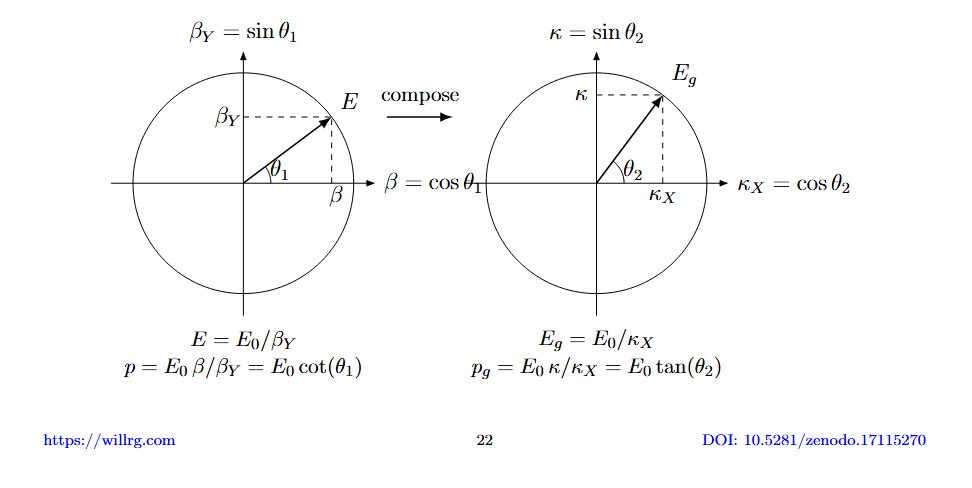
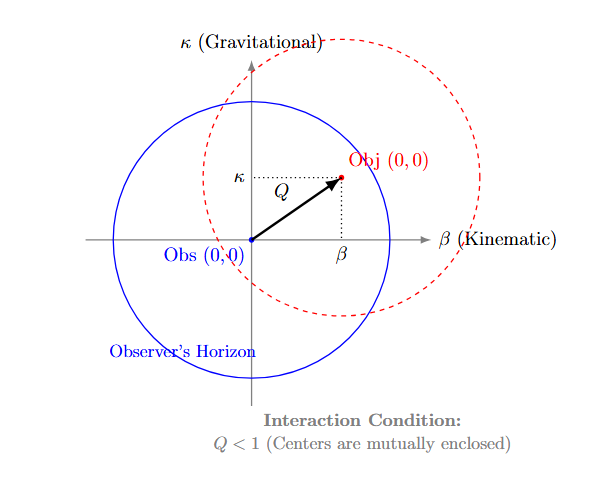
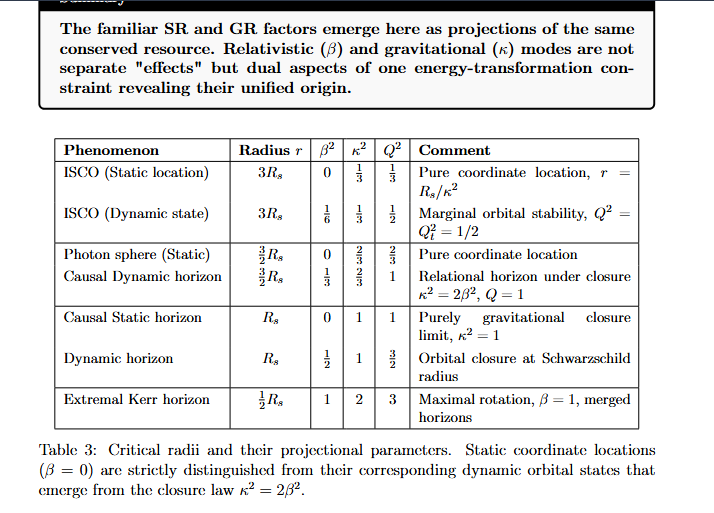
This is the most important question you could possibly ask. In physics, to measure change, you have exactly two options for a reference point: Option 1: The Standard Method (The Ghost Reference) Standard physics tries to establish a universal background grid. To do this, they invent a mathematical concept called the "Observer at Infinity" (asymptotic flatness). They pretend there is a magical observer infinitely far away, where gravity is zero and space is perfectly flat, and they measure everything relative to that ghost. It has no physical reality, but it makes correct approximations. Option 2: WILL Relational Geometry (The Real Reference) In RG, there is no background grid and no observer at infinity. The observer is always the origin point. Every observer places themselves at the exact center of their own relational coordinate system: [math](\beta, \kappa) = (0,0)[/math]. (its not space and time its state difference) When you observe a star, you are not locating it on a universal 3D grid (x, y, z). You are measuring the energy differential between your state and the star's state. You measure two projections: 1. Its kinematic shift relative to you (Velocity/Direction): [math]\beta[/math] 2. Its gravitational shift relative to you (Potential/Depth): [math]\kappa[/math] Here is the geometric representation of how these two projections define the system's state on their respective relational carriers: The total change - Total Relational Shift - between you and the star is just the sum of squares of these two projections: [math]Q^2 = \beta^2 + \kappa^2[/math] (don't confuse with simple right triangle, [math]Q^2[/math] is NOT constant) Now, here is the beauty of Relational Reciprocity. If that star has an observer looking back at you, they do not see themselves at some coordinate [math](x,y,z)[/math]. They place themselves at [math](0,0)[/math]. They measure your speed and your potential relative to them, and they calculate the exact same total shift: [math]Q^2 = \beta^2 + \kappa^2[/math]. This reciprocity can be visualized on the [math]\beta-\kappa[/math] plane. The observer is always at the center, and the observed object is at the end of the [math]Q[/math] vector: There is no common background arena. There are only mutual total shift magnitudes [math]Q[/math] computed from each observer's own relational origin. This is what I mean by Ontological Minimalism: we do not need to invent an empty box for the universe to exist in. The relationships are the geometry. And this way all extremely complex GR surfaces emerge as simple and beautiful ratios: If you want to interact with this geometrically, I made a very simple interactive graph showing how the Observer, the Object, and the Total Shift Q relate to each other: DesmosQ as Total Relational ShiftTo dive a bit deeper and see the derivations you can read this section https://willrg.com/documents/WILL_RG_I.pdf#sec:DisQ Does this clarify what the "point of reference" is? You are describing "curve fitting" - the process of inventing a free parameter and tuning its value to match the data. If I did that, you would be absolutely right. It would just be Dark Matter under a new name. But WILL Relational Geometry has zero adjustable parameters. I cannot "tune" the Fundamental Tone to make the curves fit. It is strictly derived. Here is exactly what the Fundamental Tone is: 1. The Hubble parameter ([math]H_0[/math]) is not a fitted cosmological parameter in RG. It is derived algebraically from the Fine Structure Constant ([math]\alpha[/math]) and the Cosmic Microwave Background temperature ([math]T_{CMB}[/math]): [math]H_{0}=\frac{T_{CMB}^{2}}{\alpha}\sqrt{\frac{32\pi G\sigma_{SB}}{3c^{3}}}[/math] There is absolutely nothing to adjust here. It relies only on fundamental constants and the single most precisely measured temperature in cosmology. 2. The Fundamental Tone is simply the geometric frequency of the observable universe. It is the speed of causality ([math]c[/math]) divided by the circumference of the Hubble horizon ([math]2\pi\frac{c}{H_{0}}=2\pi R_H[/math]): [math]\text{Fundamental Tone} = \frac{H_{0}}{2\pi}=\frac{c}{2\pi R_{H}}[/math] The Mechanism (Coupling): Because [math]\text{SPACETIME} \equiv \text{ENERGY}[/math], there is no empty void. Therefore, "coupling" is not a mechanical force carried by a particle through space. They was never decoupled in the firs place. No object exists in isolation. Space is determent by relations within. The structural tension of the global horizon (the Tone) geometrically superimposes with the local kinetic state of the star. [math]\beta_{Q}=\sqrt{\beta^{2}+\sqrt{\beta^{2}\frac{R_{s}}{3\pi R_{H}}}}[/math] You can interact with this derivation and confirm it yourself using this pretty Desmos project: https://www.desmos.com/calculator/s9gvcuttqm Because I have zero free parameters, this specific geometric constraint either predicts the exact rotation curves of 10,000+ datapoints of hundreds of galaxies perfectly, or it completely fails. You cannot "curve fit" thousands of different galaxies using a single, rigid equation unless that equation represents the actual structural constraint of the universe. So using the words "curve fitting" towards my research makes no f*** sense. Does this clear's out the misunderstanding for you?
-
You welcome! And yes this idea is not new. Leibniz, Mach, Einstein, you, me... I like this gang! The Tone depends on Hubble parameter (H_0) and I derived it from alpha and T_CMB. I can't say for sure yet but so far my bet is on the temperature. But its probably wrong to refer to a single parameter... Its all connected. But for intuitive one-liner its fair to say that it might be what we interpret as expansion could be more like cooling down... This is brilliant! You just said yourself that SPACETIME≡ENERGY. The concept force carrier assumes that there's a void through which, one has to "carry" the "force". Can you see the problem? What your intuition tells you? Is this an accusation or misunderstanding? Im not taking lightly calling my research "curve fitting". You have to present the argument properly or take it back. In my humble opinion the best way to develop intuitive and deep understanding is engage with equations. Just play around with them. So I made a desmos project for you https://www.desmos.com/calculator/s9gvcuttqm It calculates H_0 and then using it to predict the rotation speed of the solar system. Also I think Im getting better at it. This one is pretty.
-
Thank you for pushing me on this. Your critique forced me to look deeper into how my own equations handle the observable light signals, and I have to concede a major point to you: you are absolutely right that we cannot ignore the frequency shift of light. In fact, it holds the exact mathematical answer. I think the friction between our perspectives comes down to the fact that we are looking at two different layers of the Doppler effect. In my Relational Orbital Mechanics (R.O.M.) framework, I strictly separate the observed frequency shift into two components: 1. Observer dependant: the raw optical signal ([math]Z_{raw}[/math]) 2. Systems intrinsic: the invariant systemic state ([math]Z_{sys}[/math]). When you analyze the standard linear Twin Paradox, you are tracking the raw line-of-sight signal ([math]Z_{raw}[/math]). This includes the optical signal delay and the longitudinal Doppler shift (the red/blue shifts you mentioned). It absolutely works for calculating the end result, but the optical delay masks the underlying geometric engine. In R.O.M., the true proper time projection of the system ([math]\tau_{Wo}[/math]) is literally the exact inverse of the systemic frequency shift: [math]\tau_{Wo}(o) = \sqrt{1-\frac{R_{s}}{r(o)}}\cdot\sqrt{1-\beta(o)^{2}} = \kappa_{Xo}(o) \cdot \beta_{Yo}(o) = (Z_{sys}(o))^{-1}[/math] Here, [math]Z_{sys}[/math] is strictly the product of the gravitational redshift ([math]z_k = \frac{1}{\kappa_{X}}-1 [/math]) and the transverse Doppler shift ([math]z_b = \frac{1}{\beta_{Y}}-1[/math]). It dictates the algebraic aging difference instantly and continuously, without relying on signal travel times. [math]Z_{sys}(o) = (1+z_{ko}(o))(1+z_{bo}(o))[/math] This is why I brought up the circular orbit scenario. In a circular orbit, the distance is constant, so the longitudinal line-of-sight Doppler effect drops to zero. The "optical noise" of [math]Z_{raw} = (1+\beta_{int}(\cos(o+\omega_{i})+e \cos(\omega_{i}))\sin(i)) Z_{sys}(o)[/math] strips away, and we are left staring purely at [math]Z_{sys}[/math]. The central observer and the orbiting observer age differently not because a signal takes time to flip from red to blue, but because the continuous, invariant structural tension ([math]Z_{sys}[/math]) geometrically restricts their internal proper time ([math]\tau_{Wo}[/math]). The light just transmits this underlying state. I realize this is much easier to see when you can interact with the math directly. I've built a full Desmos project that contains the closed algebraic system of R.O.M., showing exactly how these invariants generate the orbits and frequency shifts natively: I also have the formal documentation and a massive dataset test explaining how this system rigorously separates the geometric reality from the line-of-sight optical shadow ([math]M \sin(i)[/math]): 1. The complete closed algebraic system R.O.M.: https://willrg.com/documents/WILL_RG_I.pdf#eq:rom 2. Documentation: https://willrg.com/documents/WILL_RG_I.pdf#sec:M_sin(i) 3. Blind Data Test Results: https://willrg.com/msini_test 4. R.O.M Desmos Project: https://www.desmos.com/calculator/n4lmkpsebx I'd love for you to play around with the Desmos graph. When you look at it through the lens of separating [math]Z_{sys}[/math] (the geometric state) from [math]Z_{raw}[/math] (the optical shadow), does this bridge the gap between our two explanations?
-
Asking questions on public forum about new model with new ontology its like changing pants in the middle of the crowded street. We never in our history had a chance to ask as many and as dumb questions as we want without being judged or annoying. That's why I think AI will do wanders in education. We living at exiting times.
-
You make a fair point. I accept the critique. "Simplifying" means extracting the core mechanism, and I owe you a direct conceptual answer without making you dig through the full mathematical derivation. Here is the "Why" and "How" of the energetic floor, translated from algebra into physical concepts: The "Why" (The Ccause): Standard physics treats spacetime as an empty container (a void) where objects move and interact. Remove objects - the container will stay. So it postulate its ontological independency like its real thing. There's no empirical data that force this postulate. Here's what Einstein had to say about it: ``There is no such thing as an empty space, i.e., a space without field. . . . Space-time does not claim existence on its own, but only as a structural quality of the field.'' Albert Einstein, \textbf{Relativity: The Special and the General Theory} (Appendix V: ``Relativity and the Problem of Space''), 1952 edition, Methuen (London), p.~155; based on earlier 1920 additions. I complete agree with this quote. But standard physics does not. It speculate this extra primitive: So when standard approach has 2 primitives: 1. SPACETIME 2. ENERGY I have only one: 1. SPACE-TIME-ENERGY and just for convenience of shorter name and a sudle ironic joke I calling it: WILL ≡ SPACE-TIME-ENERGY ⟹ [math]SPACETIME \equiv ENERGY[/math]. The Universe is not a box; it is a closed relational structure. No background. So there's no such thing as just distance. Distance or period can form only between objects/events. Distance is the tension between potential states. Because the topology is strictly closed, any energy perturbation (like a star orbiting a galaxy) cannot just dissipate its influence into an infinite emptiness. It must interact with the boundaries of the system itself (the global horizon). The "How" (The Mechanism): You are the center of your observable Universe with Hubble horizon (R_H) as a boundary of causality. Energy is change. The rate of change is universal and finite. Faster change in space ⟹ slower change in time. The value of "change rate" associated with c - stays conserved. Interactions are not instantaneous, causality propagate just like a wave one thing influence another thing energy transforms but stay conserved. So if we have non instant propagation of cause and effect (c) and we have a boundary as Hubble horizon (R_H). This leads to waves of cause and effect propagation to interfere with themselves. Think like a guitar string or even better think like a drum skin (math says drum). Waves can interact in a good way or bad way. All bad ways just dissolves. So constructive interference only can make a stable propagation. And like with any harmonics the lowest posible would be the fundamental Tone. It means 1 oscillation of this tone will have a wavelength of your observable Universe. And we can calculate it: Its just speed of light divided by the circumference of Hubble horizon expressed as a frequency [math]\frac{c}{2\pi R_{H}}=\frac{H_{0}}{2\pi}=3.5148579278\times10^{-19} 1/s[/math] for the reference its 1 full oscillation in around 90.1565273986 billions years. So we currently still in the yearly days of fundamental Tone cycle. OK, now Imagine a star orbiting the center of a galaxy. In the standard model, the only thing keeping it moving is its local kinetic energy fighting local gravity. When it gets far away, gravity drops, so the math says the star should slow down. When it doesn't, they invent "Dark Matter" to pull it. In RG, the vacuum itself has a structural tension ([math]\rho_{\Lambda}[/math]) between you and R_H. It required to keep the Universe's geometry open against collapse. The star is not moving through an empty void; it is vibrating on a globally tensioned geometric "carrier" (think of a stretched drum skin). The local orbital frequency of the star and the global frequency of the horizon (the Fundamental Tone) superimpose. This creates a constructive geometric interference. This interference adds a constant energetic baseline to the star's kinetic state. As the star gets further from the galactic center, its local gravity drops, but it hits that baseline geometric tension. It cannot slow down past this limit, because slowing down would require it to decouple from the global horizon fundamental Tone, which is topologically impossible. That absolute limit is what we observe as the "flat rotation curve." And to test this hypothesis I used equation from wave mechanics where 2 values are multiplied under the square root to model geometric interference: [math] v_{obs}^2 = \underbrace{v_{N}^2}_{\text{Local Self-Energy}} + \underbrace{\sqrt{v_{N}^2 \cdot (\Omega a_{Mach} r)}}_{\text{Reson. Interference}} [/math] That absolute limit is what we observe as the "flat rotation curve." To make the mechanics of this geometric interference perfectly clear and dimensionally strict, we can express this exact relation through dimensionless velocity (β = v/c). The interference occurs strictly between the local causal limit (the Schwarzschild radius of the central mass, R_s) and the global causal limit (the Hubble horizon, R_H): [math]\beta_{Q}=\sqrt{\beta^{2}+\sqrt{\beta^{2}\frac{R_{s}}{3\pi R_{H}}}}[/math] Here, the term under the inner square root is the direct cross-correlation (interference) between the local kinematic state (β²) and the global structural tension. This tension is expressed as the pure geometric ratio of the two causal horizons: R_s / (3πR_H). It is this exact fundamental resonance that provides the constant energetic baseline and prevents the orbital velocity from dropping. And when I tested against 10000 + datapoints from 3 different datasets I got precise agreement. Regarding what constitutes a "minimal system": a true generative geometry does not require an absolute coordinate grid or a "start point to every location." It only requires relative energy differentials. Spacetime is generated by these relations; it does not pre-exist them. Does this conceptual summary answer your "how and why" more clearly? And this is exactly why I developed WILL-AI. Its free its open and it trained on all 3 main papers of mine. Don't expect him to preform any complex calculations (he cant use any tools) But he can unswear any questions about the model and provide citations. When I was testing him by comparing mine and his answers to the same questions - it was hard to decide do I prefer mine or he's answers. So yeh have fun: https://willrg.com/WILL-AI/ Feedback on he's performance is required so please do share the feedback at some point That is not the sense Id like to propagate. I can't promise anything about your sense (as its in majority your internal processing), but I can guaranty that direct and sound questions will provide you with direct and sound answers. The hard part is to transform the sense in to direct and sound question. Actually I think https://willrg.com/WILL-AI/ could help you with this. He can process half-baked questions.
-
Both hard questions and in order to unswear them properly you will need to read: https://willrg.com/documents/WILL_RG_I.pdf https://willrg.com/documents/WILL_RG_II.pdf and at least the firs half of https://willrg.com/documents/WILL_RG_III.pdf In total its about 150+ pages and I can imagine what a gatekeeper it might be. So I made you a nice and easy interactive chart: https://willrg.com/LOGOS2 the logical and philosophical core is on the chart it self, and if one wants to see the math - every logical step is clickable and will direct you to the precise section. A more detailed version of the LOGOS chart you can find here https://willrg.com/LOGOS_MAP/ but this one is still in development. For now it covering only https://willrg.com/documents/WILL_RG_I.pdf Please let me know how the LOGOS2 chart communicates the idea.
-
Why are you here? You not reading my answers you ignoring my derivations after 20+ comments posted you cant even answer the basic question about model under critic. So why are you here? Are you that desperate for self validation that you hanging out in speculations subforum in order to school armatures? And here you got the armature that publicly schooling you... Must be hard for your fragile ego to accept it... I feel sad for you man... From now on I will ignore all your messages. I wish you to find reasons to love and respect yourself.
-
Yes you did and I provided you with an unswear that you once again completely ignored. You asking questions and then ignoring the answers. Is that the type of communication you want to be a part of? Since you want to talk about equation of state - yes please tell me how I deriving the pressure term and what w=? I end up and why? And this time please try not to make your typical category error where you assuming the Universe is a container filled with fluid. Are you capable?
-
Guys, hold on, not all at once please!😁