
Genady
Senior Members
-
Joined
Everything posted by Genady
-
Does the QFT provide a sufficient answer? It does not. Not in QED, the best current theory.
-
How many?
-
How your questions are different from ordinary or conventional approach to behavior of objects under gravity?
-
Make it short. Embed figures. Use LaTeX for formulas.
-
The law of gravity is known. Try to answer your questions by applying it.
-
From the "Guidelines": ... members should be able to participate in the discussion without clicking any links ... ... Attached documents should be for support material only; material for discussion must be posted. ... ... Keep alternative science and your own personal conjecture to the appropriate forum (Speculations). ... See Guidelines - Science Forums.
-
As I have mentioned, there are many ways. One of them is that the multiverse's space is not necessarily three dimensional. If its geometry is not Euclidean, for example.
-
On the scale of several hundred megaparsec and more the visible universe is homogeneous and isotropic. It means that on that scale it is the same in all directions.
-
As the bodies outside our visible universe make pretty much spherically symmetric shell, their gravitational effect inside the shell is identically zero.
-
Even without water issues, the growing roots of Ficus tree in my yard have killed over the years surrounding coco palms, one by one.
-
It is curious that the same mechanism gives both the attractive effect of dark matter and the repulsive effect of dark energy.
-
The hypotheses above may be complementary rather than contrasting because they seem to relate to different aspects of the "four why's of animal behavior" of Nikolaas (Niko) Tinbergen, i.e., causation, development, adaptation, and phylogeny.
-
What does it mean? The model tells us how it happens. Some future model might derive this model, i.e., the equations, from more generic principles. The previous model, aka Newtonian gravity, included a notion of mass acting on the ship. This is an approximation, which is not included in the current best model.
-
The spacetime geometry obeys certain differential equations. The solution of these equations depends on initial and boundary conditions. The mentioned mass is a part of these conditions.
-
I don't know what is unclear. Clarify. Restate the unintentionally struck question, please.
-
The physics is clear then.
-
This is true for homogeneously and isotropically distributed sources. What about other "smeared" sources? The Weyl tensor is not necessarily zero, but the curvature is not away from the source.
-
What happens if the sources are everywhere?
-
Yep, it was obvious indeed.
-
Perhaps it's obvious but I don't see where \(g_{rr}\) in the denominator comes from, here: \[a^r = -\dfrac{c^2}{2} \dfrac{1}{g_{rr}\ g_{tt}} \dfrac{dg_{tt}}{dr}\]
-
What is \(T\) in \[a^\mu = -c^2 g^{\mu\nu} \dfrac{1}{T} \dfrac{\partial T}{\partial x^\nu}\]
-
Because Earth or other body you mention are far away and your ship cannot be affected directly by them without "an action at a distance." What it can be affected by directly is the geometry of spacetime at that same point where and when it is "here" and "now". I still don't know what you mean in that question. Does what?
-
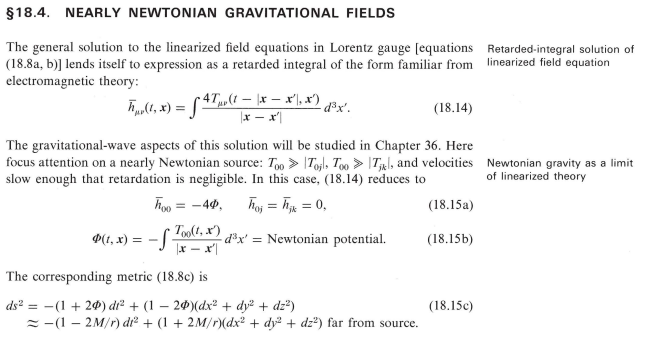
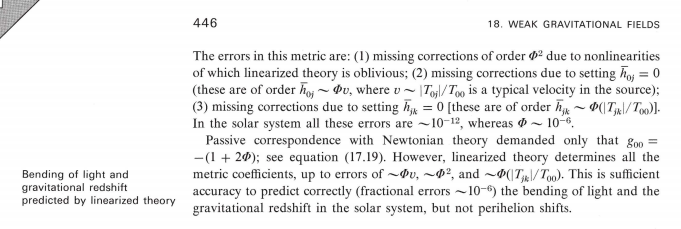
The following story from Zee, A. Einstein Gravity in a Nutshell (p. 52) is in the same line: Long ago, an undergrad who later became a distinguished condensed matter physicist came to me after a class on group theory and asked me, “What exactly is a tensor?” I told him that a tensor is something that transforms like a tensor. When I ran into him many years later, he regaled me with the following story. At his graduation, his father, perhaps still smarting from the hefty sum he had paid to the prestigious private university his son attended, asked him what was the most memorable piece of knowledge he acquired during his four years in college. He replied, “A tensor is something that transforms like a tensor.” 😉 Here is one, from MTW's Gravitation. All variables are real numbers. The most important one, \(T_{00}\), is energy density:
-
Any geometry with zero Ricci tensor and non-zero Riemann tensor.
-
It can be a non-flat solution for some sets.