
Genady
Senior Members
-
Joined
Everything posted by Genady
-
If it has basic inhabitable conditions then a probability is high that it has some form of life. If it doesn't have life at this moment, it will some time later. There is no point in seeding life where life is already present or will be soon (in astronomical times.)
-
If they live underground, underwater, inside caves, any other difficult to access places, it would take very long time and huge effort to find them and even more so to make a reasonable conclusion that nothing is anywhere. By robots? We are still discovering new species and new ecosystems on Earth that we didn't know about. On the other hand, they sure depend on environmental conditions which would be affected by newly seeded life.
-
Leaving all other aspects of this discussion out, I have a scientific / technical question: How would we ever know that an inhabitable world is sterile? We don't have a way to know what was / is an evolutionary path of life there. Thus we don't have a way to know where and how to look for it. Can we program a robot to do something that we ourselves don't know how?
-
I've ran it three times (clicking randomly since I don't know which color I enjoy most etc.) I think the three parts of the "results" are just coming out in various combinations.
-
I've noticed this cheap trick of making movies in the metallic blue shades, about 10-15 years ago. I hated them too, but not because of the coloration, but because they inevitably were bad movies (to my taste, of course). So, after a while, as soon as I saw this color I just stopped watching at once.
-
Yes, the rest mass of the battery, but not the rest mass of the electric fields.
-
Mass is not additive. A mass of the whole is not equal sum of masses of its components. In the particular example, the mass of a charged battery is not equal the sum of mass of the uncharged battery and mass of the electric fields. The mass in this example is gained "in the form of energy" of the electric fields, but not in the form of their mass.
-
(I have added the numbers to the quote above.) 1. I don't know how to separate an effect of color from that of other factors. 2. Fractions of a second. 3. No. 4. No. 5. No. 6. See #1.
-
-
I would like to include other factors, especially demographics, but (a) I don't have that information, and (b) the set is small as is, doesn't make sense statistically to make clusters. As I've mentioned, curiosity. These data perhaps have some answers, we just don't know the questions yet. I believe that accumulation of resources for undetermined utility is a key to progress. Some of it at some time will be handy, or crucial. That's why it will be done at random times and the "subjects" won't know when they are observed and when they are not. Eventually, the habituation will take over and the "subjects" will behave normally.
-
I do plan so. Not consecutive weeks necessarily, but perhaps random weeks from time to time.
-
Yep. Somewhat similar here. I read books via Kindle for PC, and the forums window is open on the background, so I notice when something new appears there. Then I go to check at the next convenient stop.
-
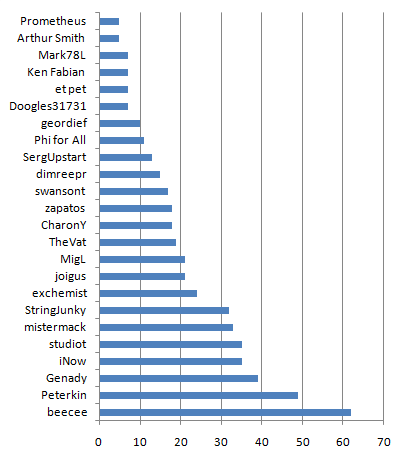
I was curious about how many and how often post in the forums. Here are the numbers for the week from Saturday, January 29 to Friday, February 4. Including only the members with more than 3 posts in the week.
-
To be even more precise, we should add that the last condition is required only for the on-shell i.e. non-virtual massless particles
-
Not directly about the topic question, but still rep points related. I've noticed a long time member with 10 posts in total and marked with 10 rep points, but when I look at their posts I don't see any flags at all. How come?
-
I've had the same thought, but I feel too new here still to make this suggestion. I do agree and support and +1.
-
There are more than one way to arrive to a definition of momentum, e.g. as a conserved quantity associated with space translation invariance as per Noether's theorem. But as a conserved quantity in the Lorentz covariant 4-momentum for a massive particle, it is p=mγv "p(v) = mγ v = mv[1 + v2/2c2 +···]." (Weinberg, Steven. Foundations of Modern Physics (p. 109).)
-
And, in the 115+ years since then, the physics has proceeded very carefully and has found a clear and efficient way to deal with these concepts. The "mass" is generally a term for the invariant mass, an inherent property of a particle (or, a specific coefficient in a QFT Lagrangian), i.e. "the rest mass". The "other numbers [] obtained for the mass" are not in use, nor are the "other definitions [] of the force and the acceleration".
-
I immediately have three non-technical questions regarding this proposal: 1. In what way is it an "insurance policy"? When and how this storage would be used? 2. Why is it better than 'the Svalbard Seedbank in Norway, also known as the "doomsday vault"'? 3. They say, "Because human civilization has such a large footprint, if it were to collapse, that could have a negative cascading effect on the rest of the planet." Negative? I'd think rather positive, if any.
-
-
Well, this is where "unrealistic" starts IMO. To discover the sources of materials, first. We - not robots - cannot yet figure out water on Mars, after a long time trying, observing, experimenting, sending multiple probes, etc. On / in a next door neighbor. Can we program a machine to do something that we don't know ourselves how to do? I don't think so. That's even before smelting and refining you've mentioned.
-
How / where from do they get materials needed to make another machine?
-
I agree with this. Moreover, I don't see what is so special about being self-replicating. A machine X can be programmed to build a machine Y. This is a robot. As a particular case, it can be that Y=X. This makes it self-replicating. Big deal!
-
But in SR the correct equation is not E=mc2 but rather E2-p2c2=m2c4, isn't it? Not even mentioning its different meaning.
-
A former colleague of mine is very enthusiastic about prospects of large scale space exploration based on self-replicating von Neumann probes. I've never heard of them before. From a brief reading of several Internet articles, it seems to me not realistic. Not the self-replicating aspect of it, but what it will be replicating, i.e. the fully automated explorers. Do you know of strong arguments I could use to curb his enthusiasm?