
joigus
Senior Members
-
Joined
Everything posted by joigus
-
In quantum field theory, particles are characterised as irreducible representations of symmetry groups. Symmetry transformations are different ways to look at particles that leave the quantum state unchanged. When these transformations can be expressed in terms of a finite number of parameters, these groups of transformations help us classify the particles according to their so-called Noether charges. When the system is symmetric under one of these groups --also called Lie groups--, Noether's theorem guarantees that these "charges" are conserved. Some transformations have to do with space-time symmetries. Examples are translations and rotations, which have the corresponding conserved quantities that we're familiar with under the name of linear momentum and angular momentum. In any quantum theory, charged particles are represented by complex wave functions. Everything observable depends on quadratic expressions of the form (field)*(field), where the asterisk represents complex conjugate. Because the physics is indifferent to a global phase change, a conserved quantity exists --by virtue of Noether's theorem-- that we call electric charge. In the case of angular momentum --due to symmetries under rotations--, it so happens that the spatial coordinates are not enough to represent all the rotational states of particles. Internal variables must be specified describing the orientation of a particle that allow no representation in terms of spatial coordinates. That's what we call spin. Spin has to do with rotation, although it's not nearly as intuitive as the rotation of a spinning top, eg. Charge has to do with something even more abstract, which is a phase shift in the wave function. This transformation is sometimes called "internal." Isospin invariance is not exact, it's only approximately conserved. It is an analogue of electric charge, and also occurs in this "internal space" of elementary particles. It so happens that, if you ignore electromagnetic interaction, a proton and a neutron are very similar when you only consider the strong nuclear force. You can kind of rotate the states smoothly from "being a proton" to "being a neutron." This is in close analogy with electric charge. There are other analogues of electric charge: baryon number, lepton number, hypercharge... Colour charge is similar, but more complicated, as the previous charges depend on a 1-parameter group called U(1), while colour is defined in terms of a 3-parameter group SU(3). Mass is very different. It is not a conserved quantum number like the other charges. So I would say that what gives a particle its charge and spin are its properties under global gauge transformations (global phase shifts), in the case of charge; and rotational properties, in the case of spin. This is a summary of the present theoretical understanding of these things within the context of the standard model of particle physics.
-
This is stone-engraving material.
-
Conservation of charge* precludes for all matter to transition to just photons. That's not what entropic death means. I suppose you're referring to entropic death of the universe: The alleged final state of all matter, with everything the same everywhere. The entropic death of the universe is a scenario that some people have contemplated, but it's probably not what the universe will end up like. And the reason is that the universe is very different from a gas of particles that exchange energy among themselves to end up in a state of total homogeneity. Gravity is very different. A thermally-exhausted universe would look very different from a gas of photons, believe me. *I don't mean just electric charge. I mean all charges: electric, weak, strong, barionic number, lepton number.
-
+1. Beautifully illustrated. You can even tell that some of these particles have orbital angular momentum in the direction perpendicular to their motion. There's plenty of evidence that we're dealing with particles. There's plenty of evidence that their behaviour is accounted for by a wave. The only thing that's left to do is to deal with it.
-
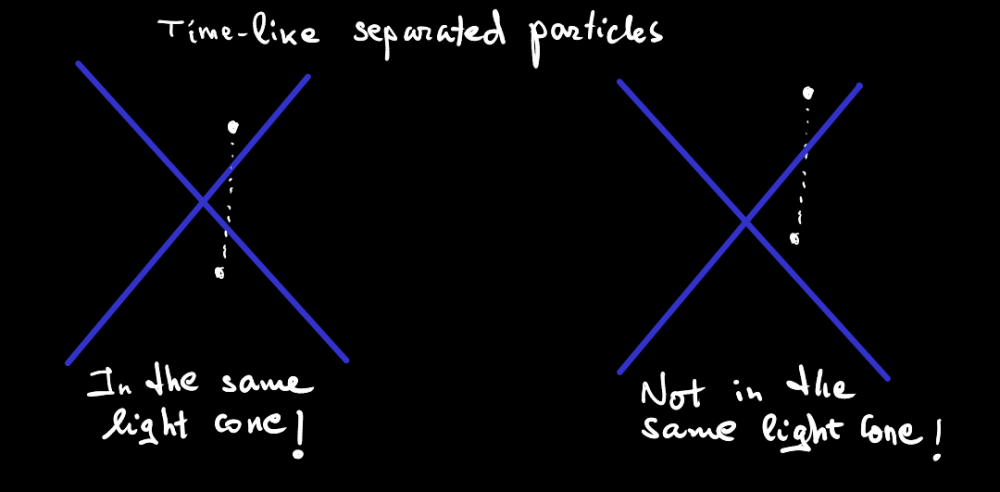
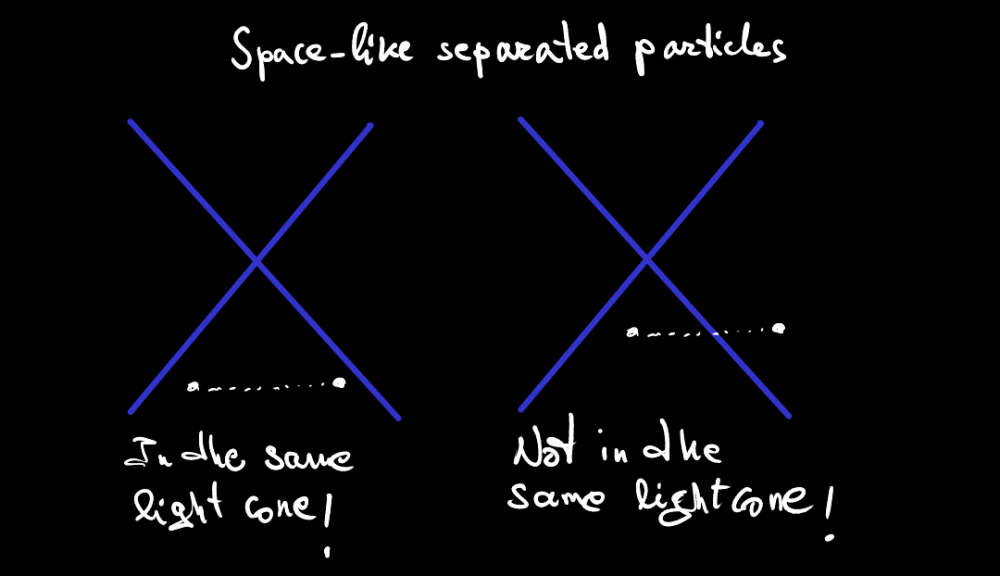
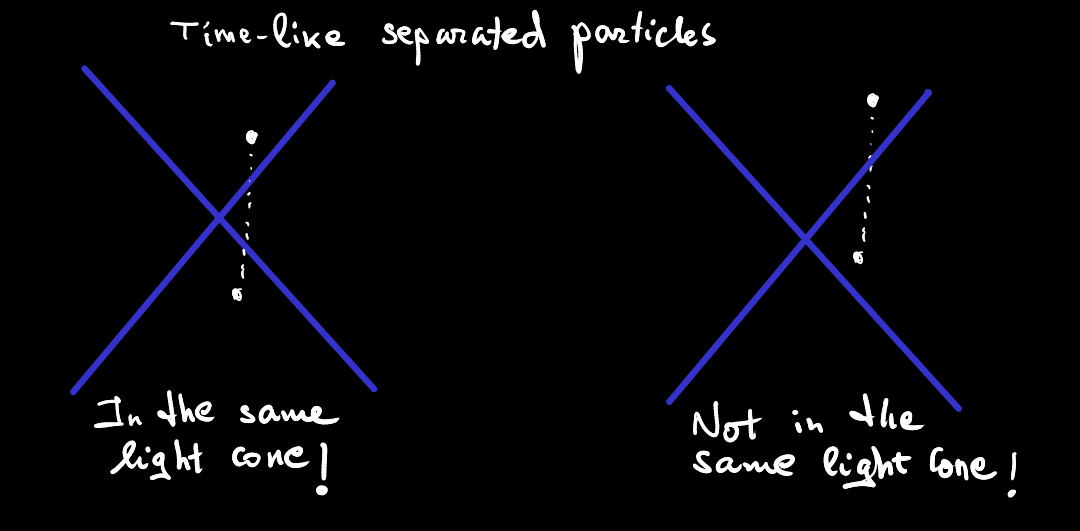
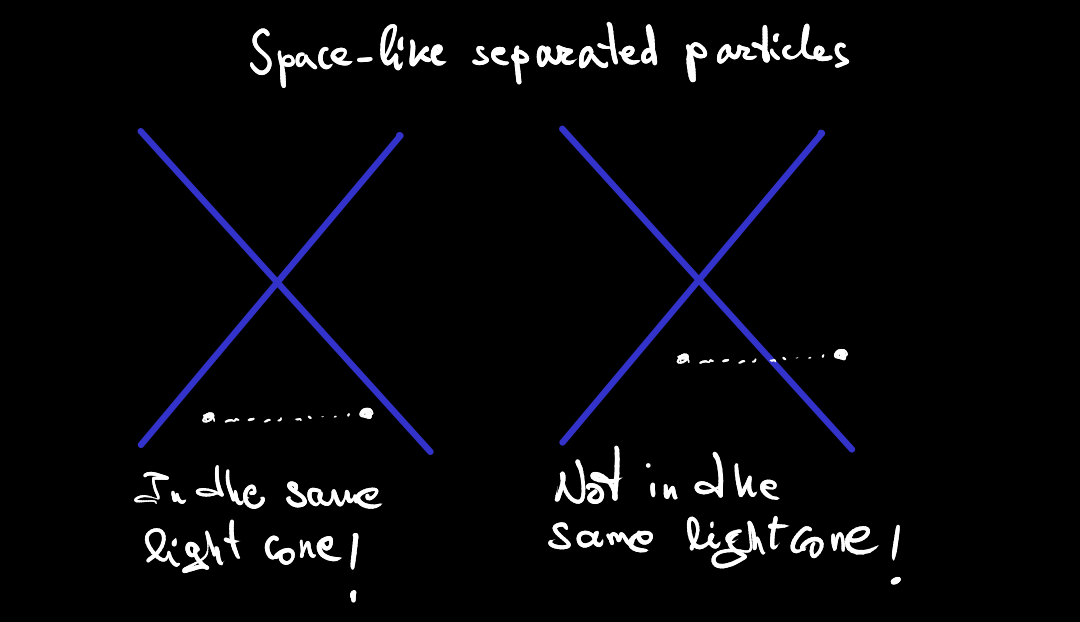
As @Eise has told you many times, SR is an embedding theory about observation of events in ST. He used the word "metatheory." It should be clear enough. For you it's not, for some reason. I'm assuming you mean "unintelligible." But anyway. You don't need world lines. Light cones are about events. Go back to an elementary physics book and learn the stuff. Nobody should be suffering your ignorance any longer. While you're at it, study some classical EM theory too. It shows that you don't understand it either. Including world lines makes the argument I'm trying to get across, if anything, more compelling, as both particles come from the same space-time point (tiny region). So it becomes obvious that the whole thing has a common cause in the past. @Eise is reproducing one of several light cones that I drew for you. The very first one was showing you particle histories. The last one showed only events, because you said "particles in the same light cone," which has about as much meaning as "we're both in some region of space." I'm positive now that we're dealing with an attention-span problem, among other things.
-
"Clasically we don't bat an eyelid with the concept that a system passes from one state to another," Isn't solving the law of motion what classical mechanics is all about?
-
What do you mean?
-
I'm not aware of any tendency of all matter to annihilate. Also, what is pure energy? Entropy has to do with disorder. You have a macroscopic state defined by few variables that's made up of many microstates you can't tell apart. Entropy of a piece of matter is the sum of its parts, and thermodynamic equilibrium is defined by entropy reaching a maximum. That pretty much constrains entropy in terms of probabilities of individual microstates.
-
Not that incredible. It's thinkable. If particles got very close to a small BH, their accelerations would be considerably big at the point of being slingshotted, and they would probably emit radiation --synchrotron radiation-- if they're charged. So my guess is they would easily lose quantum coherence. Small BH's exert huge tidal forces too. Photons are a different matter. If you use very long-wavelength photons (bigger than the BH's Schwarzschild radius), for all I know, you can get them to scatter off BH's quite easily. Would that break quantum coherence? I don't know. But my guess is yes, easily. Generally speaking, if I wanted to keep quantum coherence, the last thing I would try to do is to get my system anywhere close to a black hole and make it scatter off it. Black holes are notorious sources of entropy, and what you want is to keep things orderly. You also want to keep them as free as possible form very strong interactions. Maybe @Markus Hanke has better guidance to offer on this idea. It wouldn't surprise me if he has.
-
+1. I love the depth of this comment. At a distance, dynamics works well enough assuming field sources to be point-like, or smooth distributions of point-like things. These densities would have to end abruptly on the boundary. When you get closer, you must change the map, because more details are available to you --if for no other reason. Complex numbers and wave variables seem to be Nature's way of telling us that we must blur things out when we get closer. When you try to get even closer, and gravity becomes relevant, entropy seems to be summoned up from out of the blue... The suggestion seems to be that the mapping must be re-thought, and the conceptual scaffolding reconsidered. I should learn more about Gisin's proposal before dismissing it. So I'm not actually dismissing it. My idea of it so far is more of a "too good to be true" kind of objection. I think I'm also spotting a subtle element of anthropomorphism about it that makes me uneasy. If Gisin and/or others managed to demonstrate GR and QM as appropriate limits of the idea, I would have to admit it's really cutting some ice. I do have to say, though, that skepticism towards any new idea is a very comfortable position. When you reach a certain age, you no longer want for anybody to come around and shatter the earth under your feet.
-
Sorry if I misunderstood. If they got close to a BH, and they get captured in it, according to the HB* picture of it, they would be re-emitted in the form of thermal radiation, which means they would no longer be entangled. A BH is not a good entanglement-producing machine, as it has an entropy associated to its surface. This entropy is not entanglement entropy, it's a further scrambling of information than what entanglement entropy represents. This is all a bit dicey though. Not everybody agrees on what the HB picture of BH's is telling us. * Hawking-Beckenstein
-
You didn’t explain that was your intention and I still don’t understand what you mean. An illustration of entanglement should require at least two world lines, one for each particle, and each particle would need to stay within its respective light cone. Your illustration on the upper left “most” resembled entanglement but none of them made sense as representative of entanglement. In your picture on the upper left, I see one one event in the future and one in the past but no world lines for the entangled particles Entanglement violates the EPR situation in that one entangled particle can interact with its partner(s) instantly as if the they were side-by-side. Entangled particles need no physical connection to interact- not even light. It is instant action at a distance that violates the EPR. Your illustration on the upper left “most” resembled entanglement but none of them made sense to me as representative of entanglement. "In the same light cone" means that one particle, usually an electron, can interact instantly with any other similar particle within the same light cone provided that conditions between the two permit. This is possible in QM but not in classical physics so that is a major contrast between the two and I wouldn’t call it “nothing.” In the the classical situation, one particle can only interact with another either directly or through some physical interaction. QM needs no physical interaction. Again: "In the same light cone" doesn't mean anything. I've shown you two distinct cases of events; a couple of them were space-like separated; the other two were time-like separated. In both cases, you can make them be either in the same light cone, or in different light cones, at will. It's painfully obvious you didn't understand. Now rinse, and repeat. Sometimes, understanding something is a whole shampooing experience, as @iNow shrewdly suggested. Keep practicing. Your lack of understanding of basic physics is appalling. Epsilon and mu naught are not independent properties of space; the product of both is. The unit of charge can be independently chosen without any epsilon naught. In fact, in the cgs-unit system, there is no epsilon naught, and the basic unit of electric charge can be defined with dimensions of M1/2L3/2T-1. If you use such classic books as Landau-Lifshitz, you'll see they only use dimensionful electric charge units. I know the topic to be confusing to some people, that's why I once won a bet on this particular question. The bet was about how you can --if you want-- actually define the unit of electric charge in terms of mass, length, and time. Modern quantum field theory uses dimensionless electric charge. It's an option, and it all depends on definitions. But --and here's the essence of your misunderstanding of this particular question-- because in this universe magnetic fields are produced only as a consequence of changing electric fields, this activation of the magnetic field requires the propagation of something to be iniciated. The other constant thus becomes a measured value, which is essentially a speed. The workings of electric circuits critically depend on this speed. Here's a good Veritasium video that will make you understand this concept. It's highly imbued in physical intuition, and I highly recommend it: Good luck!
-
Under most typical scattering scenarios gravity is far too weak to be of any significance. If you try to collide particles at an energy high enough, and with an impact parameter --closeness of approaching particles-- close enough to produce a BH, I don't think ordinary QM is sufficient to deal with it. I don't know how to deal with that situation, TBH. I do know enough to guess --if not to know-- that any outgoing state would come out as a mixed state --if Hawking and Bekenstein are right--, which means, coherence would be lost. Maybe @Markus Hanke wants to take this up with more precise information. He seems to be on fire lately.
-
LOL. I had to read it again to get your drift. +1
-
It does say something beneath: Amplitudes. Are amplitudes physical? Are they just a tool?
-
You're right, though it's hard for me to concede that time were to be discrete without space --and momentum-- getting affected in a similar way. Yes. Predictions? Another thing I'm missing in most of these revolutionary ideas is the conservative aspect. Namely: How you keep in its place everything else we know to work. If you want to improve a building, you normally don't go about it changing the foundations. Another interesting aspect of these revolutionary ideas is that their authors are no spring chickens. New physics used to be the preserve of people in their twenties. Now it's coming from people who've been there for quite a while. I think that says something about the "crisis of theoretical physics" we're going through.
-
Good question. Highly depends on the nature of the interaction bringing them up together, as well as the way in which they interact with each other. If you accelerate the hell out of them, they start to emit radiation, and they finally collide and perhaps radiate some more, you can rest assured they will lose quantum coherence and no longer be entangled. Entanglement is generally produced under conditions of very ordered, very tidy, local interaction, and particles are brought to a ground state of some kind, or perhaps particles emanate from a coherent source, like in SPDC. The take-home idea is: Almost anything you do in a careless way will break quantum coherence. That's my "analysis." Let's see what other people think.
-
Hey, for me as well. We should keep an open mind... and filter out ideas too out there. Another very interesting revolutionary more in a direction that resonates with me is Julian Barbour. I don't know if you've heard of him. His core idea is that the relevant quantities to describe the Cosmos should be interrelationships expressed in the form of ratios, rather than coordinates. I gather that he and his collaborators are having a hard time relating this --at first glance-- very interesting idea to the nuts and bolts of the physics we already know and love. Maybe I will start a thread about Barbour, if I can.
-
Interesting, but I'm skeptic. Revolutions in physics normally stem from a well-balanced mixture of conservatism (a lot of it) and at most one very bold new statement. Sounds too revolutionary for the likes of me. If professor Gisin gave me a good account of something playing the role of, QP−PQ=iℏ with something other than continuous mathematics, I would pay a lot of attention, if not be immediately won over. It's not that some aspect is better addressed with the new idea. It's the not-so-easy order that everything else stays more or less where it was.
-
Again, no answer. The light cone of what? Didn't you understand that my pictures were meant to explain that two events being in the same light cone doesn't mean anything? Didn't you understand that? In my picture on the upper left, both events are in the past cone of an unspecified future event that plays no role in an EPR situation. So "in the same light cone" specifies nothing. Except that it is obviously a speed from dimensional grounds. Not only that; if you assume no sources (or being far away from sources) the meaning as a speed becomes even more obvious (can something be "more" obvious...?). The reason is that Maxwell's equations become wave equations for either E, B (or the scalar and vector potentials) and 1/sqrt(mu_naughtxepsilon_naught) being the phase velocity of the waves in the vacuum. The problem is non-locality is much, much harder to accomodate to everything else we know than non-realism. The projection postulate is non-local, but it is in a way not to produce any measurable non-local consequences whatsoever. The "founding fathers" of QM were not stupid. The problem is: What makes quantum superpositions not to live forever, and anything like "classical data" become necessary to describe the evolution of the state? IOW: What in the quantum state carries along these "classical data" (the outcomes of measurements)? In still other words: How do we accomodate in the quantum formalism the fact that one or many of the evolving components of the quantum state suddenly become irrelevant? We should do this in a way that preserves unitarity, linearity, and locality. Seems like an impossible task. Linearity is probably the most suspect of all...
-
+1. +1. Interesting...
-
Meaning "from behaviour of visible matter around them."
-
Reverse-image search produced this: https://www.cam.ac.uk/research/news/black-hole-powered-jets-fuel-star-formation It seems to be the result of a super-massive BH swallowing a region of star formation and producing as a result a pair of powerful jets of ejected material. The central bright region is probably the accretion disk of said BH. Not every spot of light is the BH. Black holes can't be seen directly. You can infer their position from gravitational lensing or from behaviour of matter around them.
-
https://en.wikipedia.org/wiki/Measure_(mathematics) https://en.wikipedia.org/wiki/Fractal Hausdorff measure (fractals): https://en.wikipedia.org/wiki/Hausdorff_measure I hope that helps.
-
(Emphasis mine.) What do you mean??? Here's a visual aid: Same particles, same events for time-like separated particles. And, Same particles, same events for space-like separated particles. What light cone are you talking about? Same light cone of what exactly? Will you make a smidgen of sense at some point in this simulation of a discussion? I'm ignoring the rest of your nonsense. Let's start with the basics. Otherwise, you're gonna turn everyone crazy here. "Especially electrons..." Yeah, that makes sense too!