
joigus
Senior Members
-
Joined
Everything posted by joigus
-
It's quite humbling, isn't it?
-
Most particles do not decay --ever--, and hardly do they annihilate. Electrons last forever, until they stumble upon a positron. Then both annihilate --each other.
-
Let's say it's puzzling, not paradoxical. Keep in mind inertial observers at spatial infinity are an idealisation. More realistically, far away observers that are locally inertial would have to be falling ever so slowly towards the BH. Times would be very, very long; but not infinite. I'm saying this without doing any calculation, BTW. From intuition. Static observers, OTOH, would have to be trying to escape to the attraction, in order not to fall. They would have to power up their rockets to stay there. The closer you get to the BH, the more dramatically the static observer differs from the locally inertial one. @Markus Hanke and/or @Mordred will probably give a more detailed, and much more rigorous account of it.
-
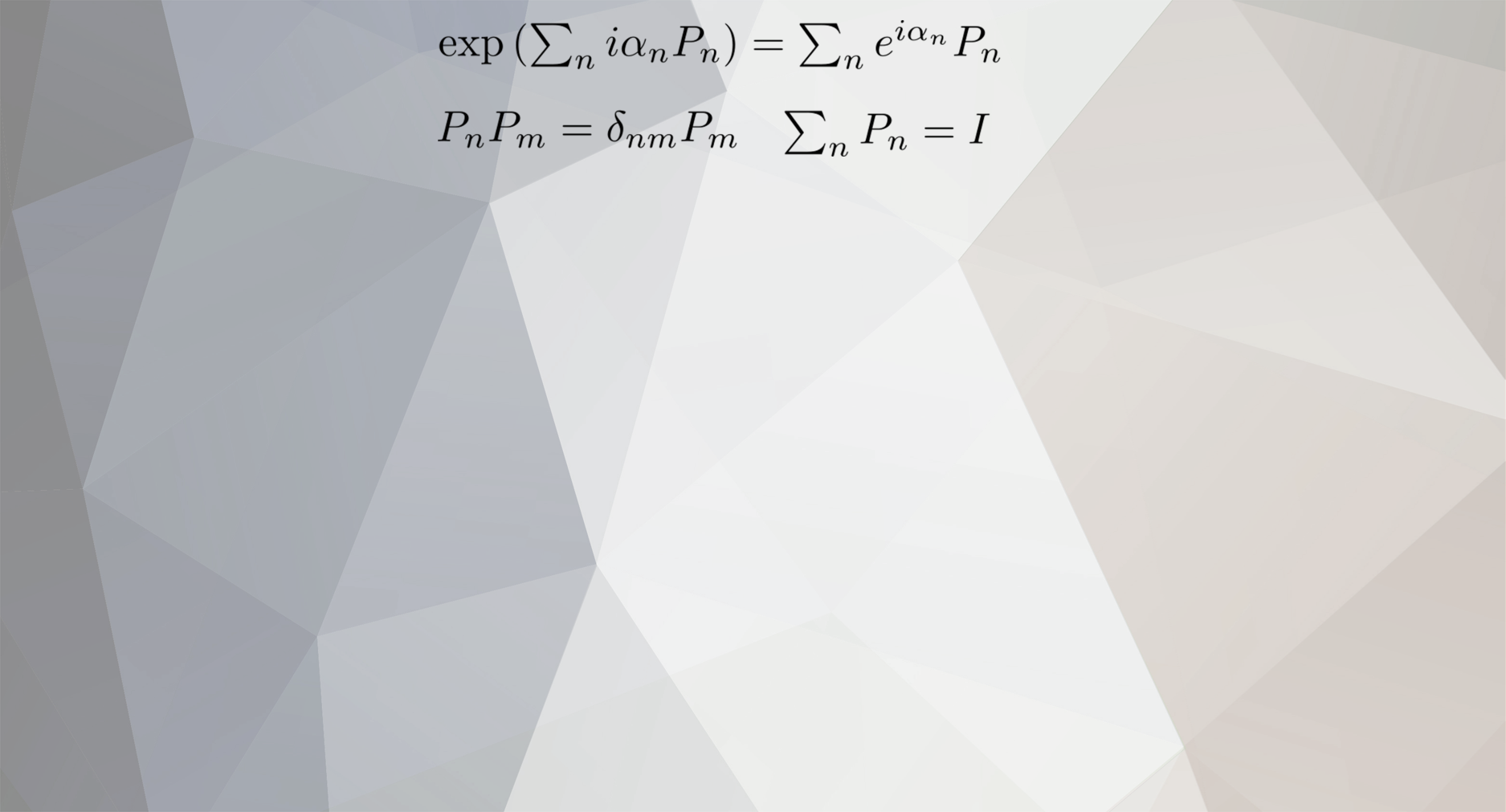
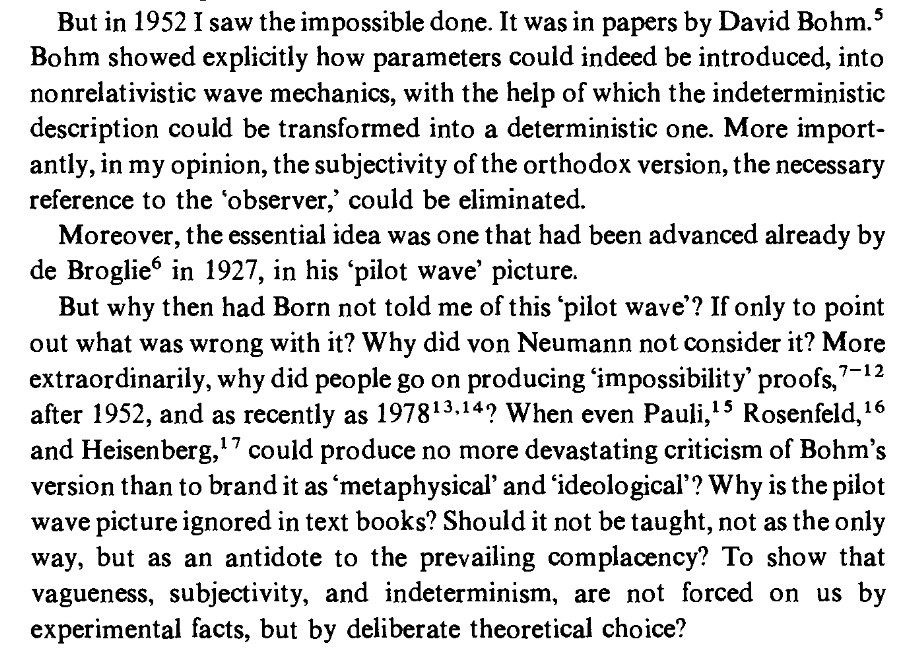
This is only because you can't read appropriately. It's been explained before. I suggest you go back and do your homework. You've said many more silly things, but one silly thing at a time, please. You say this because you don't understand quantum mechanics. Quantum states have a space-time factor and a spin factor. These are very different Hilbert subspaces of the overall state. Einstein's original argument was about particle trajectories, which "live" in the space-time factor of the state. Particle trajectories have to do with a highly singular space of states. A model of hidden variables for particle trajectories does exist however insatisfactory it may be for heuristic reasons. It's called the De Broglie-Bohm pilot wave. Bell considered this model very closely, and wondered why, if his theorem forbids hidden variables, the explicit building of a model implementing particle trajectories is possible. Here, my dear ignoramus: From: Bell was puzzled by this: How is it possible, when swarms of impossibility theorems concerning the completion of QM with hidden variables were known at the time, that a model of hidden variables was flying in the face of those? Is there something wrong with our theorems? You see? History of ideas is more intricate than what you'd have it be. The answer is very simple, although in no way obvious: Einstein's original argument is about particle trajectories, while the argument of hidden variables post-Bohm, is only about spin. It's not that I haven't told you, is it? Because QM, in its entirety, needs to be factored out into space and spin, the whole of QM will never be possible to expand in terms of hidden variables that give you all that the theory gives you. Period. But the commutation rules for the space algebra and the commutation rules for the spin algebra are very, very different. One can be given a discrete parameter representation, while the other cannot. One requires non-compact operators --unbounded-- while the other doesn't. And another important difference: While, for space variables, you can pick the x-representation for all of it and expand the whole space factor of the state in mutually commuting variables, for spin OTOH, you must be content with only one projection. IOW, space admits a totally-commuting representation for its variables. This doesn't happen for spin. There's a mathematical frustration for spin. There are no c-numeric functions of (sx,sy,sz) even though all these components "live" in the same subspace of the overall state. You must pick one, plus the total square of all of them to expand the basis: (sz, sx2+sy2+sz2), as you should know. Otherwise, you have no business discussing anything here. OK. I will leave the argument there for the time being. Try to see if you can digest that, and I'll try to explain more as I can.

-
Here's a riddle for you. If they've sent FTL information, how come it can't be used to send an FTL signal? You haven't described any protocol that does that, and you haven't described the physics. And I'm certain that it can't be done for reasons abundantly explained. I couldn't care less what you think about I'm in touch with this or that, or whether I understand this or that. The principles they've used in the Danube experiments have been known for nearly a hundred years. Quantum mechanics is a local theory and has no FTL transmission of anything, or of any kind, as proved and explained repeatedly. It wasn't only by myself, but also by many others, some of whom are more in touch than you or I will ever be with "the experimental side of things." Quantum systems have this feature of keeping "indefinition in classical data" for long distances. That's everything at play here. No new physical principles have been discovered in the Vienna experiments. It's all good-old-reliable QM, known since the '20s-'30s. It was Schrödinger who first pointed those out. It's only that the experiments have been possible to conduct only very recently. And hats off to that. The problem with QM is it's so unintuitive --even so late in the game as today-- that people who don't understand the conceptual and mathematical framework well enough, and start drawing conclusions from popular-science books and YT videos, like you seem to do, easily get in the habit of repeating this kind of poorly thought concepts to no end. I'm very familiar with this social phenomenon, and Gell-Mann shrewdly prevented against it in the snap of an interview that I posted at the start. Feynman, of course, had similar views, as expressed by Gell-Mann in other fragment of the same interview. Bell was very ambivalent about the consequences of his theorem, and sometimes preferred to declare that "it only proves quantum mechanics is right." You can find a testimony to that from Susskind on his lectures about entanglement. You seem to be only interested in wearing down other members by mumbling over and over the same misconceptions. That they are misconceptions has been shown very clearly. You haven't answered to Swansont's arguments about the signal; you haven't answered to MigL's and mine on the formalism, you haven't answered to Eise's review of the literature, and finally, you haven't answered to Markus Hanke's laconic --but mathematically precise-- account of what entanglement is all about, pretty much clarifying or insisting on points raised by MigL, Eise, Ghideon, Swansont, and myself. In order to keep living in this imaginary world of yours, you appeal to whatever fringe interpretation there is, embracing one theory --no matter how speculative-- and dropping another --no matter how fundamental-- as you see fit, only as long as it seems to support your claims. Sometimes it is the TIQM we have to believe, other times it's the WF of radiation with absorbers at spatial infinity, which is a theory of classical electrons and classical radiation... Other times it's Copenhagen's interpretation --the last one without you even realising you're implying it. And still other times you declare SR is not relevant to this discussion, or Zurek's discussion of the measurement is not relevant to these measurements --for some mysterious reason.
-
This is, I think, an interesting question that can be answered on a number of levels. 1) Mathematically: You solve the equations and see that GR really does predict these distorsions of space-time escaping away from the colliding BHs at speed c. 2) Empirically: LIGO experiment did confirm this prediction 3) Intuitive afterthoughts, thoughtful phrasings of what the equations might be telling us, and why the naive reasoning might fail: Gravitational waves do not behave like EM radiation or fluxes of charged particles at all. Upon further reflection, there's actually no reason why they should. First, they correspond to a highly non-linear, highly non-static situation, in which you absolutely can't see them as "objects" running away from a static horizon. I'm not sure that, during the collision, the horizon is even properly defined, or smoothly defined in any clear way. You can look upon them, though, as distorsions of space-time that, to make things even more complicated, propagate as degrees of freedom of the Weyl tensor (the part of Riemann curvature tensor that doesn't have to vanish, even in the vacuum.) I'm certain that radiation and particles do not propagate as degrees of freedom outside of the Einstein tensor. I expect this answer you won't find 100% satisfactory or understandable, but I hope it is enough to convince you that you can't think of GW in terms of radiation escaping from a static horizon. They are, in a manner of speaking, distorsions of space-time itself that run away from the initial colliding distorsions. Put quote marks as you see fit especially in the last sentence. I hope that's helpful. No, we see nothing. Light escaping from immediate vicinity of BH's horizon is extremely red-shifted, thereby undetectable. Light from inside can't get out.
-
Oh, I see. "Assuming a syllogism" was a bad choice of words. With this "assuming a syllogism" I was referring to the illusion it creates, IMO. But the system is not thinking logically, at least not a 100% so. The only logic is a logic of "most trodden paths" so to speak. I may be wrong, of course. Perhaps modern AI implements modules of propositional logic in some way. I'm no expert. 😊 I liked your "experiments" anyway.
-
But I didn't mean that it derives its conclusions from pure logical assumptions. I meant the opposite: That there's an apparent element of empiricism, as is to be expected from a machine that learns from experience:
-
Well done! You've just conducted an experiment to test the hypothesis. The chat engine is clearly assuming something --B's sex-- that's not literally implied by the question. It seems as though the system is assuming the answer must be based on a syllogism, not a "loop," or a truth to be derived from the question itself. It's good to have you back, BTW. I wonder if there's a way to guarantee that's what's going on here.
-
I agree that there are fine linguistic points to be made, involving among other things, whether we are allowed to extend the possibilities to cells, or to deceased people, etc. But language, ordinary language, has a lot of context attached to it that results in the answering party filtering out possible answers that probably are not relevant to what the asking party wants to know. I would therefore address the apparent "bug" that the system ignores the obvious answer, provided B is a woman, which is what I find most interesting. My guess would be that AI systems learn by experience, and we in our roles of experience-based learning machines --and AI engines try to mimic us in a way-- rarely are fed questions of which the answer is implied in the question, so the system has not been fed enough statistics to face a situation in which the answer is implicit in the question itself. Or not often enough. In Spanish we have this joke --that you normally play on kids-- of asking "What colour is St James' white horse?" My father was particularly fond of "Who's Zebedee's daughters' father?" Kids do not expect the answer to be implied by the question, so sometimes get confused. Maybe AI systems can suffer from some version of this glitch that seems to be rather based on what you expect a question to be about than on a clean logical parsing of said question. And the reason may well be that the AI engine, as kids do too, bases its "expectations" on previous experience, and thus approaches the question based on these "expectations."
-
Nothing in what you've quoted implies FTL transmission. The papers you link below don't say anything about FTL transmissions. What the papers mention as "Alice's logic" or "Bob's logic" --across the Danube-- corresponds to representations of the wave function --polarisation directions-- that they must either agree upon beforehand, or --as is the case with this experiment-- by sending a classical signal --under the strictures of SR-- essentially informing about the chosen selected basis. You, of course, misunderstand all of this, as you've been doing for 25-odd pages so far, and keep doing it, either because you don't care, you a vested interest in keeping up the hype about FTL, or some other reason. My guess about why you keep doing that is as good as anybody's. A meaningful, intelligent, well-informed conversation about the topic is impossible with you. You keep adding these words that are not there, as well as many other words --or combinations of them-- that don't mean anything. Like your "particles that are in the same light cone."
-
Again: It is for you to explain, if there is such a signal, how come it doesn't contradict special relativity, which clearly forbids such signals? If there is, but it is completely inconsequencial, how do you know there is such a signal? What experiment do you propose to measure such a signal?
-
Very interesting. Thank you. Yes, it took me some time to picture it in my mind. It's not the most intuitive picture I can think of. A mirror asymmetry that's compatible with spatial isotropy and homogeneity is certainly possible. Every bit of tetrahedral clustering slightly skewed on the average.
-
I see. Depletion is more to do with solar wind, so the momentum of protons hitting the atmosphere is essential. I also think this thread requires an expert to guide it through.
-
Some people believe as they see and reason, and say why. Other people see and reason as they believe, and say "why not?"
-
Thanks! I used \( \sqrt{2K_B T / m} \) with Boltzmann's constant. The ballpark of it certainly checks with me. Your argument seems convincing, and very informative. +1 We sometimes forget the cosmic time scales. We see Saturn in the sky with its beautiful rings and it isn't a static situation. Probably the aftermath of a catastrophe as compared to Solar-system lifetime. Similarly, it's very likely that this giant got sucked into the inner region from a recent event --in terms of the age of that star system. I sometimes fantasize with the possibilities they offer. I don't think it's too far-fetched that a select group of them can seed other systems with life.
-
I see. Just off the top of my head, apart from resolution --as you said--, it seems hard to identify telltale signs of a planetary transit, as such events wouldn't have any definite transit period. But who knows. I find this conversation stimulating. Just as I was pondering about your comments, I've started wondering about rogue planets. It seems to me that detecting them would be similar to what you're suggesting. They obviously have no neighbour star to transit against. There is a mention of microlensing techniques in relation to a possible detection on this Wikipedia article: https://en.wikipedia.org/wiki/Rogue_planet#:~:text=A rogue planet (also termed,without a host planetary system. They're based on gravitational lensing. Gravitation lensing doesn't afford you the possibility of getting data about the chemistry. But combined techniques could do it. I could be totally wrong, as I'm very far from having any level of expertise on this.
-
No. It implies the statistical correlations proven by the CHSH test. Quantum mechanics has them, and the experiments have confirmed them. The quantum state has everything you need to explain the correlations without hidden variables. No. The results are random, so no instructions. The quantum state does not respond in any fixed, pre-determined way. There is no signal --except the classical data. There is no signal --except the classical data. You only need to answer this question if you keep thinking classically. You keep thinking classically. There are many, many questions that make no sense quantum mechanically. For example, "where is the electron now?", "what is the z-projection of spin now?", or "how many photons are within this volume now?" Your confusion is unending, because you want to picture it classically. That's probably why you need a "signal" in your mind.
-
That makes sense. It's intriguing... I've read about exoplanets that are in a similar situation to what you suggest, and in some cases a trail has been identified as due to their atmosphere being lost from the exposure to the star's heat. I've just found this on Wikipedia, concerning another planet (51 Pegasi b) that's in a similar situation --tidally-locked gas giant very close to its star--, Why are experts so excited about SO2? --even more than by the presence of water or CO2.
-
Sure. It's not that this photochemistry is necessarily related to biological activity. The finding is exciting nonetheless, because it allows planetary scientists to gather information on more varied scenarios of what kind of chemical processes might be going on out there. Here's a YT video on the find: https://www.youtube.com/watch?v=eW38rqLZMPg
-
Yes, it's about Jupiter-sized, but considerably lighter. And very close to its star. I don't know how it compares to Venus. Venus has a greenhouse effect on steroids, from what I remember. So maybe this one's milder and some kind of bacterial/archaean life can manage to pull some tricks. Who knows.
-
I agree. If you think about the Earth from the point of view of external observers, and picture them looking at us only through a random time window, the most likely thing they would see would be a world ruled by cyanobacteria. Multicellular life came very late in the game. OTOH, inferring the existence of organisms like, say, an elephant only from chemical signatures seems far-fetched. So we may be seeing signatures of some life forms we have no idea what it may be, or its degree of complexity. It's also possible that some worls that potentially would harbour life, would find it impossible to get past the equivalent-to archean or proterozoic eons. It would be amazing to find them nonetheless. Transits against more-distant stars? Do you think they could carry relevant chemical information?
-
The Google vs IBM race is probably what's fuelling most of the hype. Brown & Susskind It's an analogical model of an analogical model of a hypothesis. Interesting, yes, but overselling it doesn't help anybody, except --perhaps-- investors. There's your answer, @geordief
-
This certainly sounds like a big deal: https://www.nature.com/articles/d41586-022-03820-3 5 papers published so far on it: References Rustamkulov, Z. et al. Preprint at arXiv https://doi.org/10.48550/arXiv.2211.10487 (2022). Alderson, L. et al. Preprint at arXiv https://doi.org/10.48550/arXiv.2211.10488 (2022). Ahrer, E.-M. et al. Preprint at arXiv https://doi.org/10.48550/arXiv.2211.10489 (2022). Tsai, S.-M. et al. Preprint at arXiv https://doi.org/10.48550/arXiv.2211.10490 (2022). Feinstein, A. D. et al. Preprint at arXiv https://doi.org/10.48550/arXiv.2211.10493 (2022). But I would like to sample opinions from local experts. Some kind of photochemistry seems to be going on in the atmosphere of exoplanet GASP-39b The bulk of the information I've been able to gather so far is the presence of some mighty-selective absorption lines detected during the transient, and significant amounts of CO2 and SO2.
-
The original claim is not that physicists have created a wormhole in a quantum computer, but that they may have devised a valid simulation algorithm for a wormhole with the help of a quantum computer. Building a quantum computer that runs this algorithm is another matter. Headlines truly are the plastic surgery of information.