
joigus
Senior Members
-
Joined
Everything posted by joigus
-
 I think it's interesting to try and find analogies that reproduce some of the peculiarities of QM. What I usually feel is that some analogies manage to reproduce one aspect of it, while others are good at reproducing another. But all of them generally fail at reproducing all features completely. Incompatible questions are questions you can't ask at the same time (impossibility of simultaneous interacting measurements) and for which you cannot prepare states perfectly defined in both answers (impossibility of filtering measurements that produce definite values for both.) After you introduced your husband and wife analogy, I started thinking of a similar extension for the analogy corresponding to another, incompatible observable. I was thinking along the terms of: When both of them got married they signed a pre-nup contract, and one of them owns a house. But for some reason the contract was ambiguous as to the ownership of real estate. So until the question is legally settled, it is not defined whether the house belongs to the family of the deceased, or to the surviving one. Something like that. I will take more than one look at your version of the analogy, but for the time being I'll tell you that I was thinking in similar terms. Only with the undefined property being ownership over one object --or the right to use it, if you prefer. I think it gets close to the idea somehow, although the analogy becomes more and more complicated as you try to fit more aspects of actual QM.
 -
Exactly. If you measure a particle's spin along a particular direction, that spin is no longer entangled to any other spin in the universe. You have just set up a qubit to 0 or 1, as people in quantum computing say. Well, sure, of course. You could also send electrons and positrons, one after the other. Or whatever other code, or use the frequencies and positions, like we do for a TV set. But then it's not information contained in the spin. It's in other variables. And they would be subject to subluminal speed limits and causality. Like anything else. Is that helpful?
-
If you sit at one place and take spin measurements on a particle (say a photon,) being completely clueless about whether that particle comes from an entangled pair, or triplet, etc., you wouldn't know. There's hardly anything you would be able to say about other parts of the universe it's just disentangled from. One particle is... well, one particle. You measure its spin --after that, it becomes disentangled from whatever it was entangled with before --as @MigL said. Suppose it gives +1 in the direction you set your polariser at. What can you say from that? Practically nothing. +1: That's all your information. Just one piece of data from a measurement doesn't tell you anything much about where it came from. If you take care not to do anything that changes the spin, it will produce +1 again and again. So, sure, you can say something about this photon now. If, OTOH, you measure spins for a stream of particles all identically prepared in the same entangled state, you would see a sequence now. It could go like: +1, +1, -1, +1, -1, +1, -1, -1, -1, +1, +1, -1, +1, +1... So what? What can you tell from that? You can call upon Zeilinger himself, if you wish, to interpret your data. You can tell nothing from that. Not yet. It's just a random sequence of binary code. But, if you can arrange to communicate --by the usual, sub-luminal channels-- with someone far away in the Andromeda galaxy measuring the partner particles making up the identically-entangled pairs, now, and not before, you would be able to tell something, if you're lucky. If you both have chosen the same polarisation direction for your respective polarisers, you would find something funny: They're exactly anti-correlated each and every time. When your particle reads "+1", the other one reads "-1", and viceversa. But if you set your polarisers in a non-parallel way, there's not even the slightest amount of correlation. That's a big wow! on my part. It's strange, weird, seems magic --if you don't understand QM. But still doesn't allow you to send any signals in and of itself. As I said in the other thread, concerning quantum teleportation: https://en.wikipedia.org/wiki/Quantum_teleportation However, and most importantly, even if, after having gone through all that trouble, you find the perfect anti-correlation, your local stream of data (the sequence of +1, +1, -1, +1, -1, +1, -1, -1, -1, +1, +1, -1, +1, +1..., etc.) is still a random, nonsense, totally-garbage noise of +1's and -1's. What do you wanna do with that for the purposes of communication? See my point? Do you want to communicate with the Andromeda galaxy with photon spins somehow coding a message? Fine. Here's one particular way you could go about doing that. You take a sufficient power of 2, eg, 27=128 You can code 128 characters with this. More than enough for all to represent the different characters in the English language, lower case and capitals, plus Arabic numerals, spaces, punctuation, and a bunch of special symbols. It could go like, Space -> 0000000 Dot -> 0000001 a -> 0000010 etc. Now you can prepare your photons to "mean something." It would --it would have to-- look like a pre-determined, precise sequence of zeros and ones. Importantly, you have to filter the sequence so that each photon is +1 (stand-in for 1) or -1 (stand-in for 0) to be precisely at the place it has to be to constitute your message. I think the idea is clear enough at this point. You can't do that with the output of an entangled state. A random string of 0's and 1's is not a message. And it's not, no matter what direction you set your polarisers in. Sending a random sequence is not a message, no matter how non-classically structured these strings of noise are. Even though they are. All my previous comments go without even starting to consider the problem of keeping quantum coherence through interstellar space all the way from here to the Andromeda galaxy, with interstellar dust, asteroid rings, cosmic rays knocking off my photons, etc. I don't envy the engineer whose task was to guarantee something like that.
-
Yes. He really needs to read --with utmost attention-- Einstein's Gedanken on how two distant observers synchronise their clocks. SR is not a nagging theoretical preconception that can be brushed aside for the purposes of doing your thing. It's the theory of how one attaches times and positions to events, and does it consistently. That's why we're beeing such "sticklers" about this. Let's see if he finally understands this, because last time I looked he qualified it as "bickering."
-
Eise also told you how the Clauser experiment is not, while the Aspect experiment is an Alice & Bob SR situation. You really should get your "stuff" together, Bangstrom. I can't say a 100% you're just trolling around, because I must confess I've also considered --like Eise-- possible language barrier, circumstances I may not be aware of, etc. But this is getting ridiculous, and it does sound like you're just trolling around.
-
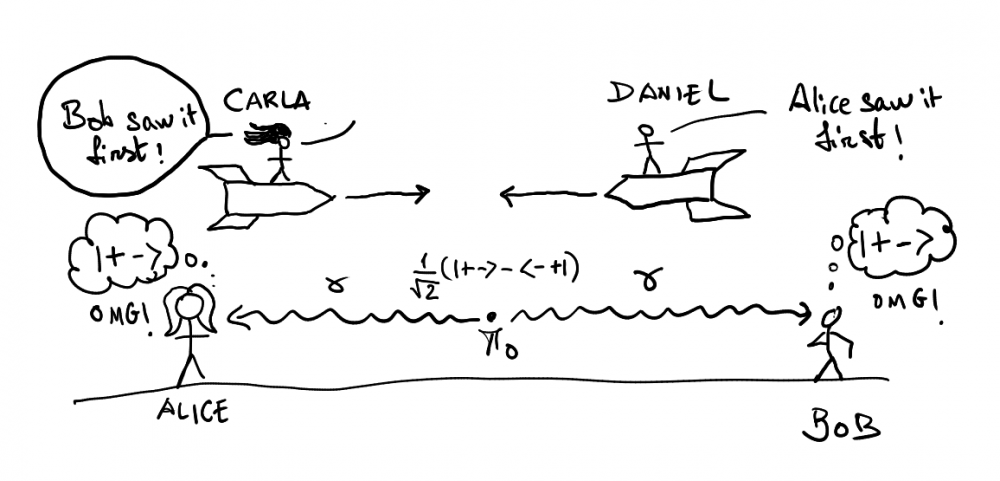
1+1=0. Easy peasy. Only problem is that's not true. If a person can't handle addition, any silly mistake they see as easy-peasy. It's easy for you because you've got the wrong picture. An observer moving away from your "first" measurement at high-enough speed would see it happen later. I took pains to make a drawing to explain it to you, but to no avail. Sure. "Madam, your husband died in an accident. You're a widow now, but don't worry. That's just a name we're giving you." This person's life changes abruptly from there on, but she's none the wiser until the news come. The problem is you don't even understand the dumbed-down example. And that's because you think you understand it and try to explain it to everybody else. I leave you with Bertrand Russell: We're all here probably fools and fanatics ganging up on a wiser, enlightened mind. This is the whole question of non-commutativity. Dirac introduced this interesting concept of q-numbers, as opposed to c-numbers, to highlight this idea, I think. C-numbers are the ordinary quantities of our classical, well-defined world. Q-numbers, on the contrary, are more like matrices. They do not commute. So they cannot be defined (diagonalised, perceived, spelled out, as numbers) at the same time = in the same basis of reference states. If you want to define one thing, you must un-define, or blur out, the other. This concept takes quite a bit of getting used to, but I can assure you --if I understand QM at all, and I think I do to some extent--, it's the actuall crux of the matter. The idea that, when something is "defined," other things, other attributes, must become "undefined" or a superposition of possibilities.
-
I love pasta.
-
No. That's one good reason, and a pretty important one, but not the only reason. Any initial-condition wave function of any shape you like --not necessarily a function for which Ax+By+Cz=K (plane) is a surface of constant phase, and let it propagate freely. Eventually, it will get close to a plane wave if you leave it alone, but it never reaches that profile. It's curved and contorted for a long, long while, ever so slightly less so as time goes by, but never totally plane. It takes infinite time to do so, and then the multiplicative constant must become zero. "Plane" is what they tend to be, given enough time, but not what they are. Plane waves are extreme simplifications. Their localisation probabilities produce an infinity, so they're not the actual representation of a physical state. They're toy models. Plane waves are, eg, what the amplitude looks like in some region when you prepare the state having it go through infinitely many collimating screens, and then let it "relax" until it reaches this situation in some region of interest. OTOH, there has been extensive study of states which propagate in one direction, but package orbital angular momentum in the directions perpendicular to the propagation direction, so they're not plane waves. Look up for Bessel and Airy packets. They're very interesting, and quite a surprise when you're used to this simplifying idea that free waves are plane waves. Many people say it, but it's very old, sloppy, non-rigorous QM. We understand it better now. Another more realistic approach to a free Schrödinger wave is a Gaussian wave packet. Another one is the wave function of a particle coming out of a slit. It's never plane, although once it's got out of the slit, it's totally free. So V=0. But even more simply. Take the free Schrödinger equation: \[ i\hbar\frac{\partial\psi}{\partial t}=-\frac{\hbar^{2}}{2m}\nabla^{2}\psi \] Now suppose you know, for some reason, that the momentum is in the z-direction. So you can do the separation \( \psi\left(x,y,z,t\right)=e^{-iEt/\hbar}e^{ip_{z}z/\hbar}\varphi\left(x,y\right) \). Now plug it into the time-independent Schrödinger equation: \[ -\frac{\hbar^{2}}{2m}\left(\frac{\partial^{2}}{\partial x^{2}}+\frac{\partial^{2}}{\partial y^{2}}+\frac{\partial^{2}}{\partial z^{2}}\right)\psi=\frac{p_{z}^{2}}{2m}\psi \] So your Schrödinger equation splits into, \[ \frac{\hbar}{i}\frac{\partial}{\partial z}\psi=p_{z}\psi \] and, \[ \left(\frac{\partial^{2}}{\partial x^{2}}+\frac{\partial^{2}}{\partial y^{2}}\right)\varphi=0 \] The second one is the Laplace equation, so any harmonic function in the variables perpendicular to the selected momentum will do as a perfectly valid --and actually much more realistic-- solution to the Schrödinger equation. This is why people have been studying for some time now these very interesting states with orbital angular momentum packaged in them that I like to call --privately-- fusilli or tagliatelle electrons. They are free particles, and they are not plane waves.
-
This is incorrect. It's what some/many freshman or sophomore "introduction to quantum mechanics" books suggest say, and it's badly, badly wrong. Wanna know why?
-
Eigenstates of what? Position eigenstates could not be farther from being oscillatory. Waves do not have to be oscillatory. But the question actually all depends on how you define a wave, and what you wish to include in the definition. Perhaps you should actually read what I posted, as I provided a somewhat restrictive one, although by no means necessarily unique: You could, of course, weaken this definition and therefore expand the concept to include non-linear phenomena, like solitons or gravitational waves. In that case, it would be just any solution to a field equation that admits particular solutions that propagate as a travelling disturbance, \[ u\left( x-vt \right) \] Being "oscillatory" --most certainly-- is not a requisite in any definition I know. You are confusing the particular case with the general one. You are confusing the pieces into which we analyse waves with what is is an analysis of --the waves themselves. In fact, no realistic interesting solution of a wave equation is "oscillatory." Most waves suffer dispersion. What you are referring to is a monochromatic wave. The classical wave equation, the equation for the vibrating string, for example, has infinitely many oscillatory Fourier components, while the overall solution doesn't have to be oscillatory in any sense --even though every one of the pieces oscillate with its particular frequency. Welcome to the forums. I don't think chemists are mere. Not anymore than isomers are mere "isos." I think in Chemistry you're mainly concerned with electrons being comfortably set in stationary states. Either atomic or molecular wave functions with a given energy. This dispersion is still going on, but due to the peculiarities of the function being complex, and the "diffusion coefficient" being imaginary, the stationary situation, when it's spatially confined, allows for states going back and forth withing a small volume. Like --another Wikipedia image--,
-
You're absolutely right. +1. An image is worth a thousand words: The image is not mine, of course. It's from Wikipedia, and it represents the time evolution of a free quantum-mechanical wave packet. You can actually see how dispersive the non-relativistic regime is. The low-down is: Even empty space somehow operates as a dispersive medium for Schrödinger waves. Although you can get a similar behaviour for waves that are actually waves --same order in time and space derivatives-- by having them propagate through a dispersive material. The diffusion equation is, \[ \frac{\partial n}{\partial t}=-D\nabla^{2}n \] with D being what we call the diffusion coefficient. The Schrödinger equation, OTOH, is, \[ i\hbar\frac{\partial\psi}{\partial t}=-\frac{\hbar^{2}}{2m}\nabla^{2}\psi \] So it's exactly mathematically equivalent to the evolution of a complex space-time valued function with complex values and purely imaginary diffusion coefficient, \[ D\rightarrow\frac{i\hbar}{2m} \] Whether something is a wave or not is, of course, a matter of definition. I would be happy enough with an equation that's linear in the field variable and admits travelling solutions being in some sense a wave. Travelling solutions meaning, \[ \psi\left(x,t\right)=u\left(\omega t-kx\right) \] If the equation is linear, we can do a Fourier analysis of the wave, and an arbitrary solution is a linear superposition of infinitely many travelling solutions like these. But the problem of whether our equation is dispersive or not is coded in the relation, \[ \omega\left(k\right) \] That's why it's called dispersion relation. Fourier components with different frequencies have different velocities. The velocity of propagation for each component of wave number k depends on that particular value of k. That's why the wave spreads out as it evolves. In the case of the Schrödinger equation, the dispersion relation is, \[ \hbar\omega=\frac{\left(\hbar k\right)^{2}}{2m}\Rightarrow \] so that, \[ \omega\left(k\right)=\frac{\hbar k^{2}}{2m} \] The phase velocity for Schrödinger waves being, \[ v_{p}=\frac{\omega}{k}=\frac{\hbar k}{2m} \] And their group velocity being, \[ v_{g}=\frac{d\omega}{dk}=\frac{\hbar k}{m} \] For light in a vacuum, there's no dispersion, or the dispersion relation is linear, so group velocity and phase velocity coincide. If we enter a medium, then we have dispersion. For relativistic (massive, matter) waves, the dispersion relation is very interesting, giving a group velocity that's subluminal, and a phase velocity that's superluminal, the product of both giving exactly c2. The problem with relativistic equations is that they cannot be consistently interpreted in terms of one particle. They are multi-particle systems from the get go.
-
There you go again. There is no "first." None of them comes first, and then the other. It'd better not. That's why those people in Taiwan that you mentioned earlier are just measuring the speed of nothing. It is a non-speed. That's why Ghideon's analogy is so brilliant. There's no speed at which the woman becomes a widow. Or it's infinite, whatever way you want to say it. It's a logical fitting between both ends. Nothing travels. No Cramer, I'm sorry. It's the "speed" at which infinitely many propositions are anticorrelated, and infinitely many other propositions are totally non-correlated. I am. Let me give it a try. Let's introduce another Ghideon-observable: If I destroy their house while they're away, they "instantly" become homeless. In the classical world, It's possible to know whether a person is "widowed" and "homeless" at the same time. In QM those could be incompatible observables. What's interesting in your analogy is that you've introduced a world of potentialities: Legal bindings, conditions, attachments, etc. This is, in the analogical space, playing the part of the wave function.
-
You guys are forgetting that sometimes we are surprised with a gem by other members. I personally find @Ghideon's analogy of the widow/widower very illuminating. I've been trying for years to find an analogy that illustrates this particularly difficult point that you can instantly obtain information about a remote thing without physically affecting it, and there you are --and the example not being quantum mechanical. To me, it's worth all the effort spent. Here it is again:
-
A Zen master once said, Light is what allows you to see the elephants. Light is not the elephants. Dark is not light. Light is not dark. Light is light. And there's nothing lighter than light.
-
Our goal is to have goals. Our purpose, to have purpose. May I also point out that there is such a thing as too much reproduction... 🤷♂️
-
Cosmology is of no relevance here. Experimenters doing quantum interferometry, quantum teleportation, and the like, do not refer anything to the CMB. That would be silly. The CMBR is distinguished from a cosmological POV, not from a POV of local quantum mechanics. Seems trivial to you only because you do not understand, and looks now as if you will never do. The experimenters decide who does the measurement: One of them, the other, or both. And they also decide when that happens, in their respective local reference frame. OTOH, observers moving with respect to them, see the measurements happen in different temporal order, depending on their state of motion. Will you at some point understand this? You have a flair for getting everything backwards like I've never seen before. Everything is together --non-separable, that's why I say it's "hardwired," and it comes apart after we do the measurement --the particles become disentangled, and the density matrix goes from pure state to strict mixture state. Nothing is observed until it is observed. There is no signal. Filtering measurements carry no signal either. In this way, it's similar to a non-interaction measurement, like counterfactuals --Elitzer-Vaidman bomb tester-- or filterings.
-
Seems to me that this is an insurmountable objection. It is what I would call a zero-order problem with the OP's idea. IOW: The hypothesis is not even designed to do the job it's intended to do.
-
Man oh, man. That's a great analogy!!! +1 It's freakin' brilliant. You've made the other person a widow or widower, without actually doing anything to them. You have learnt something about them because of what you've done at one point. You know something about the other person's future. But the other person, and those around her or him, are clueless until the "classical data" are sent to them. Those classical data are under the constraints of delay, because they do have to use a signal.
-
Yes, you're saying this since day one. I will repeat: SR always applies in sufficiently small regions of space-time. There is no known experimental exception to it, and there's no reason to expect any. Quantum entanglement is every bit as compliant with SR as every other physical process we know. If you think this not to be the case, explain why with theoretical arguments from mainstream physics, or direct us to the experimental evidence. So far you're just parrotting unsubstanciated claims by other people. We are all aware of the existence of these claims, as we are aware of the existence of bad music. There's a thin line separating serious science from free-floating fantasy, and some people take every oportunity wherever they find ambiguity, or a grey area, to cross that line. There's bad science too, you know? I wasn't born yesterday. No. An Entanglement is a property that only very special many-particle states satisfy. It's not a set of entities having properties according to which we can do statistics. The statistics of such properties is hardwired in the state without them being "real" properties of the individual entities. The entangled state is the entity as far as the current theory understands it. No quantum numbers of spin make up the Bell state. The individual quantum numbers are totally undetermined. The eigenstates are totally undetermined. The particle identities are totally undetermined. There's no cohort. There's no set of internal colours, markers, tags. So far as we know today, there isn't. Maybe in the future someone will come up with an idea to weaken the criterion of reality to define these variables and make it all consistent with known physics, but so far it hasn't happened. Entanglement is a property in itself (the ending "-ment" should give it away). A cohort is a set of individuals with properties (like, eg, people aged between 16 and 20, unemployed, and single.) So no, you're not dealing with this topic with any degree of scientific of philosophical care. You're obviously ignorant of relativity, as well as of how and why it's critical in this discussion. Yes. At least @MigL has told him, you @Eise have told him --and he's telling you again--, and I have told him. I had no objection to that anthropomorphic expression either. I think everyone involved in this thread understood it is just a manner of speaking.
-
I think this is more or less equivalent to what @Janus already mentioned about the old "tired light" hypothesis: More or less what I meant when I said, Although I don't know how light being red-shifted amounts to it becoming 6 times the mass of baryonic matter through the billions of years. Red shift is not the same as photons "staying around." This argument, or similar ones, are bound to be reborn in the minds of people who think they understand the problem. It was ruled out long ago, and I must confess I've never considered it because it's so off the mark in so many directions. DM is a big unknown today. It could be exotic matter, or it could be "quintessence" or... who knows. But it's not light. We do know that much today. Astrophysicists say it's not baryonic, nor EM --so no photons--, nor weak-interacting[?] The Wikipedia quote is, in fact, incomplete: It does not appear to interact with charged particles. Keep in mind the EM field interacts with itself only too weakly. It does not scatter off electrons or ions AFAWK. DM does not interact electromagnetically at all. Photons do. Maybe a mixture of different things... Perhaps. It's either something that clusters very, very loosely, or just a deviation from Einstein's equations. I don't know and, so far as I can tell, you don't know either.
-
LHC gets tons of data about QCD background and rules out wrong hypotheses and ideas about how matter behaves. It provides an excellent school for engineers and experimental physicists. It fosters collaboration among nations. But maybe you're right. We should throw money at other --more worthy-- causes. Here's another one that's in sorry need for more money:

-
SR is relevant to everything physics. It's the local limit of GR, it's the basis of QFT. There are no known experimental exceptions to it. Analysis and theoretical discussion on how nothing about QM can contradict its salient facts has been the subject of study for decades. I suggest you study thoroughly how it underpins all of physics. It will be very illuminating. You cannot just say "oh, but this is not SR," and get away with it. About "bickering," If people tell you there are non winged lions, that's not bickering. That's stating something that's very likely to be true. It's for your own intellectual good when people tell you so. There are no winged lions, and there is no contradiction to special relativity. You can take that to your grave. I'll take it to mine.
-
Oh, don't worry about the words. It could be arranged if you show some equations. What about the virial theorem? It is essential to understand the velocity distribution of objects moving around in a gravitationally-bound cluster. Everything you've said so far is inconsistent with what I know about the virial theorem for galaxies. And you don't need GR for it. A classical calculation would suffice, as the speed of the galaxies is safely within the non-relativistic regime. Mind you, photons themselves are always relativistic, and red-shifted, and subject to gravitational lensing, but the speed of the galaxies due to the presence of photons is not, and could be treated non-relativistically. I want to see how visible radiation from galaxies accounts for a big whopping bulk of mass that represents most of the mass and goes far and far away, well outside of the galactic halos, and somehow stays thereabouts. What you propose is so amazing that I --for one-- demand no less than extraordinarily convincing proof for this extraordinarily outlandish claim. How is the light emitted from a lamp almost 6 times the mass of the lamp? You tell us. (When I say mass I mean energy.)
-
What do you mean by this? What does it mean "light climbs out more and more the farther away from the source it is?" I don't think that's physics.
-
This sentence doesn't make sense gramatically, let alone physically. A cohort is a set. I'll get back to you later.