
joigus
Senior Members
-
Joined
Everything posted by joigus
-
Don't forget prokaryotes and eukaryotes are worlds apart in almost every sense conceivable. If I had to bet, I'd say life that's similar in organizational level to prokaryotes is relatively common in the universe. But eukaryotes are a completely different kettle of fish, my friend. It took many eons, ( a whole boring billion years at least) for them to appear when Earth already looked like there was gonna be nothing but bacteria and archaea forever and a day. This concept of deep time takes a while of ordinary human thinking time to sink in. The most likely thing out there is some kind of mush, just because the most likely thing around here is some kind of mush. The world we see now is anecdotal in comparison.
-
It's not that fine-tuning suggests a multiverse, I think. Rather, the idea of a multiverse (with different domains having different values of the physical constants) makes whatever value for the constants inescapable for some part of the multiverse where there is intelligent life, therefore supressing the need for an "outside" contrivance (creator). There are other games in town. Eg, Smolin et al.'s idea of cosmic selection, Tim Palmer et al.'s idea of universal constants as coming from attractors of some chaotic regime, etc. I'm not going to watch the video, sorry.
-
I was gonna say something similar to what Swanson said. I suspect subtlety is in the word "find." If "find" = "identify unmistakable telltale signature of", then I think I understand what those scientists are saying, and I wouldn't be totally shocked.
-
Here I should've said the Levi-Civita connection, sorry. Anyway, even the manifold connection can be introduced independently from the metric.
-
In case anyone's interested... In addition to baryon number non-conservation, one would need T (=CP) violation, plus C violation alone, plus a universe out of equilibrium --if I remember correctly-- for baryon asymmetry. As we already know of C and CP violation, T would be automatically satisfied if CPT holds, which we believe to be the case. https://en.wikipedia.org/wiki/Baryogenesis#GUT_Baryogenesis_under_Sakharov_conditions
-
Exactly. Subtract 8 from 24 24-8=16 (waking hours) Multiply by 3600 (seconds per hour) 16*3600=57600 Divide by 10000 (ads per day) 57600/10000=5.76 seconds per day available to see an ad with the minimum estimate of 4000 ads you get 14.4 seconds. Still not very believable. There wouldn't be time for anything else. Your screen or interface might "see" those ads. You don't. That's why they hire so-called attention-engineers.
-
Great summary. I agree with Genady and Markus. Connections are quite independent of metric in general. It's one of the hallmarks of Einstein's GR that the connection is a metric one. Thereby the words "metric connection". Rods haven't been a standard for quite a while. A gauge fibre bundle is an example of a metric-less connection. The gauge field A provides the parallel transport along the manifold, while the gradient of A gives you the parallel tranport on the fibres \( \Psi \), the whole structure is (locally) a product MxF (M=manifold, F=fibres), but with no metric for the \( \Psi \)'s. Sometimes I have a problem understanding what the OP sets out to do. This is one of those times. Before one starts thinking about physics, one should get a clear picture of what needs to be solved. Going back to metric connections in order to try to solve a problem GR doesn't have doesn't look promising. Things that are considered solved are considered solved for a reason or, should I say, for a bundle* of reasons. *
-
The golden ratio is the positive root of x2=x+1 That is (1+sqrt(5))/2 https://en.wikipedia.org/wiki/Golden_ratio In a certain sense, it is the most irrational number, meaning that its continued-fraction approximations are as bad as can be. The letter phi is used for many things. It would be futile to try to give a complete list.
-
I totally agree with @Genady too. We seem to be fo the same mind in this respect, or very similar. The way Kant analised Nature and science, and epistemology, blew my mind when I was a teenager. Didn't follow him quite equally well when he spoke about other things, moral in particular, or "practical reason." In fact, I see many clues that the world we see and measure could be but a projection from some more "fundamental" level, perhaps involving things other than geometry. Watching for clues from pure mathematics could not be entirely misguided.
-
Time is a scalar under spatial rotations. Time is not a scalar under changes of reference frame that involve a speed. Also, things that change sign under certain transformations (spatial inversions) are scalars for everything else (every other transformation of coordinates). Those are called pseudoscalars. An example is the projection of an angular velocity on a fixed vector of space. Another example is the wave funtion of a meson. Etc. Which one do you mean? Also, a vector and a dimension are different things, as you've been told. Etc.
-
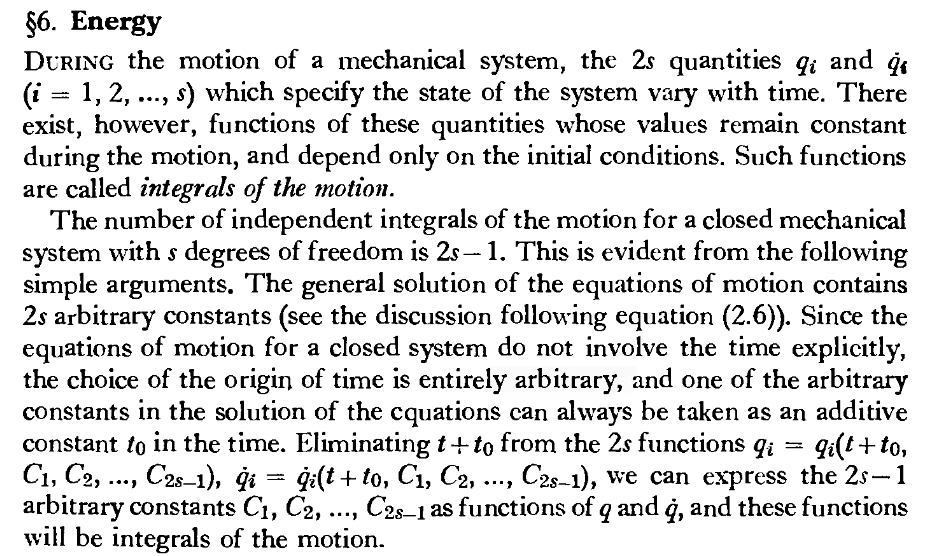
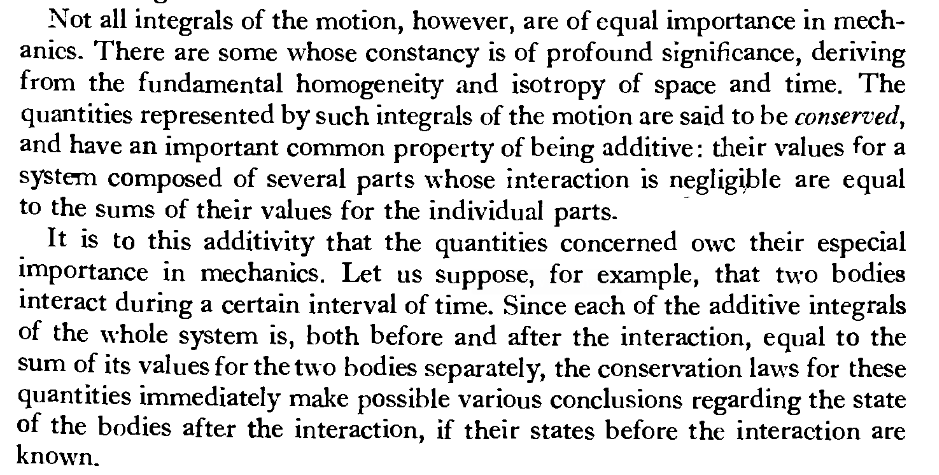
Although I think I totally understand @Genady's point, the problem with conservation laws as standalones to spell out determinism, is the following, brilliantly exposed, as I remember, in Landau's mechanics: If you manage to solve the differential equations of the system by brute force or sophisticated methods, you can always look at it like this "movie" which mathematically is represented by the explicit q(t) q'(t) (all coordinates and velocities of all degrees of freedom for all times). Once you've done that, you can always claim certain functions f1(q,q´), ..., fn-1(q,q´) are integrals of motion AKA conserved quantities. I've just found the quote: The problem is, of course, what Landau quickly points out next: What @Eise calls "vanilla determinism", if I understood him correctly, might be related to this particular point. It is one thing to assert (perhaps have a theoretical principle to do so) that tells us that all information of relevance "is there". It really is there!!! Yes, but a very different thing altogether is to be able to predict, retrodict, etc. with that information. For that to be done, it might be necessary to have the system speak our language. That means integrals of motion that we can measure and find the correlations of. What I would like to be done within my lifetime is a robust proof, both theoretical and experimental, that Nature is deterministic in principle, but undeterministic de facto, presumably in way similar to how it's done in classical mechanics as concerns chaos theory. I think it's been tried and it hasn't exactly worked as expected. Quantum chaos, AFAIK, is not chaos of the quantum, although there are interesting connections. * Even a deterministic sub-level that we are not given to solve or use, or perhaps understand. BTW, what I call n in my previous comment (number of coordinates and velocities) is what Landau calls 2s.
-
I cannot find a smidgen of physics or logic, or maths, in anything you say here. You don't know any physics, and you don't want to know any physics. "The edge of existence" is a meaningless pretentious nothing term. I'm out.
-
It sounds so similar to something that doesn't exist at all that only an expert on barely existing things would barely be able to tell the difference. Things physical must either have definite properties under rotations (therefore have some spin), or not behave properly under rotations (in technical parlance we say they must carry a representation of the rotation group). A thing that looks like an arrow carries a spin-1 representation of the rotation group. Its projections on the x, y, z axes do. A thing that looks like a perfectly symmetrical sphere, naturally is assigned a spin zero. It doesn't change when you rotate it by any angle in any direction. What does the quasi-thing you talk about do when you rotate it? It must either do something that all observers can agree upon (and therefore have spin) or violate so-called the principle of general covariance and do stranger things that different observers wouldn't be able to agree upon. That's spin.
-
Absolutely not. A particle with no spin is a non-thing. Like a cloud with no water vapour.
-
I know. Likewise, I don't see a reason why it would not be possible in principle. If you take determinism really seriously, it's kind of a given really. Determinism is an inevitable logical consequence of: (1) generalised use of analytic functions, and (2) the physical law abiding by the principle of the differential equation. If that paradigm is correct, you can always reconstruct the value of all physical parameters everywhere and at every time by just Taylor-expanding the functions, provided you could measure field inhomogeneities with infinite precision (derivatives of arbitrarily high order.) It's just a corolary of our model (perhaps delusional?) of the world. The alternatives always involve step-wise changes that are unpredictable, but have the unfortunate[?] character of being ad hoc, somewhat contrived... (Collapse of the wave function, fractal algorithmic "steps", discrete updating law of cellular automata...)
-
No. It must have spin 2 if quantum field theory is to work for everything else. It's been tried with spin 0, 1/2, and so on. It doesn't work. It was understood in the '60s. And calling it a primal entity doesn't make it better, unfortunately. https://www.fnal.gov/pub/today/archive/archive_2012/today12-10-19_NutshellReadMore.html#:~:text=While the matter particles of,and momentum in the universe.
-
I think you got this absolutely right. V. Neumann tried to get a really robust proof that hidden variables were hopeless if QM is right. He thought he did. It's perhaps not widely well-known that Bell further elaborated on V. Neumann's argument and extended it to commuting observables, which resulted in what we know today as the Kochen-Specker theorem, which should be called Bell-Kochen-Specker. In a nutshell, what it says is that for some quantum systems, you cannot even assign reality to pairs of commuting variables. Analogously to the "regular" Bell theorem, this only happens for naggingly-difficult-to-spot pairs of variables. The thing about determinism is it blurs the boundary between causal and non-causal, as cause and effect are both co-determined by the deterministic law... I'm loosing my train of thought. I wanted to say more on @Markus Hanke's hopes that some version of superdeterminism coud be not so far-fetched --if not altogether plausible. They have to do with the possibility that the universe is actually holographic in nature. Maybe later.
-
Nietzsche is dead.
-
(My emphasis.) Not quite. I will only laugh at the matter simply because the matter is so insignificant.
-
Not always easy to do, but best advice IMO.
-
Logic by association, "just so" stories... Same old, same old... Why not DJL standing for Daniel Jay-Lewis? And why not a different lettering?, like:

-
Thanks! Yes, that's the source. Here's a reference to the recollection, In the forums below, G. 'tHooft himself clarifies these questions and some more. In a nutshell, and to the extent that I understand correctly, cellullar-automaton variables provide "onticity", but are affected by probabilities themselves, and produce the quantum states as something that very much looks "emergent". The space-time being essentially what we all know and love: https://physics.stackexchange.com/questions/34217/why-do-people-categorically-dismiss-some-simple-quantum-models As to non-locality of the Broglie-Bohm model, I'm aware that people claim it is. The claim is always kinda wrapped up in some obscure wording, never in the mathematics. I don't think relevant physicists have ever weighed in with the discussion, except to the effect of dismissing it from a distance --pun intended. <speculative> Of course, I'm sure the BB model cannot --at best-- be the whole story. It's got anthropocentrism written all over it. IMO, it must be some kind of toy-modelled approximation to some non-linear generalisation of field theory that exploits the (infinite dimensional) dynamical possibilities that gauge freedom affords. Throw in further assumptions on how this lumpiness of the gauge degrees of freedom correlates to the linear amplitude and there you are: your stand-in for realistic degrees of freedom, plus the reason why they cannot be ultimately determined: they can be changed by a simple gauge transformation, so they cannot ever be determined. </speculative>
-
OK. That's a historical point I cannot claim to be 100% sure about, so you may be right. I didn't mean he abhorred of the use of probabilities. I meant rather that Nature at the most fundamental level bespeaks probability. IMHO, Einstein's position towards QM, while it didn't significantly change, did experience a shift in emphasis perhaps. I know for a historical fact that at some point he's quoted as accepting probabilities appearing at the most fundamental level (whatever that means.) But his real qualms must have been not so much about probabilities as they were (must have been) about reality. What he did not accept until the bitter end was the possibility that there be no elements of reality below that level. He's been quoted as saying, https://www.scientificamerican.com/article/the-universe-is-not-locally-real-and-the-physics-nobel-prize-winners-proved-it/#:~:text=As Albert Einstein once bemoaned,regarded as a bad move. Correct me if I'm wrong, but I think this testimony came relatively late in his scientific career. It is a relevant matter to distinguish between something Einstein said in 1935 and, say, 1950. You know these things much better than I do. I think the concept of reality is the one that didn't let him sleep at night. He knew QM is deeply, unmistakably, irrecoverably at variance with the notion of a real world, existing independently of the observer. The problem with locality is that many people have used it for decades in several different ways, not all of them mutually overlapping. I'm not totally convinced that Bohm's theory is non-local in any meaningful sense that I can recognize. Of course I could be totally wrong and simply misunderstanding the finer points these experts are making. Strictly speaking, Copenhagen quantum mechanics is (mildly) non-local already, because of the fact that components of the wave function that now are light-years away, must go to zero just because I've measured something here on Earth. For better or worse, nobody can measure the consequences of something non-measurable disappearing out of existence[???]... But the user manual of QM does tell you to do that in your equations, which is a faux pas in local physics. Not that anybody has worried about that or (most) even noticed for about 50 plus years.
-
You should understand that "being at rest" are meaningless words in physics. Motion is relative. You should understand that what you are picturing as your "point of collision" is frame-dependent. You should understand that comparing how two different test masses accelerate towards a certain third mass which is source of a gravitational field acting upon those masses (context of the equivalence principle) is a different situation than the one you propose (two masses that collide under their mutual gravity). It's perhaps worth saying that gravity alone very rarely results in collisions in classical physics, because of centrifugal barriers, so the situation you propose is not nearly as general as it should be, especially considering the extraordinary character of your claim. You should have an understanding of relative motion*, vs centre of mass motion, vs motion described in a more general inertial frame. There are many important things that you misunderstand here, and so far you don't seem to be willing to understand, in spite on good efforts by several members. Please, be aware that you do not have a theory. You do seem to have several important misconceptions on basic Newtonian physics that lead you to believe a widely accepted theory, fastidiously checked, both experimentally and theoretically, forwards and backwards, is wrong. You should clarify your position, before anybody can prove you wrong. Nonsense cannot be proven wrong. * @Janus and @studiot in particular have emphasized this.
-
I have no idea what your thought experiment has to do with gravity, if anything. The principle of equivalence has to do with two different masses in the presence of a third mass (source of field). The fact that relative accelerations between mutual objects are equal and opposite is a trivial kinematical fact, and has nothing to do with gravity. Maybe I have misunderstood the whole thing. If that's the case, I do apologise.