Everything posted by sethoflagos
-
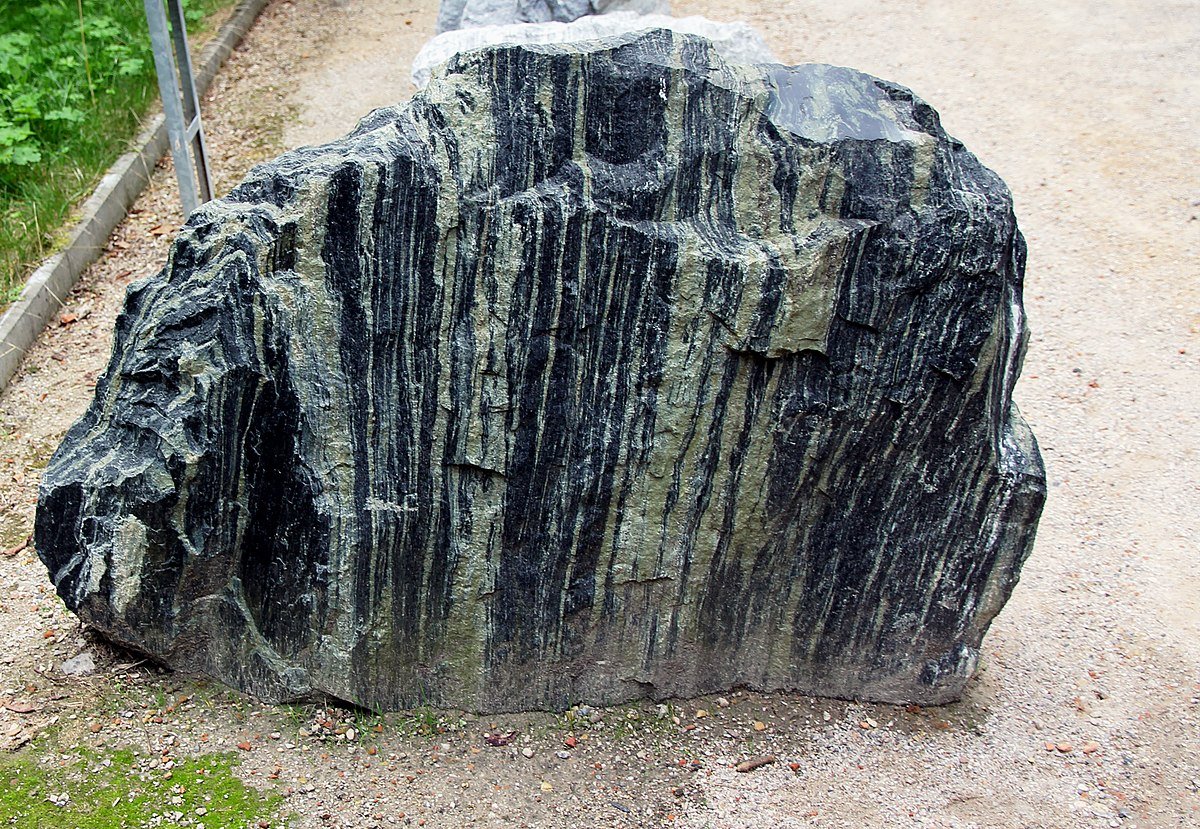
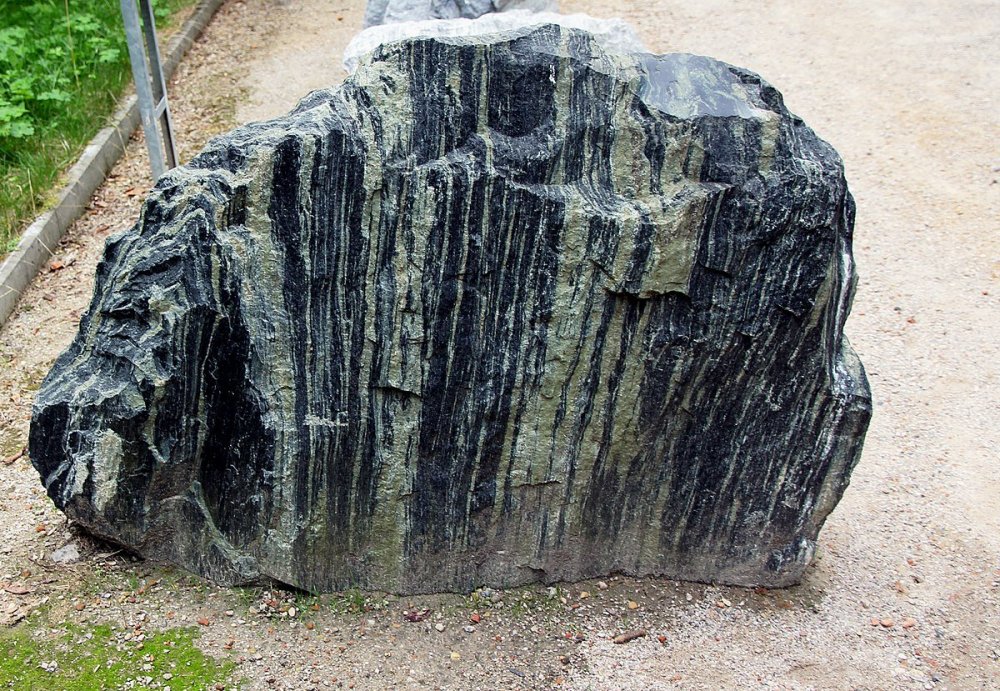
You might be able to glean a little more from Geology of the Greenock district Memoir for 1:50 000 geological sheet 30W and part of sheet 29E (Scotland). From what I can make out, the beach walk north starting at the Highland Boundary Fault near Kilcreggan will cross: 500m of Bullrock Greywacke until junction with School Road 2000m of Dunoon Phyllite until just after beach crossing of Dowall Burn in Cove 300m of Beinn Bheula Schist to just before Knockderry House Hotel 100m of 'metabasalt' before continuation of Beinn Bheula Schist This last looks to be associated with the Loch Katrine Volcaniclastic Formation situated directly across Loch Long from the hotel, which is dated to Ediacaran Age. Since the hotel is built on this formation I'm guessing it's a good candidate for the photograph.
-
Shouldn't speculate really, but the first thought that came to mind was amphibolite. Similar tones, textures, banding, and definitely not out of place for that area.
-
Looks to be a higher grade of metamorphism than phyllite I think, but it's had knocking on a billion years of pretty tortuous goings on and is wearing its age and experience perfectly. No problem in enjoying it simply for what it is.
-
Spectacular stuff! Where is it? Coincidentally, I've just been watching a bunch of YT videos on shear zones on Rob Butler's channel. They go pretty deep while still remaining approachable to the interested layperson.
-
Packed a small wound in my arm one time with salt to stop it getting infected. Healed well enough but with more scar tissue than normal.
-
If you've not come across it already, you might find this online geological map of interest at https://www.bgs.ac.uk/map-viewers/bgs-geology-viewer/
-
Not sure the BBC really do this story full justice. Original JGS open access article and pdf download at https://www.lyellcollection.org/doi/full/10.1144/jgs2024-029
-
That's impressive! One reason I never got around to performing the full Trumpet Sonata in public was the difficulty in finding a pianist prepared to take on the accompaniment. But I never felt I'd truly mastered the solo part either so probably just as well. Maybe it's just coincidental that Wernher von Braun attended his music class but to my mind Hindemith's standard text on music theory (Craft of Musical Composition Book 1) would be better understood by music students if they had a reasonable grounding in physics. It reads very much as a Standard Model of Pitch Intervals.
-
I'd forgotten how much I enjoyed listening to this as a teenager. And how much almost all my schoolfriends didn't.
-
'Value' is too ambiguous a term here. Although it remains highly subjective in degree, 'artistic merit' in terms of craftsmanship, relevance and depth of personal expression is a better concept to work with I think. This at least excludes the market value of exclusive private ownership of the work which I see as an entirely separate (arguably psychotic) consideration. Some of the above posts seem not to make a clear, or indeed any, distinction between the two measures.
-
We're not there yet. Your OP seemed to suggest an inviscid classical orbital velocity field about some (undefined) axis of rotation: ie some particular solution of the Euler equations for some undefined geometry. The first thing you have to help us get our heads around is what exactly you mean by the word 'vortex' for a system that sounds as if it should have a local vorticity field value of zero throughout. It will differ appreciable from the familiar(ish) picture we have of vortex phenomena in viscous fluids. Maybe tell us the geometry of your containment? How you get the superfluid rotating in the first place? How does local fluid velocity vary with distance from the axis of rotation? Reassure us that the Euler equations aren't going to start producing singularities (which they are apt to do when presented with non-physical boundary conditions) Probably easier just to start and finish with this. Will a frictionless wall stop the car? 🤔 (I don't think this is quite as silly a question in context as it sounds. Again, how would one persuade a superfluid to rotate?)
-
https://en.m.wikipedia.org/wiki/The_Making_of_the_English_Working_Class Recent events following the 2024 UK general election have reminded me of how much this book influenced me in the late '70s. https://en.m.wikipedia.org/wiki/Herbert_Read The collection of essays 'Anarchy & Order' concerning (broadly) the role of art within a left-leaning libertarian framework is difficult to obtain outside the UK second hand market. But we'll worth discovering. https://en.wikipedia.org/wiki/The_Roads_to_Freedom Tied up a lot of loose ends for me and far easier to read than Being and Nothingness https://en.m.wikipedia.org/wiki/The_Master_and_Margarita https://en.wikipedia.org/wiki/Auto-da-Fé_(novel) Just 'must reads' imho. Beware: may cause offence to people called Karen (among others)
-
That's my reading too. Must say that I'd be more swayed by better hard corroborating field evidence to support the thermomechanical simulation, though I appreciate the logistical difficulty of getting the material evidence to the earth's surface in the case of divergent plates; the most relevant materials are heading in the wrong direction. Also a bit concerned by the dismissal without much explanation of late palaeozoic, early mesozoic structures that didn't fit the pattern as well as the later mesozoic to early cenozoic structures the study focused on.
-
Having said that there are a pair of suspicious large low-shear-velocity zones sat close to the core mantle boundary: the African and Pacific LLSVZs. Some claim these to be Theia remnants.
-
Hey! Don't jump to conclusions! Just to throw something into the mix, how about mantle delamination at constructive plate margins. https://www.nature.com/articles/s41561-024-01473-7#:~ This model for creation of the Tibetan plateau has been kicking around for decades, but along with the OP it reinforce the role of delamination as a global phenomenon. So uplands aren't necessarily evidence of large scale granite emplacement.
-
Only if you believe the advertising slogans of the authoritarian right. The irony is quite clear in the Auschwitz welcome: "Arbeit macht Frei"
-
Although the wattless current does no work, it still has to be accommodated in the supply manifesting in larger cross-section conductors and larger generator kVA demand. Getting the kVA back closer to the kW load via a capacitor bank can yield substantial savings.
-
And there's no possible justification for that? Retired IT manager has a bash at terraforming tropical paradise. What could possibly go wrong?
-
We are in the 21st century. Was no soil analysis performed prior to excavation? Never mind an EIA. Even now when the project seems to have gone tips up, the OP is trying to get free advice off the internet rather than employ the professional services that should have been on board before shovel touched dirt. The pH problem was foreseeable. It doesn't surprise me that this project is based in Thailand. It has a very familiar ring to it. I've seen many similar scenarios over the years here in Nigeria.
-
RFO is a real slow burn fuel so they're probably close to isothermal combustion through most of the power stroke. Hence they can achieve the high cylinder pressures and consequent high torque output without incurring extreme combustion temperatures. Similar to how power stations limit NOx with staged combustion.
-
This is consistent with your base sediment clay being carbonate rich - ie a marl, as mentioned above. And your solution is to... change the environment? No qualms about social responsibility when it conflicts with short-term commercial interest?
-
You get very similar figures for gas turbines too (their inlet compressors typically run also at 25 bara). Whatever the technology, it's always limited by the available metallurgy.
-
Just some ballpark figures to give an indication how deep this rabbit hole goes: For a 10:1 (isentropic) compression ratio of inlet air @ 300 K, 100 kPa, compression stroke ends at 754 K, 2,511 kPa. (~ 350 psig) Theoretical adiabatic, isochoric, stoichiometric flame temperature of isooctane ~ 2,900 +754 - 300 ~ 3,354 K By Pressure Law, Peak Theoretical Combustion Pressure = 2,511 * 3,354 / 754 = 11,170 kPa (~1,600 psig) And yet car engines appear able to run for quite a while without the spontaneous catastrophic disassembly such figures may suggest. This observation is consistent with actual instantaneous P,T values not exceeding 50% of the above by very much.
-
Quite. And 'liberating' vast quantities of sequestered carbon dioxide in the attempt.
-
It's similar to the pH range of Malham Tarn, a Site of Special Scientific Interest and a national nature reserve in the UK. The pH of lakes is determined not so much by what is in the water (an effect) but by the underlying sediments either of the catchment area or the lake itself. Does the OP proposal consider destruction of eg. a 100 foot thick bed of marl, along with potentially a productive and highly specialised ecosystem?