sethoflagos
Senior Members
-
Joined
-
Last visited
Everything posted by sethoflagos
-
No. The phenomena you describe are examples of homeostatic and closely allied responses which are classic feedback loops. They respond to the effects of external influences in such a way as to restore equilibrium. Consciousness is not a prerequisite for this much less such anthropomorphic concepts as feelings and emotions (in plants??!). My post was concerned with feedforward control which is much more of a challenge for evolution to implement.
-
Blond? To spare a hurt to souls too tender 'Tis safe to use the other gender
-
For me, these symptoms remind me that the great enjoyment I gained out of rugby and motorcycling in my teens and early adulthood do have their costs.
-
Given the sort of temperatures available, TH~375K, TC~300K the Carnot efficiency would be a mere 20%. After losses, they'd struggle to achieve a nett positive power output. Reading between the lines, my guess would be that the data centre is cooled by a heat pump that discharges into a hot oil circuit that in turn supplies the domestic heating. Maybe wrong, but that's the approach I'd go for.
-
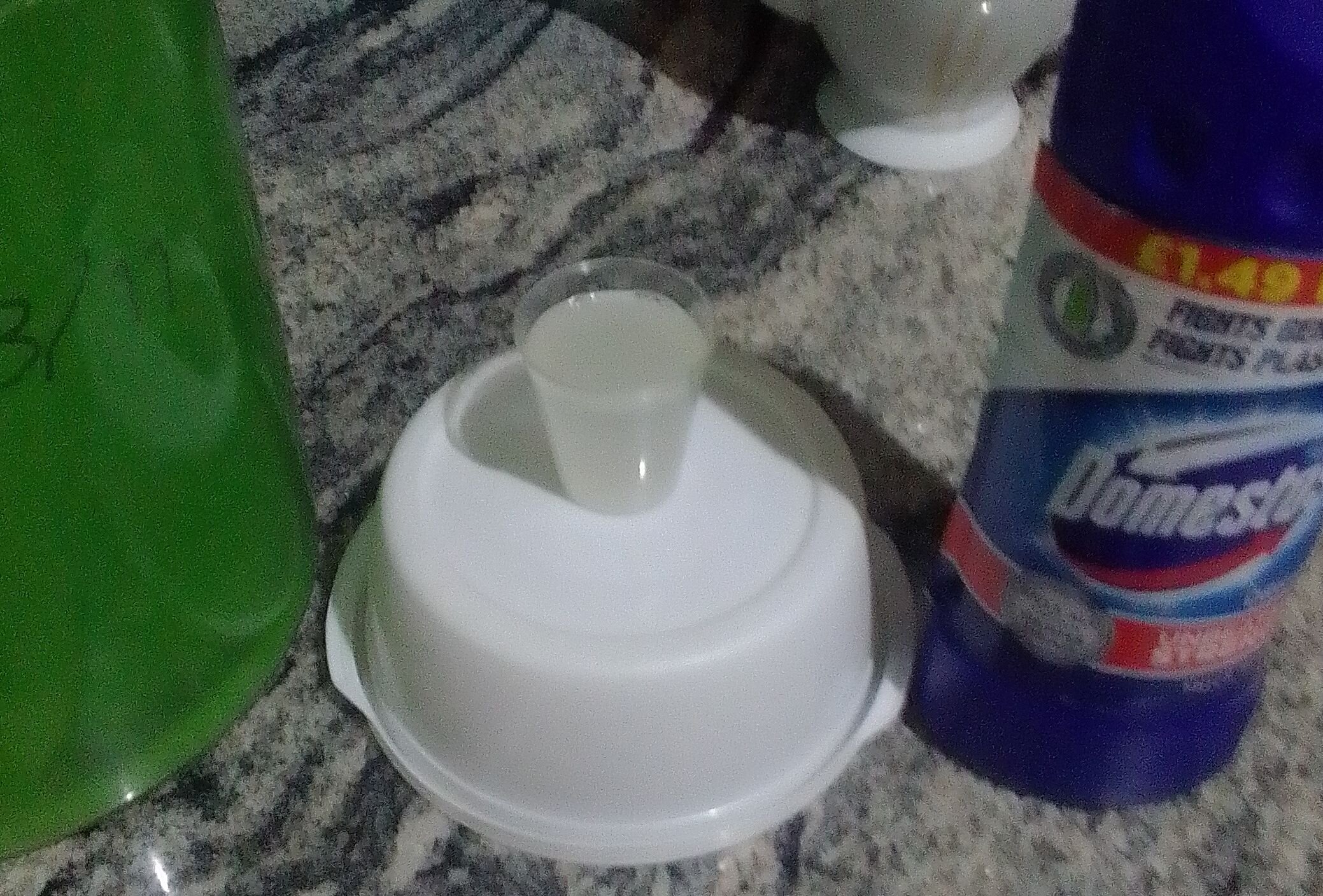
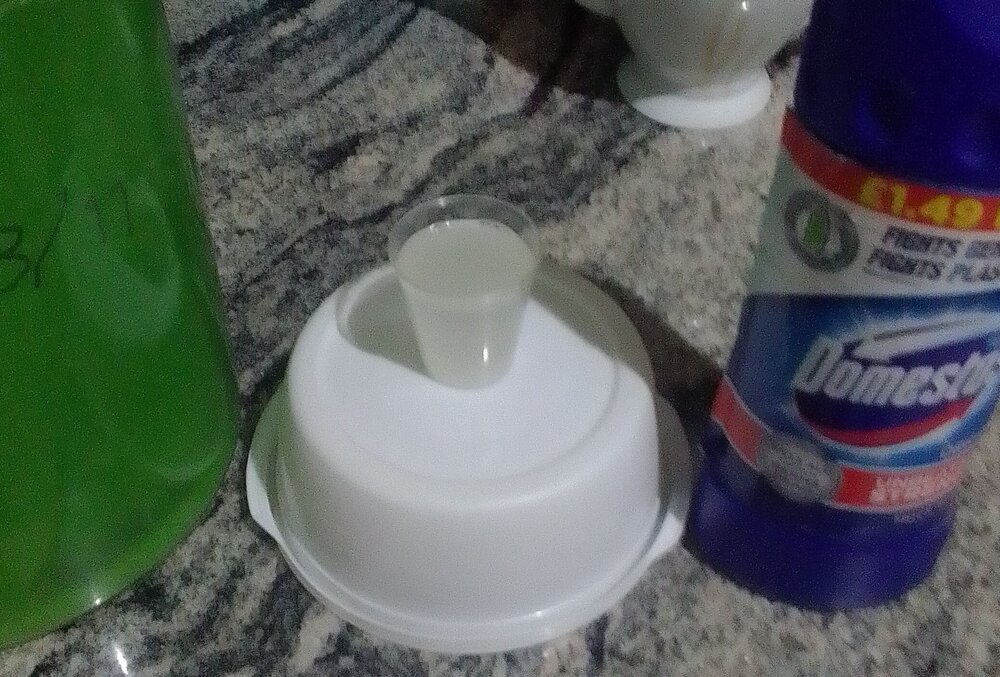
Domestos is a pretty concentrated solution of sodium hypochlorite and probably overkill as an oxidising agent. Could it bump iron into one of the higher valency ferrate states? My money is still on @exchemist 's intense green citrate complex. Given the suboptimal nature of my bucket chemistry, and the fact that the species of interest must be barely into the millimolar regime, perhaps there simply isn't enough oxidation product to be visually detectable.
-
... resulting in the ste being inaccessible for a few hours around midday when Cloudflare had a hiccough.
-
@Patch Cabbage , stop feeling sorry for yourself, and follow this advice. We're not doing brain surgery here.
-
For me (and my point of interest here is low temperature thermodynamics) the crossing the Rubicon moment was the confirmation of my instinctive feel that spherical coordinates were a much better framework for these essentially circular functions than Cartesian coordinates. Trying to bang square pegs into round holes and all that. I'm a lot more comfortable mit Dackeln, die auf Deutsch heulen.
-
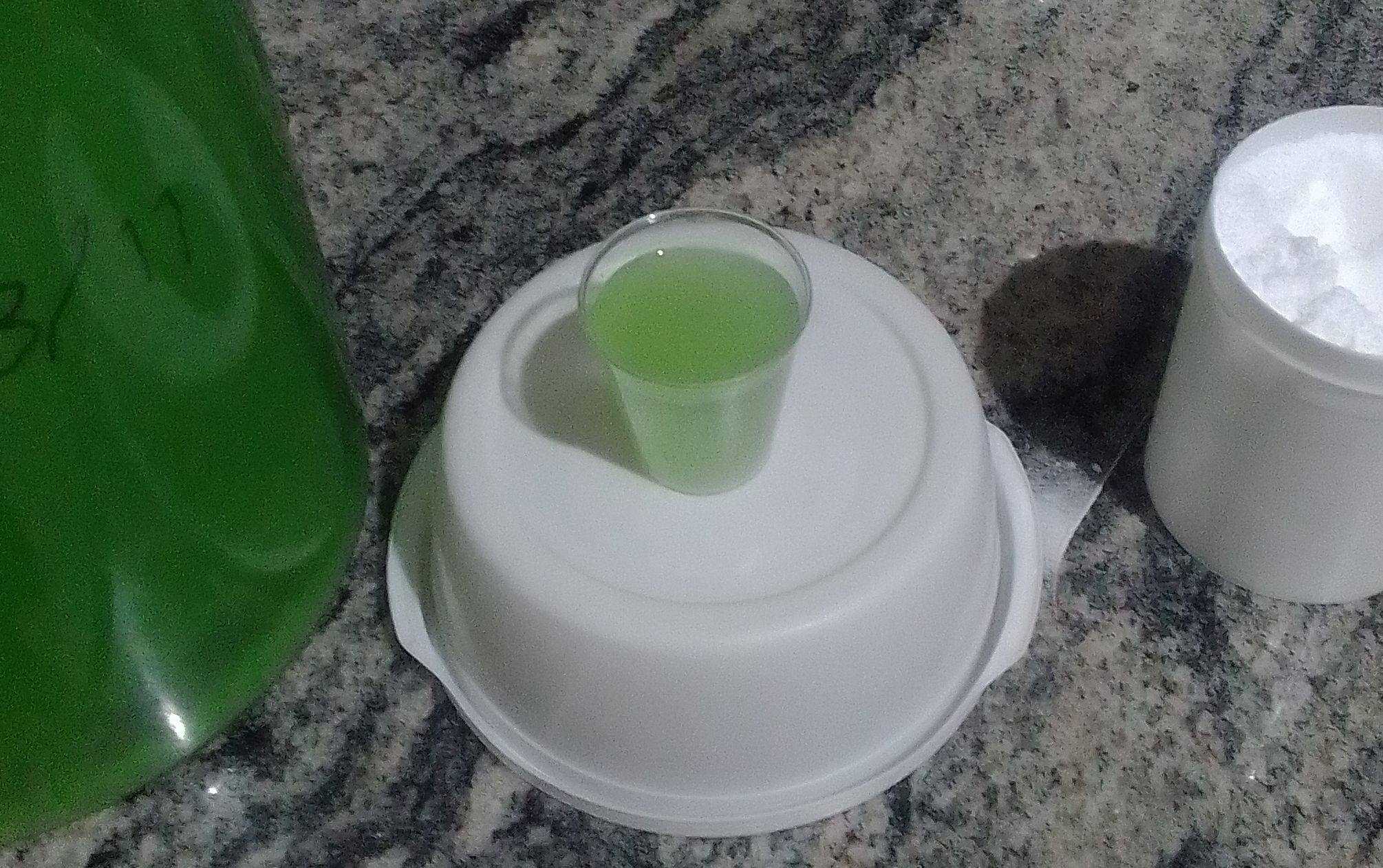
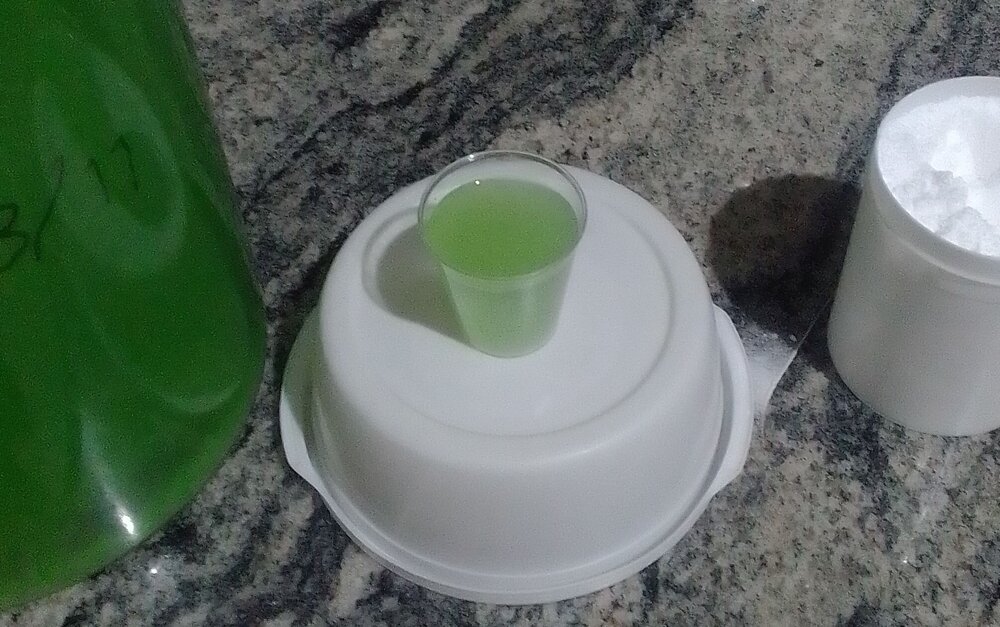
Before baking soda After baking soda Bit of a fizz and little else. After Domestos Moreorless instant change. No dark precipitate.

-
I've been trying to get my head around k-space for a while. It's quite clear that I'm too stupid to understand Wikipedia's explanation, so in desperation, I asked ChatGPT all the dumb stuff that I'd found impossible to follow elsewhere. I know that this is just Physics 101 to most of you (though please feel free to flag any nonsense). What struck me was a) it often seemed able to guess what my next dumb question would be, even prompting me with it. b) it answered those dumb questions with far greater clarity than I expected and at the right level for me to comprehend. I know that the issue with authority remains a critical one. But I still found it a remarkable learning experience. Comments welcome. I began with: Explain k-space and its application to equipartition ChatGPT said:k-space (also called wave-vector space or momentum space) is a mathematical space where each point corresponds to a wavevector k=(kx,ky,kz), which describes a sinusoidal mode of a field or particle in a system. In physics—especially statistical mechanics, solid-state physics, and quantum mechanics—k-space provides a natural way to count and analyze the allowed energy modes of a system. This is crucial for understanding equipartition and why it fails for high-frequency modes (leading to the ultraviolet catastrophe). ✅ 1. What is k-space?A system (like a box of gas, a vibrating solid, or electromagnetic radiation) can be decomposed into normal modes of oscillation: ψ(r)=A eik⋅r. Each allowed mode corresponds to one point in k-space. For a box with periodic boundary conditions, the allowed values of kx,ky,kz are discrete: kx=2πnx/L, ky=2πny/L, kz=2πnz/L. Visually, k-space is like a 3D grid of allowed oscillation states. Because the states are closely spaced when the box is large, one often treats them as continuous and counts states as densities: Number of states in d3k=V/(2π)3 d3k. ✅ 2. Why k-space matters: counting the number of modesMany physical quantities—energy, density of states, thermodynamic averages—require knowing how many allowed modes exist with wavenumbers between k and k+dk. In 3D: g(k) dk=V/(2π)2 k2 dk. This function g(k) is the density of states in k-space. ✅ 3. Application to EquipartitionEquipartition theorem: Each quadratic degree of freedom contributes 1/2 kBT to the energy. For classical waves (e.g., electromagnetic radiation or acoustic vibrations), each normal mode of frequency ω(k) has two quadratic terms (kinetic + potential), giving: Eper mode=kBT. To find total energy: Count how many modes exist at each k using k-space density of states. Multiply by kBT. Integrate over all k. ⚠️ 4. What goes wrong (Ultraviolet Catastrophe)Using equipartition with classical physics: U=∫0∞g(k) (kBT) dk. But the density of states grows as: g(k)∝k2, so the integral diverges: U→∞. This is the ultraviolet catastrophe: classical equipartition predicts infinite energy because there are infinitely many high-frequency modes in k-space. ⭐ How quantum mechanics fixes itQuantum mechanics says each mode has energy: E=ℏω/(eℏω/kBT−1), not simply kBT. At high frequencies (ℏω≫kBT), modes are frozen out (unoccupied). Thus the k-space integral becomes finite: this is the origin of Planck’s law. 🔵 Summaryk-space is a representation where each point corresponds to an allowed wave mode. Equipartition assigns energy to each mode—but because the number of modes grows as k2, the classical prediction diverges. Quantum mechanics modifies the energy per mode, preventing divergence. If you'd like, I can also show: how k-space leads directly to the Rayleigh–Jeans law how density of states is derived from the geometry of k-space how equipartition applies differently in solids (Debye model) Just tell me! You said:How does k-space lead to the Raleigh-Jeans Law ChatGPT said:Here is the clean, standard derivation of the Rayleigh–Jeans law starting directly from k-space. 🔷 1. Start with electromagnetic modes in a boxA cubic cavity of volume V=L3 supports standing electromagnetic waves. Each mode is labeled by a wavevector: k=(kx,ky,kz), ki=2πni/L. Each allowed mode corresponds to one point in k-space. 🔷 2. Count the number of modes using k-space geometryThe allowed k-points form a 3D grid. In the large-box limit, this becomes continuous, and the density of states in k-space is V/(2π)3 The number of states with wavenumber between k and k+dk is the volume of a shell in k-space: g(k) dk=V/(2π)3 ⋅ 4πk2 dk=V/2π2 k2dk. For electromagnetic waves we must multiply by 2 for two polarizations: gEM(k) dk=V/π2 k2dk. 🔷 3. Convert from wavenumber kkk to frequency νLight obeys ν=ck/2π. So k=2πν/c, dk=2πcdν Insert these into the density of states: gEM(ν)dν=V/π2 (2πν/c)2(2π/c)dν. Simplify: gEM(ν)dν=8πVν2/c3 dν. This is the classic k-space density of photon states per frequency. 🔷 4. Apply classical equipartition to each modeEquipartition theorem says every quadratic degree of freedom contributes 1/2 kBT. Each electromagnetic mode has two quadratic terms (electric + magnetic), so the total energy per mode is: ε=kBT. So energy in the frequency interval dνd\nudν is: dU=ε gEM(ν)dν=kBT⋅8πVν2/c3 dν. Divide by volume to get the spectral energy density: u(ν)dν=dU/V=8πν2/c3 kBT dν. 🔷 ⭐ This is the Rayleigh–Jeans Lawu(ν)=8πν2/c3 kBT This predicts that energy density grows as ν2. 🔥 5. Ultraviolet divergence from k-spaceBecause the number of modes grows as: g(ν)∝ν2,, integrating u(ν) to high frequency gives: ∫0∞u(ν)dν=∞. This is the ultraviolet catastrophe—purely a result of k-space mode counting + classical equipartition. Planck solved this by replacing classical equipartition with quantized energy levels. If you'd like, I can also derive: Rayleigh–Jeans law using ω instead of ν, the Planck law using the same k-space method, or a graphical comparison showing how quantization fixes the catastrophe. You said:Can k-space be represented in spherical coordinates? ChatGPT said:Yes — k-space is very naturally represented in spherical coordinates, and in fact this is often the most convenient way to count states because many physical systems depend only on the magnitude of the wavevector: k=∣k∣=(kx2+ky2+kz2)0.5.. ✅ k-space in spherical coordinatesWe define: k = radial distance in k-space θ = polar angle ϕ = azimuthal angle So a point in k-space is: k=(k,θ,ϕ).. The volume element becomes: d3k=k2sinθ dk dθ dϕ. This is exactly analogous to spherical coordinates in ordinary real space — except now the “space” is the space of wavevectors. 🔷 Why spherical coordinates are usefulMost systems (e.g., photons, phonons, free electrons) have energy that depends only on the magnitude of the wavevector: E(k),ω(k),ε(k),etc. So instead of summing over a 3D grid of (kx,ky,kz), we sum over shells in spherical k-space. The number of states in a thin spherical shell of radius k and thickness dk is: g(k) dk=V/(2π)3∫d3k=V/(2π)3 (4πk2) dk. This simplifies to: g(k) dk=V/2π2 k2dk. With polarization for photons: gEM(k) dk=V/π2 k2dk. This expression (arising directly from spherical coordinates in k-space) is the starting point for: the Rayleigh–Jeans law, the Planck spectrum, the Debye model for lattice vibrations, electron density of states in solids. 🔷 Geometric pictureIn k-space: All allowed wavevectors fill a 3D grid. Modes with the same magnitude k lie on a sphere of radius k. Counting states becomes counting the volume of a spherical shell. This is much simpler than counting states in Cartesian coordinates. ⭐ SummaryYes — k-space is commonly expressed in spherical coordinates. This gives: d3k=4πk2 dk, and leads directly to standard mode-counting formulas used in blackbody radiation, phonons, electrons, and any system whose energy depends only on k=∣k∣. If you want, I can show: a diagram of spherical shells in k-space, how the spherical form leads to the Debye density of states, or a comparison between Cartesian and spherical counting. You said:Why doesn't the number of states V/(2π)^3 have dimensions? ChatGPT said:Great question — and the key is that V/(2π)3 is not the number of states. It is the density of states in k-space, and it does have dimensions. Let’s unpack this carefully. ✅ 1. What is V/(2π)3?It is the factor that tells us how many allowed k-states occupy a small k-space volume element: number of states=V/(2π)3 d3k. So it is a density: (states) / (k-space volume).olume). ✅ 2. Dimensions of each quantity◾ Volume VVV[V]=(length)3=L3. ◾ Wavevector kA wavevector has dimensions of inverse length: [k]=L−1. Thus the k-space volume element has dimensions: [d3k]=(L−1)3=L−3. 🔷 3. Dimensions of the factor V(2π)3The denominator (2π)3 is dimensionless. The numerator V has dimension L3. So: [V/(2π)3]=L3.. It is not dimensionless. 🔷 4. Why does the final number of states become dimensionless?Because you always multiply this factor by d3k: V/(2π)3 d3k. Now check the dimensions: V∼L3 d3k∼L−3 So: [V]⋅[d3k]=L3⋅L−3=1 → dimensionless, as it must be, because you’re counting states. ⚠️ Common misconceptionPeople sometimes say “V/(2π)3 is the number of states per unit k-space volume,” but they forget that k has inverse-length units, so the density must carry units. It is: V/(2π)3 with units L3. This exactly cancels the L−3 from d3k. ⭐ SummaryV/(2π)3 does have units: it scales like L3. It is a density of states in k-space (states per k-volume). When you multiply by d3k, the length units cancel, giving a dimensionless count of states, as required. If you'd like, I can also explain: why the 2π appears at all in the first place, how the density changes for periodic vs. fixed boundary conditions, or how this leads directly to the Debye and Rayleigh–Jeans densities of states. You said:Why does 2π appear in the first place? ChatGPT said:The appearance of 2π in the density of states V/(2π)3 comes directly from the wavelength–wavevector relationship and the boundary conditions used to define allowed wave modes in a box. It’s not arbitrary — it follows from Fourier analysis and the structure of standing waves. Let’s go step by step. 🔷 1. Allowed wavevectors come from boundary conditionsFor a particle or wave in a cubic box of side L, the standard choice is periodic boundary conditions: ψ(x+L)=ψ(x). A plane wave inside the box looks like: ψ(x)=eikxx. Periodic boundary conditions require: eikx(x+L)=eikxx⇒eikxL=1. This is only true if: kxL=2πnx, nx∈Z. So the allowed values are: kx=2πnx/L. This is where 2π first appears. 🔷 2. The spacing between allowed k-values isΔkx=2π/L. In 3D: ΔkxΔkyΔkz=(2π/L)3. Thus each allowed k-state occupies one “cell” in k-space of volume: (Δk)3=(2π/L)3=(2π)3/V. Flip this over: density of states in k-space=1/(Δk)3=V/(2π)3. That is exactly the famous factor. 🔷 3. But why is it 2π and not something else?Because Fourier modes are periodic with period 2π. A plane wave has phase: ei(kx)=ei(2πx/λ). The connection between wavelength λ and wavenumber k is: k=2π/λ. This is built into: Fourier transforms complex exponentials orthogonality relations momentum quantization in quantum mechanics If you used a convention like einx/L instead, the 2π would go somewhere else (into the Fourier transform normalization). The physics is unchanged — the 2π is a convention that makes formulas come out clean. But with the standard Fourier basis, the natural spacing in k-space is: 2π/L. 🔷 4. SummaryThe factor 2π appears because: Allowed wavevectors in a finite box satisfy ki=2πni/L from the requirement eik/L=1. This gives a spacing in k-space of Δk=2π/L. Each quantum state occupies a volume (Δk)3=(2π)3/V. Therefore the density of states is V/(2π)3. Ultimately, 2π is baked into Fourier analysis and the definition of the wavevector k=2π/λ. If you'd like, I can also show you: how the result changes if you choose non-periodic boundary conditions, the full derivation from Fourier transforms, or how this connects to quantum mechanical momentum spacing p=ℏk. You said:Expand e^(ikx) into trig functions ChatGPT said:To expand eikx into trigonometric functions, we use Euler’s formula: eiθ=cosθ+isinθ. Set θ=kx, giving: eikx=cos(kx)+isin(kx). That’s the full expansion. 🔍 Optional: Real and imaginary partsReal part: ℜ[eikx]=cos(kx) Imaginary part: ℑ[eikx]=sin(kx) This is why a plane wave can always be represented as a combination of cosine and sine waves. If you want, I can also expand e−ikx, express plane waves as sums/differences of sinusoids, or show how this relates to Fourier transforms. You said:Show how it relates to Fourier transforms ChatGPT said:The identity eikx=cos(kx)+isin(kx) is not just a mathematical curiosity — it is the foundation of Fourier transforms. Here’s how they are connected in a clean, intuitive way. 🔷 1. Fourier transforms use complex exponentials as basis functionsA function f(x) can be decomposed as a superposition of waves: f(x)=∫−∞∞f~(k) eikx dk. This works because the complex exponential behaves like a pure oscillation — it is the combination of cosine (even part) and sine (odd part): eikx=cos(kx)+isin(kx). Thus a Fourier transform is really the decomposition of a function into cosines and sines of varying wavelengths and phases. 🔷 2. Real Fourier series arise by splitting exponentials into trig functionsA Fourier series for a periodic function can be written in two forms: Complex exponential formf(x)=∑n=−∞∞cnei2πnx/L. Trig (sine–cosine) formf(x)=a0+∑n=1∞[ancos(2πnx/L)+bnsin(2πnx/L)]. The equivalence comes directly from: ei2πnx/L=cos (2πnx/L)+isin (2πnx/L). Thus: the real part of the exponential gives the cosine term; the imaginary part gives the sine term. The Fourier coefficients relate as: cn=1/2 (an−ibn), c−n=1/2 (an+ibn). Splitting the exponential form gives the trig form. 🔷 3. Continuous Fourier transform uses the same logicThe continuous transform is: f~(k)=∫−∞∞f(x)e−ikxdx, f(x)=∫−∞∞f~(k)eikxdk. Using the expansion: eikx=cos(kx)+isin(kx), this becomes: f(x)=∫−∞∞f~(k)[cos(kx)+isin(kx)]dk. If f(x) is real, the sine and cosine parts combine to give the familiar cosine transform (even part) and sine transform (odd part). 🔷 4. Why complex exponentials are preferredComplex exponentials make Fourier transforms: much easier to manipulate (differentiation, convolution, phase shifts). more symmetric (positive and negative k handled naturally). compact (no separate sine and cosine coefficients). Using sines and cosines directly is possible, but it explodes the algebra — complex exponentials tidy everything. 🔷 SummaryEuler’s formula eikx=cos(kx)+isin(kx) is the bridge between: ➜ complex exponential form of Fourier transforms➜ sine–cosine form (classical Fourier decomposition)Thus the complex exponential basis used in Fourier transforms is simply a compact way to encode all sine and cosine components of a function. If you’d like, I can show: how differentiation in real space becomes multiplication in k-space, how Fourier transforms relate to the uncertainty principle, or how the Fourier transform is used in quantum mechanics (momentum representation). You said:So the 2π factor arises because there are 2π radians in a full wave cycle? ChatGPT said:Exactly — that’s the deepest and simplest reason. The factor of 2π appears everywhere in wave physics and Fourier analysis because: One full oscillation corresponds to 2π radians of phase. Here’s what that means and why it affects the allowed k-values and the density of states. ✅ 1. A plane wave oscillates by 2π radians per wavelengthA plane wave is written as: eikx. Its phase is: ϕ=kx. After one wavelength λ, the wave must return to the same value: eik(x+λ)=eikx. This means the phase change over one wavelength is exactly one full cycle, i.e., 2π: kλ=2π. Therefore: k=2π/λ. This alone explains why 2π appears in all wavevector formulas. ✅ 2. Boundary conditions → allowed k-values contain 2πFor a box of length LLL with periodic boundaries: ψ(x+L)=ψ(x) requires: eikL=1=ei2πn. So: kL=2πn⇒k=2πn/L. Again the 2π is directly tied to the number of radians in a cycle. ✅ 3. Every “cell” in k-space has volume (2π/L)3The allowed k-values are spaced by: Δk=2π/L. So each quantum state occupies a k-space volume: (Δk)3=(2π/L)3. Then the density of states becomes: 1/(Δk)3=V/(2π)3. This is why the Rayleigh–Jeans, Planck, Debye, and electron density-of-states formulas have (2π)3. 🔷 4. If a different convention were used, the 2π would move elsewhereSome older textbooks define the Fourier transform without the 2π: k=1/λ, or distribute 2π symmetrically in the transform pair. Those conventions shift where the 2π appears, but the physics is the same. Modern physics uses the convention: k=2π/λ because it makes plane waves take the clean form eikx with kx measured in radians. ⭐ Bottom lineYes — the entire reason the 2π factor appears is because a full wave oscillation corresponds to 2π radians. This single fact propagates through: the definition of wavenumber the spacing of allowed states Fourier transforms mode counting in k-space the Rayleigh–Jeans and Planck laws the Debye model of solids momentum quantization p=ℏk It all starts from one cycle = 2π radians. If you want, I can also show how the picture changes if we define the Fourier transform using cycles instead of radians.
-
For the record, I did as you suggested and didn't get the colour change in a container open to the air. The vivid green correlates with acidic, anaerobic, reducing conditions. We may get some indication whether these factors are causal or not in a week or so when fermentation is complete, and I crack open my first bottle. Nigerian accessible aquifers can exceed 10 mg/l Fe so something around a mM solution of ferrous ion is feasible. Don't you love laterite.
-
Whereas I've recently resumed taking an early breakfast to better structure my daily routine (I can too easily slip into a nocturnal lifestyle). Sitting out on my balcony shortly after sunrise with a whole-wheat taco and pot of strong black tea watching the aerobatic display of the dozen or so little swifts (Apus aerobates) that take their breakfast in our courtyard is a real pleasure.
-
I can well believe it.
-
I can get locally grown beetroot here. Steaming them is a bit of a chore, but cold pickled beetroot is one of life's necessities. I've been meaning to have a crack at fermented beetroot. Borsch too. The site has just informed me that I've become a primate, so thanks for that! 😊
-
It complements those mentioned and challenges others. Much of the design process involves the resolution of conflicting specifications. I found the approach of dialectical materialism a very helpful tool here. In contrast, idealist and post-modern thinking would tend I think to lead to lengthy project overruns. Just because it looks right doesn't mean that it is right: but if it looks wrong, then wrong it invariably is. Not always easy to explain exactly how it's wrong but one red flag too many; some niggling lack of symmetry; a certain slapdash character in the detailing...
-
Ascorbic acid is a pretty good oxygen scavenger. Can it reduce Fe III? Afterthought: yes, of course it can! That's why it's used to clean the stains from dripping taps! (Duh!) Perhaps. My ginger goes straight into 40% vodka. There ain't nuffin going to mess with me after that!
-
My thinking too. Which is why I'm curious. No stratification at all as far as I can tell. A thin layer of spent yeast on the bottom It's almost like a (somewhat cloudy) ferrous sulphate solution. We do get pretty high iron levels in our boreholes, and that goes for the raw cane sugar too. But not enough I'd have thought to do... Hang on, those flocs were suspiciously ferric hydroxide coloured... How intense a colour can the ferrous citrate complexes get? Glad to provide the prerequisite boot! 😄
-
Boiling plus lemon juice definitely and rapidly darkens the liquid due apparently to some reaction with the molasses at lower pH I've verified that bit by repetition. This dark brown component flocculates while remaing in suspension, while the continuous phase definitely has a green tinge to it. The day old stuff in the decanter no longer has the dark brown flocs. Since a proper ginger beer plant is supposed have both alcoholic fermentation and a symbiotic(?) Lactobacillus ferment, I added a teaspoonful of sauerkraut brine to the plant when I restarted it yesterday. That too is now developing a distinct greenish shade (though no brown flocs). I''m quite intrigued. I think I'll let this run and see what happens.
-
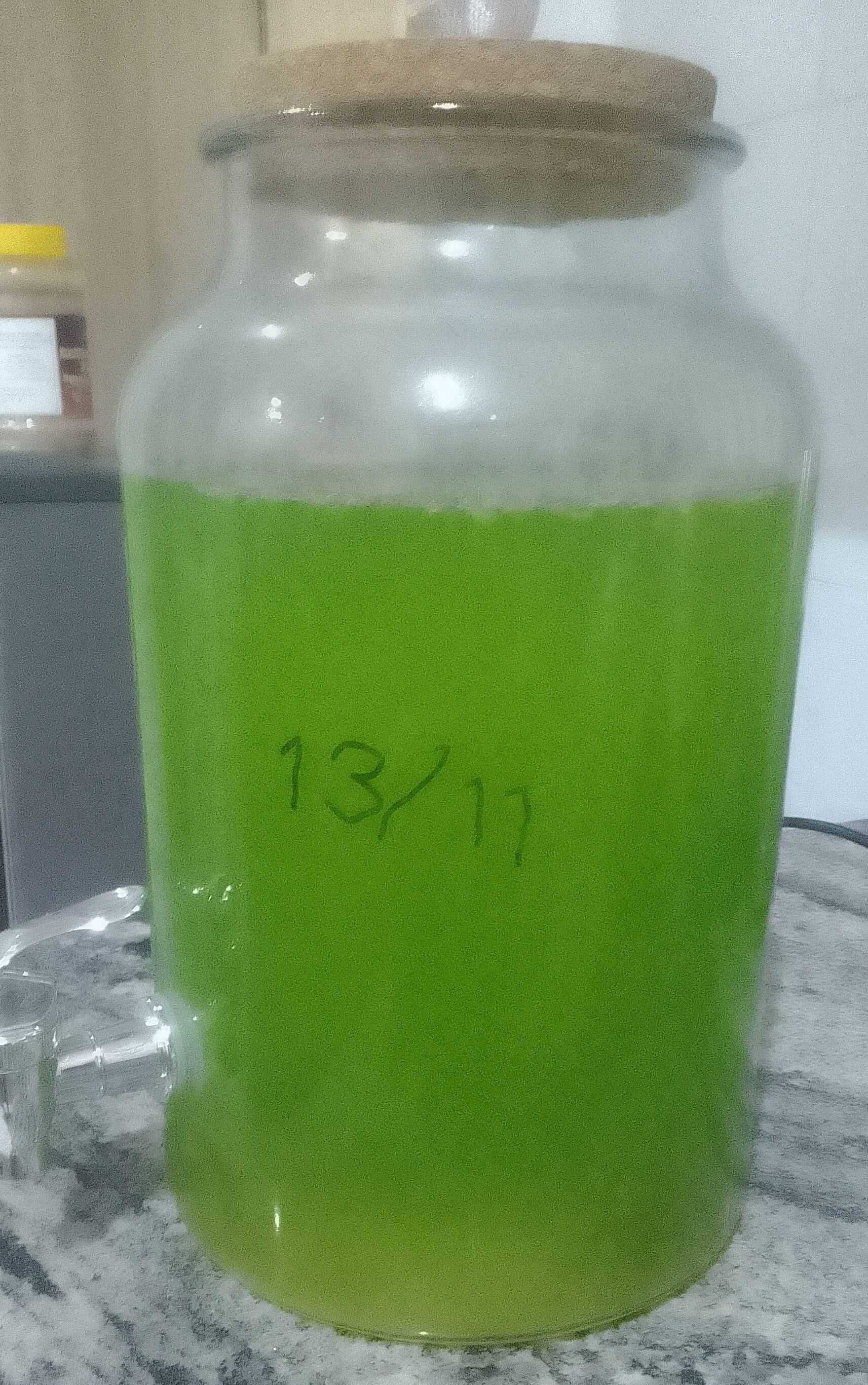
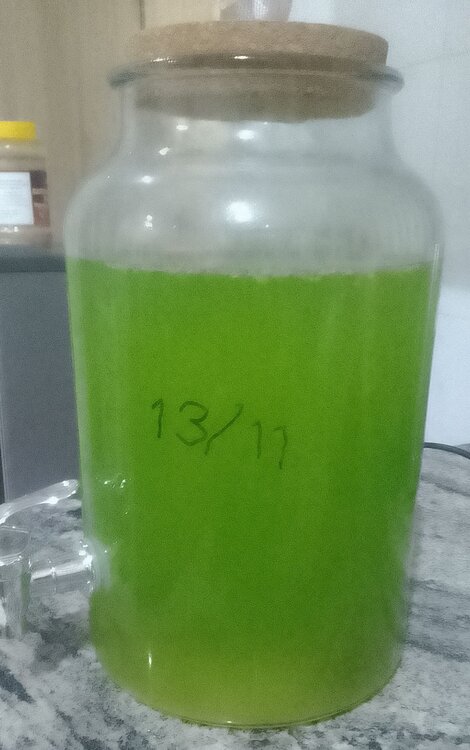
Uniform apple green all the way through. Smells normal. The starter plant was and still is the usual off-white. The sugar was boiled to dissolve and left to cool for an hour or two before I added the filtered starter and lemon juice, and syphoned it into the previously unused decanter. I must say that the sugar solution was a darker brown than expected (see earlier image). I'd have thought 350 g sugar in 4 litres would see off a lot of the competition.
-
Best get it back in the dark room then.
-
Though perhaps @exchemist or @CharonY might be able to explain the striking overnight colour change in my brew: Fermentation appears to be progressing normally. Ingredients are filtered borehole water, fresh root ginger, natural (non-centrifugal) cane sugar, champagne yeast (Saccharomyces cerevisiae ex-bayanus) and, as of yesterday, juice of two lemons.
-
A little earlier. An early breakfast became the norm in England around the turn of the 16th century. Throughout the mid- to late-mediaeval period, it was sneered at by the 'gentry' as being for those who engaged in manual labour in the morning ie. the agricultural peasantry. Bread and beer isn't such a bad way to start the day I think.
-
A similar situation arises in the Sudanian Sahel and Acacia Sahel belts of West Africa where long, practically rainless dry seasons limit land productivity almost as effectively as the boreal winter. This contrasts sharply with the year long productivity of the equatorial coastal belt just a few hundred kilometres to the south where survival depends not on storage and rationing of food and water through lean times, but on defence of the home range. The differences this has produced both culturally and physiologically over the millennia can be quite striking.
-
A single 5.6 litre cork topped drinks dispenser (of all things) appeared in one of our more upmarket shops this week. Gave me the chance to kill two birds with one stone. ... Getting s ginger beer production line underway and piloting my makeshift airlock idea. Seems to work.

-
Perhaps more to the point, if we managed to construct a near perfect z-transform for the universe, it could in principle generate the initial boundary conditions (values of 'fundamental constants'?) necessary to create some arbitrary future state (eg universe lifetime>>10100 years, biology). As it is just maths, and maths does not in principle require a universe to be valid, that perfect z-transform would have some sort of existence at t<=0... Simulpost. Apt since we're into simulations here.