
stephaneww
Senior Members
-
Joined
-
Last visited
-
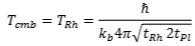
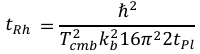
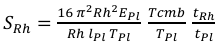
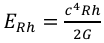
hi everybody in a first time I want to seak about a new approch of cosmoloy wich link H and Tcmb with this formula : In 2015, Tatum et al. proposed an equation for the H and the CMB temperature , noted 𝑇𝑐𝑚𝑏, that as since been formally derived from the Stefan-Boltzmann law by Haug [4] so we also have : then we assume that the entropy at hubble radius should be SRh * 𝑇𝑐𝑚𝑏 = ERh i.e. the total energy include in the Hubble volume I have find this heuristic formula for SRh with ERh =energy density * VRh , you'll can verify that we always have : SRh * 𝑇𝑐𝑚𝑏 = ERh For ERh , you can also use this formula with Rh =c tRh : reference: 4. Haug, E.G. CMB, Hawking, Planck, and Hubble Scale Relations Consistent with Recent Quantization of General Relativity Theory. Int J Theor Phys 63, 57(2024).https://link.springer.com/article/10.1007/s10773-024-05570-6 (PDF) An exact formula of entropy cosmic in Rh=ct cosmological model. Available from: https://www.researchgate.net/publication/394522931_An_exact_formula_of_entropy_cosmic_in_Rhct_cosmological_model [accessed Aug 18 2025].
-
Hello, With MΛRH be the mass of dark energy included in the Hubble sphere at Hubble time tH We still have a dimensional problem because : MΛRH = 2/3 tH3 ... with kilos coming from the calculation of a cube of seconds !!! Note also that this would imply an increase, in the Hubble sphere, of the mass of matter (dark and/or baryonic) with the age of the universe. This does not exist in the consensus cosmological models today. In the same way one always has with a dimensional consistency problem: at tH, ΩΛ = 4/3 G/c3 tH2 These dimensional coherence problems (always with the same ratio with respect to the measurements) may have their origin in our ignorance of what is dark energy. Translated with www.DeepL.com/Translator (free version)
-
hello I would like to know the complete formula to have a precise value of the value of the acceleration of the expansion of the universe (m/s^2) at the Hubble radius in the Lambda-CDM model please ...if possible with an arXiv source, which would be a luxury thanks in advance
-
to be synthetic : S = lPl2 is a surface (= plate for the Casimir effect) 1/S = 1/lPl2 in QFT or 1/S = Λ in cosmology are energies according to their side in the equality of the Casimir effect, their physical meaning is different. I do not see anything more convincing
-
of course there are no plates in cosmology just as Λ was initially used to make the universe static to finally account for the acceleration of the expansion of the universe, 1/S = Λ changes the physical meaning of physical plates. The fact remains that dF / dS keeps the physical meaning of an energy density (or of a pressure if you prefer)
-
once again : in one side S is the surface of the plates, in the other side dF/dS is an energy density in Casimir effect egality
-
Let's see: with : SPl = lPl2 Planck surface 1/SPl = 1/lPl2 = zero point energy of the QFT FPl/SPl = energy density of zero point energy of the QFT the physical meaning is not in doubt here so why would putting 1/S =Λ not make physical sense ?
-
Hello In fact the solution is probably very simple : We just have to pass the surface S on the other side of the equality of casimir effect with : 1/dS = Λ and dF = FPl = c4/G, Planck force We have thus by the same trick as the change of side of the equality for the cosmological constant in the EINSTIEN equation to obtain the energy density of the cosmological constant. We don't need physical plates in the cosmos anymore
-
There was a bit of irony in my question: I don't see how one can invoke 2 plates to talk about the Casimir effect in cosmology. So it must be something else. Λ and lPl-2 are energies expressed in m-2. You don't need to know complex QM terms, nor QM to understand this.
-
ok this is beyond what I know and understand uh, does he use two plates or a space geometry in this approach?
-
ok question : do they need 2 plates for this calculational approach ? I
-
it's not a problem. it is indeed an excessive shortcut on my part. i haven't found any sources in my proposition, cosmologycal constant and zero-point energy of quantum fields are linked to obtain the Casimir effect
-
here : https://royalsocietypublishing.org/doi/10.1098/rsta.2019.0229 you can read the whole article, I didn't take the time to translate it al either it was badly said or it is a problem of automatic translation I refer you to the whole article quoted above here too but I haven't access : https://www.semanticscholar.org/paper/The-vacuum-energy%3A-Casimir-effect-and-the-constant-Elizalde/e0d922a743ae3c2c5ef7cb61cfb391f1fab7fcb3
-
it is simply the interaction of the cosmological constant at the quantum scale (lPl-2). It does not "become" the cosmological constant. The cosmological constant is already in the equality. It is the identification of (1) to (2) that allows to say that we are in the framework of the Casimir effect https://fr.wikipedia.org/wiki/Effet_Casimir#Expression_de_la_force_par_unité_de_surface traduction : Moreover, it is more than likely that the effect also depends on the distance L between the plates. "Probable" does not prohibit another way of presenting L-4 edit : moreover I would be curious to know what L4 represents in nature
-
oops yes indeed it is a pressure or J/m3 i.e. an energy density the units of (1) and (2) of the first post indicate it and are correct they