CharonY
Moderators
-
Joined
-
Last visited
Everything posted by CharonY
-
Not sure whether that is really being under someone's thumb thing or just part of the liberation of the poor multi-billionaire class.
-
Well, yes I do use the command line frequently, but I didn't have to deal with networks for quite a while now. But it is mostly because I got used to it from working with SPARC systems and later linux (mostly for bioinformatic work). Many tools I use are only running from command line, but I take your point, this is not how most folks would use windows. I always tell myself that I am going to install linux onto all my old servers but then I never do and just have huge paperweights. Quite possibly- I honest cannot recall. There was an order to things that did not make a lot sense to me when I tried. If there is really just a tool that you need with it, you could either just make a clean linux install, or perhaps even try a portable version to see if it suits your need. Yeah, that would be nice, wouldn't it? Always comes at a surprise whether you can actually use the hardware you got. Or try a quick fix you find on some fora which takes hours and then breaks something else. Or not.
-
! Moderator Note While the OP is an invitation to some level of speculation, all are based on mainstream chemistry and there is literature that one can use as foundation. As long as the scope does not change it should be perfectly fine to stay here.
-
Linux on older laptops have been a nightmare, usually related to driver issues. That being said, I never found Linux to be a good platform if you intend to only use is it as a graphical OS. The advantages are elsewhere (unless something radical has changed) and quite a bit of it is is that the command line is much more flexible than the Windows command line. Dual booting has been a bit of a hassle, too and while I got it to work on desktops without any issues, it worked maybe on half of my laptops. Usually the issue was on the windows side and I had to re-install it.
-
From a business perspective no. I am not sure whether 30 million were indeed saved by layoffs, but Twitter used to be evaluated around 30 billion (and was bought for more) but by 2024 estimates but it below 1 billion. On the other hand, he is able to use it as a personal propaganda platform and has given Nazis and other folks a home. https://www.nbcnews.com/tech/social-media/x-twitter-elon-musk-nazi-extremist-white-nationalist-accounts-rcna145020 So for him it may have been worth it. Well, in many cases you really just have to follow what is happening. There are heaps of lawsuits, and at the end we can see whether the actions passed the minimum requirement of being lawful. Also there were repeated reports that folks were fired and then they struggled to re-hire them as they did not realize that their roles were essential. If it happens once it is really bad. But there are so many reports that is more like clown car situation. The issue is that even for a company this could be disastrous, but since federal workers render essential and in some cases life saving services, making mistakes like that are really, really bad. Also, if you break things, it is way more expensive to put it back together. When all is done, I will take bets that the overall costs will be way higher than whatever they will save. Especially if we consider cost to the public, in terms of health, safety and essential services. https://www.bbc.com/news/articles/c4g3nrx1dq5o https://www.nbcnews.com/politics/doge/usda-accidentally-fired-officials-bird-flu-rehire-rcna192716 https://www.bostonglobe.com/2025/02/20/science/epa-layoffs-trump/?s_campaign=bostonglobe%3Asocialflow%3Atwitter&utm_campaign=Globe_Twitter
-
There is a big difference in what folks claim to have done and what they have done. If you always claim more than you do, you are wandering into con territory.
-
That is pretty much known not to work. And no, the truth is going to lose out eventually in the social media landscape as the truth is usually less emotionally engaging. And emotions is what ultimately fuels and monetizes social media. Traditional media had its own problems being largely concentrated in few powerful hands, but now their role is further diminished. Information flow is driven by individuals and their emotions now. And a big part of the problem is that I have yet to see good approaches to address that. Most attempts (e.g., better education) are still based on (IMO) outdated assumptions. I feel that this line of inquiry deserves a separate discussion thread, though.
-
Yeah, the lionization of folks was (IMO) already tasteless then. And as it turns out I have little evidence for genius level intelligence and only some against- which is my broader point. Given lack of evidence, an assumption of average or above average is usually a good starting point. The examples I have seen of him discussing a variety of topics (though they might be biased) do not provide any evidence to suggest otherwise. Now talking about his broader life history, from what I read it does seem that a) his family wealth has provided him with ways to explore opportunities and b) he does have a knack to convince folks to give him money. But again, I don't see that that this necessarily requires high sophistication. For example, Trump was able to convince people to invest in him by pretending to be richer, in part by impersonating a fictional publicist to boost himself. I.e. being shameless goes a long way in grifting. What is even worse, in areas where he claims to have expertise (e.g. in programming, as that was where he initial made seed money), he really seems to flounder. That leaves soft skills on the table, such as leadership and communications. He might be above average in both, though there is a lot of celebrity cult going on there where it is really difficult to figure out the actual achievements. Not that any of that is terribly important, was we see clear ineptness played out in plain sight. This is not to say that geniuses (of whatever sort) always display competence. Often, expertise is found within a narrow range and whatever he is doing now is clearly outside of it.
-
From one of the links regarding his upcoming biography: It seems that there is really no evidence of an actual test.
-
Occam's razor, if there is no evidence of genius, why assume it? There are currently dozens of lawsuits exactly trying to stop it. Going through courts is a slow process. A big issue is that he is being used as a wrecking ball by the GOP and a disposable at that. If things go wrong (which they likely will, given the lack of competence), they can always say that he was just an outside advisor and try to wash the stench off him. If for some reasons his actions prove to be liked by the public, they can wear the success, too.
-
There is still no evidence of scientific acumen. Also, he is not working as a scientist. You got jerk and wrecking things right, though. In other words you merely use the shaky moniker of genius to justify his bad sides, including being a Nazi.
-
Fair enough and expanding perspectives is certainly not a bad thing.
-
! Moderator Note As noted, please provide a summary of some other basis for discussion, instead of pointing towards a pdf. As major elements do not seem to follow mainstream physics I have moved it to speculations. Please take a moment to read some of the guidelines for posting and discussing speculations.
-
I think my perspective is a bit different from yours and the author's. I am less worried about decisions and quality of individual politicians (which, I must add, is certainly worrisome in itself), but I focus more on the overall system and the population. I think one assumption that quite a few moderate politicians have is that once the folks like Trump and Musk are gone there will be reckoning and subsequent to a status quo before they came into power. A kind of of normalcy, if you will. However, I do think we are in a new normal situation. I have ranted on modern information systems quite a bit a few times, so I will spare you that, but I will say that the current system and the prevalent misinformation is fuel for especially radical right wing ideologies which have gained tremendous power over the last decade. I.e., I think it goes way beyond Trump his cronies and a bunch of scared, self-serving sycophants. First, we will have folks that support it out of fear, then, we will have folks do the same thing, but with conviction. Some of these elements we have seen played out with the tea party, and I think the trend has accelerated (and again, is broader than just the North American continent). If we do not deal with it on a systemic level, I fear that there will be no reversal of these agenas.
-
I think I have seen it, and read excerpts but it looked all very handwavy to me. I.e. it didn't really inspire me to invest into it. There was little science that I could recall. I found it mostly trying to justify his perspective, which would be fine, but lacking scientific rigor to actually bring something new to the table. It seems to be heavy with regard to wondering about stuff, which is fine, really. But it is light on the actual intellectual work, which is a red flag to me, especially if someone in any way claims to revolutionize something.
-
Yeah, no wonder that he is against pronouns. He likely just doesn't understand the concept of language.
-
I think the idea is for male white straight and loyal guys. We gotta keep the talent pool as shallow as the intellect.
-
I wished that was true, but in my gut I feel that we have gone down a road that is not only difficult to reverse, but it is also no longer linked to just one person anymore. I think of it more like digitally distributed cult, which is way worse.
-
Exactly. I think that calling it a pathology is severely misleading. It gives a false sense of security that only folks with this condition will do horrible things. Rather, it is something that most of us are capable of doing when in similar positions of unchecked power. Conversely, this means rather than focusing on individuals, it is more important to create a system that is resilient against corruption. And I think anyone with a shred of honesty knows the answer to that question. As others have mentioned, it depends on how one defines genius or brilliance. He is good in getting money, suggesting some level of people's skill. However, when we talk about intellect, at least in public there is little evidence of that. The main evidence is that he has tons of money and that is being praised by folks who, incidentally are dependent on him. While he might not be a total moron, there is overall little evidence that I have seen that suggests any sort of genius level of intellect. Incidentally there is an upcoming biography scrutinizing his intellect: https://www.thewrap.com/elon-musk-biographer-says-no-evidence-billionaire-has-intellectual-achievements/
-
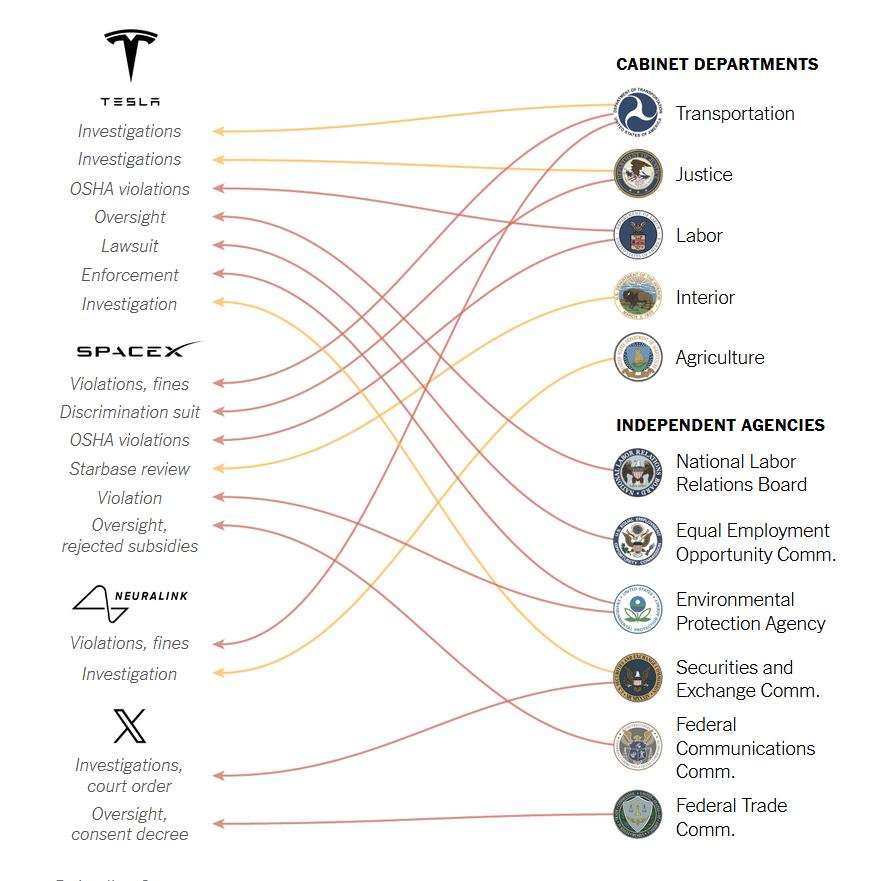
Also scrapping oversight (from the NYT). Some of which has already happened. Especially as they have repeatedly shown to just blatantly lie https://www.cnn.com/2025/02/19/politics/doge-canceled-contracts-8-billion-invs/index.html. If they had any good intentions, honesty would be just the barest minimum. And they cannot even pass that threshold. Also one important thing to understand, DOGE was set up as a pure advisory committee, which has certain requirements and limitations. A proper community with operational functions would be under more stringent oversight. https://en.wikipedia.org/wiki/Federal_Advisory_Committee_Act As we can see that in practice DOGE, pretty much doesn't act like an advisory committee by asserting a range of powers, including firing folks.
-
Attention is part of it I think, and consumerism another. Opiate for the masses, so to speak.
-
I do wonder though how much of the "savant" part is facilitated by generational wealth.
-
Mexico was not considered, their skin color has the wrong shade. Canada would likely just become feral and with plans to burn down the White House again.
-
In contrast to Musk, I am actually a professional scientist and colleagues have commented that I have an interesting approach to the concept of sanity. Not once did I feel the urge to throw out a Hitler salute. Being in a position of power does not equate being a genius. I would like to see you make a good argument that Trump is one. Also, what you say is basically they are good at being con men. Which mostly requires you to have a gullible target group that you can con. While these are all mechanisms helping money to go to the top, it is not even entirely necessary as a proximate mechanism. Rather, it can be an outcome of a change in the relationship between labour and capital and how the resulting outputs are distributed. For example, if investment goods (e.g., machinery, automation, computers) are getting cheaper there might be an incentive to invest more into them then into labor cost, which reduces the share of labor shares. And this can be accelerated if those investments, or e.g. something like software, increases productivity of capital investments. Couple that with capital mobility and resulting loss of labor bargaining power. Even if a company was led ethically, the way the market works simply incentivizes activities that reduce labor income and increase capital income. Cripple that by adding regressive tax models, and the process only accelerates. It is so funny, or sad, when academics are doing that. I mean, if your suit is from Men's wearhouse you are not part of the elite.
-
Considering he is also still blaming Obama (e.g., recently for the plane crash), one would need a very deep breath indeed.