
Genady
Senior Members
-
Joined
Everything posted by Genady
-
It was referred to as "Red Army" in reference to events which occurred before the end of WWII. It was referred to as "Soviet Army" in reference to the later events.
-
Perhaps, in the West, but not in the Soviet Union. There, it was referred to only in historical terms.
-
There was no "Red Army" in Afghanistan in 1980-1985.
-
There is an important, albeit not often mentioned, requirement for a coordinate system, without which one real parameter would've sufficed to specify any point in any dimensional manifold.
-
My Dutch friends here also have cancelled their plans to visit the US, because of him.
-
Guidelines - Science Forums: "members should be able to participate in the discussion without clicking any links"
-
Most people know nothing about how gravity works or doesn't work and thus they don't have any way to know that this conspiracy theory is not true.
-
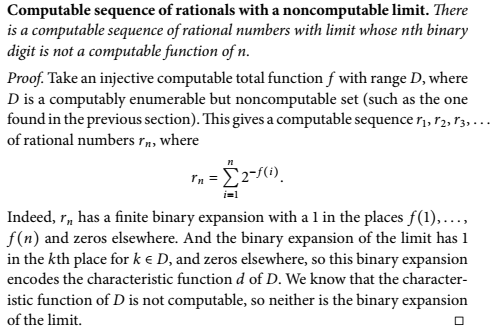
The sequence [math]r_n=\sum_{i=1}^n 2^{-f(i)}[/math] is increasing and bounded, thus it converges.
-
This is a proof of a statement in Stillwell's "Reverse Mathematics", p.77: My question is, how do we know that the sequence [math]r_1, r_2, ...[/math] converges?
-
A new direction of thinking has appeared recently in a discussion of this question. During the discussion, it has been noticed that Black coral - Wikipedia says, "The corals derive their name from their black skeletons, which are composed of protein and chitin," which has brought up this response: "which are composed of protein and chitin Your answer is in there somewhere. The laying down of the components has to have some electrical or chemical offset that produces the coiling. Probably not from the helicity at the nano scale of assembly. Cellulose does the same twisting for plants - is vines. Here is some discussion of chitin on the nano to macro scale, regarding colour, iridescence of insects and the like, and colours from cellulose in plants. As well as twisting - macro needs more research to explain it all. https://hal.science/hal-04202351v1/file/Adv Funct Mat 2023_M Mitov.pdf" The previous hypothesis has focused on development of the coral polyps. This new direction rather focuses on development of the coral skeleton.
-
Thank you!
-
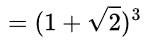
Yes, it does. Here is the next step (attach this to the previous chain of equalities): Yes, I see what you mean. BTW, would you please remind me of the tags/delimiters for inserting LaTeX in SFn?
-
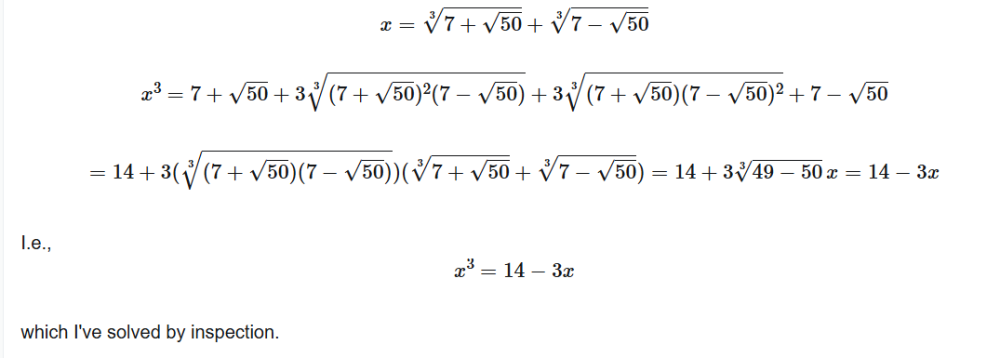
This is the same as how I've solved it: So, x=2. Then, somebody has showed me different way. I'll give you a hint: (I make these LaTeX expressions outside because I don't remember what the tags in SFN are.) However, these are not solutions.

-
If it is, this will be a third way 😉.
-
Yep, that's the only way I know. How about the one above it?
-
And another one, the last one of this kind that I seem to remember: Find two 4-digit numbers that multiply to give 4^8 + 6^8 + 9^8.
-
Here is another puzzle from the "Without a Calculator" set: I know of two different ways to solve it and I'm curious about your way.

-
This is correct.
-
Yes, 216 is specially related to the other numbers in the puzzle.
-
I got this nice little math puzzle elsewhere. I got it with a hint but try without the hint first. Here it goes: P.S. Without a calculator, of course.

-
'Oh, you aren't even ripe yet! I don't need any sour grapes.'
-
It appears to be quite simple:

-
I got the answer - Robinson arithmetic - Wikipedia.
-
Yes, the galactic North Pole and our North Pole do not coincide, but this doesn't change the sense of rotation. Important fact is that the galactic North Pole lies in our northern hemisphere. AFAIK, our galaxy rotates clockwise as viewed from the galactic North Pole. This is what I remember from my astronomy class years ago.
-
It doesn't sound right. Anyway, here is how it looks: