
Genady
Senior Members
-
Joined
Everything posted by Genady
-
The physicist–philosopher Ernst Mach (1838–1916), who spoke of “the artificial hypothetical atoms of chemistry and physics,” never accepted their existence. As late as 1916, shortly before his death, he declared that “I can accept the theory of relativity as little as I can accept the existence of atoms and other such dogmas.” This goes to show that a scientist can maintain his own principles, bravely holding out against a wide consensus of the scientific establishment, and still be wrong. Weinberg, Steven. Foundations of Modern Physics (p. 58).
-
It is good for public support and perhaps for funding.
-
Three. Years 1-4, 5-8, and 9-10. All three were good and different.
-
This is very good point. Unfortunately, most people (in my anecdotal experience) have this image of math thinking being 'algorithmic' / 'logical' / 'sequential' / 'linear' / etc. Regarding the trial and error, my math teacher had rules of working on math problems, such as: - don't use notebooks, use loose sheets of paper instead, so you can spread them around on the desk or on the floor to see and to come back to your trials, errors, and partial or intermediate results; - use only one side of a sheet of paper, so you can see all your work without turning a page; - never erase what you tried; use a pen, not a pencil; ...
-
The down quark field interacts with the up quark field and the W-boson field transferring to them its energy and momentum.
-
I wouldn't know about it if not for this footnote in Zee, A., Einstein Gravity in a Nutshell:
-
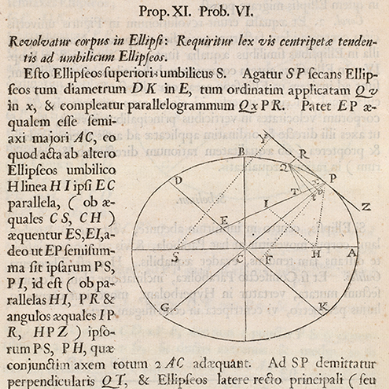
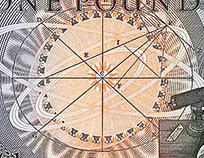
Here is the Newton's original drawing, which the banknote artist has copied: How is your Latin? Anyway, the artist has added the background and in it, he placed the Sun exactly in the center of the ellipse, where the major and the minor axes intersect (the point C). This is where the Sun cannot be. By the Kepler's first law, and per Newton as well, the Sun is in one of the foci (the point S). PS. In the earlier hint ("Hint: focus on the geometric drawing.") the word "focus" was the hint.
-
Simpler, simpler. Where is the Sun?
-
It is quite elliptical:
-
Sorry, if you mean the angles between the orbit's planes, you're right, they are too wild for the real planets in the Solar system. Still, there is something else, more fundamental wrong.
-
No, something else is wrong. (The orbits might be viewed at the angle.) Hint: focus on the geometric drawing.
-
-
Were they? Space Shuttle Solid Rocket Booster - Wikipedia
-
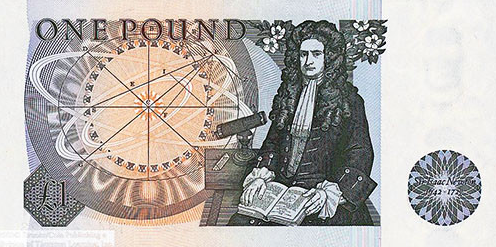
Something is off in this image on the back of an old British one-pound note, scientifically speaking:
-
This is not my default assumption. To start with, it is not true that "Google estimates that 4 to 10 thousand advertisements are seen by a person on a given day." The truth is that if one googles this question, then one gets this answer. Where these numbers come from? Here is an interesting story, How Many Ads Do We Really See In A Day? Spoiler: It’s Not 10,000 | The Drum.
-
I suspect that the critical word is "Pastor."
-
I am not sure why to call this a head. I'd say it has its eyes, brain and the mouth in its torso.
-
That URL does not work for me, but this does: https://static.wikia.nocookie.net/powerlisting/images/2/29/GAN21961.jpg/revision/latest
-
Yes, the method has changed. The WAGing has not.
-
-
Could help to have more than two pairs of appendages. E.g., insects.
-
In the late 400s BC Democritus proclaimed that “atoms and void alone exist in reality.” He offered neither evidence for this hypothesis nor calculations on which to base predictions that could confirm it. (Weinberg, Steven. Foundations of Modern Physics.) 2500 years later: Speculations must be backed up by evidence or some sort of proof. If your speculation is untestable, or you don't give us evidence (or a prediction that is testable), your thread will be moved to the Trash Can. (Speculations Forum Rules.)
-
It was Russian literature in my case. We read a lot! Some of the books, that most of you guys perhaps know about, were: War and Peace - Wikipedia Anna Karenina - Wikipedia Crime and Punishment - Wikipedia The Idiot - Wikipedia The Brothers Karamazov - Wikipedia Dead Souls - Wikipedia The Prisoner of the Caucasus (poem) - Wikipedia Eugene Onegin - Wikipedia
-
Saw this article, Computer Science Is No Longer the Safe Major - The Atlantic and realized that it was Not Yet the Safe Major when I decided to take it. It was then a brand new, just opened, never existed before major in the university I was applying to, and as I struggled to decide which major to take, this sense of adventure made it to stand out for me.
-
Mathematical models do not have such limitations, IMHO.