Genady
Senior Members
-
Joined
Everything posted by Genady
-
Except the Dutch: (Natural Selection May Help Account for Dutch Height Advantage - The New York Times (nytimes.com))
-
Let's try "reverse engineering". The trigonometric solution gives an exact angle, x=12 degrees. It still seems to hint to a geometric solution. Here is another "conspiracy": 12+18=30, 48-18=30. Any new ideas?
-
Unfortunately, in spite of noticing that angles' "conspiracy", I don't see how to use it in a drawing /construction. On the other hand, the "analytical hints" from @studiot's post above lead to the solution quite directly.
-
I don't know. I hope for the latter.
-
Yes, of course. As long as we're clear about the RFs.
-
In my reference frame you don't have free will, and I know that in your reference frame you do. In my RF I have free will, and I know that in your reference frame I don't. There is no paradox as long as we are clear about the reference frames in question. I can talk about your free will when I refer to your RF and about my free will when I refer to my RF. It is very similar to Alice watching Bob falling into a black hall. In Bob's reference frame he passes the event horizon in a definite time. In the Alice's RF he never does. Alice knows that in his RF Bob crosses the EH, although in hers he does not. Bob knows that in Alice's RF he doesn't cross EH, although in his he does.
-
As to so many other questions in physics, an answer to the OP question depends on a reference frame. In this case, there are two types of reference frames with different answers, external and internal. An external observer can, in principle, observe a neuronal machinery working according to the laws of physics and leading inevitably to a decision. There is no room for free will in this reference frame. On the other hand, an internal observer, who is busy with making a decision and thus who even in principle cannot be occupied at the same time with observing the neuronal machinery, makes the decision according to their free will. Just another instance of "Alice and Bob".
-
I have been following this "invasion" for many years as well, starting with the very first appearance of the very first lionfish in our waters in 2009. Our Marine Park management got seriously involved in the research and in the population control attempts of lionfish. They organized many presentations by scientists as well as by other parties interested in this development. And I have witnessed the process directly under water over the years. "Long term" is the the only issue because there is no stability or balance state of the ecosystem in short term. Every year is different, with or without lionfish. One year, there are unusually many barracudas, other year - "flamingo tongue" snails cover soft corals everywhere, yet others - lobsters, ctenophores, floating sea weed, mass moray die off, etc. etc. There is no base line to compare against in a short term. The ecosystem is highly dynamic and "disruptions" is a norm. That lionfish got from Florida to Carolinas is understandable. The Gulfstream pushes them that way. But how did they get to the Southern Caribbean? It's a long swim against current...
-
I think this problem can be solved by geometrical constructions rather than generically using sine rule, because the numbers, 48 and 18 degrees, have a specific property: on one hand, 48+18=66, on the other hand, 180-48=132=66x2 could be two angles of 66 degrees of an isosceles triangle with one angle of 48 degrees.
-
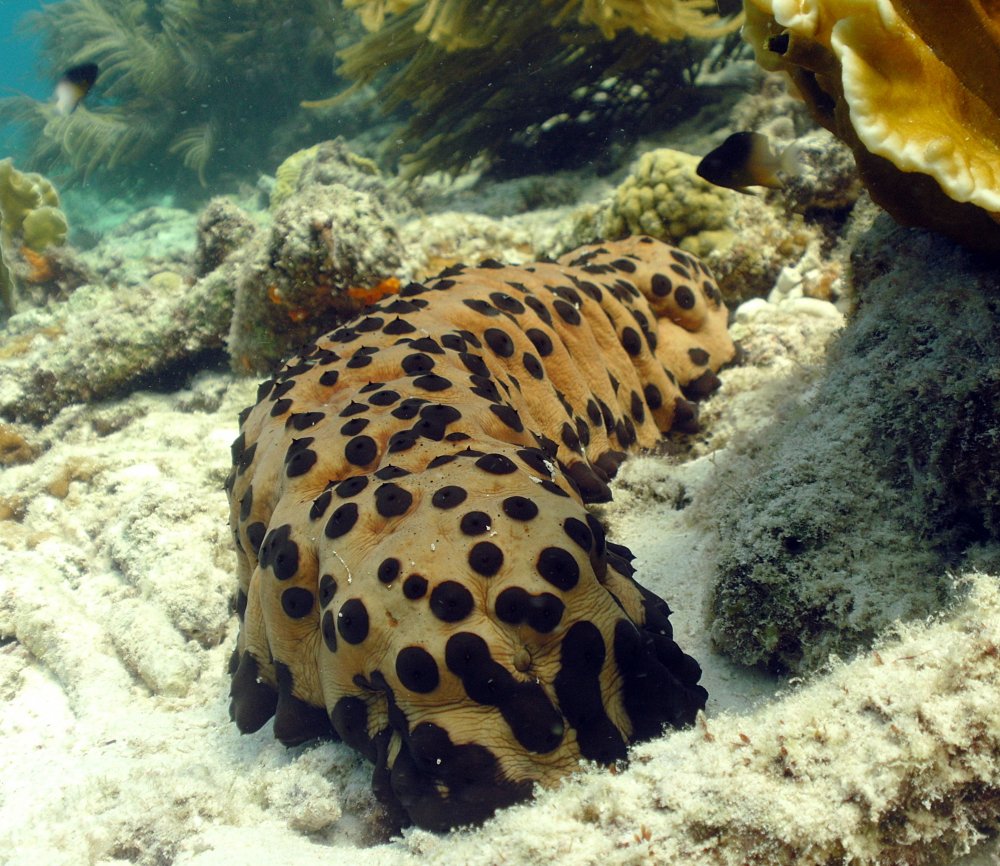
This is not a caterpillar. This is a sea cucumber, about half a meter long. I don't know if it is poisonous, but the coloration might suggest so. Or, mimicry.
-
After obtaining the original report in the NE Journal of Medicine I see that there is no determination of the source of the infection. The only two mentions of the meal are: and So, yes, as @CharonY said above, the articles in the popular media misrepresent this case claiming that the source of the infection is known to be the leftovers from the restaurant meal. (It is not only the article that I've linked in the OP, there are more like that.)
-
Thank you for the correction. Do they know what the source of the bacteria was?
-
There were several posts recently about food safety issues. The following recent case might be of interest in this light: Student had legs, fingers amputated after eating leftover Chinese (nypost.com)
-
There are many good textbooks on physics. They can teach a lot.
-
You are certainly right and the phrase, "if you take this position" is a key part. Here is another position, which I've expressed several days later, These are two of possible consistent positions (not 'my opinions').
-
There is a 'religion' and then there is a 'science of religion'. The former is taught / preached in churches, temples, etc. The latter is defined as, (Science of religion Definition & Meaning - Merriam-Webster) and is taught in educational institutions, e.g. here. It is only appropriate for this forum, being a science forum, to restrict discussions on religion to the latter.
-
Did you know that there is no heaven and hell in the orthodox Judaism, no life after death, God is not a pleasant character, and he doesn't care if you believe in him or not?
-
You are absolutely right. A dog person here. Even if I don't have free will, they pretend I do. But I know what you mean. My daughter used to be owned by a cat
-
Here is a study of the lionfish invasion discourse evolution. Turns out that even back in 2015 I was not alone in my doubts, although in a minority. I also represent the "local knowledge" that started to correct the often baseless initial claims. Carballo-Cárdenas-E..pdf (ncsu.edu)
-
So, my neurons, my action potentials, my transmitter concentrations, my blood pressure, etc. made me to decide what I've decided. This is correct. On the other hand, my neurons, my action potentials, my transmitter concentrations, my blood pressure, etc. taken all together IS me. Thus, it is me that made me to decide what I've decided. Isn't this a free will?
-
This is a good clarification, which may solve the apparent contradiction: We don't have a free will in a mathematical sense because the outcome of the decision is determined by the preceding state of the universe, but - We do have a free will in a physical sense because the outcome of my decision appears in my mind before it appears anywhere else. All decisions I take are a result of my past and the way I process the information ... This IS a free will!
-
In the words of Gerard ’t Hooft, it is determined but not pre-determined. There is no way to know what will happen before it in fact happens.
-
Sorry, decided not to reply. Deleted.
-
Yes, we do.
-
I'm reading "Number. The language of science" by Tobias Dantzig. Published originally in 1930 and recommended by Albert Einstein. Very pleasant read indeed. One observation I want to share is, that with regularity the author makes little remarks like this: It seems that "these people" annoyed him very much then, 100 years ago, long before Internet.