
joigus
Senior Members
-
Joined
Everything posted by joigus
-
We might agree on more than you think, if we clarify our respective definitions. Following literally in your defining footsteps, pigeons --or some kind of Kaspar Hauser, for the purpose of making it a person-- are/were/would be atheists. They don't believe in god, even though they're clueless about it. But we need a definition. In a wider sense, I would say there must be both nature and nurture factors in determining how gullible a person is. I very much agree with, But I also think, eg, that a person with StPD would be far more likely to believe in all kind of supernatural things than a person whithout such condition.
-
LOL. I suppose it's very much about how much stock you put in it. I could become a bigendian --or a zilchist-- in a matter of seconds if my life depended on it.
-
The way I see it, you certainly need a certain amount of exposure to the concept in order to be able to tell whether you believe in it or not. Suppose you arrive on a planet where a furious debate is going on about the concept of 'zilch.' The first thing they tell you upon your arrival is: 'Hang on, are you a zilchist or an azilchist'?
-
Depends on what you mean by an 'atheist'? Are pigeons atheists? They certainly aren't religious. I'm guessing when we say 'I'm an atheist' we're refering to some kind of criterion based on a previous framework of ideas.
-
Working with youngsters gives you the plasticity of some kind of psychological amoeba. Your environment --as I see from your last post-- has been completely different. In my own words: From:
-
Very similar feeling here. If nothing else, forums like these help me keep working on it and adding consistency to a building that's bound to end up failing. It's like taking a look into a room that you haven't visited for a long time. I hope that something called wisdom emerges finally. Sometimes I feel that flexibility does the job much better --where I stand now-- than rigidity. Something like collagen for my aging cells?
-
I always try to apply simple formulas. One that works for me is: Mean well and everything will take care of itself when a misunderstanding appears. For example: Don't be disingenuous, and eventually it will become apparent that you aren't. I never got the impression that you were being disingenuous, or 'looking like an idiot' either, BTW. A nice PM clearing the air does wonders too. I make many mistakes, including those having to do with probing my own understanding, so how could I blame anyone?
-
Trying to summarise: We need something massive/abundant enough. We need something that doesn't interact at all in any other way, except gravitationally. We need something that clusters significantly --very unlike photons, has some mass--, but not too much -> little dissipation --very unlike ordinary matter. From what I gather, this leaves no alternatives but: (1) Exotic particles that are not coupled to anything in the standard model and are massive, copiously produced during the big bang, or combination of massive and copiously produced, so as to yield the desired gravitational effect. And stable once they've been produced -> existence of lightest exotic particle. Or --a quite conservative, but more compelling idea, IMO, (2) Massive right-handed neutrinos that give a very small mass to the left-handed neutrinos as per see-saw mechanism, via interaction with the Higgs + plausible mechanism why one of the 3 RH neutrinos cannot decay. The first alternative requires going beyond the SM in a significant and adventurous way. One would have to find different fits with mass/abundance to make it work. The second one requires generalising the SM ever so slightly. And there exists a proposal for it that's being developed and which predicts that one of the three LH neutrinos must be massless. N. Turok, L. Boyle, K. Finn et al. https://arxiv.org/abs/1803.08930 https://arxiv.org/abs/1803.08928 https://www.youtube.com/watch?v=d-hPmjjjC-I (Public Lecture) I hope I didn't forget anything important.
-
My best guess would be both atheism and religion are learned. But I also think there must be* genetic and early-environmental factors (pre-natal, natal, perinatal) having to do with how likely it is that you develop into one or the other. Let's see what the experts think. * Meaning: I wouldn't be surprised at all if there are.
-
(The answer in my emphasis.)
-
In the case of wave-particle duality, there doesn't seem to be the words to subtitute them. Speaking from personal experience, it feels like people have given up on trying to understand this double nature in terms of old concepts, and prefer to say things like 'quantum behaviour,' 'quanta,' and the like. Another interesting case that can perhaps be subsumed here is when people realise that something that seemed very special is but a particular case of a more general phenomenon. In field theory, eg, the word 'charge' was reserved for 'electric charge,' while people who work in field theory today tend to call anything that's conserved 'Noether charge' or just 'charge.' For these people, energy, momentum or angular momentum components, etc, are just 'charges.' It tends to make life easier when the context is understood by everybody in the field. I'm not a language determinist, BTW. I think it's more of a two-way connection. Sometimes language affect our thinking, other times it's our thinking that ends up being affected by the way we think.
-
Oh, and the list goes on and on. There is no 'quality time' in scientific English, but in regular English, there is.
-
LOL. Another way of saying 'heavy.' There is also a curious effect that's more horizontal --discipline to discipline-- than temporal. I think your example of 'metal' has a horizontal component to it. Eg: Physicists use 'reversible' with a different meaning than chemists do. For a physicist, 'reversible' means the process is infinitely slow, and every intermediate state is one of equilibrium, while chemists may use it in that sense when discussing thermodynamics, but definitely often use it meaning that a chemical reaction is completely displaced in one direction. Biologists too.
-
Another interesting shift in nuances is: Gauge invariance -> Gauge symmetry -> Gauge ambiguity I've even read and heard pronounced the expression 'gauge junk.' That's probably because, while we think we understand very well what heat is about, in the case of gauge ambiguities it's not so clear. So you have to write down the equations to comply with an apparently beautiful and simple symmetry principle, and once you start your calculations you have to throw away half of it because it's junk? What's that about?
-
You definitely should. The very reason why there are gauge fields is better understood in terms of the Lagrangian formalism. It's a beautiful language to express every fundamental physical theory we know. It also makes hard problems look simple. The downside is perhaps that it's far less intuitive than thinking about forces of different kinds. Another downside --and a very big one, mind you-- is that systems with dissipation are not possible to describe by means of Lagrangians. That's because friction is an emergent behaviour.
-
There's so much one can do with words. As said above, a system stores energy, not heat. It can give it out, off or away by means of work or heat exchange. Words in science are as good as the mathematical concepts they help us remember, the precise experimental operations they represent, etc.
-
Neither do I. And I can assure you I won't. Absolutely. I would even go as far as to say that there are several assumptions that are unphysical in my picture. In my 'defence,' my attempt was not meant to illustrate how real wind behaves. A spatially-confined gust of wind that's hitting a wall obviously does not correspond to my simpleminded 'model' of particles coming from -infinity and bouncing off an infinite wall, back to -infinity, while keeping completely parallel to each other. It's just an illustration of how a continuous supply of particles hitting a wall at a certain velocity will transfer momentum per unit area, but you have to give up on F=ma, not because it's any the less true, but because that relation is not the one that's useful. What's useful is transfer of momentum per unit area per unit time. Unfortunately, my model cannot be made consistent with the continuity equation, which I now realise after having thought about it for a while --even if it gives the right result by tinkering with the numbers. I think Studiot is thinking of a slightly different setting than you are, with no ground to sustain the wind so as to produce eddies, as you have pictured. But maybe he will be willing to ellaborate on that. I do believe @Boltzmannbrain has probably understood the main point, without getting bogged down in finer details of zero-velocity areas, stationary currents circulating, and the like, of which I'm --partially, at least-- guilty. The take-home lesson is: A continuous supply of particles at speed v, and constant density d, hitting a wall, will exert a force on a wall that's more simply expressed as proportional to dv2. The calculation of the dimensionless coefficient being a matter of correctly applying fluid mechanics. What's going on is transfer of momentum. Shall we leave it at that? I am happy with that, at least, for the time being. But if you want to discuss more, I'll be happy to take a back sit and learn --or refresh my memory-- a little more.
-
There is the possibility that I made a mistake. Let's see what other people have to say. Now that I think about it, it's not so clear the the continuity equation is satisfied at the point of hitting the wall. \( 2v\rho \) mass per unit area per unit time is hitting the wall, while only \( v\rho \) mass per unit area per unit time is bouncing off. There seems to be a mismatch. Qualitatively, it's clearly all about transfer of momentum, which in this case is better looked upon in terms of mass flow and individual momentum transfer per particle. Getting the constants right is another matter. I'll probably have to think about it some more when I get the chance. Anyway, it's just fun thinking about these problems.
-
Not really. But you can make it one. I'm sure you've taught a teenager at some point in you life. If you want to share your recollections/conclusions on a new thread I, for one, would be interested.
-
No. Sometimes infinity appears in a mild form, that can be tamed. That's why we teach those instances to teenagers (eg limits.) Other times it's like you say. Still other times finite problems are every bit as difficult. And quantum superpositions are not superpositions of 'real' and 'imaginary.' What are you on about?
-
Just another WAG.
-
I'm OK with that. Every time mathematicians publish a proof, there's a time period during which the jury is still out. Another caveat on terminology though. Mathematically-minded people like to say 'QFT is a functor' --thereby 'functorial.' This is a concept in category theory. People also say 'action is a 'functional' --a function of function that produces a number. Those are very different concepts with very similar terms, so it's necessary to tread carefully.
-
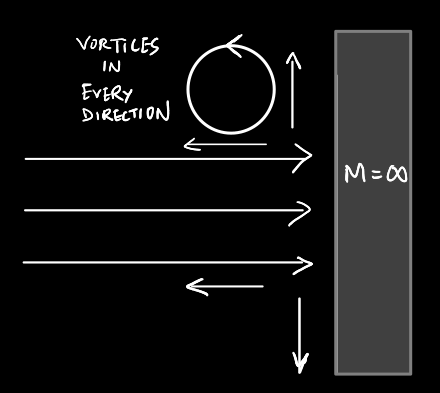
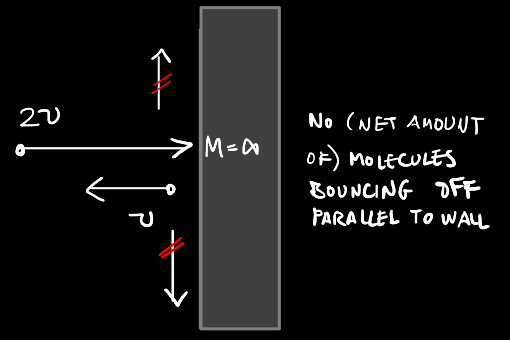
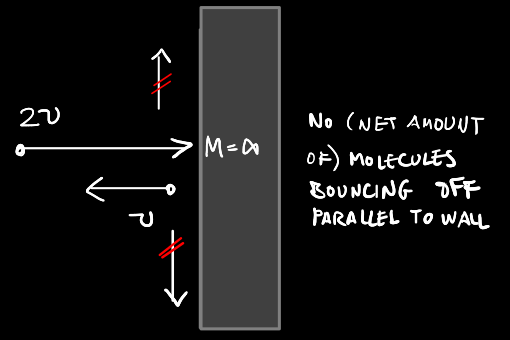
I think I got a reasoning that recovers the 1/2 factor that @sethoflagos posited from Bernouilli's equation and, by now, I'm totally convinced is right. In the general situation --but still idealised, as we are assuming an infinite wall, and a constant velocity field pointing right in the image, we'd have something like, An ensemble of particles that's equivalent as to momentum --and K.E.-- transfer is, This would give a velocity field and a density that are consistent with the continuity equation iff 1/2 the molecules are going right, and the other 1/2 is going left --but with half the velocity. Otherwise, we wouldn't be getting an overall velocity field going right with velocity v, as 2v-v=v, while v-v=0. So the density \( \rho \) must --on average-- be made up of 1/2 the molecules going right --and eventually hitting the wall--, and the other 1/2 going left --and therefore never hitting it again. Although we still have \( \rho\triangle V=\rho Sv\triangle t \), this gives us twice the molecules that are going to hit the wall within time \( \triangle t \). Therefore, I should have written, \[ \triangle p=\frac{1}{2}v\triangle m \] which gives \( \frac{1}{2}\rho v^{2} \) for the pressure. In the more realistic case, it is certainly true that molecules moving wildly in all kinds of oblique directions would contribute to the --constant-- density, but this is made up for in the simplistic model by assuming that they're not there, and the average leftward motion is totally carried by particles moving perpendicularly to the wall. Note for @Boltzmannbrain on aspects already mention by other members: Newton's equations of motion are valid thoughout, of course. But there are cases in which thinking in terms of momentum transfer is more useful. This is, I think, one of them. Please tell me whether you agree/disagree with this --admittedly-- drastically simplified model.
-
Here. I didn't remember very well. Mathematicians seem to have proved it's unsolvable, on account of incompleteness theorems: https://www.eurekalert.org/news-releases/490733
-
Sorry I can't comment much on that. I know next to nothing about Polyakov loops. From what I gather, those are Wilson loops applied to a QFT upon which you've performed a Wick rotation. I suppose they give you topological invariants of the corresponding thermal theory?