
joigus
Senior Members
-
Joined
Everything posted by joigus
-
Agreed.
-
This made me think of Feynman's comment on "unworldliness" and the 'beautiful' equation U=0, https://www.feynmanlectures.caltech.edu/II_25.html#Ch25-S6 By the way, I think the OP is using a word, "complexity" --that has a very specific meaning in physics and other sciences very intimately connected to it-- to mean something better captured by "difficult", "cumbersome", "steep learning curve", etc.
-
How likely? What are the odds for both particle and string?
-
More wishful thinking...
-
The only way it could be important is if it had observable consequences, isn't it? Why care so much about the model? Not every complex space with an inner product has a numerable basis. Hilbert spaces do. They must be dense (or closed under limits). That's a very nice property, and so we demand it. Does it play any role? Not really, as far as I can tell. No feature that's impossible to measure really plays any important role in the physics. Calculational convenience, I suppose. I am sorry, but it doesn't say much to me. Ok. That's your take. To me it does.
-
Sorry, a fractal what? From where?
-
I think the question could be translated into: Is there any way in physics that we can (experimentally meaningfully) ask the question of whether space/time, or either one of them --or any other variables for that matter-- has the power of the continuum? I don't think there's been any proposal to test that, and I don't think there can be. It is a very interesting question, though. When you report an experiment, you always do it by means of a finite string of numbers and/or characters. I think this says it all. It's probably an undecidable question, unless some connection is established --that we don't know of as yet-- between discrete mathematics and transcendent mathematics. It doesn't seem feasible that that will happen any time soon. Plus, I also said somewhere before, Self-quotation from:
-
For constructive criticism, read, For a little more constructive criticism: You're missing gluons and Z, W bosons. You're missing mixing angles and many other attributes of particles/fields. Dark matter and dark energy are very different things. Emptiness... that's not physically defined. Your diagram looks like a sink, gasket and all, with a rubber piece on top of it. Please, pull the rubber piece and let it all go down the drain. You're wasting your time, and you're wasting everybody else's.
-
Don't forget the Flemings of the Stone Age:
-
No, it's a quiet place, a mountain village. In that sense it's an island. I meant to use quotation marks: my "island". But I forgot. Sorry.
-
It's a wonderful feeling walking your dog along the beach. I don't totally rule it out. Maybe some day when I'm back in my island.
-
Don't sell yourself short. Intuition is a factor in this. Funny how data pop up in your mind. I've just looked at a map of Russia, and the story of the building of St. Petersburg came to my mind, and how it was meant to obtain a north-western port by Peter the Great, and the human sacrifice it took. That would have given me a better chance at the question, but it didn't come to me when I was trying to answer it. I would have remebered it is NW of Moscow.
-
Sorry. Modern physics has a funny way of self-flagellating itself for so many centuries of missing the point. Or, Modern physics has a funny way of self-flagellating itself for so many centuries of missing the point. I'm under a Victorian influence now, owing to a thread by @studiot.
-
I'm sorry to say I didn't do very well. 5/8. Congrats to everybody else. In my defence, I never studied musical notation --so I took a chance between the correct one and the opposite--, the St. Petersburg one was hopeless for me, as I can't quite place St. Petersburg in my mind within the accuracy of one time zone, and the grammar question puzzled me, as eg "from" is certainly a preposition, though IMO it never tells you where or when something is in relation to something else. OTOH, "across" and "about" give you all kinds of different relations besides those related to time and space. In my mind, it seemed just too narrow, so I decided to stretch my definition of a clause, to disastrous effect. I guess I would make a poor Victorian.
-
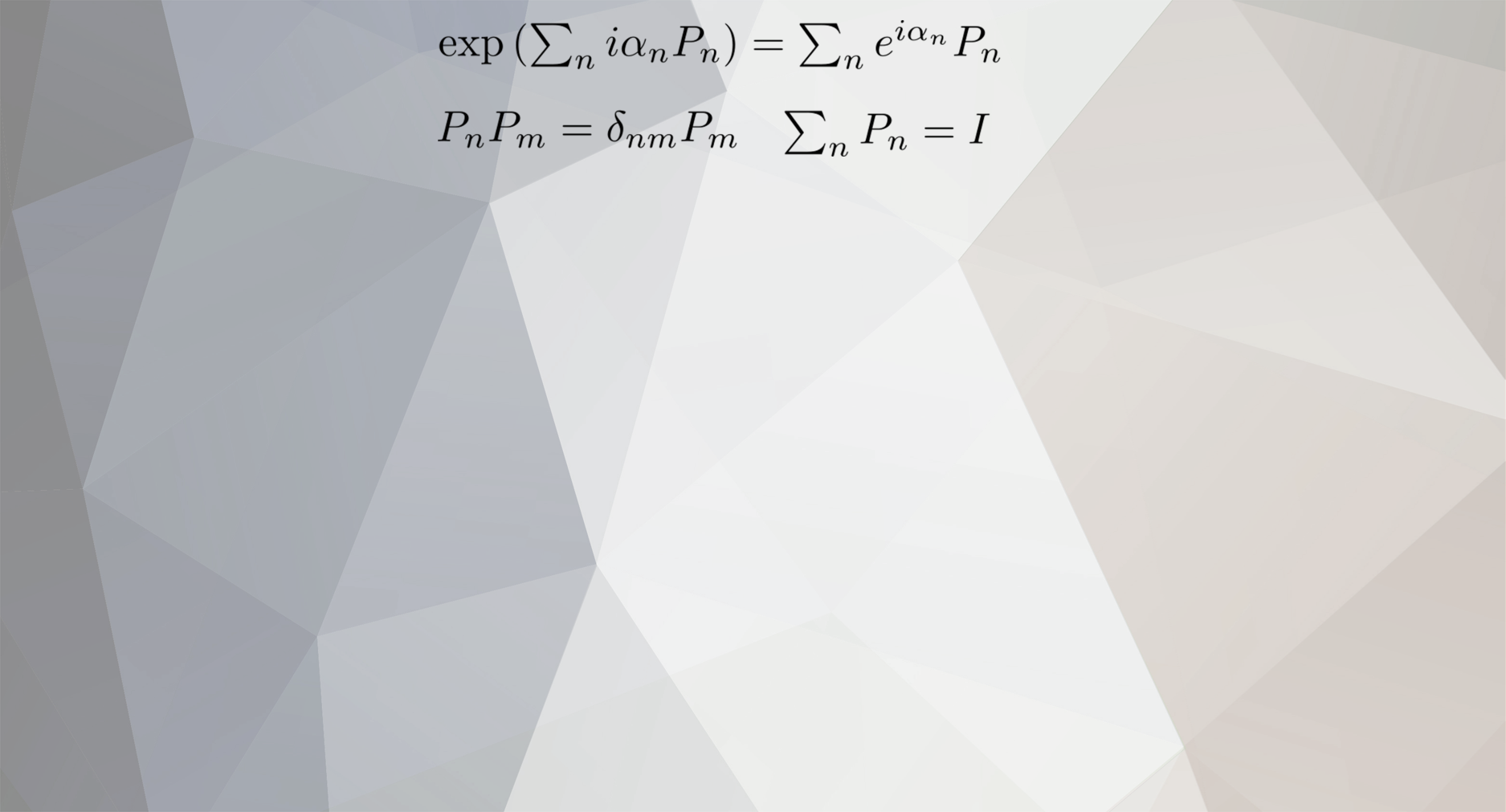
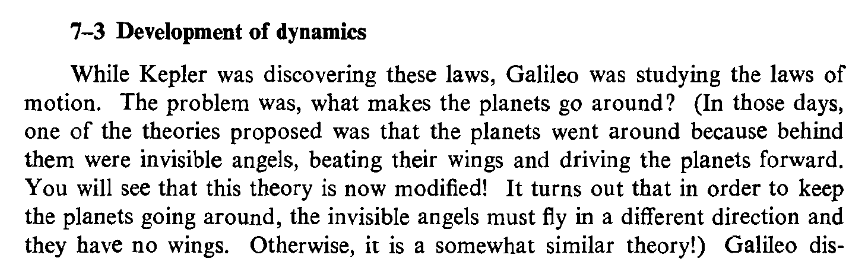
Exactly. +1 That's a good one. I think the one to keep in mind is, Not quite the point. You get closer to the heart of it if you keep reading, Modern physics has a funny way of self-flagellating itself for so many centuries of missing the point: Colour, strangeness, flavour, etc. It's not that physicists are thinking about pigments or ice-cream. If the mathematics is the right one --symmetries, conservation laws, boundary conditions, Lagrangian...-- then it's fine, and you can call them angels for all that matters.
-
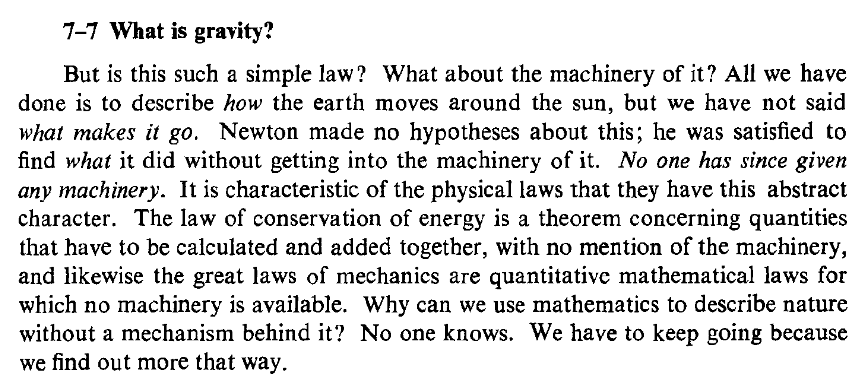
The need for a mechanism. Another ship that sailed long ago. Incidentally, [...] and, Now, who said that? William of Ockham is the busiest dead philosopher ever!
-
No, you don't seem to. Can you produce anything other than Trash-Can material?
-
Thanks for your comments everyone. I'll get up to speed ASAP.
-
As to Ashtekar, Plebanski. It kind of boils down to successive changes of variables to get from a Lagrangian formulation to a Hamiltonian one, that's amenable to QM. The logical path is Palatini action -> Plebanski action -> Ashtekar Prime crash course (Lee Smolin, Perimeter Institute): https://pirsa.org/09070000 I do not properly distinguish between Lagrangian, Palatini, Plebanski, Ashtekar. Lagrangian is the focus. The rest are successive ways of reducing the number of "generalised coordinates" until the theory is really more user-friendly. A particularly illuminating step is when the curvature tensor is reduced to an expansion in a self-dual part and an anti-self-dual part. The content of Einstein's equations being that the anti-self-dual part is identically zero --something like that, I forget lots and lots of details.
-
Agreed. Extra-nice topic. The Bible on this: https://www.cambridge.org/core/books/spinors-and-spacetime/B66766D4755F13B98F95D0EB6DF26526 https://www.cambridge.org/core/books/spinors-and-spacetime/24388801C4B4BA419851FD4AF667A8F0 'Twistor' is another key word to look for in this concern. Twistors require masslessness, so it's a bit more of an adventurous approach. But very worth taking a look too.
-
https://en.wikipedia.org/wiki/Wave–particle_duality
-
Forces do appear in simplified contexts, if you want to call them that. https://en.wikipedia.org/wiki/Ehrenfest_theorem If you define your force as the gradient of the potential, -V'=F then the time rate of change of the space-average momentum of the wave is the space-average of the 'force'. So they are connected. Only in the average. As for classical systems the wave is sharply peaked around a central value, you get the familiar picture which you're trying to use to explain the more general picture. You don't understand quantum mechanics. That's (part of) your problem.
-
Energy only occurs in a theory that's invariant under time translations. This much we understood when Lagrangian and Hamiltonian mechanics became general enough, well-understood enough, that it became mathematically transparent why it should be so. In classical physics (both Newtonian and Einstenian) you can always widen your outlook so as to see your physics as happening in a background that is everywhere the same, and at all times the same (in Newtonian theory, absolute space; in SR, space-time). If your system doesn't conserve energy, you can always understand it in terms of it being part of a bigger system that does conserve energy. That's why energy is conserved in both theories. In GR, on the other hand, and very importantly, energy is something of a bit schizoid dual* concept that has to be connected through Einstein's field equations. Energy must always be exactly zero when you consider the energy term on the LHS of the equations, and the RHS of them. You have a sort of geometric energy, and a material-content energy, plus a vacuum energy that's conventionally placed on the LHS of the equations. All the energy terms must be counterbalanced. In order to incorporate the caveat in its very name, we could call it 'energy-like balancing scalar invariant' or something. I don't think the term would stick. Unfortunately, we're stuck with just 'energy'. In 'raw' quantum field theory (QFT, in flat space-time) you always have energy conservation for an isolated system, for reasons similar to those that make SR an energy-conserving theory. When you try to combine both (GR & QFT) the desire to asign 'reality' to energy and momentum becomes, if anything, even more unclear. Especially if you want to include the Big Bang in the picture. There you have several models where the 'creative work' is done by the vacuum --inflationary models--, where energy and momentum appear because of features of particular geometric models --CPT-invariant universe, conformal, cyclic, you name it. But, whatever the framework, energy and momentum's entering the scene must be accounted for, and it doesn't seem easy to do that by attaching to them any concept of 'hard reality'. By 'hard reality' meaning: They are something that is there, has always been there, and will always be there, 'from ever', forever, and for every observer or way of looking at it, or measuring it. Something has to give at certain critical points, and under certain symmetry demands. * It's actually even worse than dual. It's a triad: We have matter-content energy, geometric energy, and this vacuum-energy term that we can place either on the RHS or the LHS of the equations if we will.
-
Thanks for acknowledging it early. Word salad is not difficult to detect. Early detection system is important, and members are an essential part of it, IMO.
-
https://www.oxfordlearnersdictionaries.com/definition/english/pap_1?q=pap