
joigus
Senior Members
-
Joined
Everything posted by joigus
-
Chinese peasants apparently have become both money lenders and manufacturers of electronic components. That's not disrespectful. Sounds more like ignorance to me. The most dangerous vice in this world is probably a half-arsed sense of security based on what you think you know when you combine it with power.
-
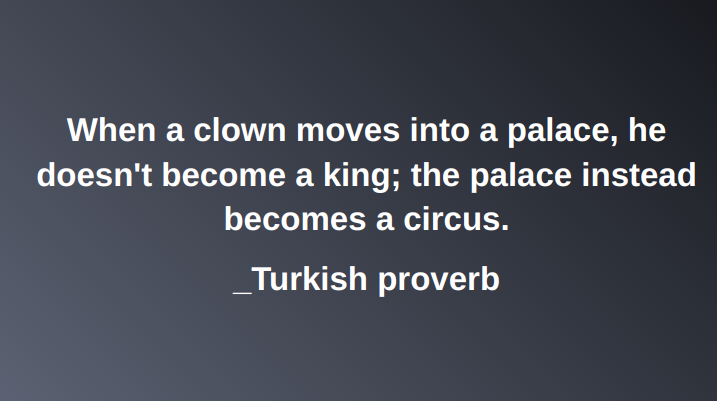
Not an actual Turkish proverb apparently, but comes in handy nonetheless,
-
...chemical engineers.
-
It's all a big grinding machine. A metabolic system of ideas. The system will regurgitate it again when it's necessary. I'm getting off-topic, and dangerously philosophical again...
-
Well, I'm sure it's not a new idea...
-
Not exactly. I should have said "perceive" instead of "recognise" to make it clearer. I don't think we are separate from the rest of the universe. I do believe the physical laws can produce the illusion of being a separate thing from the rest of the universe. I also said 'I would be happy with...' This implies that I was drawing a working definition for the purposes of discussion, while a more robust definition might (and perhaps should) be possible. Even taking what I said without the previous caveats, I don't see how it would be taken to imply that the universe is a mental projection. It would go more in the direction of the self as being a projection of some kind.
-
No, I haven't. Not at all. I haven't watched the video because according to the rules of this website the onus is on the members to explain the ideas on the thread. Not on the members to read or watch any supplementary material to be accessed off-site. Federico is well respected. Federico once successfully worked as a scientist. Let's leave it at that. None of that proves any point about quantum fields and consciousness. This has been addressed by other members. Suffice to say: What I said was intended as an analogy, reads like an analogy, and is an analogy. You saying it's not is just you saying it's not. You're clearly splitting hairs here. Again with the dictionary: Instincts is a useful term that includes many different responses according to different circuitry not processed entirely within the purview of the individual's volition. So it is an umbrella term. I can't make sense of any part of this paragraph. Let alone believe that any of this foggy concepts are "clinically validated". You also said plants, fungi, and the like have "feelings" or self-awareness of some kind. I think @zapatos and others, have asked for scientific literature supporting such claim. Then you said E. Coli does not feel because it doesn't have a brain. I never said I do. I don't. I do have an idea of what it can't possibly (very plausibly, rather) be.I'm not going down any philosophical rabbit hole. I'd be happy with something like "the ability to recognise oneself as an individual, separate from the rest of the universe". I haven't watched the video, so I don't know what Federico or Mat said. That has nothing to do with a quantum field. It's clearly a misnomer then. I'm not really envisioning anything. I'm drawing analogies between what strikes me as a silly idea and another hypothetical --but equally silly-- idea. Namely, that elementary quanta had other familiar attributes of conscious beings. You see, "quantum fields", "quanta", etc just means "elementary particles". "Instincts" is kind of an umbrella term for many things, none of them applicable to fungi or plants, as far as I'm aware. Physical fields are not responsible for feelings, or instincts, or happiness. Those aspects of so-called minds in all likelihood emerge from very complex interactions involving recursive correlations among / between aggregates of many elementary particles (or the fields representing them if you like), only when organised into protein tissue. Reinforcement of those correlations, and so on and so forth. That it's not the other way around is only too obvious, and I can't make a better job of explaining it.Just off the top of my head, electrodynamic effects are many orders of magnitude stronger than gravitodynamic effects. Also, intense electrostatic fields induce polarisation in matter, that gravitation does not. You would have to maintain electrically charged elements on conductor surfaces (capacitor plates of some kind), rather than at center-of-gravity placement, which suggests strange effects like all your effective "weight" being placed at a particular surface. Then capacitors tend to get discharged, so it sounds energy-costly. I'm not an engineering-inclined person, so perhaps someone more technology-minded can offer better insights.I think it's more likely to be derived from some kind of Roman-antics. I wouldn't put too much creedence on such connections. Very likely ex-post-facto plays with words. But this is just an opinion.Yeah, that's more Utnapishtimian?Since when do you need Petri dishes to carry microorganisms around? Utnapishtim's contemporaries strike me as good candidates for plausible carriers of those. IMO, you're flogging a dead horse two and a half meters from it.No. It's a death sentence for your theory. Particles also emit single photons when placed in an ion trap and made to twist under magnetic fields. Particles decay. Particle showers appear in high-energy collisions. Etc. No interference there.Detailed calculations: Nuclei's rest frame: \[ ρ = n p - n e ⁻ V = 0 \] Electrons' rest frame: \[ \rho=\frac{n_{p}-n_{e⁻}}{V}=0 \] Protons' rest frame: \[ \rho’=\frac{n_{p}-n_{e⁻}}{V’}=0 \] Where \( V’=\gamma^{-1}V \) Charge and number are special-relativity invariants. It's only volume that varies with an inverse gamma factor. So, as @swansont said, Same applies to the number of protons. I hope that helped.Apparently you.Out of his depth, he is. It's as if a realtor had taken charge of the world... Hang on a minute... Has a realtor taken charge of the world? May be so. Maybe Frost was wrong and the world will end neither in ice nor in fire, but in a ton of bricks falling over our heads.\[ \gamma=\frac{1}{\sqrt{1-v²/c²}} \] \[ \gamma\times0=0 \] Last comment by @Markus Hanke & @swansont spot on, I think. You cannot take electron density in proper frame for electrons while proton density in "rest" frame.@ALine, can you propose an experiment that would conclude, without a shadow of a doubt, that bees must be conscious and not otherwise? A well-defined, widely-enough agreed-upon Chinese-room argument? Furthermore, what is the "otherwise"? Is there such a thing as being semi-conscious? Conscious but not so much? Dual, or n-valued consciousness? Consciousness without an identity? Perhaps "ambiguous" --in some sense to be defined-- consciousness? Wholistic --in some sense to be defined-- consciousness? IOW --and here's the tricky point--, what is the non-conscious against which we can test the conscious? The possibilities could be endless, especially once we realise our notion of consciousness probably comes from being human and experiencing it in our own human way. That's probably why @iNow was asking you for a definition. People of science normally ask for a definition first. Then, an experiment.The whole here would be the salient aspects of life. In this case, consciousness. The parts would be quantum fields. No. You're trying to explain a salient aspect of a narrower reality (humans and how they perceive the world) by making it an attribute of the most fundamental things we know (quantum fields). By the same token you could venture to say quantum fields might have recollections, free will, bad temper, and so on. It doesn't seem a very promising line of reasoning. If it happened to be, you would be asked to substanciate it very carefully You lost me here. What does all this story about nursing and rape, and the smell of babies, have to do with quantum fields?.Isn't this just another case of an unfortunate inversion of the whole and the parts? In more modern terms, trying to explain the components in terms of the emergent? An elephant doesn't explain biology. Biology is purported to explain the elephant. That's how it looks from my ongoing process of learning anyway. Don't glorify consciousness. Most important things that keep you alive happen while you're anawares. Maybe thanks to you being anawares. I thank my stars for my hippocampus. I don't have to think again every time I ride a bicycle, or tie my shoelaces. 'Tis a consumation devoutly to be wished, I've been told --having a ninety-something percent of biological processes running the business of me, without me knowing. Rookie mistake...I remember this one. I understand some lawyers find it quite funny. And I with them.I disagree. It would be a Lorena Bobbitt.

Important Information
We have placed cookies on your device to help make this website better. You can adjust your cookie settings, otherwise we'll assume you're okay to continue.
Account
Navigation
Search
Configure browser push notifications
Chrome (Android)
- Tap the lock icon next to the address bar.
- Tap Permissions → Notifications.
- Adjust your preference.
Chrome (Desktop)
- Click the padlock icon in the address bar.
- Select Site settings.
- Find Notifications and adjust your preference.
Safari (iOS 16.4+)
- Ensure the site is installed via Add to Home Screen.
- Open Settings App → Notifications.
- Find your app name and adjust your preference.
Safari (macOS)
- Go to Safari → Preferences.
- Click the Websites tab.
- Select Notifications in the sidebar.
- Find this website and adjust your preference.
Edge (Android)
- Tap the lock icon next to the address bar.
- Tap Permissions.
- Find Notifications and adjust your preference.
Edge (Desktop)
- Click the padlock icon in the address bar.
- Click Permissions for this site.
- Find Notifications and adjust your preference.
Firefox (Android)
- Go to Settings → Site permissions.
- Tap Notifications.
- Find this site in the list and adjust your preference.
Firefox (Desktop)
- Open Firefox Settings.
- Search for Notifications.
- Find this site in the list and adjust your preference.