
Ghideon
Senior Members
-
Joined
Everything posted by Ghideon
-
I think it is so vaguely written that it may be interpreted the other way around in some cases? If external radiation is entering a black hole or some other body the radiation is never re-emitted from then a tiny amount of energy/mass is added and hence there is a tiny increase in gravity. Note! My note is not intended to add credit to the opening post or invalidate @Phi for All's analysis, it's meant to highlight how rigorous language and models are required in science. Something OP seems to miss.
-
The security of RSA relies on the practical difficulty of factoring the product of two large prime numbers, the "factoring problem". So far this thread does not contain any intelligible description of a new method for factorisation and certainly no improvements over the current state of the art methods. No-one seems to understand your approach towards factoring but still there are several members that have explained why it can not work. Five pages into the discussion I’m pretty confident that there will never be any useful description provided. Equations and associated claims have been dismissed by simple counter examples. The result is that my current level of confidence in RSA is not changed by anything provided in this thread and my best guess is that my opinion is shared by a. wast majority of users of RSA encryption.
-
That is a different question, not related to system of units. If I, the designer, was located somewhere where gravitation is different than on earth it would not affect the design of a space probe; the design would be determined by the space probe mission and not my location. If the space probe would be operating on a planet with different gravitation than earth that would have an effect on the design. I have not studied space probe design enough to have any detailed opinion how to design for a planet more massive than earth but intuitively it would be more difficult to land softly and harder to launch into space from the planet's surface. I would have to take that into account when planning the mission, its objectives and designing the probe and other systems. And in all the cases above I would use our current system of units (metric or imperial but not a mix of them).
-
Maxwell's electromagnetic wave equation: 1865. Max Planck's solution to the black-body radiation problem: 1900 Einstein's explanation for the photoelectric effect, that light is composed of individual packets of energy called photons: 1905 Dirac using first-order perturbation theory to explain the phenomenon of spontaneous emission: 1927 (emphasis mine) What does "just as" mean, for instance when transmitter and receiver are separated by some distance? Are you suggesting a replacement for relativity, information exchange at infinite velocity, something else? https://archive.org/details/dynamicaltheoryo00maxw/ https://en.wikipedia.org/wiki/Quantum_mechanics http://myweb.rz.uni-augsburg.de/~eckern/adp/history/einstein-papers/1905_17_132-148.pdf https://en.wikipedia.org/wiki/Quantum_field_theory
-
Yes it does. That's one reason I prefer to use a particle model* when that model predicts how light behaves. You seem to move backwars; trying to use older models even when they fail to match observations . Why? *) And of course I would use a wave model when that is appropriate. And to explain for instance the phenomenon of spontaneous emission I would study quantum electrodynamics and fields rather than the earlier models.
-
Did you miss that in the linked article, and in your quote, Hossenfelder uses "particle" when appropriate? (And also "wave" when appropriate.) If Hossenfelder calls the photon a particle in those circumstances where light is best modelled as a particle, that’s good enough for me.
-
The photo electric effect is one example. The experimental results disagree with classical electromagnetism. Continuous light waves, according to the classical electromagnetism, transfer energy to electrons, which would then be emitted when they accumulate enough energy. Study of the photoelectric effect led to important steps in understanding the quantum nature of light and electrons and influenced the formation of the concept of wave–particle duality.* As far as I know Planck and Einstein got one Nobel prize each for their contributions regarding properties of light that the wave model failed correctly to predict. If you disagree with the mainstream science, Plank, Einstein and the Nobel committee's decision feel free to provide an alternative explanation. *) See https://en.wikipedia.org/wiki/Photoelectric_effect and references from that page.
-
Because some of the properties of light and some interactions between light and matter can't be explained by treating light as a wave. Planck* got a Nobel prize for his discovery that energy (an hence light) is quantised: "in recognition of the services he rendered to the advancement of Physics by his discovery of energy quanta."**) *) Not Plank **) https://www.nobelprize.org/prizes/physics/1918/summary/
-
Einstein got the Nobel Prize for the photoelectric effect. He proposed that a beam of light is not a wave propagating through space, but a swarm of discrete energy packets, known as photons. Maxwells equations did not, as far as I know, predict the photoelectric effect or that light energy is carried in discrete quantized packets .
-
The article you linked to is discussing missing baryon problem, not to be confused with the dark matter problem or the baryon asymmetry problem. It look like you misinterpreted the paper and draw incorrect conclusions regarding dark matter? http://chandra.harvard.edu/blog/node/399
-
Suppose an observer B is in a circular orbit around an observer A. Note that this means A and B are separated with the same distance at all times. Questions: 1: Per your ideas, will a clock at observer A remain in synch with a clock traveling with observer B? 2: Will A and B agree on the measurement of the length of B's orbit? (A and B measure in their respective frame of reference) 3: What is the mathematics that gives the answer to questions above? 4: How does 1-3 compare with established models in relativity theories? 5: How is red shift or blue shift involved?
-
I think that current RSA encryption is quite unaffected by the things presented in this tread.
-
It looks like you did not yet understand Eise. Absolute length and time does not exist. Space-time distance invariance, on the other hand, is first mentioned in https://www.scienceforums.net/topic/126011-length-contraction-in-a-block-universe-must-be-an-illusion/?do=findComment&comment=1189820
-
Using this new insights you may read the thread from the start. This time you may find how your questions have already been answered? Because as far as I can tell, all* the members that have answered you knew about Eise's information and accounted for that. *) I think mods have handled some exceptions
-
Please try again, and please provide a reference to more information. Something based on mainstream science would be good.
-
Given the context we discuss spacetime with four dimensions, ”frozen 3d universe” is ambiguous. There are at least three interpretations that are very different. Please try again. And provide a reference to more information.
-
What does ”frozen 3d universe” mean?
-
Good, we may examine that later (other members have posted some points that may be simpler to start with) But there is always one direction: A, B in my example will always agree that the train is going forward. We know that the train is moving in one direction hence we are able to determine what each observer A and B will see from their point of view; a left-to-right or right-to-left movement. (Forward meaning the locomotive comes first, pulling a number of wagons. An observer on the train will also agree with A and B)
-
In my initial post about muons; where in that example is the illusion you claim exists? I posted a simple picture above, explaining some of the things you seem to struggle with in the explanations given by other members. Is there any part of the picture and description that you like to be further explained?
-
Trying to provide a hint*, assuming I understand the problem: -It may help to look at different parts of the DFA in isolation and what each part contribute. -You can try to apply one specific example to the DFA and check want comes out. Let's try the second case using "abba". As "a" is entered as input to the DFA, the upper path will be followed. Can you figure out what happens for the next character in "abba", the first "b"? Do we progress to a new state or stay in the same state? *) no complete answer since this is homework section
-
Here is a simplified picture that may help: A white train T moves relative to points A and B The points A and B are not moving relative one another. The train T moves from left to right when seen from a position at point A. An Observer on the other side of the train (at location B) will see the train going from right to left. Basic observations: 1: There is one train. 2: The number of observers does not affect the number of trains. 3: The concept of left and right depends on point of view. Hopefully the above simplified example may help you form the correct questions or identify misunderstandings.
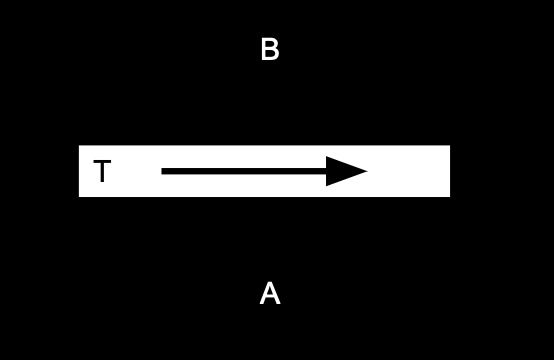
-
There is some frame of reference S where a 100m long train (proper length) will have the length 1m according to special relativity. If the question "world lines are 1 meter apart" is physically meaningful, can you explain how?
-
And In the last question, do you mean a 100m long train (proper length), a 1m long train (proper length), special relativity length contraction of 100m to 1m (measured in some frame of reference)? Or something else? Proper length or rest length is the length of an object in the object's rest frame. (https://en.wikipedia.org/wiki/Proper_length)
-
I disagree with the conclusion. The currently used system of units allows us to design space probes and rowers that works predictably in micro gravity and on other planets. It sounds unnecessary complicated, from an engineering perspective, to plan and execute such missions if the units of measure depends on location. Side note: confusion between metric and imperial units has caused at least one failure already; the Mars Climate Orbiter: Source: https://web.archive.org/web/20010920052120/http://sunnyday.mit.edu/accidents/MCO_report.pdf
-
A specific observer can't move relative themselves; one observer is always in one inertial frame*. So the observer will make observations, consistent with relativity theories, in that single frame. That means the observer will observer one and only one set of x and t coordinates (as described by @md65536). *) Multiple observers may share a single frame and any observer may change frame but as far as I know no observer can be simultaneously in two different frames.