exchemist
Senior Members
-
Joined
-
Last visited
Everything posted by exchemist
-
In principle it should have some chemical properties in common with bismuth, though modified by the relativistic effects that influence orbital stability in very heavy elements, so may resemble thallium in some respects. There is a write up of expected chemical properties in the Wiki article on this element. But of course, if it were stable, we would already know it was not Moscovium.😉
-
OK. These seem to be linear analogues of the planar conducting structure I was describing in graphite: https://www.sigmaaldrich.com/GB/en/technical-documents/technical-article/materials-science-and-engineering/organic-electronics/light-emitting-polymers i.e. long 1D chains of conjugated aromatic rings, built up from dye molecules, rather than 2D sheets.
-
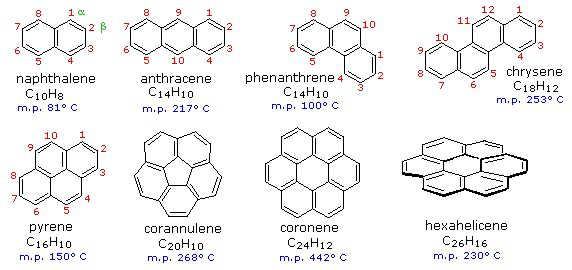
The exception in that case is due to the electrons in the π-bonds. To go back a step, benzene is often drawn with 6 carbon atoms in a ring, with alternating single and double bonds (the Kekulé structure). But actually that is misleading. All 6 bonds are identical. You can consider each of the 6 atoms as sp2 hybridised, i.e. forming 3 σ-bonds at 120deg to one another, 2 to neighbouring carbons and one to hydrogen. That leaves one electron per atom in a p-orbital, perpendicular to the plane of the ring. These p-orbitals overlap with their neighbours to form a delocalised system, all the way round the ring. You can see this in the anomalous magnetic properties of benzene and other so-called aromatic molecules with this type of structure. You can generate a "ring current", causing the electrons to flow round the ring and create a magnetic field. https://en.wikipedia.org/wiki/Aromatic_ring_current The same is true of fused aromatic rings, e.g like the ones in the diagram below: Graphite is what you get if you have an effectively infinite set of these fused rings, forming a sheet (like chickenwire), with successive sheets of rings stacked on top of each other. The bonding between sheets is only weak van der Waals attraction. This is why graphite is slippery (it has applications as a solid lubricant). Regarding conduction of electricity (and heat*) what you end up with is a metal-like situation, with a "sea" of delocalised electrons, able to move across the sheet of rings freely. The difference from a metal is that the electrons are confined to one plane. They cannot easily jump from one sheet to the next. But along the plane of the rings you have metallic behaviour. *Graphite is used for the heat shields of spacecraft, as it conducts heat well along the planes, but very poorly between one and the next. So it is ideal! OLEPS? Wot dey?
-
A changing magnetic field will classically induce an EMF. If a conductor is available, a current may then flow. But in the case of an electron in a molecular orbital, (i) this does not produce a changing magnetic field and (ii), as I've pointed out, there is no conductor if the bonding is covalent.
-
Give me an example of a porous liquid, then, and I'll withdraw my remark.
-
Aha, my troll detector has gone off. Nobody serious would think a 5cSt liquid could be porous.
-
When you say 5cSt, you don't say what temperature. If you mean 40C, that is quite a low viscosity lubricant. It will leave only a thin film, which I think won't collect as much dirt and dust as a more viscous product. Silicones themselves are fairly inert with respect to weak acids (e.g. citric, acetic), at least at the concentrations found in foodstuffs. I am not aware of any micro-organisms that metabolise silicones, but they most certainly could grow in any food particles or droplets that adhere to machinery parts wetted by the lubricant. But all this is just my opinion. I am not expert on lubricants for the food processing industry. I think you would be better off to direct these questions to people in the industry with relevant experience of silicone lubricants.
-
Yes, I've used one of these for about 20 years as well. As it still works, I have never taken it to bits to look at the mechanism. But I bought one for use in a holiday house on an island in Brittany, where the cooker uses bottled propane and I found it didn't work. I'm not sure if it was the humidity - I find it works less well in a humid atmosphere - or whether the spark is simply not energetic enough to ignite propane, for some reason.
-
Then do some reading, you lazy so-and-so. Nobody here is going to do your assignment for you. The world doesn't need a dud oncologist who cheated his way through medical school. If, having done your reading, you have specific questions, that's a different matter.
-
I don't think vague is the right word. There are questions the theory does not answer, but that is something different. Like any theory in science, the big bang theory is rooted in observation and testable by observation. It cannot answer questions for which no observations are available. Science is always limited by that. In science, you can't just make stuff up.
-
This appears to be textbook psychiatric word salad: https://en.wikipedia.org/wiki/Word_salad
-
Hmm. Interesting possibility. Though not many casement windows in my parents' Victorian house. They were just about all sash windows- except in the kitchen, actually.....
-
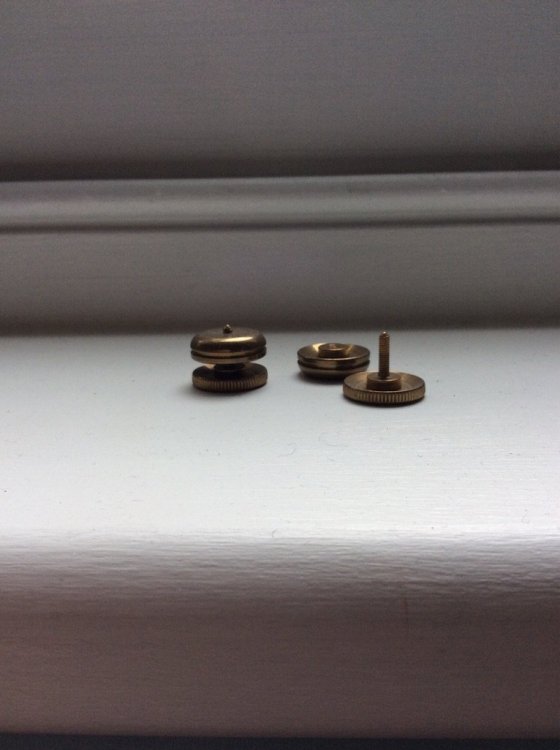
Yes the top screws onto the knurled bottom as shown. Too light for a paperweight - they only weigh 14g each. When the top is fully screwed home, the end of the threaded spindle protrudes through a hole in the top. You can see this in the left hand example. This just might be a possibility, though when fully screwed in the thickness of paper it would bind is only 3mm. No, the split is just a groove running round the circumference. It seems to be decorative - unless it is for a missing O-ring, I suppose. Or indeed for a band to passed round both members of the pair, as you suggest.
-
Does anyone have any idea what these are? I have a pair of them, made of brass (no jokes please!), about 1.5cm, 5/8" diameter. Each one comprises an upper and a lower half, which screw together. They look as if they might function in rather the same way as a pair of cufflinks, but obviously they are not cufflinks (too heavy, too cumbersome to screw together on a shirt cuff.) I wondered if they were weights for holding down a tablecloth outside, but you'd need to make holes in the corners for the threaded part to pass through. So that seems unlikely. They came from my parents' house, so probably something used half a century or more ago.
-
Electricity requires a flow of electrons through a material. The electrons in covalently bound molecules are generally not free to flow throughout the structure, so no conduction of electricity occurs. (There can be exceptions, notably graphite, in which the π-orbitals of the fused rings of carbon merge to form a conduction band, allowing the electrons in those orbitals to flow.) As for magnetic properties, yes, electrons can create magnetic fields, due to their intrinsic angular momentum and sometimes also due to orbital angular momentum, if they are in orbitals that have this - many do not. But simple creation of a magnetic field does not imply that electricity is generated.
-
Bear in mind that the rate expression depends on how the rate-determining step of the reaction mechanism arises. In the case of the decomposition of acetaldehyde, it tells you something about the reaction mechanism, in the pressure regime considered. Pressure can affect the order of reaction kinetics, cf. Lindemann-Hinshelwood mechanism. Secondly, nothing in the information supplied tells you the temperature at which these reactions are taking place. N2O5 is a gas above about 50C.
-
Ask yourself: what is the dependence of the rate on the concentration of hydrogen? And what is the dependence of the rate on the concentration of ethyne? And take it from there. What do you think?
-
Then it is unlikely to be able to run many of today's apps in any case. This is certainly the case for my 7 yr old G3 iPhone. It does have a camera but it is full of dust inside and takes terrible pictures, so it would have no chance of scanning a QR code, even if it could run the app.
-
Hydrogen is not a metal at normal temperatures and pressures. It has been predicted to be metallic under tremendous pressure, but so far no one has been able to demonstrate this reliably. There is something that runs through the Periodic Table known as the "metal/non-metal diagonal". This cuts through the p-block, but if you extend it to the top left, it would cut through the s-block too. So it is not necessarily the case that because H sits in the s-block it has to be a metal. After all, some versions of the Periodic Table also place He in the s-block. Essentially, the ionisation energy of hydrogen is too high (i.e. the electron in the 1s shell is too tightly bound) for it to be metallic.
-
Gosh, I bet you eat rusty nails in your porridge as well, like Desperate Dan in the Dandy.
-
Since this is a UK adaptor, I would expect it to be fused. That would stop it drawing a current that was unsafely high. The lowest fuse setting in the UK typically is 5 amps and the highest 13amps. 13amps at 240V corresponds (W =Vi) to 3kW - enough for a powerful electric fire or kettle. If your blanket is drawing no more than 60W each side then the combination is 120W which draws a current of 0.5 amps. This is equivalent to 2 bedside lights and is well within any safety limit - and any fuse that may be fitted in the adaptor.
-
This is called "sealing wax". Details of composition etc here : https://en.wikipedia.org/wiki/Sealing_wax You can buy sticks of it. But I wouldn't use it to take an impression, because to do its job of sealing it has to stick to things, obviously.
-
What is hard to understand about the Wiki explanation of what it is? Archaeology, which is one of the disciplines it uses, involves some scientific techniques. Egyptology is the study of ancient Egyptian civilisation. That puts it among the Humanities, I would have thought.
-
I don't think the acceleration appears to be less to the remote observer, if he is doing his experiment competently. If he is competent, I think he will calculate the acceleration using a clock on the planet, not one in his lab, in order to correct for the gravitational time dilation effect.
-
It is interesting to me that you are so concerned about people using the side effects of these new energy systems as an argument for delay. I must say I see little or none of this in Europe. The various arguments are about pros and cons of alternatives, not to stymie progress but to make sure we go into them with our eyes open to the side-effects, and some plans in place to deal with them . This is historically not something the human race has been very good at - hence the crisis we now find ourselves in. Nuclear is a case in point. We probably have no option but to retain nuclear as part of the energy mix for electricity generation, but we need to be aware it is probably the most expensive option, if we include full cradle-to-grave costs. None of these alternatives is problem-free. Myself, I think that is a good argument for backing several horses rather than trying to pick a winner: there may be further unforeseen consequences with any of these routes.