
Everything posted by exchemist
-
Do you have evidence of people being driven out, or of "new sceptics" being deterred from entering the field? Where does this come from? And what do you mean when you say there is no more certainty? I should have thought the evidence of rapid warming and increases in extreme weather events was becoming clearer by the day.
-
Thanks, I was tiring a bit, to be honest. But as so often, I find these discussions with eccentric people can lead to rewarding spin-offs. I was unaware of Tyndall's work in the c.19th until now, nor did I know when it was that IR spectroscopy was first developed, nor that it was our old chemical kinetics friend Arrhenius who first suggested atmospheric CO2 could have a profound effect on the climate. So I've come out of all this ahead, which makes the digging worthwhile. (It also reminds me of my time as a trainee patent agent, searching for prior art in the Patent Office Library to knock out a rival patent application. We had to do it by hand with indexes and paper documents in those days. And you never quite knew until the end what piece of information would be decisive.) Above all, I'm delighted that @Doogles31731 is now satisfied that science has indeed replicated Tyndall's work, by way of the design and use of the modern IR spectrometer, fitted with a gas cell. If you search the web for "IR analysis of gas mixtures", you will find a raft of references, many to commercial analysis applications, others to research papers, patent applications etc. I'm not going to dig through all these for you. Suffice it to say that this has been a standard analytical technique for gases for half a century. So it's time for you to move on to your next objection to the science of climate change, I guess. I've no doubt that, guided by "Watts Up With That* " and other disinformation sites, you can keep this game going almost indefinitely. Maybe I'll play, maybe I won't. It's now the weekend, after all. * Here's a link to a bias check on that site by the way: https://mediabiasfactcheck.com/watts-up-with-that/
-
Yes I think that is increasingly the case. 10 years ago, maybe, you could just about have some people with more or less rationally held minority opinions on this (e.g. there is or was that Dane, I forget his name), but today it's almost like Cold Fusion. The killer, I think, is that we are starting to see a number of the predictions coming to pass, at least directionally.
-
Yes indeed, but our friend won't have done these searches, as he wants to be able to claim there are basic gaps in the science. I get the feeling he may have built a whole house of cards on this notion, which could be why he is reluctant to let it go. But no doubt we will find out.
-
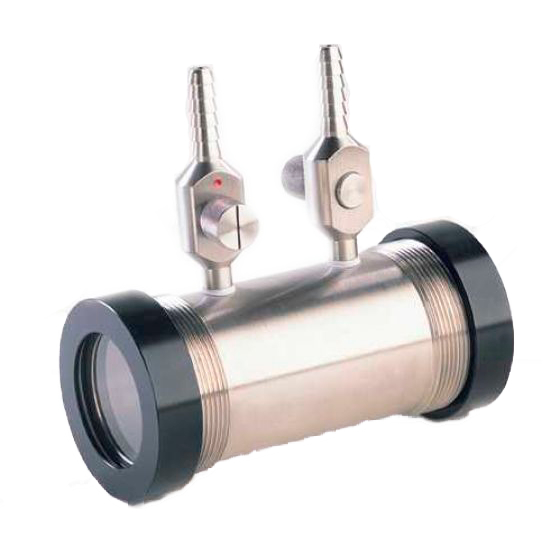
I'm wondering what on earth more any of us can do more to convince @Doogles31731 that there is not, as he imagines, some crucial gap in the basic data in science, just because nobody has revisited Tyndall's 1859 experiment. I suppose one thing is to provide a picture of an IR gas cell, to show him that in fact what a modern IR spectrometer does is exactly what Tyndall did, with the crucial addition of a means of analysing the absorption as a function of wavelength. So below is a picture of a gas cell. It is in effect Tyndall's tube, with windows at the ends transparent to IR. (To this day, many of these windows are made of rock salt, NaCl, though other minerals can also be used.: Another thing we could do is show how mixtures of gases are routinely analysed by IR, every day. Here is a link to a manufacturer of IR gas mixture analysers: https://www.servomex.com/gas-analyzers/technologies/infrared/ Apart from that, I confess I am rather stumped.
-
I have not spent any time on this thread talking about my supposed "beliefs", as they are not the subject of the thread. I have spent my time trying to understand what was bothering you and trying to fill in what you thought was missing, by explaining the relevant science. (Though I notice that you, by contrast, have started talking about "belief systems", and introducing extraneous issues like 10 year old letters from retired NASA engineers that shed no light on the issue under discussion. Why is that?) Where you are right, though, is that yes, I do have trouble allowing you to retain a "belief system" that relies on ignorance of science. This is a science forum. The people here are here to learn, and spread, knowledge of science. That's what I'm interested in. So in your case, the important thing for me, once I had smoked out where the gaps in your knowledge are, has been to teach you a bit about infra red spectra of gases. To your question, if Tyndall got feeble (but non-zero) deflections with these gases, he may well have had some contamination. Perhaps that the gases were not entirely dry or something. Or maybe it was an artifact of the experimental setup. That happens a lot. But we can't ask him so we will never know. He did very well for a man of his time with the equipment he had. Do not imagine that you can use Tyndall's reports of feeble deflections to cast doubt on what we know, today, about the infra-red spectra of these gases. That would be about as idiotic as if someone were to insist, today, on dropping balls from the Leaning Tower of Pisa* to reconfirm the acceleration due to gravity. *I know Galileo did not actually do that: he used an inclined plane.
-
Indeed. I dry them in the small oven at 50C for an hour and then loosely screw on the tops, to keep dust out until I am ready to re-use them.
-
I found this very informative indeed. It answers the original question I posed perfectly.
-
I agree screw cap bottles are key. Because I need to restrict myself to 3-3.5 units max, on the evenings when I drink, I use those little quarter bottles you can find in the supermarket and decant into those, fill them to the top to minimise the oxygen exposure and keep them - red and white equally, in the fridge. With most French wine, one of these bottles is 2.5 units approx, giving me headroom for a small sherry or so as an aperitif. As they are only quarter bottles, the reds will come up to drinking temperature after an hour or so out of the fridge. I've found I can keep even the reds for a week this way, without adverse effect on the flavour - sometimes the younger ones even get a bit better from the short air exposure during decanting. I just need to wash out the bottles carefully each time after use.
-
I'd have thought the dependence of path length on angle of incidence of radiation would be fairly elementary to the modelling. And I did mention scattering. More interesting, in my estimation, is the effect of pressure (collision) broadening on the shape of the absorption bands. That won't be trivial, seeing that it is a function of altitude. And then there is all the atmospheric photochemistry going on in the stratosphere/tropopause as well (for example ozone, having a dipole, absorbs in the IR). And then there are the oceans..... I've never delved into what goes into these models but they must be monsters.
-
Nobody, least of all me, is dismissing the importance of measurements of the earth, the radiation it receives and its atmosphere (and, crucially too, its oceans). It is @Doogles31731's idea of more Tyndall-style experiments in tubes with mixtures of gases that I am saying is redundant.
-
In that case I should look out for them. I don't drink much champagne, though I keep handy a few bottles of Deutz, which we don't see much in the UK but was introduced to me by my late wife's Oncle Philippe. In fact, on checking, see the Wine Soc currently has Antech Crémant de Limoux , Héritage 2018 going for £17/bbl. That's a lot cheaper than champagne, certainly. (And also a Blanquette de Limoux but that is semi-sweet so I'll give it a miss.)
-
Aha. This is in Languedoc, I see. Interesting. Are these wines made by the méthode champenoise?
-
I posted Tyndall's paper out of interest, for any other readers of this thread. I thought it was a nice paper and a very impressive piece of work for a man of his time. I'm afraid you are now revealing just how much you do not know of fairly simple science. It's a pity you were not more upfront about that at the beginning. It could have saved a lot of time. I repeat, yet again, that the experiment you propose is a total waste of time, as we already know the results it would give, from widely available data on the IR absorption spectra of the various gases involved. What Tyndall says about a mixture of hydrogen and oxygen absorbing feebly, whereas chemically combined hydrogen and oxygen (water vapour) absorbs strongly, is bloody obvious. They are different molecules!!! Ditto ammonia versus a mixture of hydrogen and nitrogen, or nitrous oxide versus a mixture of nitrogen and oxygen. So of course they will give different results! But in fact there is an interesting point here, in that those gases whose molecules are just pairs of identical atoms do not absorb in the infra red, whereas those which are composed of different atoms will absorb. A hydrogen molecule is H-H, nitrogen is N-N, oxygen is O-O. Whereas water is H-O-H, nitrous oxide is N-N-O and carbon dioxide is O-C-O. The reason for the different behaviour, in very simplified terms, is that the radiation needs a dipole (a degree of separation of electric charge) to interact with, in order make the bonds in the molecule stretch and vibrate. You get this with, say, water because O attracts electrons more strongly than H. So a water molecule has a partial +ve chargeon the hydrogen atoms and a partial -ve charge on the oxygen atom. This allows the oscillating electric field of the radiation to make the O-H bond vibrate. The same goes for the O-C bond in CO2, for the N-O bond in N2O and for the N-H bond in NH3 (ammonia). This is why both both water vapour and CO2 absorb IR radiation in the atmosphere, whereas oxygen and nitrogen are transparent to it (which means they do not absorb it). The greenhouse effect is all about the consequences of that. So you see, there is a whole lot of science here, not known in Tyndall's day, back in 1859. As I told you before, IR spectrometry was developed in the 1940 and 50s and, by the 1960s, when people like Manabe were working, the IR absorption characteristics of these gases were well documented. There are issues in applying these to the Earth's atmosphere, due to things like scattering and pressure broadening of spectral bands, and these have been studied in their own right. There are whole books on that alone: https://www.cambridge.org/core/books/abs/pressure-broadening-of-spectral-lines/atmospheric-spectra/F050FF1BA775D29DA09CE7C34D682750 So I'm afraid it is not a matter of two different, equally valid, perspectives and "agreeing to disagree". Your perspective, it is now clear, is a result of ignorance of fundamental science combined with a wish to justify a predetermined view by whatever means you can. You are seizing at random on things you don't understand but which you hope will undermine the validity of climate science. That is not a defensible attitude. There are many arguments to be had over the various climate models, but not at the level you are attempting to have them.
-
I meant leaving half of an opened bottle, not a glass, in the fridge. It's still good 24hrs later, although the fizz has subsided to more of a crémant. But still perfectly pleasant. I presume it's all to do with, firstly, the absence of surface roughness in the glass of the bottle, so few nuclei to initiate bubbles, and secondly, the low temperature of the fridge, which will increase the solubility of CO2. (There are silly old wives's tales about putting a silver teaspoon in the top, but in fact it's just that it holds its fizz quite well by itself.) Full disclosure: having something of a "dicky ticker" (a tendency to atrial fibrillation), I have to watch my alcohol intake. So I've explored a number of ways of keeping opened part-bottles of wine, to last over 2 or more days.
-
On the point about fizzy drinks, a half drunk bottle of champagne still has enough fizz to be enjoyable 24hrs later, if kept refrigerated. But that has a very smooth glass bottle with few nuclei on which bubbles can form. (Champagne is on my mind as it seems possible Boris Johnson may be thrown out.)
-
Yes, it's curious that @Doogles31731 seems to have chosen to base his climate change scepticism on claiming the absence of something that has been in every gas chemist's handbook for the last 50 years or so. I had felt at first there must be some more subtle point behind his enquiry, but it seems not. And now we get a separate issue being introduced, viz. this 10 year old letter from a group of retired NASA engineers (+ one meteorologist), asserting that the climate change issue should not be presented by NASA as settled science. Well, they would know - not. And 10 years ago is quite a while in climate science. I'm no longer sure what our poster is trying to achieve here. He talks of belief systems. Maybe he is onto something, but not in the way he means it.
-
That's interesting. What's the issue with rice?
-
This seems a bit of a strange question. Of course it depends on the food item. Think about it. You probably have a whole cupboard full of dry groceries that keep almost indefinitely at room temperature. You can leave a freshly cooked stew overnight, if you keep the lid on so it stays sterile. It all depends on, first, whether the item is a good medium for growing bacteria, yeasts etc., and second, whether or not it already has some on it or starts from a sterile position and picks them up from the air. So fresh meat and fish goes off fast, as it is an excellent medium and already has plenty of micro-organisms on it. Fresh fruit and vegetables are a less good medium (having a natural protective layer on them, i.e. skin) and will last for several days, usually. Your teabag is quite a good growth medium but starts off sterile. So that's like the stew. If you leave it exposed it will pick up spores and go mouldy after a bit but you have some time in hand before it does that - and you will re-sterilise it when you re-use it. I should have thought a teabag would be still OK after leaving overnight. (But I must say reusing teabags is not something I would do as the tea will taste pretty awful.) What is definitely a bad idea is leaving food and drink at a temperature close to blood temperature (say 30-40C) for any protracted length of time, as that is the perfect temperature for micro-organisms to multiply rapidly.
-
Out of interest, here is a link to Tyndall's paper: https://geosci.uchicago.edu/~archer/warming_papers/archer_galleys/9781405196178_4_002a.pdf Seems he used various sources of heat (copper plate heated by a gas flame, hot metal cubes) as radiation sources, rock salt plates to close the tube containing the gases and a galvanometer to measure the voltage change due to the effect of absorption on a "thermo-electric pile" (thermocouples connected in series) that he used as the detector. He looked at a range of gases and vapours and noted that the amount they absorbed varied widely. Interesting to see how much of the paper is devoted to the experimental setup, which was evidently far from straight forward. Very ingenious indeed, given the state of knowledge of the time.
-
OK, it looks as if we need to rewind a bit to explain some IR spectroscopy. The Beer-Lambert law is basic to spectroscopy and simply gives you a linear relationship, relating the % of radiation absorbed to the concentration of the absorbing species and the path length traversed by the radiation, i.e. the number of molecules in the path to do the absorbing. It is widely observed to be followed and is thus the basis of IR spectroscopy, which for decades has been a standard analytical technique in chemistry. You keep referring to Tyndall and suggest that nobody has followed up his experiment. That's because what he did was measure the absorption of "heat" (i.e. IR radiation) by various concentrations of gases, over a known path length. In other words, he had built a very primitive form of ancestor to the IR spectrometer. It was primitive in one particular respect, as it did not evaluate the absorption of radiation as a function of wavelength. Since the advent of quantum theory in the 1920s and 30s, it has been recognised that IR absorption is due to vibrations of molecules and that the absorption depends on wavelength, since molecules absorb at particular ranges of frequency, related to the frequency at which they vibrate, which is characteristic of each chemical species. The technology of infra-red spectrometry was developed in the 1940s and 50s. Since then a huge range of materials has had their IR spectra characterised. I mentioned in an earlier post the "molar attenuation coefficient": https://en.wikipedia.org/wiki/Molar_attenuation_coefficient. This tells you how strongly a chemical species absorbs, as a function of wavelength, for a given amount of substance. The "given amount of substance" is determined by....................... our old friends the concentration and the path length of the radiation, a la Tyndall. To work out the total absorption of IR radiation by a gas, you need to know the spectrum of the radiating object (since all objects radiate to different degrees at different wavelengths), and the IR absorption spectrum of the gas. You then integrate these over a range of wavelength or frequency, and that tells you the total absorption. So, given that we have known, for decades, both the spectrum of the sun and the spectrum of CO2, in exquisite detail, it is quite pointless for anyone to waste time putting more gas into tubes in the way Tyndall did back in 1859. As for synergy between CO2 and water, there is no synergy between their IR absorption profiles. Each species absorbs according to the vibrational characteristics of its molecules. If two species are present, you sum their effects. You do this in the modelling, not by filling tubes with mixtures of gases, which is quite unnecessary.
-
Thanks. But would you mind answering my question, please? What further experimental work were you expecting to find, or do you consider there should be? Because It is not obvious to me that any more experiments would be needed, as the challenge is in the modelling, rather than in the well known properties of the gases involved.
-
Good luck with Callendar. I hope it is useful. But thinking more about your response, I find myself wondering what sort of experimental work you are hoping to find. I don't profess any expertise in this field, but I'd have thought that the principal challenge is in the modelling of the climate, rather than in gathering data on CO2. Once you have the molar attenuation coefficient of CO2 as a function of wavelength, i.e. a well-characterised absorption spectrum (which is well known), I imagine the other data inputs on CO2 that you need are its concentration, perhaps as a function of altitude, and then it's matter of putting that into the mix with all the other horrendously complex factors to do with radiation intensity, albedo, the effect of the oceans and so on and so on, none of which involve CO2 per se. So what further experimental data on CO2 are you thinking would be needed? As for the comments on the variation between models, I'm not sure that is surprising, bearing in mind the complexity of the modelling. But I note we have convergence, rather divergence, which seems to suggest the modelling process is likely to be valid, plus of course 20 years more of actual experience of climate change since the start of the graph, against which to judge the models.
-
This distinction you make between motorists, cyclists and pedestrians seems to me a false one, so far as taxation is concerned. Every motorist is also a pedestrian. Most cyclists are all three. The taxation principle, insofar as there is one, is surely not that a class of person pays more or less tax than another, but that an activity that requires costly infrastructure, causes pollution and contributes to climate change should be taxed.
-
Hmm, I see. Re water vapour, I had always thought it was generally recognised that this is the main greenhouse gas in the atmosphere, but that as the amount is fairly self-regulating it does not lead on its own to a change, whereas it is the CO2 that is changing. In fact I think I have read that one effect of temperature increase due to CO2 is that the amount of water vapour goes up in consequence (not surprisingly, as the sea warms), thereby acting as an amplifier. Tell me, is it early experimental work you are looking for, specifically, or just early attempts at modelling the effect of CO2 on climate? Addendum: I've found a link to Callendar's paper, here, but it only shows the abstract: you have to buy it to read the whole thing: https://rmets.onlinelibrary.wiley.com/doi/abs/10.1002/qj.49706427503 I found this from a site called "Carbon Brief" which has a nice timeline you can click on to see various milestones: https://www.carbonbrief.org/timeline-history-climate-modelling I notice also a reference to a Mikhail Budyko, in 1956, which looks as if it might be relevant, but there are others mentioned too which might be worth a look.