
sethoflagos
Senior Members
-
Joined
-
Last visited
Everything posted by sethoflagos
-
Mrs Seth and I still have a couple of years left on our Netherlands resident cards. Are they valid in Bonaire? I might need to rest a year or so after such a long flight!
-
If we created an image of a star from not just its emr transmissions but all concurrent arrivals of its cosmic rays in a range of velocities, we'd obtain a trace of it's historic worldline as viewed from our current location in space. Is that what you mean?
-
I'm in no position to dispute this, Genady. But I don't understand why it should be so.
-
Oh dear, I seem not to have expressed myself very clearly (again). Everything you say is true. But to clarify, I was speaking specifically about past events (not objects), such as an atom emitting a photon or a merger of two compact bodies as 'causes' producing measurable 'effects' in our 'now'. Yes, other signals associated with these events may be observed by other distant observers, but in general, our observation and theirs would not have their own cause-effect relationship unless we were able to communicate our observations to each other. Certainly true if an event enacted by us produces a future effect. But a future event causing an effect on our 'now' is a whole different ballgame which we discussed recently on another thread as I remember (shades of the Transactional Interpretation). Even if possible, would the action be measurable?
-
Many thanks! Since I got no alert, I've not checked this thread for a couple of days so I missed your post. Perhaps I should press 'Follow' on my own threads!
-
I don't know GR well enough, but when we measure these shock wave patterns in the CMBR we're measuring across a vast expanse of time, so aren't we measuring a flat spacetime? I'd appreciate being put right if I've misunderstood something here. And Conservation of Energy has worked pretty well for me over the past forty-odd years. Much gratitude expressed on that thread.
-
On the largest scales the universe seems pretty flat so time translation symmetry isn't a bad approximation as far as we can tell. I don't know enough about the block universe idea to say more. It seems that there are (at least) two notions of 'now' that get conflated. There's a universal 'now' where all observers report, say, the same average value for the temperature of the CMBR and therefore the same proper time since recombination. Except for our immediate locality we cannot jointly experience that 'now' because we're not causally connected. The other 'now' is when we look back down our individual light cones at our causal histories and this 'now' is entirely local. I phrase it this way because while we perceive distant objects in the night sky, what we're really doing is interacting in the present with photons created during past events at the moment those events become causally connected to us. The macroscopic objects associated with those photon (or gravitational wave etc) producing events are no longer where they appear to be in our local 'now'. They've moved on a long time ago to a place and time with which we are not yet causally connected.
-
-
Because all the energy that built the past universe was consumed in constructing the present, and the future is no more than a set of alternate building plans awaiting selection (wave function collapse if you prefer) and availability of materials for construction. Just an interpretation. Consider observing a supernova inside some huge stellar nursery from not too close but close enough to study in reasonable detail. After the early fireworks have subsided we may expect to see a growing bright edged circle as the surrounding dust is progressively illuminated. Is it unreasonable to perceive the arrival of intense radiation at that bright edge as being experienced simultaneously around the entire perimeter even when it's several light years in diameter? And what exactly is going on at that edge other than a colossal number of particle interactions being randomly chosen from an even more colossal number of possible interactions. It may even be viewed as a phase change, but in addition to a change in physical properties it's a condensation from causes to effects. Or a condensation of an unobservable, abstract 'many worlds' future into a single throughly deterministic past with the present being a thin slice of quantum fuzz between the two. Again, just a personal visualisation to help get my head around it. Perhaps, the ambiguity of 'now' for different observers is simply an SR induced form of observer bias. Not one of them is able to observe a causal reversal, and to me, that seems to be the critical issue. Is this a reasonable view?
-
I think one reason many people have difficulty getting their heads around our current concept of measuring time is that it is so abstract. What is it that distinguishes one person's 'tomorrow morning at 8am' from another's? There's very little to cross-correlate with, and if the message came by snail mail then somebody might be waiting a long time before the other shows up. Compare this with an older, more human kind of clock. Granted it lacks the accuracy of a modern atomic clock, but it does have one crucial property that modern time-keeping has lost - an explicit chain of causal links that no observer can dispute. Some might disagree on the exact timing of Eshbaal's tenth birthday, but no one in their right mind would imagine that Moza begat Ner. There are many other historic examples such as the succession of popes or Egyptian pharoahs. Perhaps the best modern example of is the geological record with its various epochs, each marked by a distinct global change in environmental conditions, and each subdivided by a detailed succession of marker fossils. When J B S Haldane answered the query of what might challenge his belief in evolution, his response of "Precambrian Rabbits" appealed not so much to the 500+ million years difference in dating (who can truly comprehend such a non-human time period?), but the obvious dislocation in an established causal chain.
-
I was able to download the full text of Hansen's "Fundamentals of Acoustics" 4th Ed. It's written in a language I can follow and I've attached a sample chapter. Is this likely to guide me in the direction you're recommending? Fundamentals of Acoustics 4ed-Cap5.pdf
-
Thanks for the reference - that one's a keeper and gone straight into my acoustics library. I'm just focussing on the forward wave for now as that generates forms that are easily compared with standard reference material. If I include the reverse wave on an equal footing, I get a standing wave of sin(wt)cos(w(r-r0)/c) form. I'm not 100% sure why. Perhaps this is where I start having to take a serious look at impedance.
-
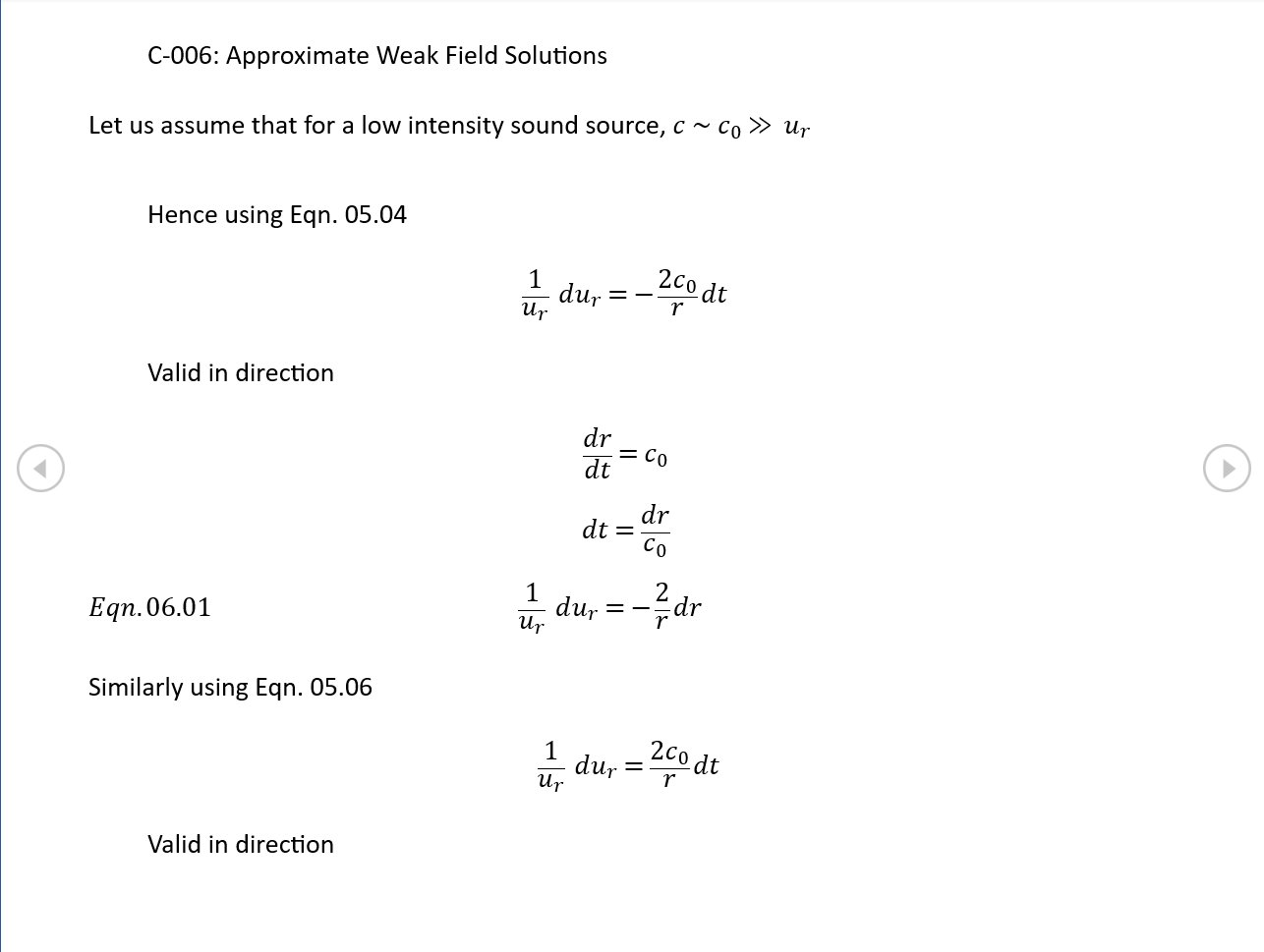
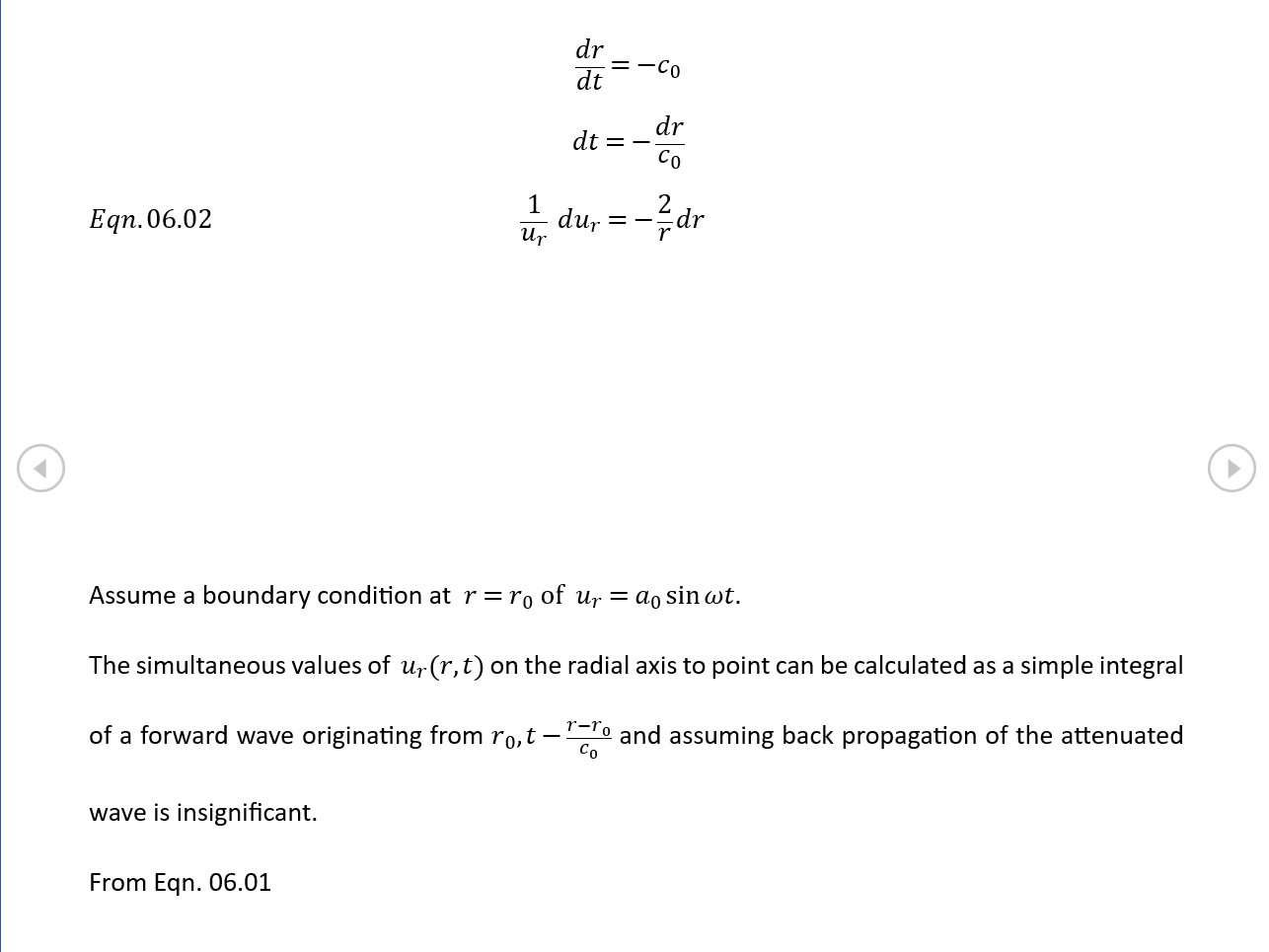
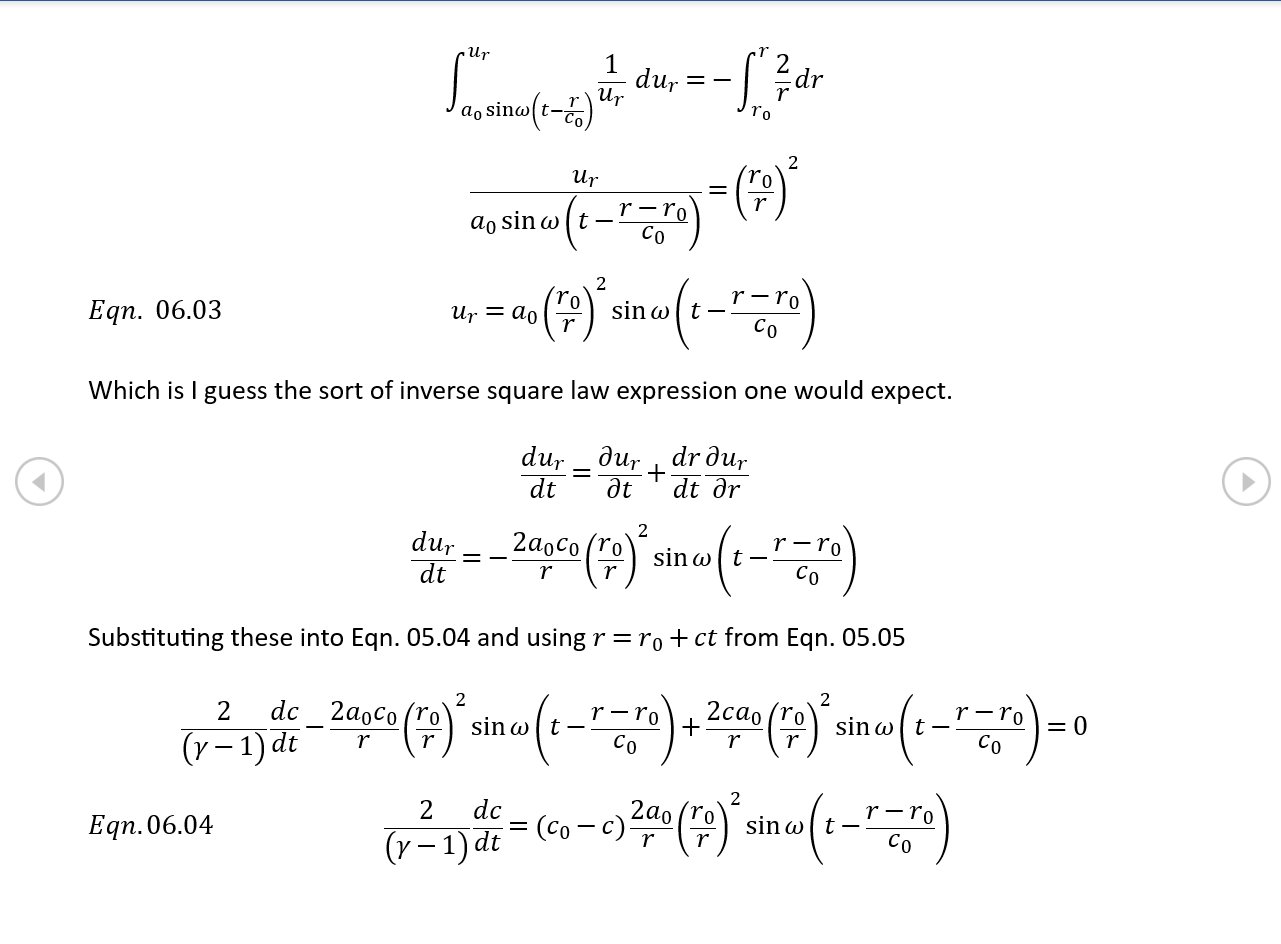
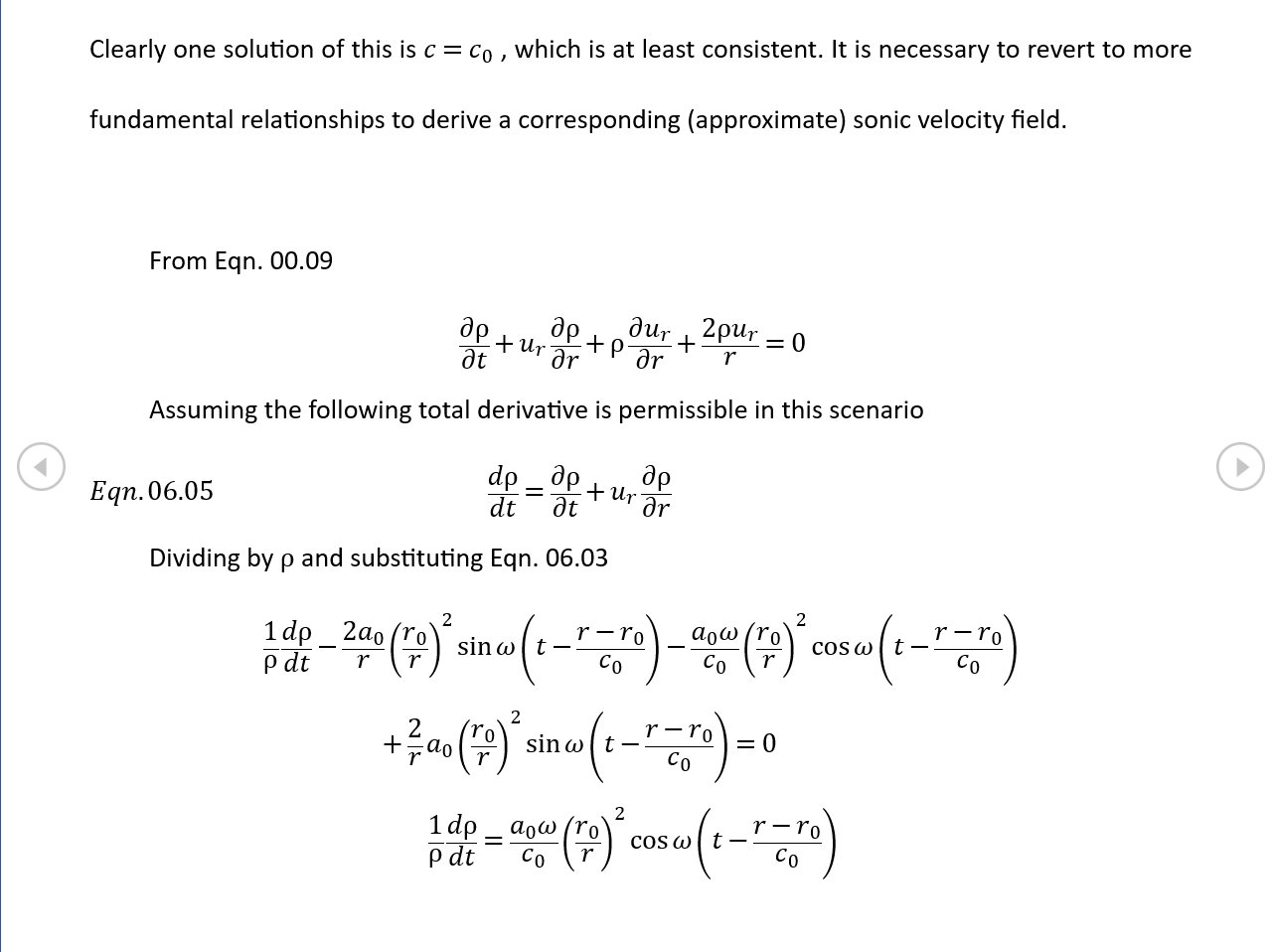
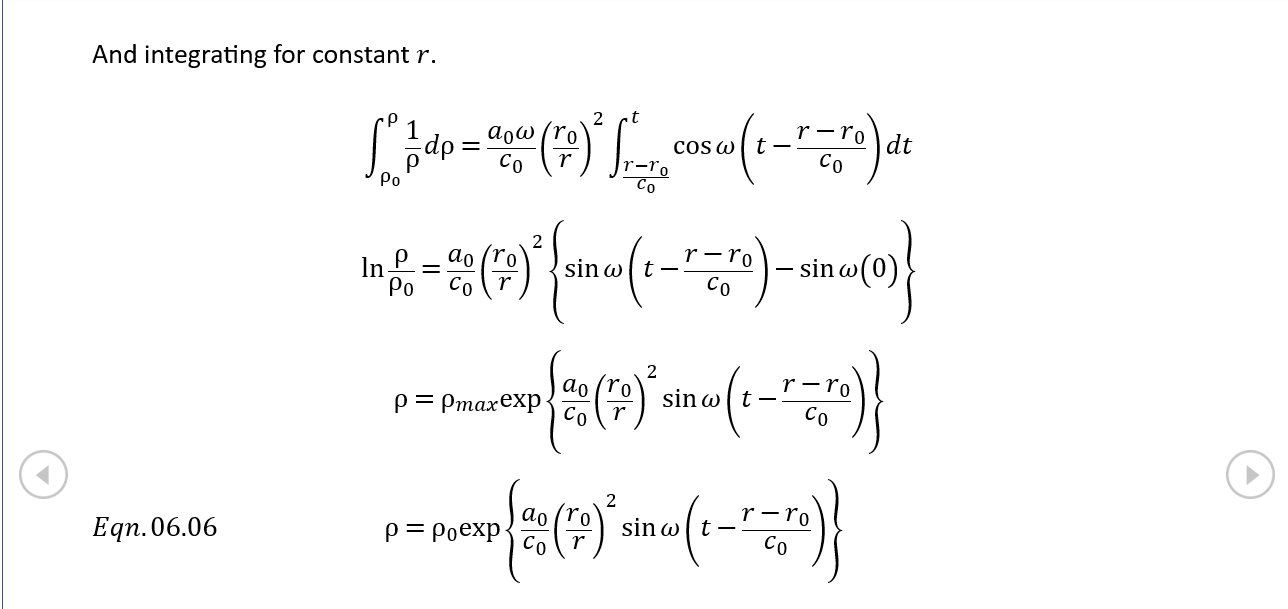
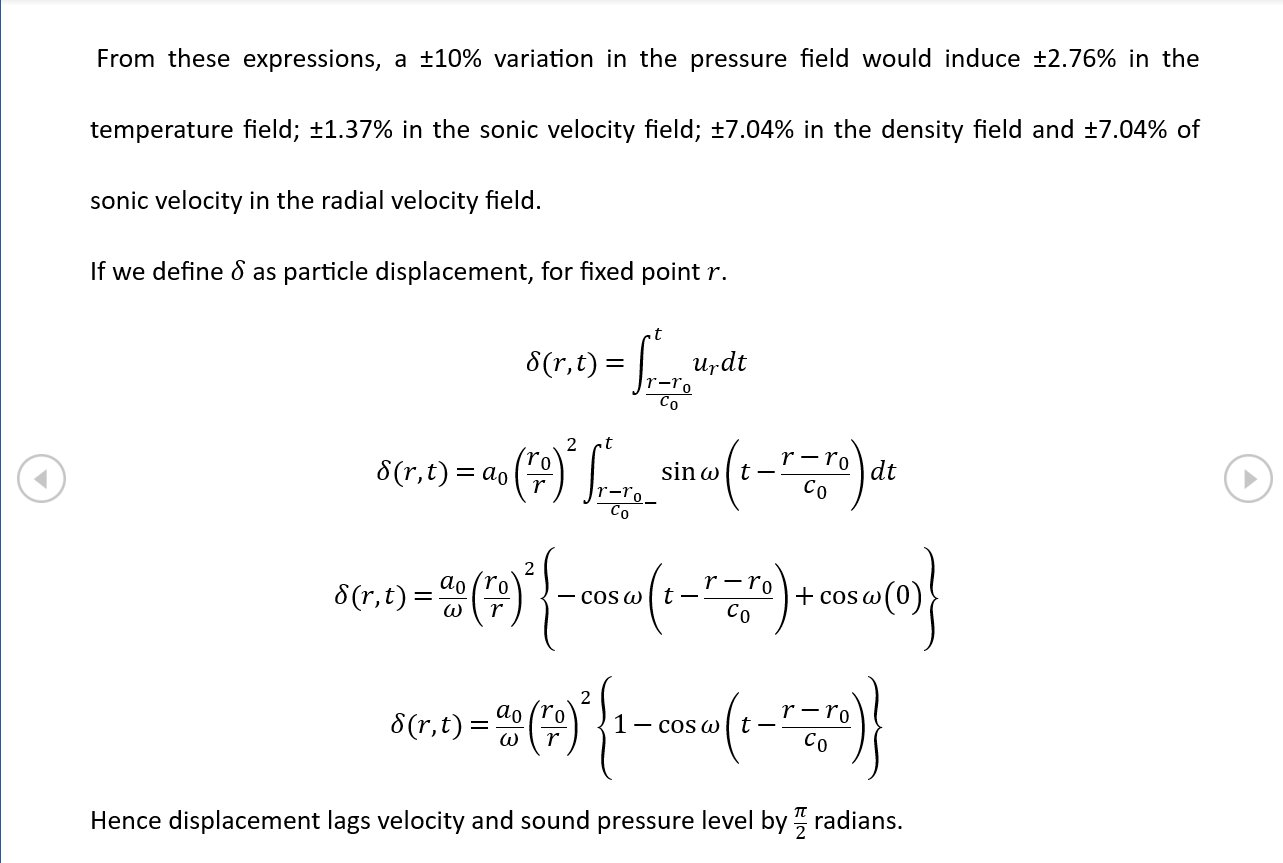
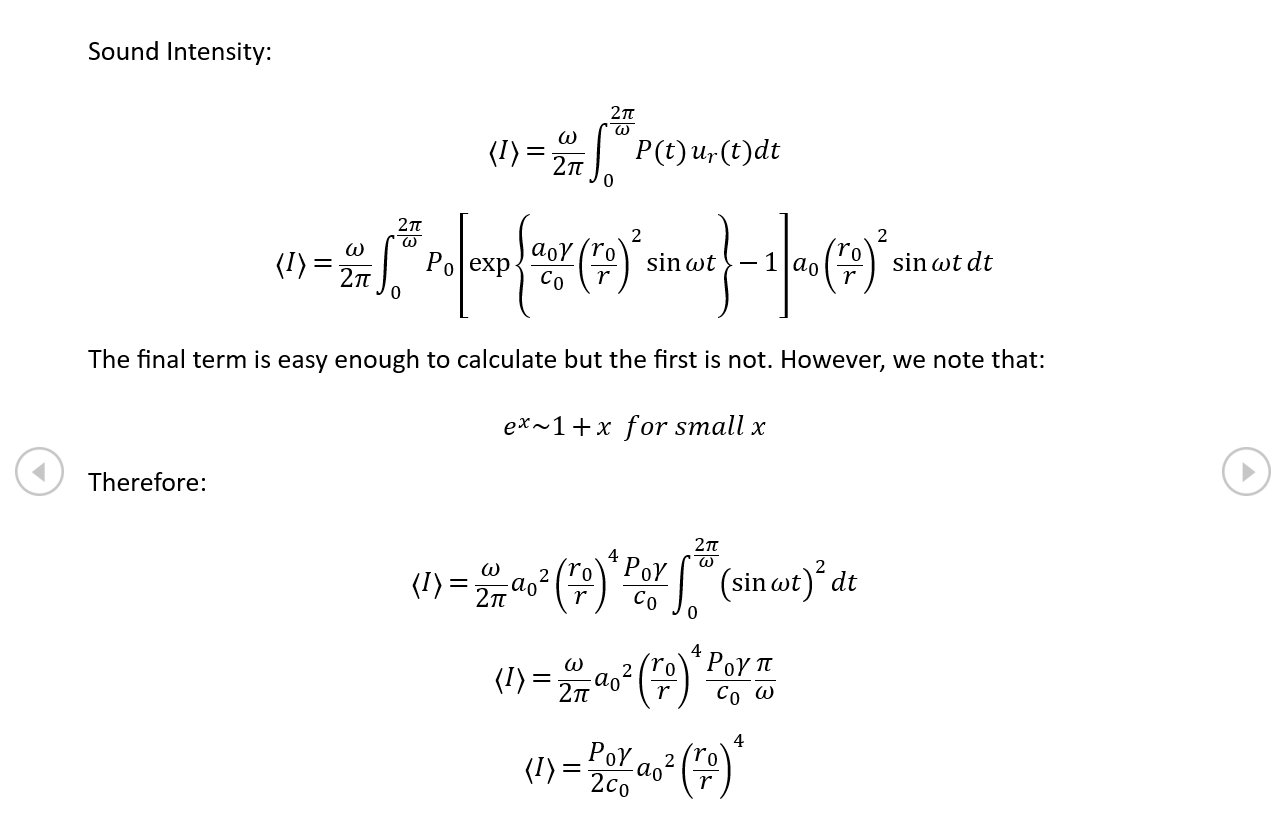
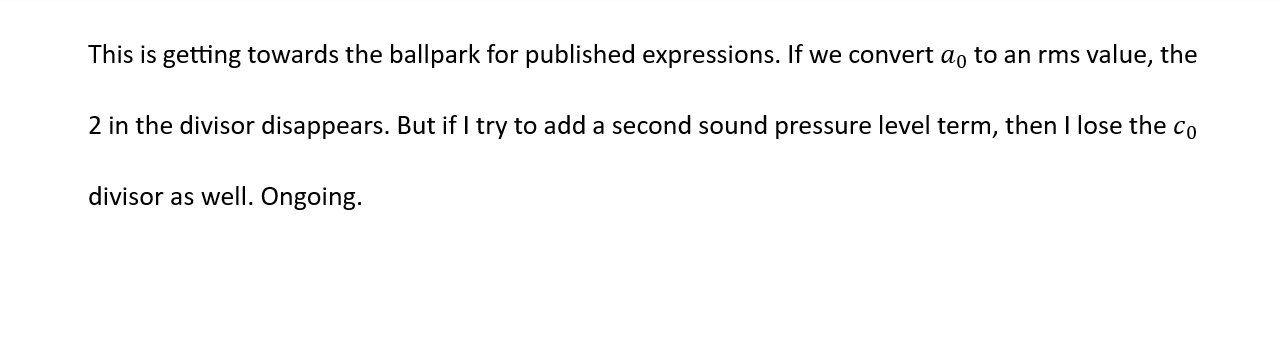
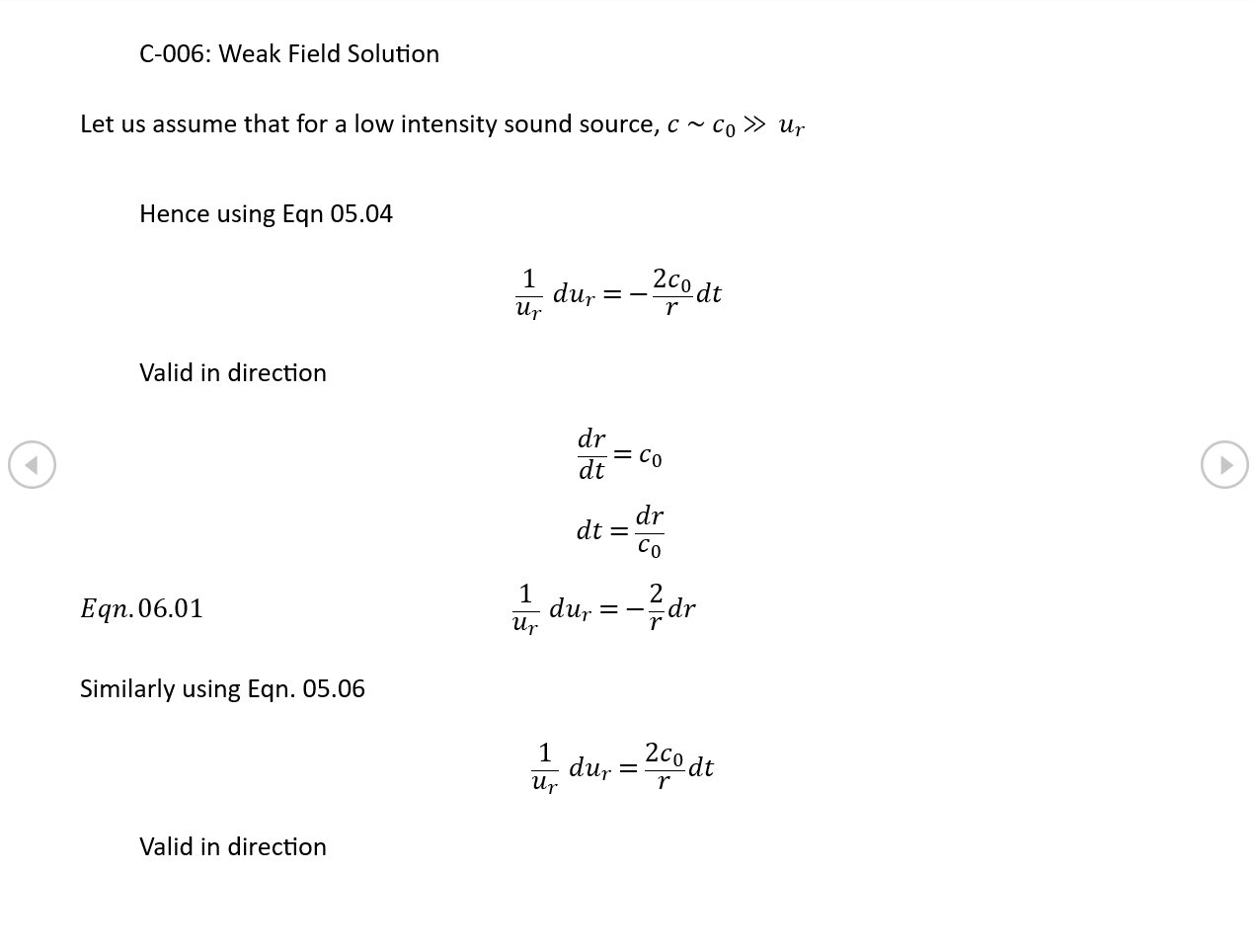
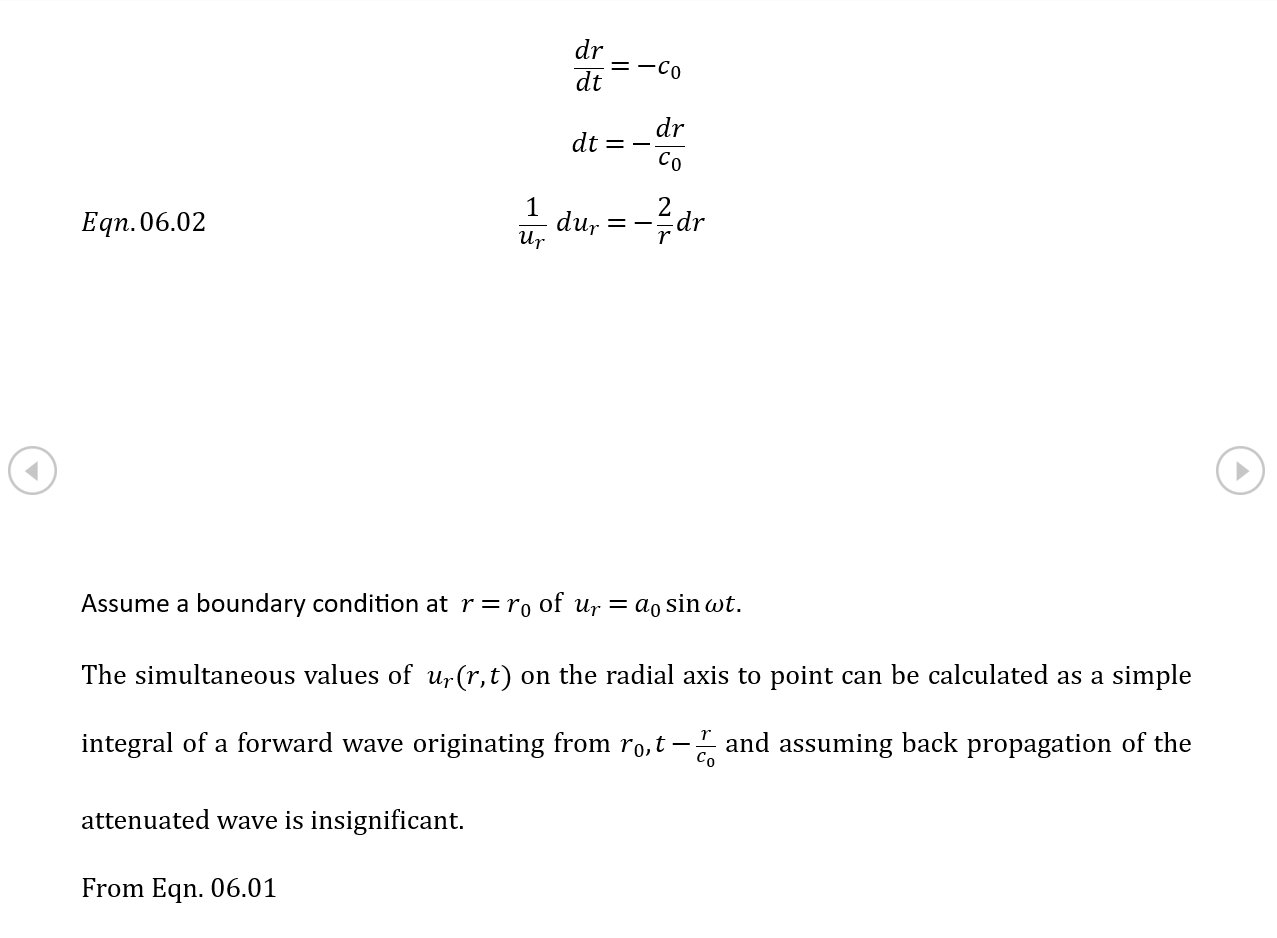
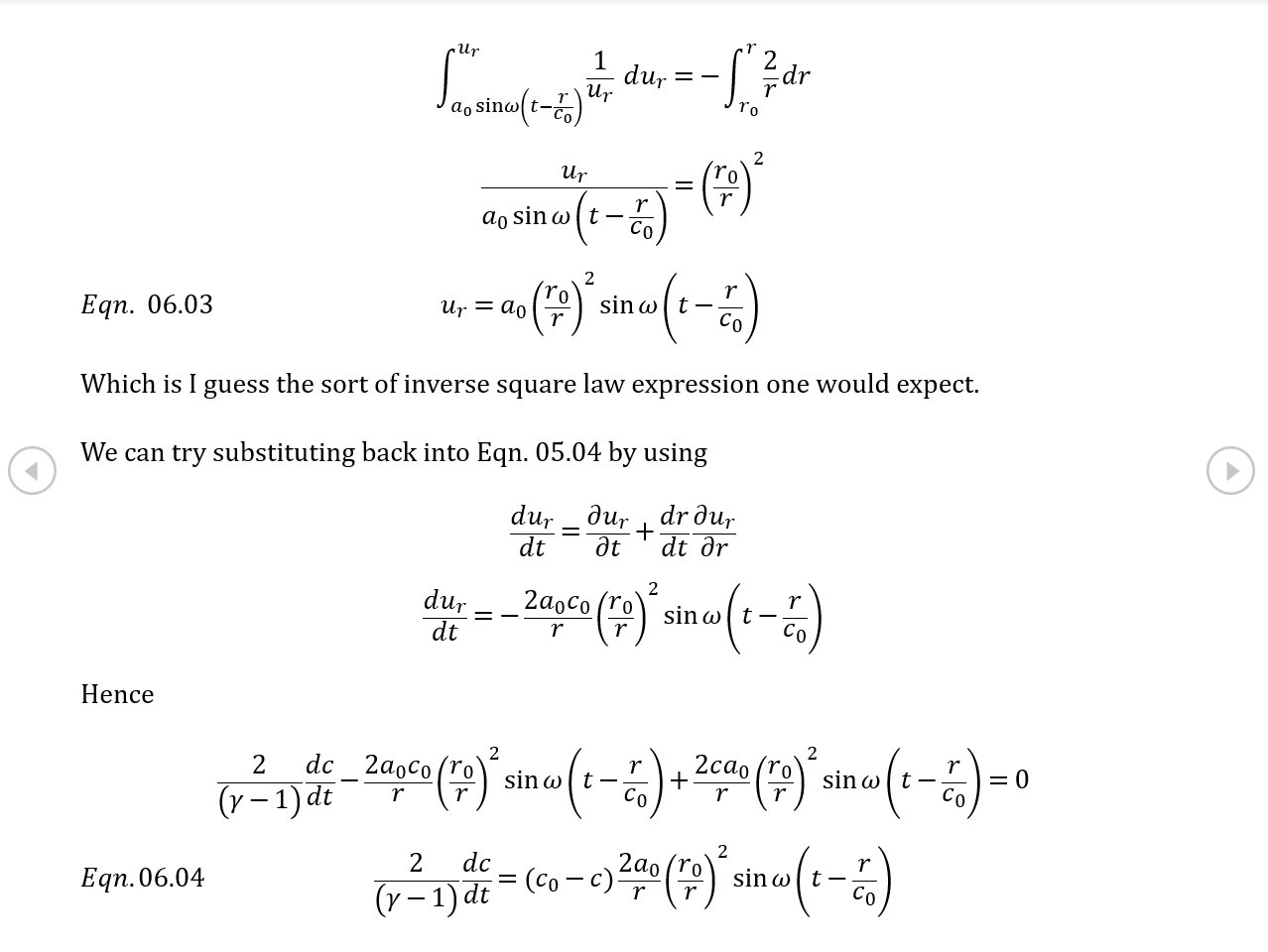
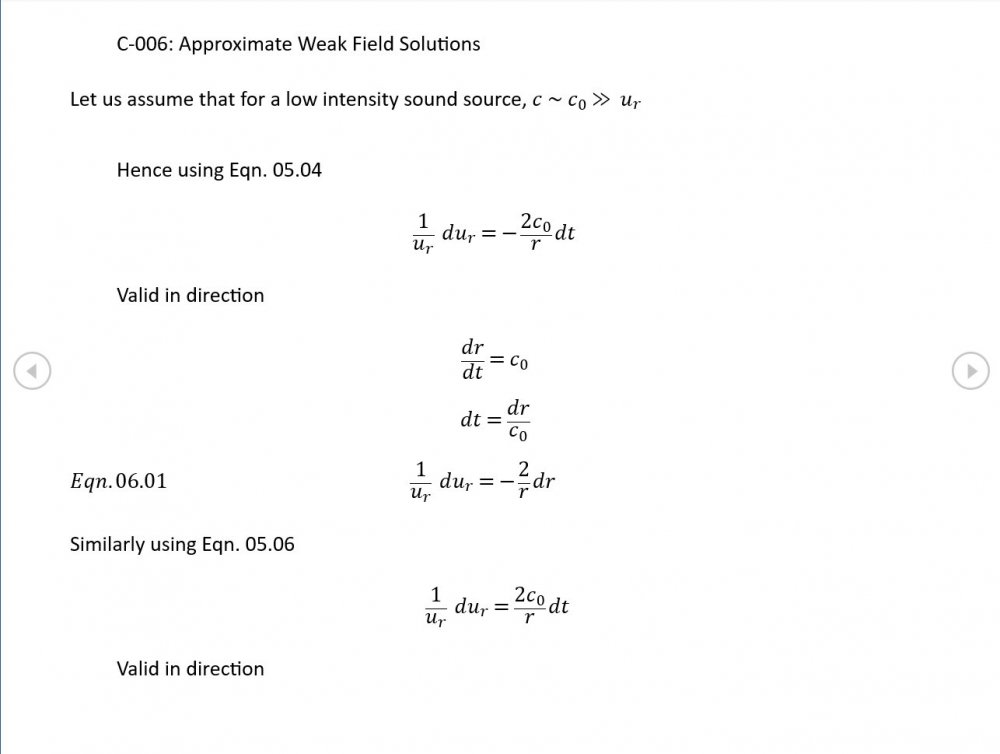
Amendments to the previous update plus preliminary approximations to all relevant fields. I really could do with someone (@Mordred) to put my use of Eqn. 06.05 under the microscope. The results that follow look credible at least as approximations, but ....
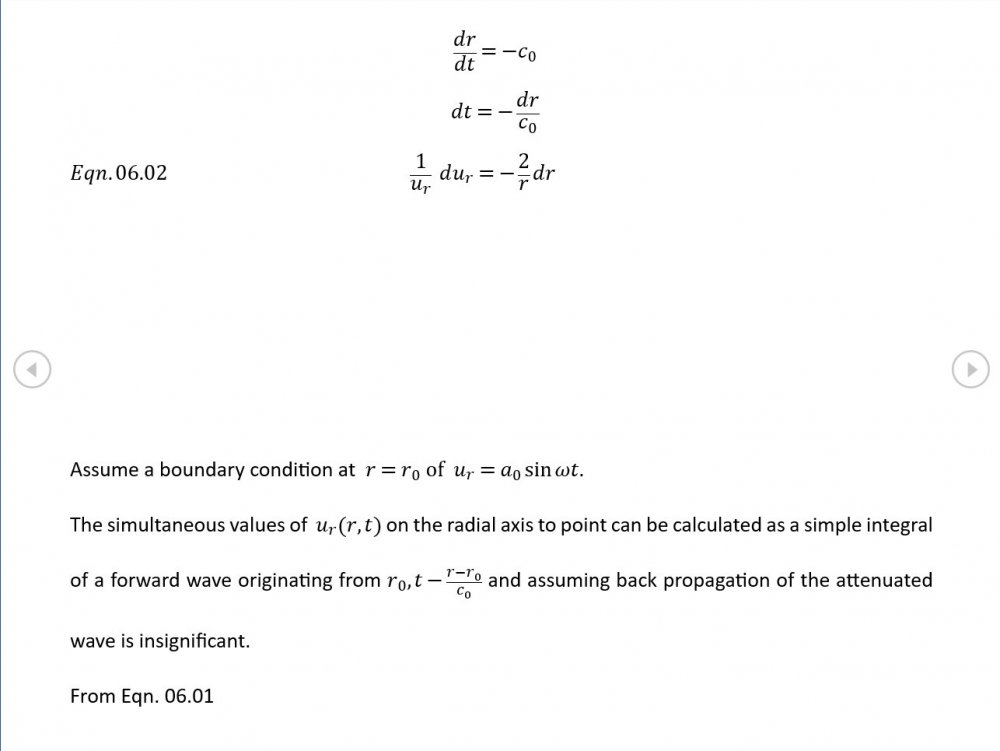
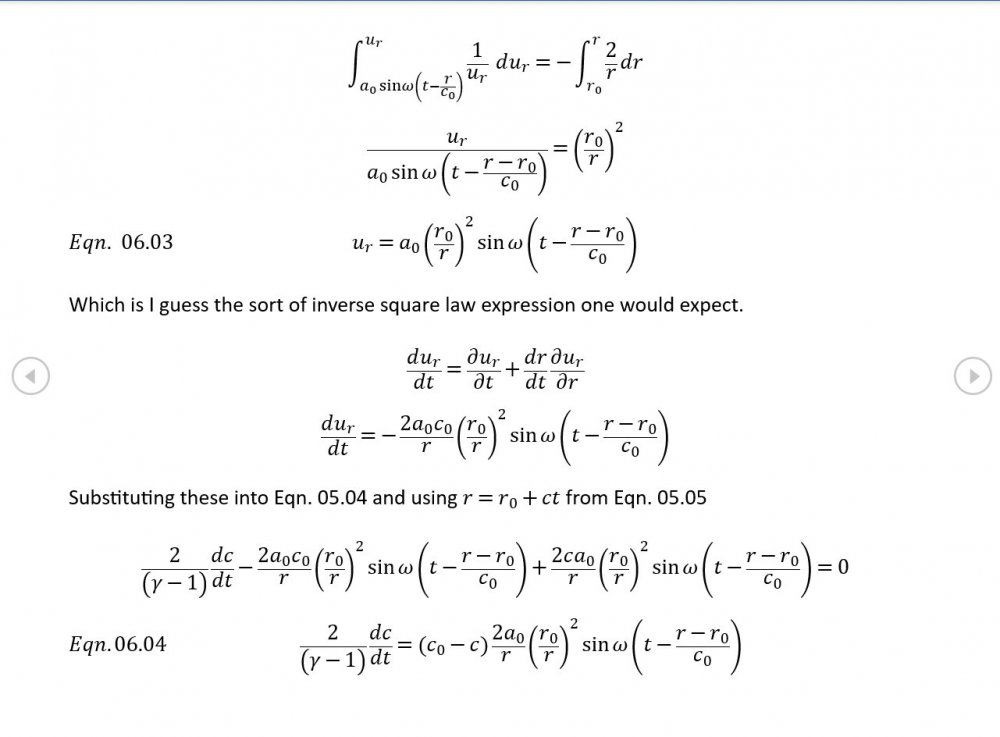
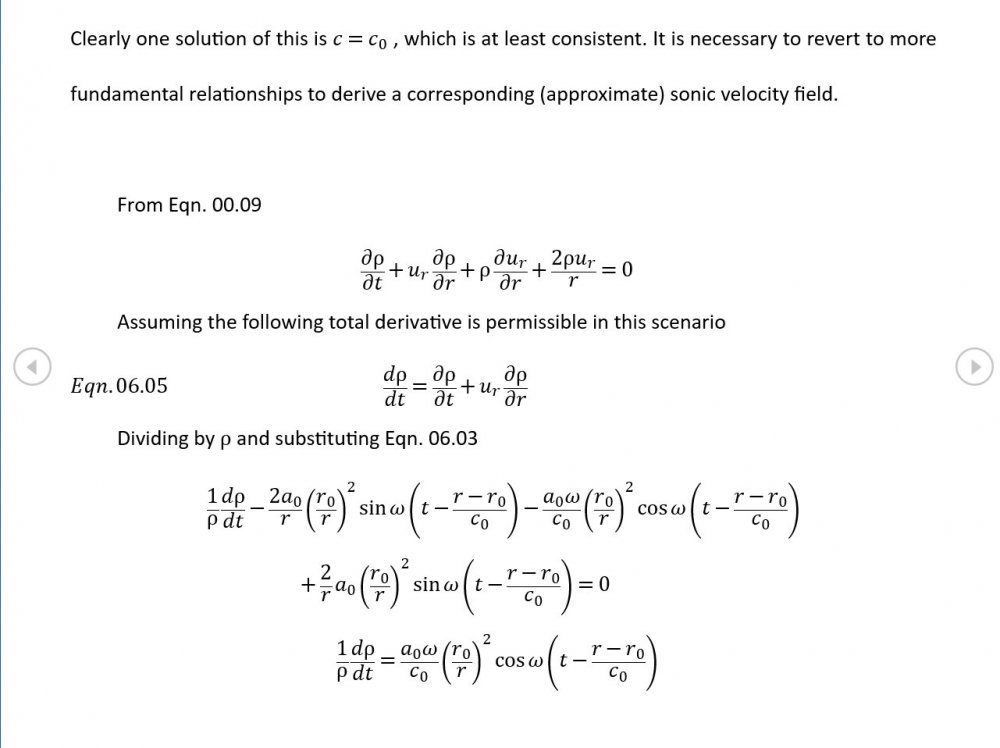
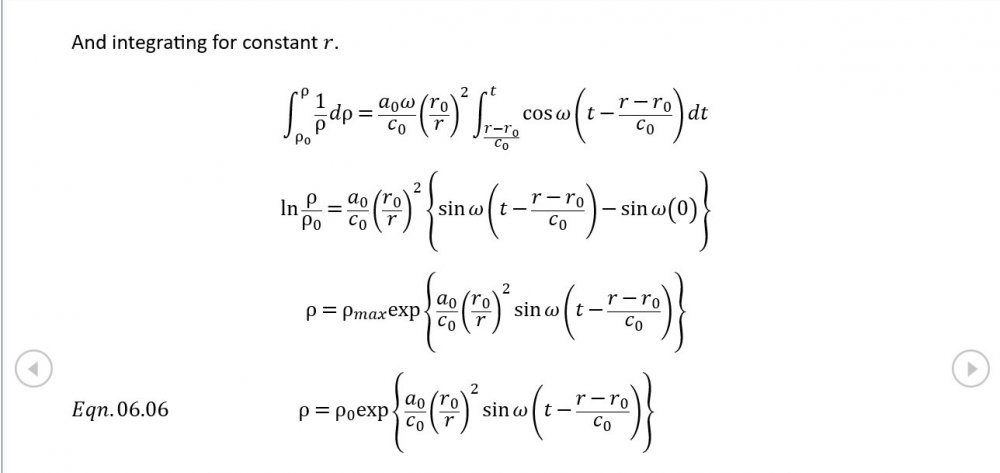
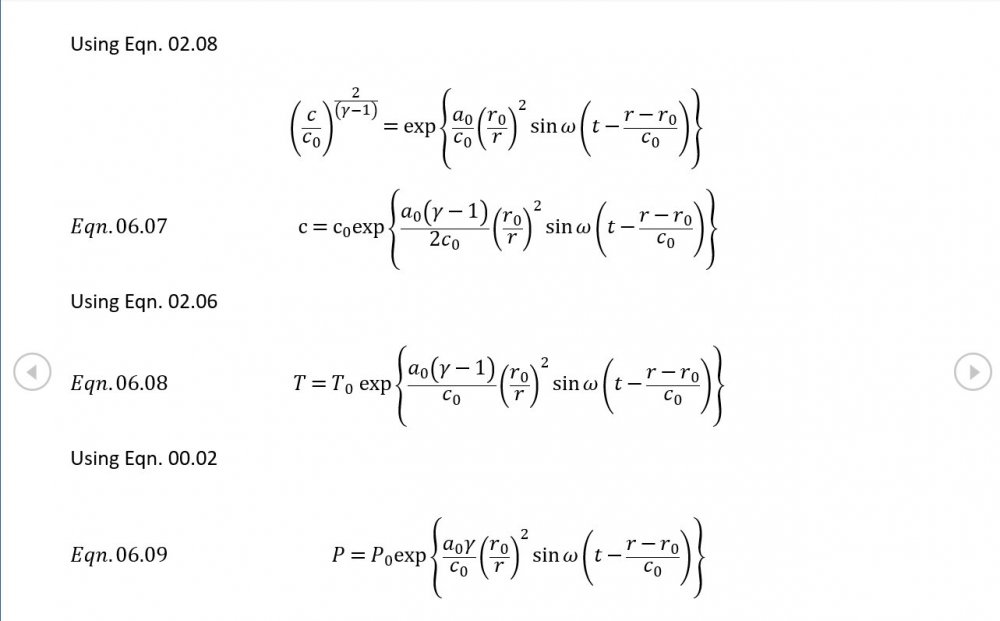
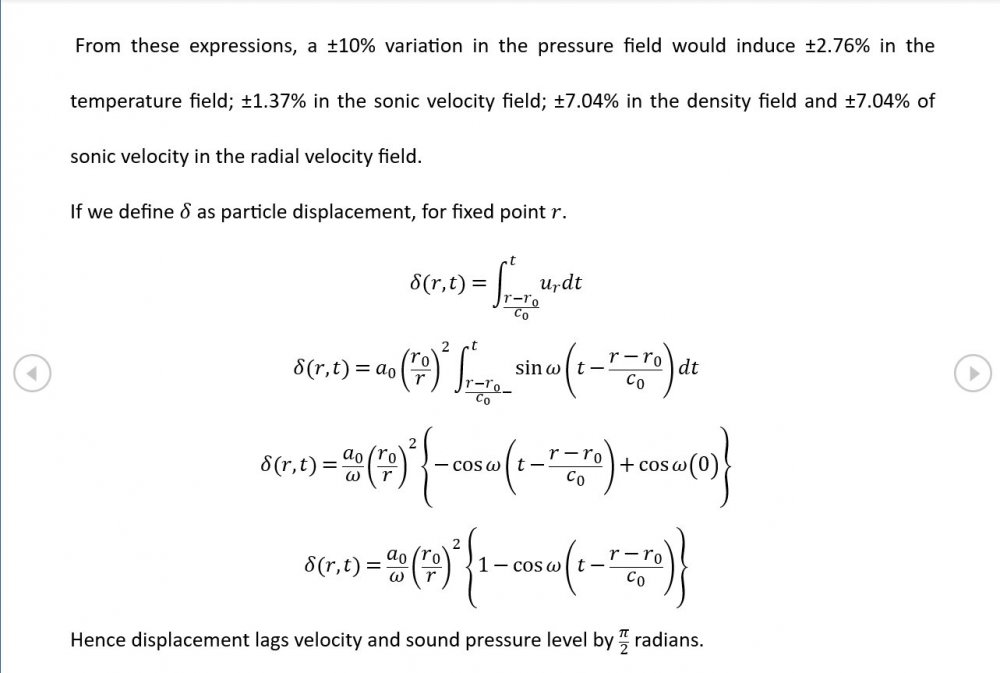
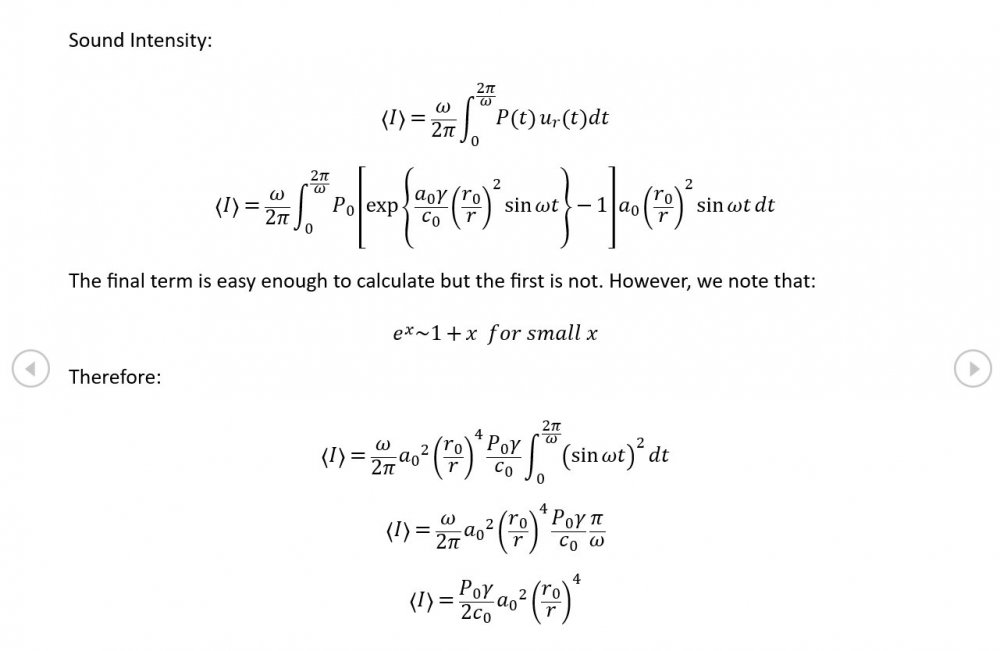
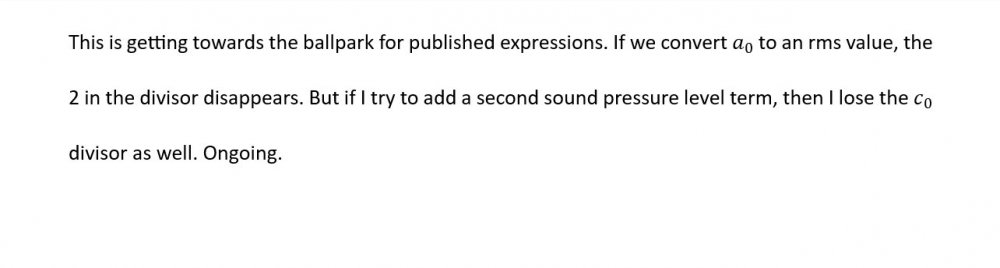
-
Good point but not insurmountable I think. The really scary challenge is that the sound output propagates back up the instrument to the mouthpiece where it acts as a high gain servo-assist on opening and closing the embouchure in sympathy with the output waveform. The output largely determines the input so there is absolutely nowhere to hang a set of initial boundary conditions unless you start from silence and integrate through all the note establishment phase.
-
Well there's the rub. As r approaches infinity the wavefront tends toward planar. Essentially I simply lose the 3rd term (2cu/r) from the ODEs and I have a planar wave. It's a little trick I found to study standing waves in low angle conical to concentric tubing. Btw I really appreciate the time you're spending on this. I know you've many other matters to attend to.
-
Shucks, missed the cut-off. r within the trig functions should read r-r0 of course.
-
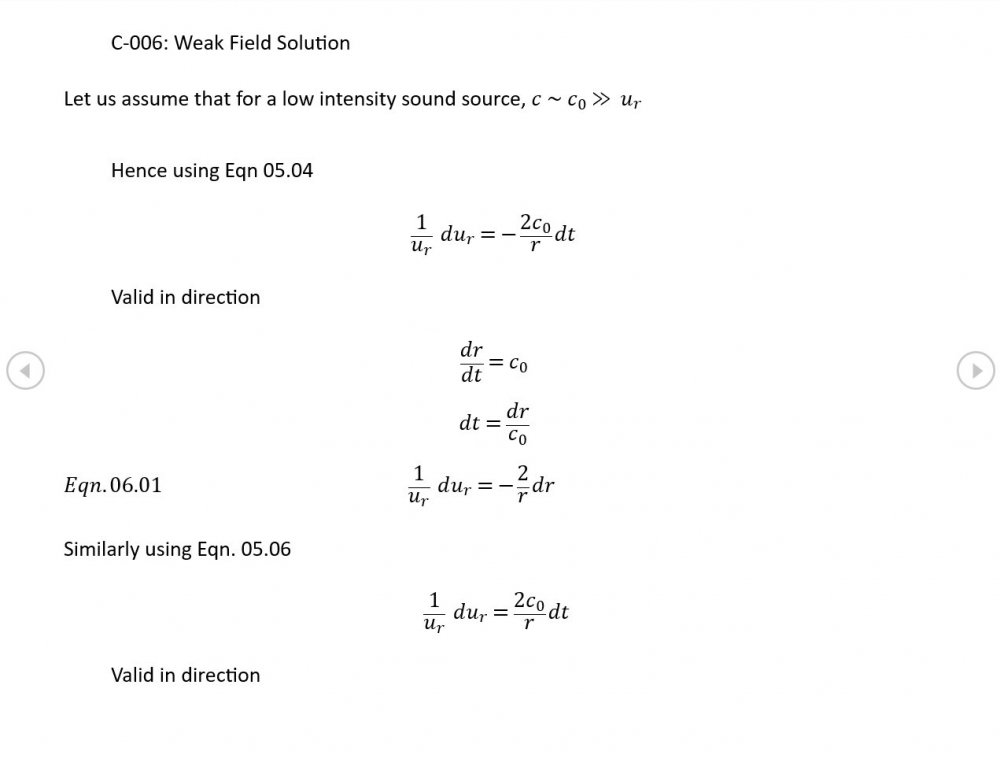
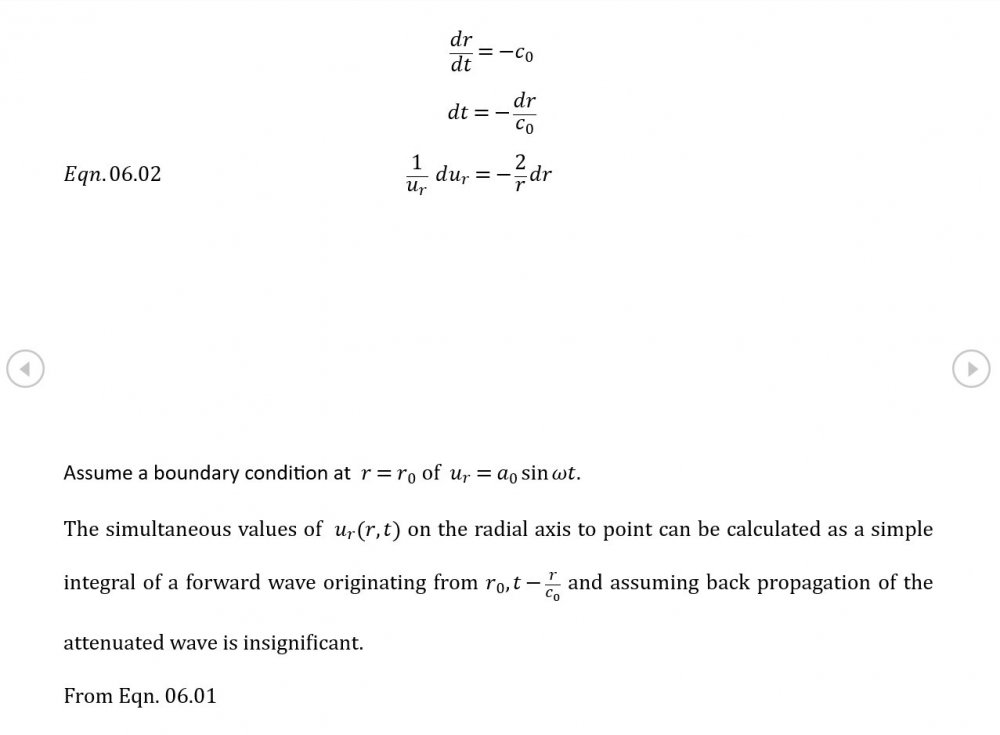
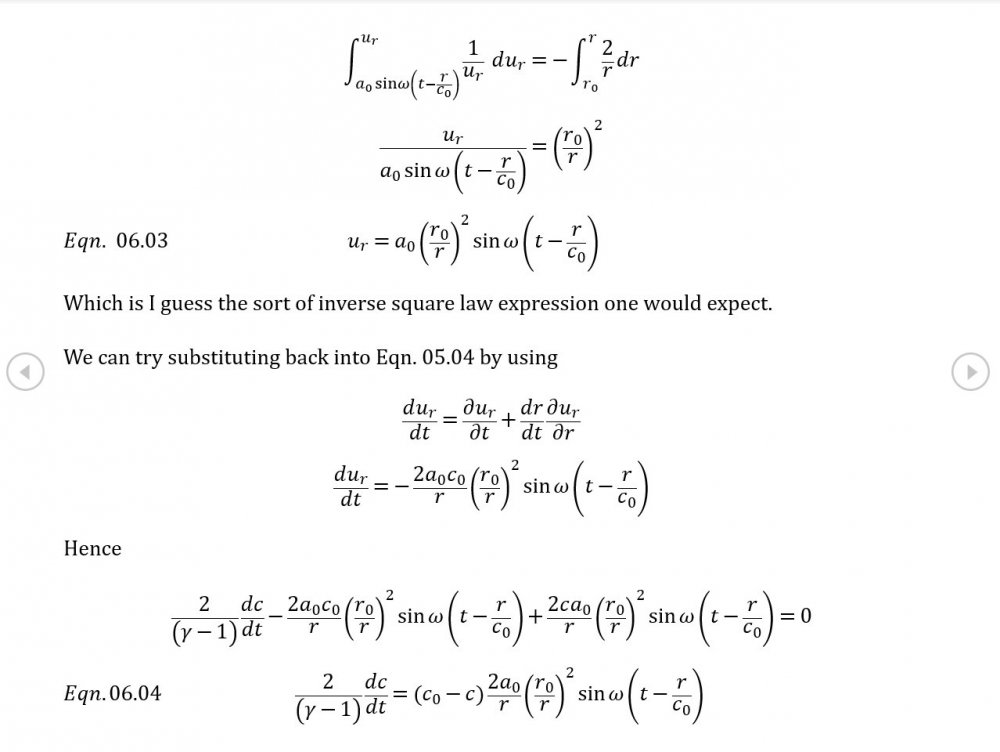
Sometimes so would I. I've worked hard all my life and set aside many topics that interested me because I could spare the time. Now that I have the time, I really would like to produce something academically worthwhile before I kick the bucket. Anyway, some weak field results hot off the presses

-
Thank you for your intervention - I appreciate it +1 Can we put the trumpet stuff to one side? It's what initially got me thinking about this topic but the OP is about building the correct general mathematical framework. The rest of your analysis is correct though the introduction of temperature via the Equation of State now needs isentropic conditions to be established via Eqn 02.02, and the introduction of a variable sonic velocity calls in Newton Laplace (Eqn 00.04) so there's 7 independent equations for 7 variables . The choice of spherical coordinates certainly helps eliminate a lot of terms that might otherwise be awkward.
-
It was based on Eqn. 02.06 given in the document posted above complete with a full derivation from thermodynamic fundamentals. Suggest you try reading it before you make any further inflammatory statements.
-
In the absence of a well developed mathematical model, these questions cannot be quantified with authority. You seem to be putting the cart before the horse. The eleven year-old trumpeter in my avatar was already getting regular paying gigs, and he says 'Citation, Please'. Or words to that effect that I'm not going to repeat in a public forum. Newtonian gravity is a far better approximation for anything you or I are likely to experience first hand. I guess this has been answered by default.
-
It's in the 'Speculations' section. If there was a citation it would be a speculation would it. Do you have anything to say on the meat of the OP or are you happy just sniping at the peripheral stuff?
-
Being 1 metre downwind of a trumpet bell will put you in the middle of a soundfield oto 1 m2. And no, the proportion of energy input that becomes acoustic energy is a matter of a musician's skill among other factors. For trumpet players above a certain standard, the kinetic energy of the DC component of flow is much less than that of the AC component. These issues are way beyond the groundwork I presented in the OP. Could we get back to that? Btw your 174 dB is effectively the sound pressure level at source ie somewhere inside the pipes which are typically 12+ mm diameter. There's a scaling factor of some thousands down to the sound pressure level at 1 metre. And I'm working with peak values not rms so 10 kPa at source will typically become oto 20 Pa at standard distance.
-
10 kPa, 8 K, 2.4 W, 120 dB seems to give a consistent picture as back-of-envelope calculations go. It's your 174 dB which is way out in left field. That's instant pulmonary embolism, burst lung zone.
-
I can never figure those things out. dB is for electricians. On a practical level, I've plugged a water manometer in the side of my mouth and registered about a metre water gauge when I'm playing a little more than reasonably loudly. If someone stuck their head within 1 metre of the business end, they'd be in some discomfort. That ties in with the 'threshold of pain' in the tables at 120 dB. I'm not sure whether the physics of sound intensity is frequency dependent either, but peoples perception of loudness most certainly is. As a rough guide, when I could play high and loud, I'd be pushing about a quarter litre of air per second into the instrument, so the PdV would be 10,000 * 0.00025 = 2.5 W. Your calculator gives 124 dB for 2.5 W/m2 so it seems to tie in. There will inevitably be some losses.
-
Depends on the frequencies and how close you are. Probably getting towards 120 dB at 1 metre.