pzkpfw
Senior Members
-
Joined
-
Last visited
Everything posted by pzkpfw
-
Can you use pipeclamps and bolts? Glue is pretty one-way. (Though drilling polycarbonate sheet for bolt holes can be tricky.)
-
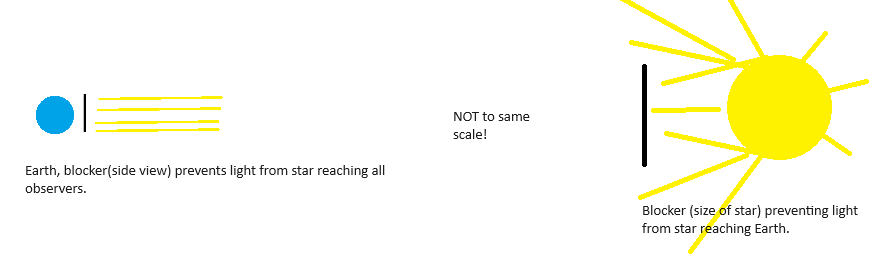
As a rule of thumb (i.e. close enough), you'd block Proxima Centauri from all viewers on Earth at the same time with a disk the diameter of Earth, if the disk is next to Earth, or the diameter of Proxima Centauri if the disk is next to that star. Anywhere in between would be a ratio. (Give or take a little gravitational lensing, and assuming everything stays still ... etc ...)
-
Did you abandon your previous thread? I'm assuming (not "suing"!) you mean JavaScript not POstScript here, too. JavaScript has no sleep. The idea of blocking code in something built for the UI is an anathema. However, you can fake it. The following works. It wraps the setTimeout in a promise, then uses await to block on it. <html> <head><title>Not a great general purpose programming environment</title></head> <body> <script> ShowLine("You can't always get what you want."); function sleep(ms = 0) { return new Promise(resolve => setTimeout(resolve, ms)); } async function ShowLine(input) { for (let i = 0; i < input.length; i++) { await sleep(250); document.write(input[i]); }; } </script> </body> </html> It seems to me you're really needing something else to do your programming with. (But you don't provide much detail to work with.)
-
setTimeout is async, i.e. it's non-blocking and will never work like this. The for loop would race ahead and make 100 setTimeouts all at once, then they'd all fire at more or less the same time, not 100 ms after each other. Also, Endy0816 is right that the null cannot be used. You do need to call a function, or have a string that evaluates to code, or use a lambda (arrow function). This works: <html> <head></head> <body> <p>Test:</p> <script> let i = 100; setTimeout(ShowDot, 100); function ShowDot() { document.write("."); if (i-- > 1) { setTimeout(ShowDot, 100); } } </script> </body> </html> If you want the first dot to show immediately, just replace the first: setTimeout(ShowDot, 100); With: ShowDot(); See: https://developer.mozilla.org/en-US/docs/Web/API/setTimeout
-
Don't you already have a thread on this stuff over in Medical Science | Anatomy, Physiology and Neuroscience ?
-
This sounds like homework.
-
It's just sloppy language. From the point of view of a person anchored to the ground, another person might appear to lift in this scenario. But it's not lift, it's more that the ground is "falling away from" the un-anchored person, and they continue to move as they did.
-
Just let it go. It doesn't matter.
-
Occams' razor suggests that bigfoot isn't people wearing bigfoot costumes, it's bigfoot hiding by wearing black bear costumes.
-
If new physics is required, how do you then answer the question in post #1 ?
-
Pareidolia https://en.wikipedia.org/wiki/Pareidolia
-
From this post, it looks like you don't actually know the big bang theory. It might be good to start with understanding current science, before deciding it's wrong.
-
Mostly I really hate time travel in any show. I generally can excuse one or two bits of magic in something (e.g. faster than light travel is pretty much required to make most Science Fiction work), but the implications of time travel are just too much for me. Having said that, I recently watched Eureka. Pretty much all of the science in that show was just silly. But that then made it easier to accept the time travel episodes. It was all really just fantasy. And the interesting bit of the time travel was that they kept the "timeline changes" in the show. That is, around half way through the run they altered their present by something they changed in the past ... never reverted it. So some characters went on in the show knowing about the "other timeline" and others only knew one. It was like the show was rebooted, with some characters knowing about the reboot.
-
I see we can add probability to the list of things you don't (can't?) understand.
-
There's also an element of "lies to children". The average person doesn't need a completely scientifically accurate explanation of something to the smallest detail. They just need to know "enough". Like the friend of mine in college (= US high school) who put his motorcycle gloves in a microwave to "dry" them, and hurt his hands when he put them on. It's like the difference between "education" by pop-sci youtube videos, vs University.
-
I think we need to explain "you can't have your cake and eat it too". Back on page 1 swansont told you "One way is to send it through a polarizing beam-splitter cube. If the polarization is in one direction it goes straight through. If it’s orthogonal it gets reflected. Knowing which way it goes tells you the polarization " So you have detectors at different locations, corresponding to the outputs of the beam-splitter cube. Which detector detects the photon tells you the spin that that photon had.
-
Are you reading replies? Neither "trillions" nor "single" applies the way you think. As already noted in this thread, the experiments are done in controlled conditions, as in, they don't leave the apparatus sitting out in the mid-day sun. And they are not dealing with one photon at a time, they are using statistics (as noted in this thread) to analyse the results over a multitude.
-
Entanglement experiments start with making two particles be entangled. i.e. you don't entangle one - what's it entangled with? Nor do you need to go looking for the other.
-
Astounded again. Nobody (in science) claims this. It's a strawman that creationists argue against.
-
That is simply astounding from someone who has twice in this thread made snarky references to "common knowledge".
-
... and a lot of what he says (that gets quoted) is at the level of pop-sci, not formal papers.
-
It comes to us, from all directions. So it's coming from everywhere. It's not like finding a specific thing in one location and thinking that's everywhere. Bear in mind it was predicted to exist, and was later found. That'd be a good coincidence if it's actually something else.
-
Nope, I meant exactly what I wrote.
-
How many elements are in A? How many elements are in B? Is there a way to uniquely pair elements from A and B 1-to-1 ? You are misapplying statistics.
-
I don't really understand the point you're making in reply to my post. To me it seems simple: 1. Enable [print to PDF] on the Linux machine (I use Windows so have no specific instructions, but it seems googleable) 2. Open Libre office, use it to open the .ODT file. 3. Print, selecting the "to pdf" option (it may show as "to file") instead of an actual printer, that'll stick the content formatted into a PDF in a file, directly on the memory stick for ease. 4. Shove the stick in the printer; it can handle PDF. (That'll give a much better quality result, easy and repeatable - especially for multiple pages, than a bunch of screen shots.) Of course it's all a bit weird. The OP doesn't tell us until their 3rd post they use Linux. Gets grumpy when their idea (like heck Brother will bother making their printers handle ODT files). And hasn't told us why they can't just print directly from their PC. I'm guessing it's because their PC is in their sex dungeon and their printer is in their laundry. Too far for a cable and they can't get the WiFi to work. (Yes, I googled whether a MFC-L5850DW has WiFi.)