
Daedalus
Senior Members
-
Joined
-
Last visited
Everything posted by Daedalus
-
I don't quite get the joke Moontanman... If that happened to me, I'm pretty sure humor would be the last thing on my mind.
-
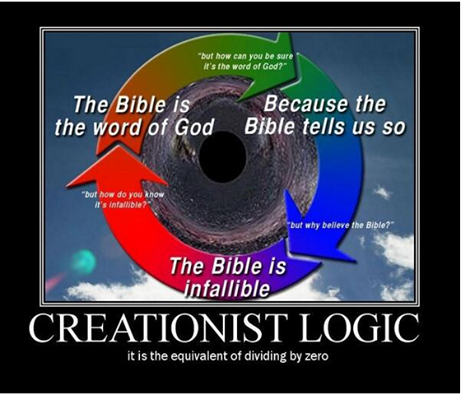
Seems fitting given the above posts:
-
In addition to thanking Imatfaal for putting together such a wonderful tutorial that will hopefully be put to use, I would also like to add that you can nest quotes. The forum software used to do this automatically when you quoted someone who also quoted someone else. To nest quotes, you simply copy and paste the quoted text inside the quote. Like in an essay - make it clear you are paraphrasing. It is rather external to this thread as a section of prose that is paraphrasing another's ideas never ever goes in quotation marks. As Stringjunky says below it might be seen as deceptive if a paraphrase is made to appear as if it were a direct quote and it is good posting practice to overtly mention that you are re-wording another persons text (see what I did there - metaparaphrasing) The behaviour of the cursor and the software doing "its own thing" is one of the reasons we decided a thread was necessary. I tried to list things that (nearly) always work - but if there are problems with any of the methods let me know and I will attempt a workaround. Of course, this involves you pressing the quote button for both posts, copying the quoted text, and then pasting one quote inside the other.
-
Anyone who has been married or in a relationship for a very long time will appreciate this one: A man and woman had been married for more than 60 years. They had shared everything. They had talked about everything. They had kept no secrets from each other except that the little old woman had a shoe box in the top of her closet that she had cautioned her husband never to open or ask her about. For all of these years, he had never thought about the box, but one day the little old woman got very sick and the doctor said she would not recover. In trying to sort out their affairs, the little old man took down the shoe box and took it to his wife's bedside. She agreed that it was time that he should know what was in the box. When he opened it, he found two crocheted dolls and a stack of money totalling $95,000. He asked her about the contents. 'When we were to be married,' she said, ' my grandmother told me the secret of a happy marriage was to never argue. She told me that if I ever got angry with you, I should just keep quiet and crochet a doll.' The little old man was so moved; he had to fight back tears. Only two Precious dolls were in the box. She had only been angry with him two Times in all those years of living and loving. He almost burst with Happiness. 'Honey,' he said, 'that explains the dolls, but what about all of this money? Where did it come from?' 'Oh,' she said, 'that's the money I made from selling the dolls.'
-
lol....

-
HAHAHAHA!!! ROFL!

-
This is why I don't go ice fishing...
-
Well, it's almost Thanksgiving. What do you have to be thankful for?

-
I seen this one on FB and couldn't help but laugh...

-
When it's not working, call tech support

-
Yep... This pretty much sums me up lol

-
The comparison game. I know what you're thinking lol...

-
Super-calloused fragile mystic hexed by halitosis Even like the sound of it, his breath is quite atrocious
-
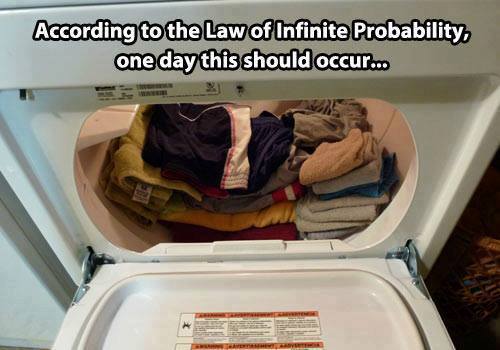
This is about as religious as I like to get Don't worry! I'm sure there's a cure... Perhaps when we invent a dryer with a "fold laundry" cycle


-
How to use the scientific method... http://youtu.be/LvkRUWk1kBE
-
A religious person was seated next to an atheist on an airplane and he turned to her and said, "Do you want to talk? Flights go quicker if you strike up a conversation with your fellow passenger." The atheist, who had just started to read her book, replied to the stranger, "What would you want to talk about?" "Oh, I don't know," said the religious person. "How about why there is a God, or Heaven and Hell, or life after death?" as he smiled smugly. "Okay," she said. "Those could be interesting topics but let me ask you a question first. A horse, a cow, and a deer all eat the same stuff - grass. Yet a deer excretes little pellets, while a cow turns out a flat patty, but a horse produces clumps. Why do you suppose that is?" The religious person, visibly surprised by the atheist's question, thinks about it and says, "Hmmm..., I have NO idea." which the atheist replies, "Do you really feel qualified to discuss God, Heaven and Hell, or life after death, when you don't know shit?" ...she then went back to reading her book.
-
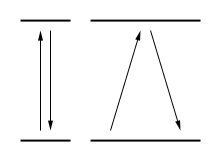
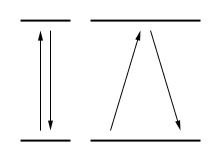
The point of the paragraph you quoted is to demonstrate the general workings of a clock. It does not in any way attempt to describe QM effects. Sure, you can attempt to bring QM into the discussion. However, you cannot truly be certain whether these oscillations, as you say, are not as physical. A counter-example to your argument can be seen in string theory. You even state that "time doesn't oscillate any more then the dimension of width oscillates". However, you failed to recognize that units of width do oscillate in their own way. I can create a wheel that marks out one meter per cycle of the wheel. Thus each unit of width that I measure represents a cycle. I can add up the number of cycles the wheel has made and arrive at a measurement of width. So, unless you have a working theory of everything and can be so bold as to rule out physical motion at the quantum level, let's keep QM out of the discussion. Here you are compounding this notion of time with how you currently understand it. There is no change in position of time over time. That makes no sense at all. However, you have to ask yourself a more fundamental question to the nature of time. One that brings into question whether or not measurements of time are needed at all in order to describe a physical system. The answer to the question is that time, as is currently measured, is not needed because we can use motion instead. If I have a light clock, I can either count the number of round trips (cycles) the pulse of light has made or I can measure the distance the pulse of light has traversed each cycle. Either way, both measurements can be used to quantify motion. One method quantifies motion to the count of cycles a clock makes and the other quantifies motion to the distance traversed by the oscillating mechanism the clock uses. You may argue that QM doesn't operate in such a classically defined way. However, much like in GR, if you cannot tell the difference between being in a room that is accelerated versus one that is in a gravitational field, then how can you tell the difference between clocks that use classically defined motion versus the few that are based on principles of QM. Both types of clocks simply count the cycles of their oscillating mechanism. The difference is that if you base time on the cycles of the oscillating mechanism, then you must account for the time dilation of clocks in relative motion to each other. However, if you base time on the distance traversed by such mechanism, then time dilation is automatically included. This is evident in that the path of the oscillating mechanism for the clock in motion relative to the observer is elongated such that the clock in relative motion will appear to run slower than the observer's clock. This is demonstrated in the following image where the observer's clock is to the left and the clock in motion relative to the observer is to the right. As you can see, the path of the oscillating mechanism for the clock that is in relative motion to the observer is elongated. The point is that if we can use motion instead of counting cycles to define equations that describe the motion of an object, then time itself must be based on motion. The result is that the differences between the temporal and spatial dimensions can be resolved within the framework of relativity by using nothing more than motion itself. In order to understand the full implications of the theory, you must read beyond the first post in the thread. I have provided a framework that resolves the differences between the temporal and spatial dimensions. Of course, there is plenty of speculation on my part. The mathematical model I provided is missing several key elements. However, I do support my argument throughout the thread and continue to develop the model. I have even created a new model since my last posting that takes into account motion across expanding space. You are at liberty to disagree with me, and I do encourage criticism. The only thing I ask is to be thorough in your objections, which requires understanding the model itself.
-
Next week we will discuss the equation for the path of rotating body moving outward along the W axis and derive time dilation accordingly. As promised, I will also post the interpolation equation that allows us to specify locations with respect to intervals that can be sampled at any given time. This is different from Newton's interpolation formula which requires each location to be sampled within equal intervals of time. Newton's interpolation formula: [math]\sum_{i=0}^{n-1} \left [ \sum_{j=0}^{i} \left [ \left ( -1 \right )^{j} \binom{i}{i-j} S_j \right ] \times \binom{i-t-1}{i} \right ][/math] The variable [math]n[/math] is the number of measurements or specified locations, [math]S_j[/math] is the location specified by the [math]j[/math] index, the [math]i[/math] index works in conjunction with the [math]j[/math] index, and [math]t[/math] is time.
-
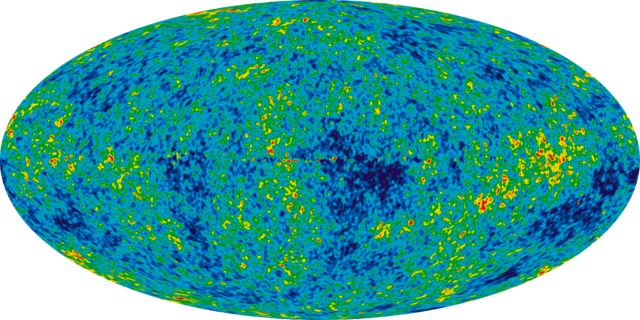
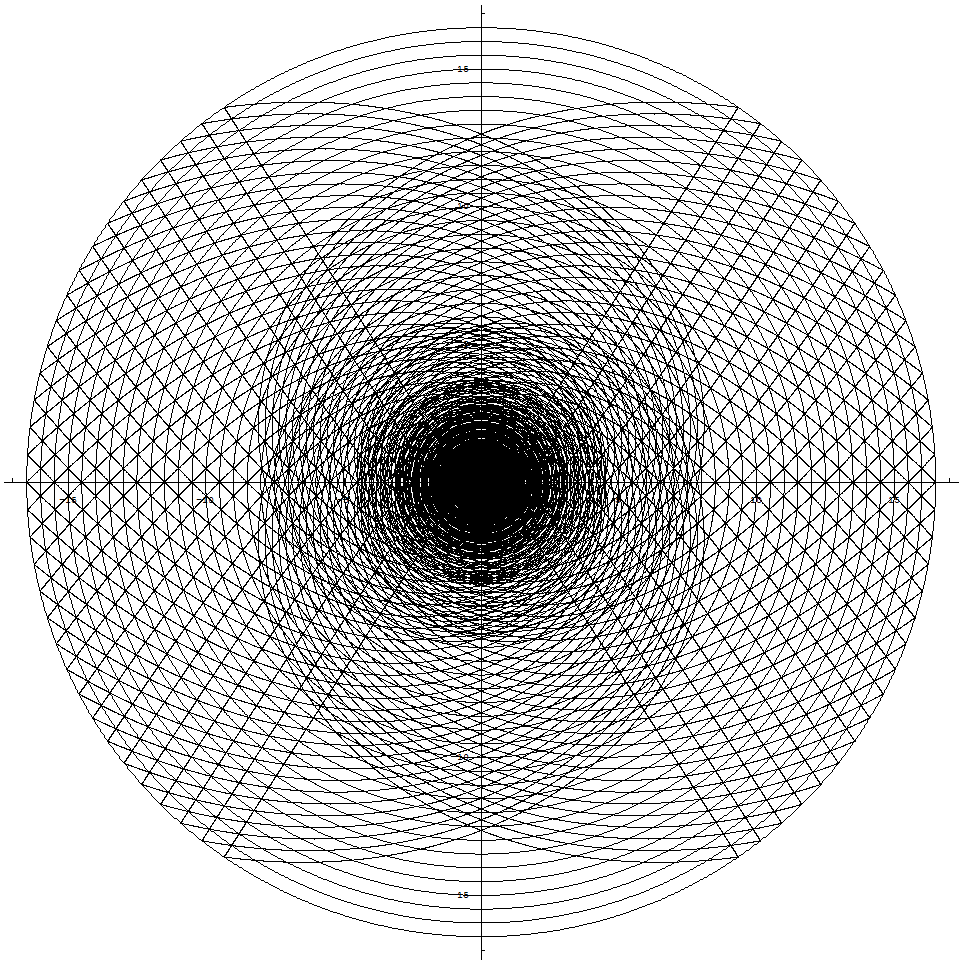
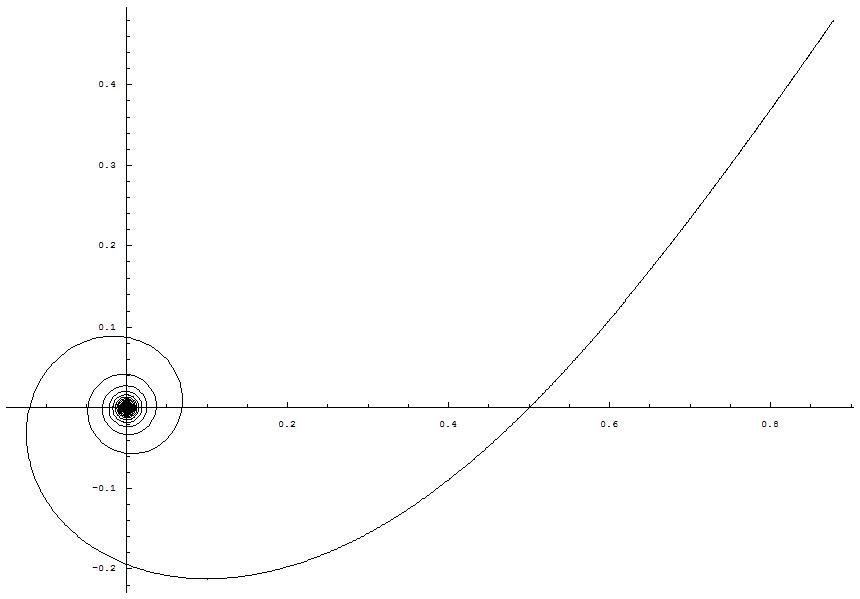
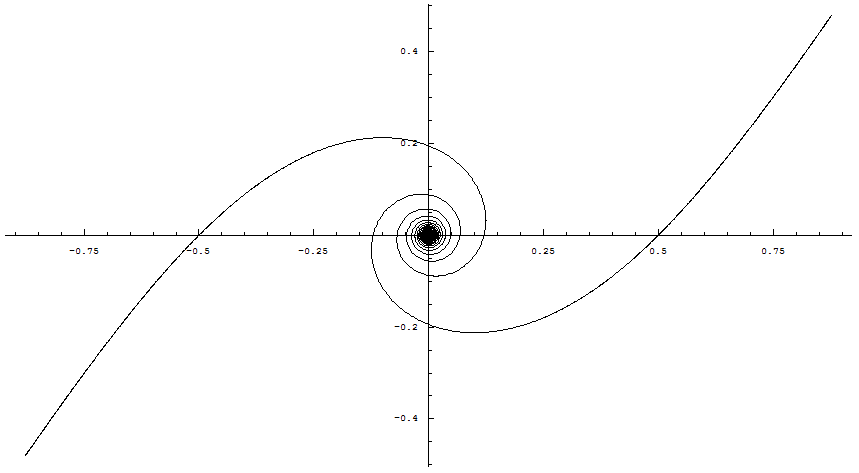
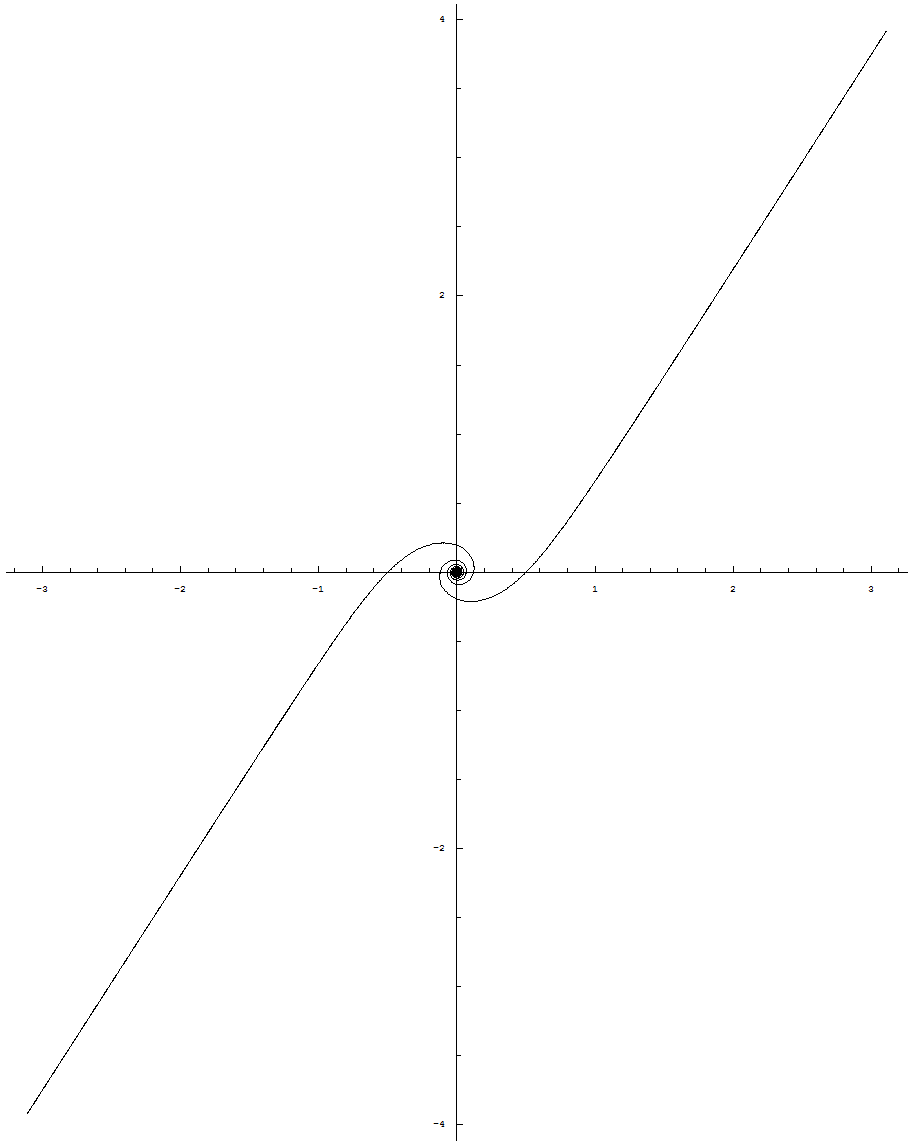
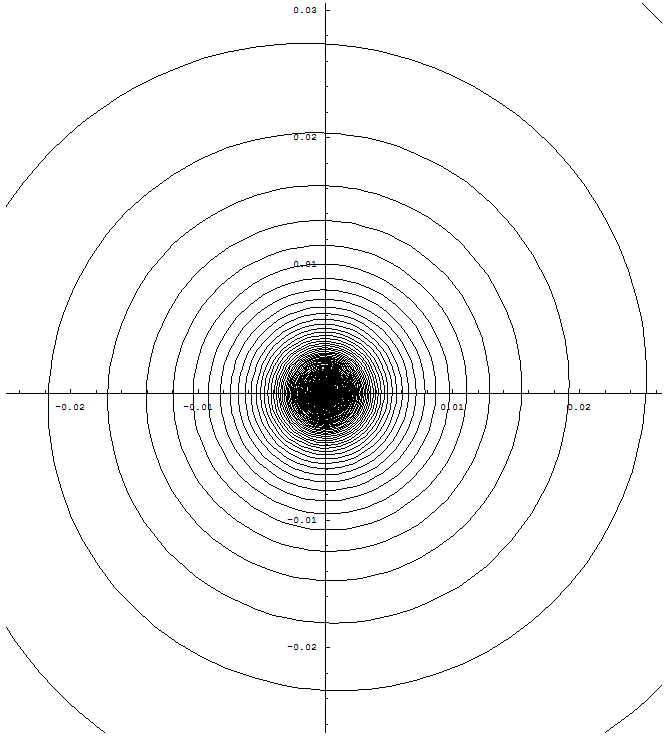
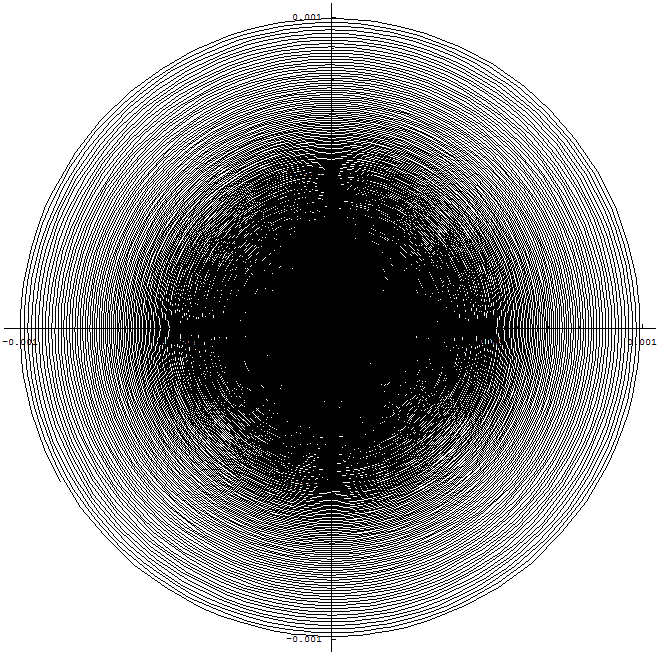
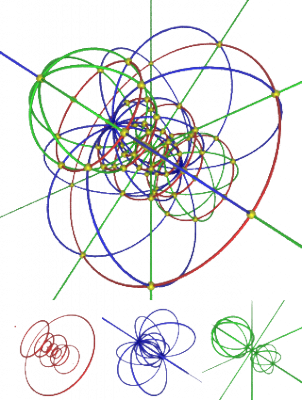
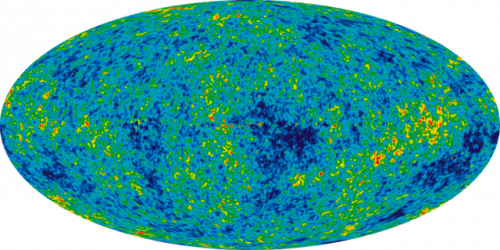
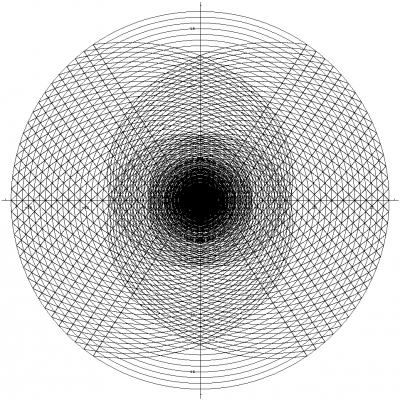
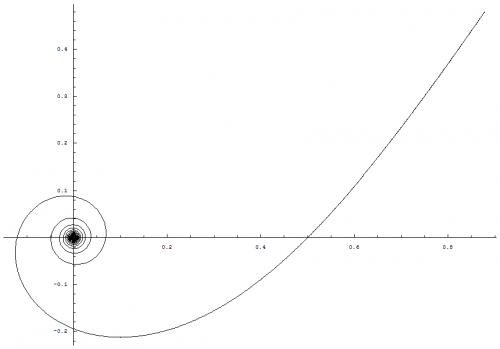
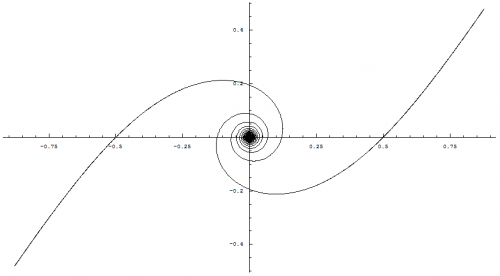
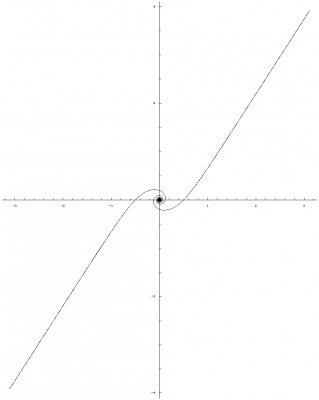
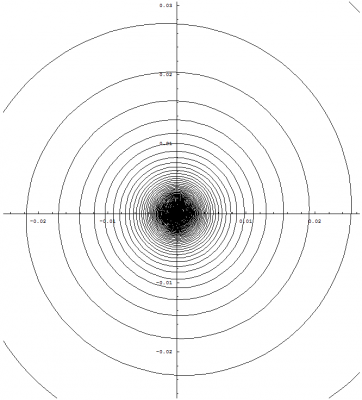
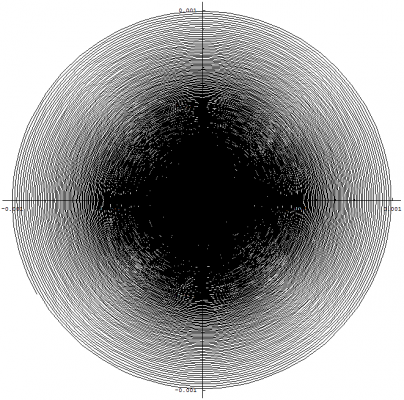
I know it has been a while since I last made a post, but I would like to continue and discuss the spiraling singularity and how I have interpreted this mathematical result of my equations. Before we get into the details, I would like to recap on what has brought us here and why I believe this mathematical framework gives us some insights into the nature of the universe. My original goal for Temporal Uniformity was to explain the phenomena of time by stating a hypothesis that dark matter is temporally displaced matter. This requires us to view the temporal dimension no differently than we do any other spatial dimension. This brings into question why we do not perceive this dimension to have any physical length, but experience a forward direction through time. This was derived by applying the mathematics of special relativity in such a way that when we solved for the speed along the W axis, we obtained the speed of light regardless of our motions through the other three observable spatial dimensions (I will re-derive the equation for the benefit of newcomers): The concept: Special relativity takes into account two main frames of reference. One is the rest frame where the observer is at rest and the other is a frame of reference in motion relative to the observer. Temporal uniformity takes into account an additional frame of reference called the Big Bang frame of reference. The Big Bang FoR has its origin located at the center of a four dimensional sphere that is expanding. This expanding sphere represents the Big Bang and we denote the subscript, [math]b[/math], to identify this FoR. The rest frame is called the time-normal FoR and is denoted with the subscript, [math]n[/math]. This leaves us with the FoR that is in motion relative to the time-normal FoR. We call this frame of reference the time-relative FoR and denote the subscript, [math]r[/math], to identify it. Both the time-normal and time-relative FoRs share the same magnitude of their space-time vectors from the Big Bang FoR's origin. In other words... from the Big Bang FoR we can say that the space-time vector with the tail located at the origin and the head located at the position of any observable body is equal in magnitude and therefore must be temporally aligned such that these bodies exist at the same point in time (i.e. everything you can see and touch exists at the same point in time). The time-normal FoR moves away from the Big Bang FoR's origin only along the W axis. But, the time-relative FoR not only moves away from the origin along the W axis, but also moves away from the time-normal FoR along dimensions perpendicular to the W axis. The key component to this view is that an observer located at the origin of the Big Bang FoR can rotate their FoR such that the time-relative FoR can become the time-normal FoR and vice-versa. This results in both, time-normal and time-relative, FoRs moving away from the Big Bang FoR's origin at the same rate as derived below: Time as defined by SR for an observer positioned at the origin of the Big Bang FoR: [math]\Delta t_{b} = \frac{2L}{c}[/math] where [math]L=|AB|[/math] Time as defined by SR for a body in the time-normal FoR being observed by an observer positioned at the origin of the Big Bang FoR (or vice-versa): [math]\Delta t_{n} = \frac{2\, N}{c}[/math] where [math]N=\sqrt{\left (\frac{V_{w} \times \Delta t_{n}}{2}\right )^{2}+L^{2}}[/math] [math]V_{w}[/math] is the velocity through the fourth dimension and [math]L=|AB|[/math] Multiply both sides by [math]c[/math] and square the results: [math]c^2 \, \Delta t_{n}^2 = 4 \, \left( \frac{V_{w}^2 \, \Delta t_{n}^2}{4} + L^2\right )=V_{w}^2 \, \Delta t_{n}^2 + 4\, L^2[/math] Subtract [math]V_{w}^2 \, \Delta t_{n}^2[/math] from both sides: [math]c^2 \, \Delta t_{n}^2 - V_{w}^2 \, \Delta t_{n}^2 = 4\, L^2[/math] Factor out [math]\Delta t_{n}^2[/math] from the left side: [math]\Delta t_{n}^2\, \left(c^2 - V_{w}^2\right ) = 4\, L^2[/math] Factor out [math]c^2[/math] from [math]c^2 - V_{w}^2[/math] on the left side: [math]\Delta t_{n}^2\, c^2\, \left(1 - \frac{V_{w}^2}{c^2}\right ) = 4\, L^2[/math] Divide both sides by [math]c^2\, \left(1 - V_{w}^2 / c^2\right )[/math]: [math]\Delta t_{n}^2 = \frac{4\, L^2}{c^2\, \left(1 -\frac{V_{w}^2}{c^2}\right )}[/math] Take the square root of both sides: [math]\Delta t_{n} = \frac{2\, L}{c\, \sqrt{1 - \frac{V_{w}^2}{c^2}}}[/math] Substitute [math]\Delta t_{b}[/math] in place of [math]2\, L / c[/math]: [math]\Delta t_{n} = \frac{\Delta t_{b}}{\sqrt{1 - \frac{V_{w}^2}{c^2}}}[/math] Time as defined by SR for a second body in the time-relative FoR being observed by an observer positioned at the origin of the Big Bang FoR without rotating the FoR (or vice-versa): [math]\Delta t_{r} = \frac{2\, R}{c}[/math] where [math]R=\sqrt{\left (\frac{V_{w} \times \Delta t_{r}}{2}\right )^{2}+\left (\frac{V_{r} \times \Delta t_{r}}{2}\right )^{2}+L^{2}}[/math] [math]V_{w}[/math] is the velocity through the fourth dimension, [math]V_{r}[/math] is the velocity relative to the first body in the time-normal FoR, and [math]L=|AB|[/math] Performing the same steps as we did above yields: [math]\Delta t_{r} = \frac{\Delta t_{b}}{\sqrt{1 - \frac{V_{w}^2}{c^2} - \frac{V_{r}^2}{c^2}}}[/math] Relating time dilation for both, time-normal and time-relative, FoRs through [math]\Delta t_{b}[/math]: [math]\Delta t_{b} = \Delta t_{n} \, \sqrt{1 - \frac{V_{w}^2}{c^2}}[/math] [math]\Delta t_{b} = \Delta t_{r} \, \sqrt{1 - \frac{V_{w}^2}{c^2} - \frac{V_{r}^2}{c^2}}[/math] This give us the following relationship: [math]\Delta t_{r} \sqrt{1-\frac{V_{w}^{2}}{c^{2}}-\frac{V_{r}^{2}}{c^{2}}}=\Delta t_{n} \sqrt{1-\frac{V_{w}^{2}}{c^{2}}}[/math] We need to solve for [math]\Delta t_{r}[/math]. First we'll divide [math]\sqrt{1-V_{w}^{2}/c^2}[/math] by both sides: [math]\Delta t_{r} \frac{\sqrt{\left(1-\frac{V_{w}^{2}}{c^{2}}\right)-\frac{V_{r}^{2}}{c^{2}}}}{\sqrt{\left(1-\frac{V_{w}^{2}}{c^{2}}\right)}}=\Delta t_{n}[/math] Simplify the fraction by moving everything inside the square root and dividing out the terms in parentheses: [math]\Delta t_{r} \sqrt{1-\frac{\frac{V_{r}^{2}}{c^{2}}}{1-\frac{V_{w}^{2}}{c^{2}}}} = \Delta t_{r} \sqrt{1-\frac{\frac{V_{r}^{2}}{c^{2}}}{\frac{c^{2}-V_{w}^{2}}{c^{2}}}} = \Delta t_{r} \sqrt{1-\frac{V_{r}^{2}}{c^{2}-V_{w}^{2}}} = \Delta t_{n}[/math] Solve for [math]\Delta t_{r}[/math] by dividing the square root and its contents by both sides: [math]\Delta t_{r} = \frac{\Delta t_{n}}{\sqrt{1-\frac{V_{r}^{2}}{c^{2}-V_{w}^{2}}}}[/math] Interpreting the result: This result makes sense because all observable bodies have a relative temporal velocity of zero, [math]V_{w}=0[/math], with all other observable bodies. In other words, we can see these objects and they do not disappear or appear at our point in time. This suggests that they are moving at the same rate through the temporal dimension as we are. This in turn yields the standard time dilation equation: [math]\Delta t_{r} = \frac{\Delta t_{n}}{\sqrt{1-\frac{V_{r}^{2}}{c^{2}-0^{2}}}}=\frac{\Delta t_{n}}{\sqrt{1-\frac{V_{r}^{2}}{c^{2}}}}[/math] However, we can determine our temporal velocity by solving for [math]V_{w}[/math]: [math]V_{w}=\frac{\sqrt{c^{2}(\Delta t_{n}^{2}-\Delta t_{r}^{2})+\Delta t_{r}^{2}\times V_{r}^{2}}}{\sqrt{\Delta t_{n}^{2}-\Delta t_{r}^{2}}}=\sqrt{c^{2}+\frac{\Delta t_{r}^{2}\times V_{r}^{2}}{\Delta t_{n}^{2}-\Delta t_{r}^{2}}}[/math] Since all observers will place themselves in the time-normal frame of reference, or the rest frame, they will have a zero relative velocity and their temporal velocity is equal to the speed of light, [math]V_{w}=c[/math]: [math]V_{w}=\sqrt{c^{2}+\frac{\Delta t_{r}^{2}\times 0^{2}}{\Delta t_{n}^{2}-\Delta t_{r}^{2}}}=\sqrt{c^{2}}=c[/math] Because we move through the temporal dimension, W, at the speed of light, this fourth spatial dimension has collapsed according to length contraction. This is a valid statement if we consider the Big Bang FoR and vice-versa. This results with us perceiving three observable dimensions of space and one spatial dimension that becomes our temporal dimension, time: [math]L'=L\, \sqrt{1-\frac{V_{w}^{2}}{c^{2}}}=L\, \sqrt{1-\frac{c^{2}}{c^{2}}}=0[/math] This explains why we experience a forward motion through time but do not perceive a length along the temporal axis. I also explain this with a little more detail in the following section about the theory behind the math. The theory behind the math: The consequence of this result is that we are located on a layer of a four dimensional sphere, or 3-sphere, that is expanding at the speed of light: The mathematics in the previous posts demonstrate that as this sphere gets larger, the mathematics approach the equations found in special relativity due to the diminishing curvature of this expanding 3-sphere: [math]w'(u)^2+x'(u)^2+y'(u)^2=\Delta \tau^2 \left ( \frac{\left(\mathit{Vl}_w \left(2\, n+1\right ) + 2\, \mathit{Wl}_0\right)^2}{\left(2\, \mathit{Vl}_w \left(n+u\right ) + 2\, \mathit{Wl}_0\right)^2}+\frac{\left (\mathit{Vl}_x \, \mathit{Wl}_0 - \mathit{Vl}_w \, \mathit{Xl}_0\right )^2}{c^2 \left (2\, \mathit{Vl}_w \left(n+u\right ) + 2\, \mathit{Wl}_0\right )^2}\cos^2 \left(\frac{c \left (2\, u-1\right )}{2\, \mathit{Vl}_w \, \left (n+u\right ) + 2\, \mathit{Wl}_0}\right)+\frac{\mathit{Vl}_w^2}{c^2}\right )[/math] Taking the limit as [math]\mathit{Wl}_0[/math] approaches infinity: [math]\lim_{\mathit{Wl}_0 \to \infty} \frac{\left(\mathit{Vl}_w \left(2\, n+1\right ) + 2\, \mathit{Wl}_0\right)^2}{\left(2\, \mathit{Vl}_w \left(n+u\right ) + 2\, \mathit{Wl}_0\right)^2}=1[/math] [math]\lim_{\mathit{Wl}_0 \to \infty} \frac{\left (\mathit{Vl}_x \, \mathit{Wl}_0 - \mathit{Vl}_w \, \mathit{Xl}_0\right )^2}{c^2 \left (2\, \mathit{Vl}_w \left(n+u\right ) + 2\, \mathit{Wl}_0\right )^2}\cos^2 \left(\frac{c \left (2\, u-1\right )}{2\, \mathit{Vl}_w \, \left (n+u\right ) + 2\, \mathit{Wl}_0}\right)=\left (\frac{\mathit{Vl}_x}{c}\right )^2[/math] [math]\lim_{\mathit{Wl}_0 \to \infty} \left (\frac{\mathit{Vl}_w}{c}\right )^2=\left (\frac{\mathit{Vl}_w}{c}\right )^2[/math] Time dilation - X and W axes: [math]\Delta \tau \left(\sqrt{ 1 - \left (\frac{\mathit{Vl}_x}{c}\right)^2-\left(\frac{\mathit{Vl}_w}{c}\right)^2}\right)^{-1}[/math] Note: Because we are talking about an expanding sphere, the W axis can be considered parallel to the local direction of the expansion when choosing a frame of reference which labels the temporal dimension as the W axis. We can hypothesize that dark matter fills the layers of this 3-sphere much like the layers of an onion, which would be nothing more than temporally displaced mass-energy. Because all mass-energy would be expanding with this 3-sphere, everything would be moving locally in the same direction and expanding outward at the speed of light. This means that the light from temporally displaced mass-energy will never be able to reach us and vice-versa. This explains why we don't see dark matter or any length along the W axis. This can be demonstrated if we visualize two photons travelling in the same direction, but offset from each other along the W axis. The photon at the end will not be able to catch up with the photon ahead of it. The photon at the front will not be able to change direction, and therefore will never share or intersect the same location with the photon behind it. However, this temporally displaced mass-energy would still be affected by gravitational fields from all spatial dimensions. This would explain why gravitational effects of dark matter can be seen as a halo around a galaxy and possibly explains why gravity seems to be weaker than the other forces of nature due to it propagating through all four dimensions of space. It would also explain why galaxies can rotate as fast as they do without flying apart as well as provide mass-energy located at our point in time with a scaffold to form around. If we look at any type of sphere, we can clearly form rays which propagate from the center of the sphere outward at any angle we wish to specify. Even though these rays would be moving away from the center of this sphere at an equal rate, they would have a different relative velocity from each other across the surface of this sphere in accordance to the angle they are propagating away from the center. This concept, along with considering localized effects of four-dimensional space, explains why the spaces between galaxies are expanding and why we do not see a center for this expansion. This brings us to an explanation for dark energy as discussed below. Massive bodies cannot go faster than the speed of light. Because the above mathematics shows us that everything is moving at the speed of light along the temporal axis, temporally displaced mass-energy cannot accelerate us toward the "future" because it would theoretically take an infinite amount of energy to do so. The inverse of this statement is that it would take an infinite amount of energy to decelerate a massive body that is moving at the speed of light. Therefore, temporally displaced mass-energy cannot pull us towards the "past". The only thing temporally displaced mass-energy could do is produce gravitational effects at our point in time and pull us along dimensions that are perpendicular to the temporal axis. Dark energy, which accelerates the expansion of space, can be visualized as temporally displaced mass-energy closer to the outer edge of this 3-sphere that is pulling us along with its expansion. Not only could there be more mass-energy closer to the edge of this expanding sphere, but it would also have had more time to expand resulting in much larger spaces between galaxies. This can be visualized by examining the cross section of the 3-sphere as shown in the above graphic. Not only can temporally displaced mass-energy explain dark matter, and possibly dark energy, but it can also explain dark flow if we consider that there is more mass-energy closer to the outer edge of this 3-sphere and that it has grouped into larger super clusters of galaxies than what we observe at our point along the temporal axis because it has had more time to do so: For the same reasons as above, we can also explain the Great Attractor: The reason why there would be a higher concentration of mass-energy toward the outer edge of this 3-sphere is due to the size of layers that radiated outward first. If we visualize a cross-section of a sphere that is composed of layers, we can see that the outer layers would have more mass-energy than the inner layers. Mass-energy in the outer layers would have been expanding longer than the inner layers. This implies that super clusters in the outer layers are composed of more galaxies than the inner layers resulting in a higher density for these outer layers. Also, the spaces between the galaxies in the outer layers would have had more time to expand and therefore would be larger than the spaces between the galaxies located in the inner layers. These spaces and super clusters can be seen as structures in the image of the WMAP for our point in time located along the W axis. I hypothesize that all layers along the W axis would have similiar composition: The mathematics I have derived in the previous posts can explain other cosmic phenomena such as the smoothness of the CMBR, or cosmic microwave background radiation. This has to do with the spiraling singularity as shown below: We normally think that everything expands away from each other much like what happens during an explosion. This causes a problem for what we see with the CMBR in how it can have such a uniform temperature. How is it possible for the entire CMBR to have this uniformly distributed temperature when one side of the expanding universe hasn't had enough time to communicate its temperature with the other side? However, the mathematics that I have derived tells a very different story: By analyzing a single photon path we can see that it actually forms a type of hyperbolic spiral. This means that the energy of the Big Bang did not just expand outward in all direction instantly, but converged to its present state as can be seen in the first image of the spiral that combines multiple photon paths. The above graph clearly shows that the photon path becomes incredibly dense towards time zero of the expansion of the 3-sphere, or Big Bang. We can also see the symmetry of two photon paths moving in opposite directions as shown below: By zooming out, we can see how these paths converge to straight lines as time approaches infinity: But we must zoom in on the spiral so that we can see how mass-energy could have communicated its temperature before expanding outward: Zooming in closer: The above image clearly illustrates how our mass-energy came into contact with mass-energy from the other side of the universe before expanding outward and converging to the expansion we see today, solving the horizon problem. The mathematics I have derived, along with the evidence provided by dark matter, dark energy, and dark flow, suggests that the idea of temporally displaced mass-energy is plausible. The big question now is what happens with inflation? Does this model allow for inflation or is it no longer valid within the context of temporal uniformity? I call on the experts to shed light on these questions to either validate or invalidate some of the speculative and hypothetical claims made within this post. That concludes tonight's posting. I hope you have enjoyed reading this and I look forward to any debate that may arise.
-
Time Dilation - W and X axes Now we will look at time dilation for the W and X axes. The process is the same as we have worked out previously: [math]w(u)=\Delta \tau\left (\mathit{Vl}_w \, \left (n+u\right ) + \mathit{Wl}_0\right ) \cos \left (\pm \frac{2\, u-1}{2\, \mathit{Vl}_w \, \left (n+u\right ) + 2\, \mathit{Wl}_0}\right )\cos \left (\frac{\mathit{Vl}_x \, \left (n+u\right )+ \mathit{Xl}_0}{\mathit{Vl}_w \, \left (n+u\right ) + \mathit{Wl}_0}\right)[/math] [math]x(u)=\Delta \tau\left (\mathit{Vl}_w \, \left (n+u\right ) + \mathit{Wl}_0\right ) \cos \left (\pm \frac{2\, u-1}{2\, \mathit{Vl}_w \, \left (n+u\right ) + 2\, \mathit{Wl}_0}\right )\sin \left (\frac{\mathit{Vl}_x \, \left (n+u\right )+ \mathit{Xl}_0}{\mathit{Vl}_w \, \left (n+u\right ) + \mathit{Wl}_0}\right)[/math] [math]y(u)=\Delta \tau\left (\mathit{Vl}_w \, \left (n+u\right ) + \mathit{Wl}_0\right ) \sin \left (\pm \frac{2\, u-1}{2\, \mathit{Vl}_w \, \left (n+u\right ) + 2\, \mathit{Wl}_0}\right )[/math] Now that we have the equation in the form that defines motion with uniform velocity along the W and X axes, we can simplify the terms inside the square root of the arc length integral: [math]w'(u)^2+x'(u)^2+y'(u)^2=\Delta \tau^2 \left ( \frac{\left(\mathit{Vl}_w \left(2\, n+1\right ) + 2\, \mathit{Wl}_0\right)^2}{\left(2\, \mathit{Vl}_w \left(n+u\right ) + 2\, \mathit{Wl}_0\right)^2}+\frac{\left (\mathit{Vl}_x \, \mathit{Wl}_0 - \mathit{Vl}_w \, \mathit{Xl}_0\right )^2}{\left (2\, \mathit{Vl}_w \left(n+u\right ) + 2\, \mathit{Wl}_0\right )^2}\cos^2 \left(\frac{2\, u-1}{2\, \mathit{Vl}_w \, \left (n+u\right ) + 2\, \mathit{Wl}_0}\right)+\mathit{Vl}_w^2\right )[/math] Next we will undo the natural units for the speed of light (Note: the equations are getting too big for LaTeX to display the image. We will define smaller equations so that we can put everything together): [math]\alpha^2=\frac{\left(\frac{\mathit{Vl}_w}{c} \left(2\, n+1\right ) + 2\, \frac{\mathit{Wl}_0}{c}\right)^2}{\left(2\, \frac{\mathit{Vl}_w}{c} \left(n+u\right ) + 2\, \frac{\mathit{Wl}_0}{c}\right)^2}=\frac{\left(\mathit{Vl}_w \left(2\, n+1\right ) + 2\, \mathit{Wl}_0\right)^2}{\left(2\, \mathit{Vl}_w \left(n+u\right ) + 2\, \mathit{Wl}_0\right)^2}[/math] [math]\beta_{x}^2=\frac{\left (\mathit{Vl}_x \, \mathit{Wl}_0 - \mathit{Vl}_w \, \mathit{Xl}_0\right )^2}{\left (2\, \mathit{Vl}_w \left(n+u\right ) + 2\, \mathit{Wl}_0\right )^2}\cos^2 \left(\frac{2\, u-1}{2\, \mathit{Vl}_w \, \left (n+u\right ) + 2\, \mathit{Wl}_0}\right)=\frac{\left (\mathit{Vl}_x \, \mathit{Wl}_0 - \mathit{Vl}_w \, \mathit{Xl}_0\right )^2}{c^2 \left (2\, \mathit{Vl}_w \left(n+u\right ) + 2\, \mathit{Wl}_0\right )^2}\cos^2 \left(\frac{c \left (2\, u-1\right )}{2\, \mathit{Vl}_w \, \left (n+u\right ) + 2\, \mathit{Wl}_0}\right)[/math] [math]\beta_{w}^2=\left (\mathit{Vl}_w\right )^2=\left (\frac{\mathit{Vl}_w}{c}\right )^2[/math] Putting everything together we get: [math]w'(u)^2+x'(u)^2+y'(u)^2=\Delta \tau^2 \left (\alpha^2+\beta_{x}^2+\beta_{w}^2\right )[/math] Expanding this out gives us the following (I hit the max image size on this one): [math]w'(u)^2+x'(u)^2+y'(u)^2=\Delta \tau^2 \left ( \frac{\left(\mathit{Vl}_w \left(2\, n+1\right ) + 2\, \mathit{Wl}_0\right)^2}{\left(2\, \mathit{Vl}_w \left(n+u\right ) + 2\, \mathit{Wl}_0\right)^2}+\frac{\left (\mathit{Vl}_x \, \mathit{Wl}_0 - \mathit{Vl}_w \, \mathit{Xl}_0\right )^2}{c^2 \left (2\, \mathit{Vl}_w \left(n+u\right ) + 2\, \mathit{Wl}_0\right )^2}\cos^2 \left(\frac{c \left (2\, u-1\right )}{2\, \mathit{Vl}_w \, \left (n+u\right ) + 2\, \mathit{Wl}_0}\right)+\frac{\mathit{Vl}_w^2}{c^2}\right )[/math] Finally, we can substitute this result into the arc length integral and factor out [math]\Delta \tau[/math] (This is where the LaTeX image size is too big. We'll have to use the defined equations.): [math]\Delta \tau \int_{0}^{1}\sqrt{\alpha^2+\beta_{x}^2+\beta_{w}^2}\, du[/math] Now that we have the length of our path, we can derive the time dilation equation: [math]\Delta \tau \int_{0}^{1}\sqrt{\alpha^2-\beta_{x}^2-\beta_{w}^2}\, du[/math] I realized that I made a mistake when discussing the limits of these equations as the variable, [math]n[/math], approaches infinity. To explain this better, I will demonstrate the limits with the variable [math]n[/math] and with the variable [math]\mathit{Wl}_0[/math]. We need to use [math]\mathit{Wl}_0[/math] as our limiting variable because it is this variable that defines the initial radius of the sphere. Basically, we didn't need the variable [math]n[/math] because it was only used to align the cycles of the light clock which can also be done with [math]\mathit{Wl}_0[/math]. Thus, the variable [math]n[/math] and [math]\mathit{Wl}_0[/math] are practically the same except the variable, [math]n[/math], works in conjunction with the parameter, [math]u[/math]. Limits using [math]n[/math] : [math]\lim_{n \to \infty} \frac{\left(\mathit{Vl}_w \left(2\, n+1\right ) + 2\, \mathit{Wl}_0\right)^2}{\left(2\, \mathit{Vl}_w \left(n+u\right ) + 2\, \mathit{Wl}_0\right)^2}=1[/math] [math]\lim_{n \to \infty} \frac{\left (\mathit{Vl}_x \, \mathit{Wl}_0 - \mathit{Vl}_w \, \mathit{Xl}_0\right )^2}{c^2 \left (2\, \mathit{Vl}_w \left(n+u\right ) + 2\, \mathit{Wl}_0\right )^2}\cos^2 \left(\frac{c \left (2\, u-1\right )}{2\, \mathit{Vl}_w \, \left (n+u\right ) + 2\, \mathit{Wl}_0}\right)=0?[/math] [math]\lim_{n \to \infty} \left (\frac{\mathit{Vl}_w}{c}\right )^2=\left (\frac{\mathit{Vl}_w}{c}\right )^2[/math] Limits using [math]\mathit{Wl}_0[/math] : [math]\lim_{\mathit{Wl}_0 \to \infty} \frac{\left(\mathit{Vl}_w \left(2\, n+1\right ) + 2\, \mathit{Wl}_0\right)^2}{\left(2\, \mathit{Vl}_w \left(n+u\right ) + 2\, \mathit{Wl}_0\right)^2}=1[/math] [math]\lim_{\mathit{Wl}_0 \to \infty} \frac{\left (\mathit{Vl}_x \, \mathit{Wl}_0 - \mathit{Vl}_w \, \mathit{Xl}_0\right )^2}{c^2 \left (2\, \mathit{Vl}_w \left(n+u\right ) + 2\, \mathit{Wl}_0\right )^2}\cos^2 \left(\frac{c \left (2\, u-1\right )}{2\, \mathit{Vl}_w \, \left (n+u\right ) + 2\, \mathit{Wl}_0}\right)=\left (\frac{\mathit{Vl}_x}{c}\right )^2[/math] [math]\lim_{\mathit{Wl}_0 \to \infty} \left (\frac{\mathit{Vl}_w}{c}\right )^2=\left (\frac{\mathit{Vl}_w}{c}\right )^2[/math] We can see that by using [math]\mathit{Wl}_0[/math], we do not affect the equation for time dilation for the W axis in the previous post. I made this mistake because the correct variable to use was not easily apparent. This also brings us to the point that it is extremely important to check and recheck ones work often to make sure that you have derived the correct calculations : ) All things aside, we can now show the limit of this time dilation equation for the W and X axes: [math]\lim_{\mathit{Wl}_0 \to \infty}\Delta \tau \left (\int_{0}^{1}\sqrt{\alpha^2-\beta_{x}^2-\beta_{w}^2}\right )^{-1}=\Delta \tau \left(\sqrt{ 1 - \left (\frac{\mathit{Vl}_x}{c}\right)^2-\left(\frac{\mathit{Vl}_w}{c}\right)^2}\right)^{-1}[/math] We could derive time dilation for the Y axis, but the equations would come out the same as we have for the X axis. This is because all we have to do is rotate the path using the initial angles we have defined in the previous post. I do have the equations that consider acceleration. However, I will save that for a later post. Also, we can see that the limits of both time dilation equations are exactly the same as the ones I originally posted on page 1 post# 7: [math]\Delta t_{r} \sqrt{1-\frac{V_{w}^{2}}{c^{2}}-\frac{V_{r}^{2}}{c^{2}}}=\Delta t_{n} \sqrt{1-\frac{V_{w}^{2}}{c^{2}}}[/math] Next, we will begin discussion on the spiraling singularity. This singularity is not a gravitational singularity. It is a mathematical singularity. But, we will discuss this in the next post : ) I almost forgot that we need to derive the time dilation equations for the mechanical clock / rotating mechanism. We will discuss this after we take a look at the singularity. The reason for this is because I have only been able to work out the time dilation equation for the W axis. I will need to obtain a newer version of Mathematica (the one that uses the GPU to crunch) to solve the equation for the W and X axes because my computer takes forever to solve the equations and factor the results.
-
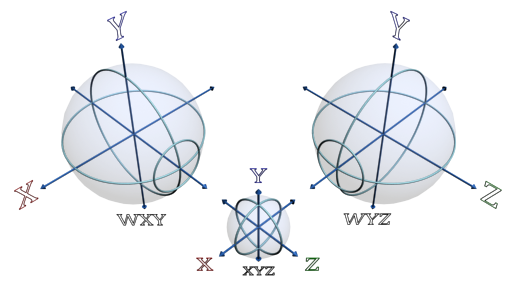
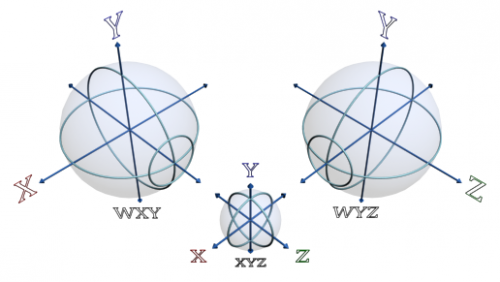
To try and explain it better Michel, it is not the galaxies, stars, or planets that are expanding. Rather, it is the space between the galaxies that is expanding. The mathematics is based on a four dimensional sphere that is growing in size which represents the space that is expanding. The clocks are not expanding. Their size remains constant. We can break the four dimensional sphere into two, three dimensional, spheres that combine to represent the "bubble" of space that we exist in. The surface of one sphere represents the XY plane and the other is the YZ plane. Because the overall four dimensional sphere is expanding, these three dimensional spheres are also expanding. The effect is such that we perceive an expanding space with no center for the expansion. If we could somehow see four dimensional space, we would see that there is a center which is located at time zero. I have created the following image to demonstrate the concept: The image decomposes the four dimensional sphere into two, three dimensional spheres labeled, WXY and WYZ. The middle, XYZ, sphere is a result of combining the XY surface of the WXY sphere with the YZ surface of the WYZ sphere. The smaller circles on both, WXY and WYZ, spheres demonstrate the portion of the two spheres which combine to make our three dimensional "bubble". Please note that this image is not drawn to scale as it would be impossible to accurately show the relationships. Also, I have not labeled the W axis as it could lead to confusion because it is very difficult to render four dimensional space. One might misinterpret the W axis as being perpendicular to itself when combining the WXY and WYZ spheres when in fact it is the same axis for both spheres. The image is intended to show how we lose the W axis as a result of how we perceive a four dimensional sphere that is expanding at the speed of light. I hope this clarifies any confusion with this system and to how the mathematics was derived.
-
I don't think that it would be proper to think of this as a scaling system. The clocks remain the same size as the sphere is getting larger. You could think of the clocks as getting smaller, but there is no need for both to scale in size. If the sphere and the clocks both expanded, then the space surrounding the clocks would never eventually flatten out. Time Dilation Before we continue this discussion it is important to note that I have choosen natural units for the speed of light in the equations from the previous posts such that [math]c=1[/math]. This is a result of parameterizing the equations such that the photon traverses the length, [math]L[/math], in the interval [math]u=0[/math] to [math]u=1[/math]. I'm sorry I didn't mention this in the previous posts. I've just had other things on my mind lately. I realized that I omitted the fact that I had used natural units in my graphs and in deriving the time dilation equations when I reviewed my notes. This means that all positions, velocities, and accelerations are proportional to [math]c[/math]. We can rewrite the equations such that [math]c=1[/math], and undo this naturalization once we have derived our equations. We will also use the arc length integral to derive the length of the path and ultimately the time dilation equation: [math]\int_{0}^{1}\sqrt{w'(u)^2+x'(u)^2+y'(u)^2}\, du[/math] where [math]w(u)=\left (W_{\gamma}\right ) \, \cos(\Delta \theta_{x}) \, \cos(\Delta \theta_{y})\, -\, \left (Y_{\gamma}\right ) \, \cos(\Delta \theta_{x}) \, \sin(\Delta \theta_{y}) \, \cos(\Delta \theta_{w})\, +\, \left (Y_{\gamma}\right ) \, \sin(\Delta \theta_{x}) \, \sin(\Delta \theta_{w})[/math] [math]x(u)=\left (W_{\gamma}\right ) \, \sin(\Delta \theta_{x}) \, \cos(\Delta \theta_{y})\, -\, \left (Y_{\gamma}\right ) \, \sin(\Delta \theta_{x}) \, \sin(\Delta \theta_{y}) \, \cos(\Delta \theta_{w})\, -\, \left (Y_{\gamma}\right ) \, \cos(\Delta \theta_{x}) \, \sin(\Delta \theta_{w})[/math] [math]y(u)=\left (Y_{\gamma}\right ) \, \cos(\Delta \theta_{y}) \, \cos(\Delta \theta_{w})\, +\, \left (W_{\gamma}\right ) \, \sin(\Delta \theta_{y})[/math] We will use the simplifed version of the above equation and we will not consider acceleration as previously stated: [math]w(u)=\left (\Delta W\right ) \cos\left (\Delta \theta_{x}\right)\, \cos\left (\Delta \theta_{y} \pm \Delta \theta_{\gamma}\right)[/math] [math]x(u)=\left (\Delta W\right ) \sin\left (\Delta \theta_{x}\right)\, \cos\left (\Delta \theta_{y} \pm \Delta \theta_{\gamma}\right)[/math] [math]y(u)=\left (\Delta W\right ) \sin\left (\Delta \theta_{y} \pm \Delta \theta_{\gamma}\right)[/math] Time Dilation - W Axis This post is only going to look at deriving time dilation for motion along the W axis. We will derive time dilation along both the W and X axis in the next post. Since we are not going to be changing our X position, our equations simplify to the following (Note: [math]c=1[/math] so it has been removed due to using natural units, also we are not considering acceleration): [math]w(u)=\Delta \tau\left (\mathit{Vl}_w \, \left (n+u\right ) + \mathit{Wl}_0\right ) \cos \left (\pm \frac{2\, u-1}{2\, \mathit{Vl}_w \, \left (n+u\right ) + 2\, \mathit{Wl}_0}\right )[/math] [math]x(u)=0[/math] [math]y(u)=\Delta \tau\left (\mathit{Vl}_w \, \left (n+u\right ) + \mathit{Wl}_0\right ) \sin \left (\pm \frac{2\, u-1}{2\, \mathit{Vl}_w \, \left (n+u\right ) + 2\, \mathit{Wl}_0}\right )[/math] Now that we have the equation in the form that defines motion with uniform velocity along the W axis, we can simplify the terms inside the square root of the arc length integral (Note: I have factored the result and arranged the terms so that we can easily derive time dilation in the following steps): [math]w'(u)^2+x'(u)^2+y'(u)^2=\Delta \tau^2 \left ( \frac{\left(\mathit{Vl}_w \left(2\, n+1\right ) + 2\, \mathit{Wl}_0\right)^2}{\left(2\, \mathit{Vl}_w \left(n+u\right ) + 2\, \mathit{Wl}_0\right)^2}+\mathit{Vl}_w^2\right )[/math] Next we will undo the natural units for the speed of light: [math]\Delta \tau^2 \left ( \frac{\left(\frac{\mathit{Vl}_w}{c} \left(2\, n+1\right ) + 2\, \frac{\mathit{Wl}_0}{c}\right)^2}{\left(2\, \frac{\mathit{Vl}_w}{c} \left(n+u\right ) + 2\, \frac{\mathit{Wl}_0}{c}\right)^2}+\left(\frac{\mathit{Vl}_w}{c}\right)^2\right )=\Delta \tau^2 \left ( \frac{\left(\mathit{Vl}_w \left(2\, n+1\right ) + 2\, \mathit{Wl}_0\right)^2}{\left(2\, \mathit{Vl}_w \left(n+u\right ) + 2\, \mathit{Wl}_0\right)^2}+\left(\frac{\mathit{Vl}_w}{c}\right)^2\right )[/math] Finally, we can substitute this result into the arc length integral and factor out [math]\Delta \tau[/math]: [math]\Delta \tau \int_{0}^{1}\sqrt{ \frac{\left(\mathit{Vl}_w \left(2\, n+1\right ) + 2\, \mathit{Wl}_0\right)^2}{\left(2\, \mathit{Vl}_w \left(n+u\right ) + 2\, \mathit{Wl}_0\right)^2}+\left(\frac{\mathit{Vl}_w}{c}\right)^2}\, du[/math] Now that we have the length of our path, we can easily derive the time dilation equation: [math]\Delta \tau \left(\int_{0}^{1}\sqrt{ \frac{\left(\mathit{Vl}_w \left(2\, n+1\right ) + 2\, \mathit{Wl}_0\right)^2}{\left(2\, \mathit{Vl}_w \left(n+u\right ) + 2\, \mathit{Wl}_0\right)^2}-\left(\frac{\mathit{Vl}_w}{c}\right)^2}\, du \right)^{-1}[/math] Because the curvature of a sphere diminishes as it gets larger we must include [math]\mathit{Wl}_0[/math] as it does affect the radius of the sphere. We can also show that this time dilation equation for an expanding sphere approaches those in SR as time approaches infinity. This can be done by evaluating the limit as our integer multiple of [math]\Delta \tau[/math], or the variable [math]n[/math], approaches infinity: [math]\lim_{n \to \infty}\Delta \tau \left(\int_{0}^{1}\sqrt{ \frac{\left(\mathit{Vl}_w \left(2\, n+1\right ) + 2\, \mathit{Wl}_0\right)^2}{\left(2\, \mathit{Vl}_w \left(n+u\right ) + 2\, \mathit{Wl}_0\right)^2}-\left(\frac{\mathit{Vl}_w}{c}\right)^2}\, du \right)^{-1}=\Delta \tau \left(\sqrt{ 1-\left(\frac{\mathit{Vl}_w}{c}\right)^2}\right)^{-1}[/math] That concludes tonights post. I have some serious family matters to attend to, so I will not be able to conclude the discussion on time dilation until next week.
-
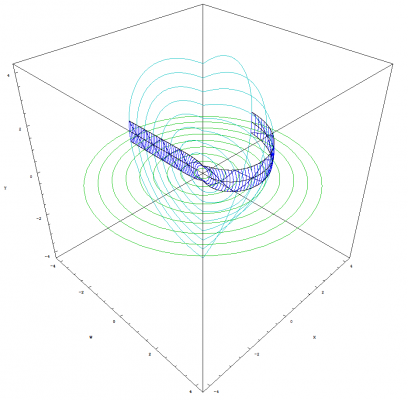
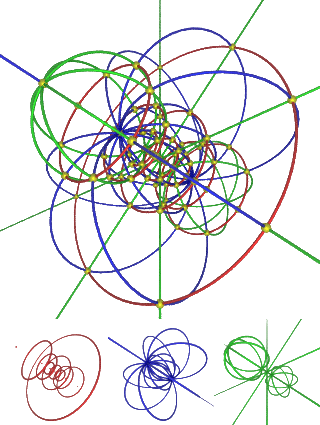
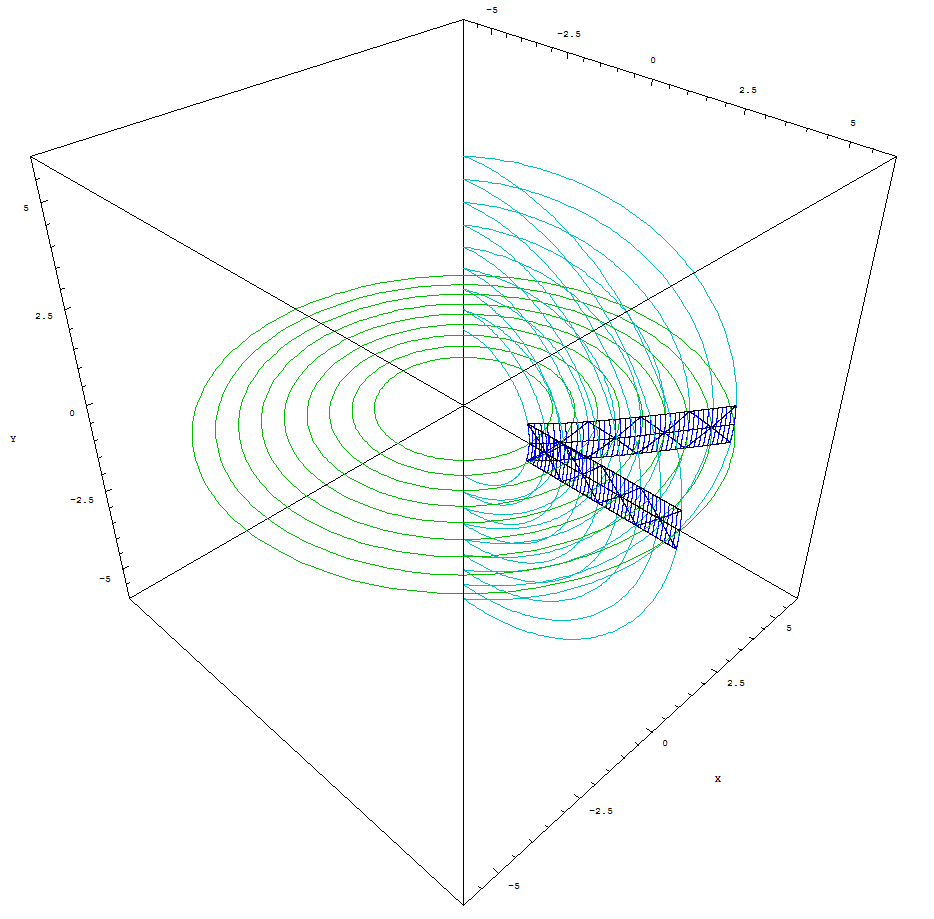
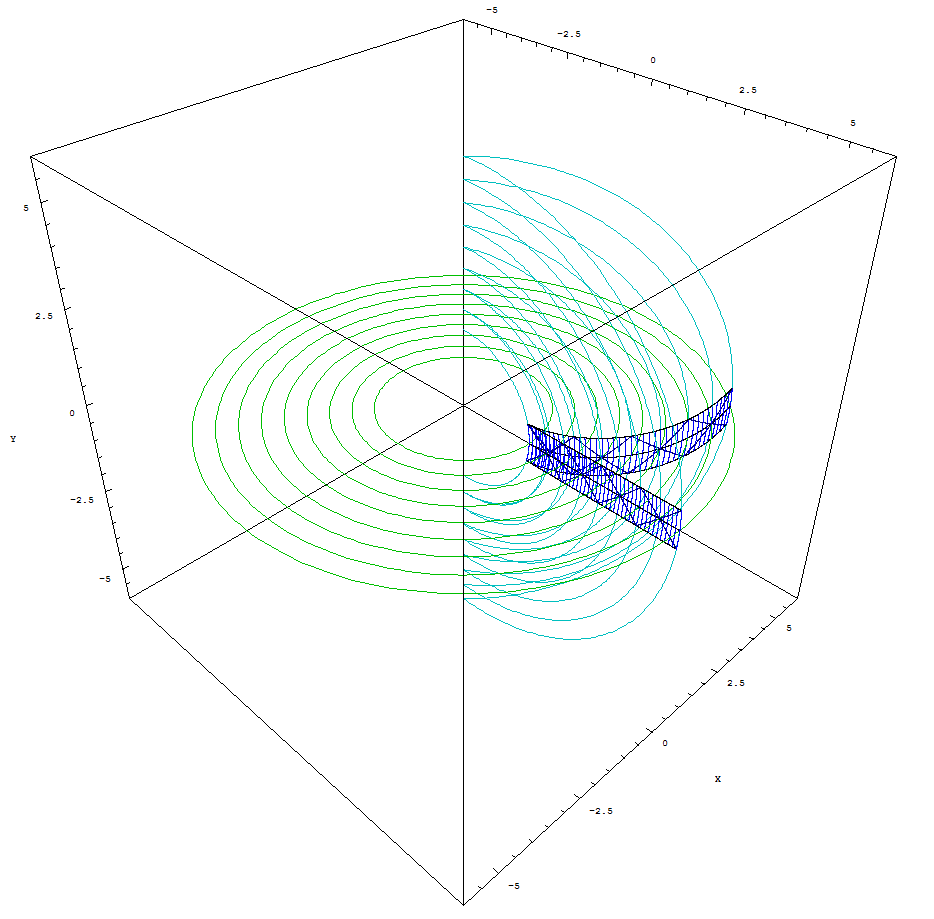
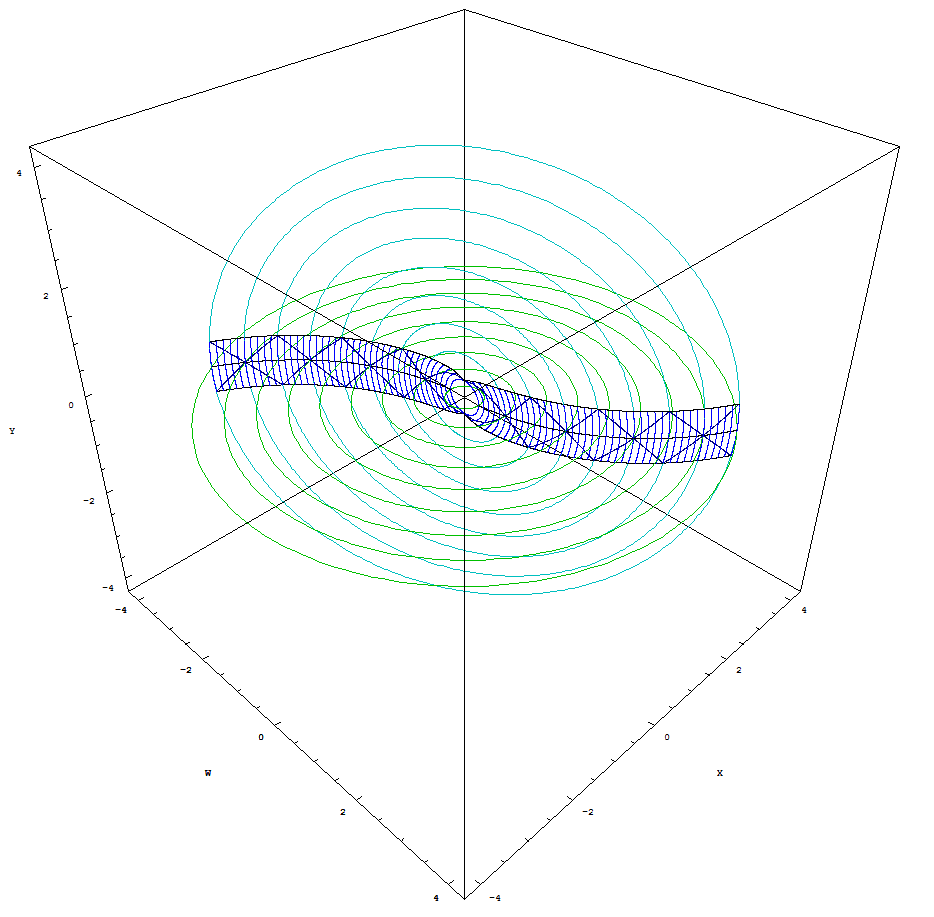
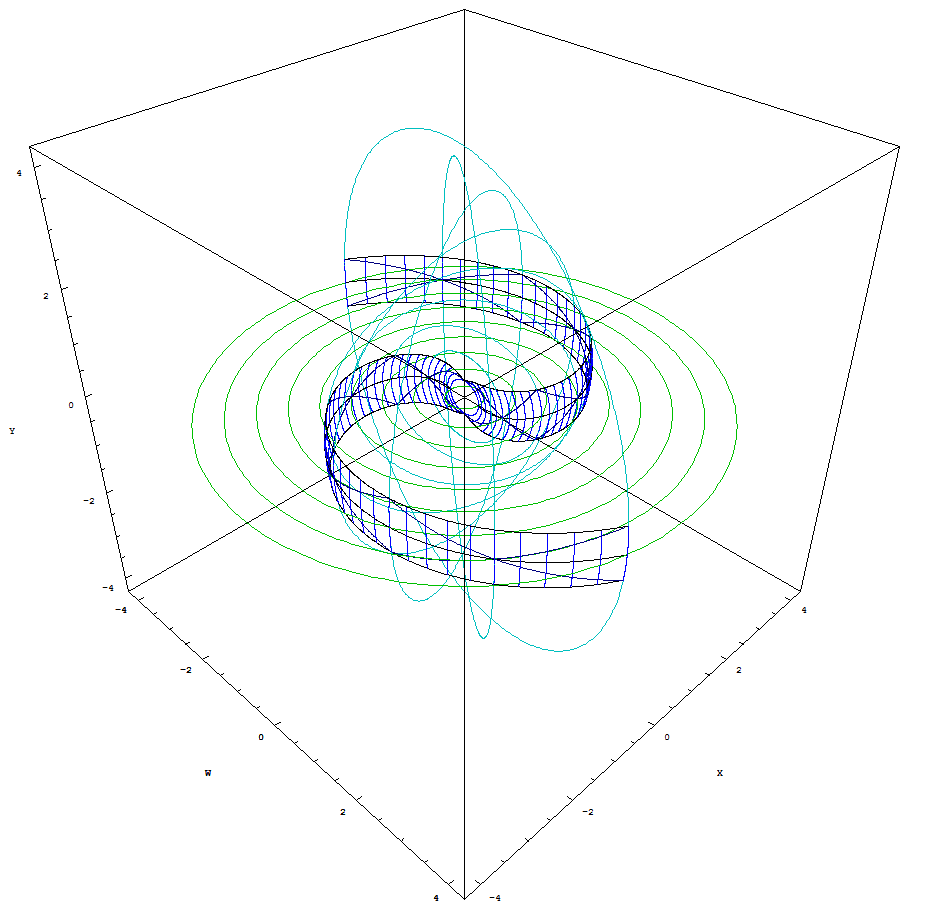
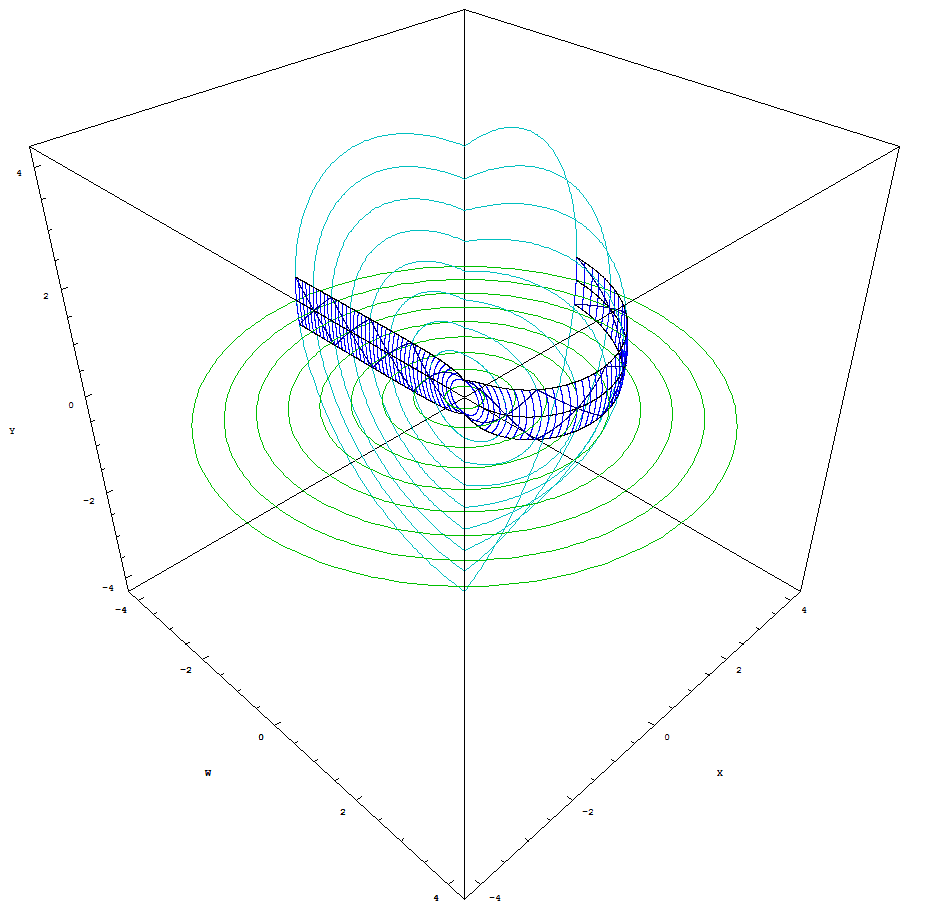
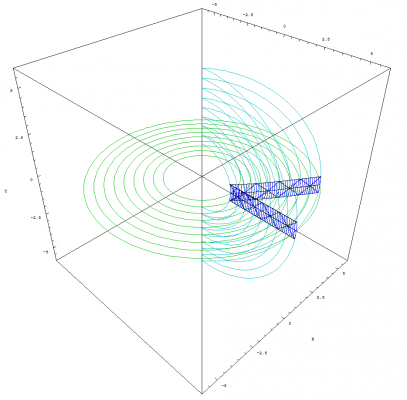
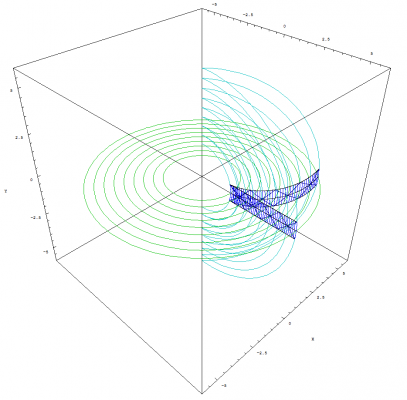
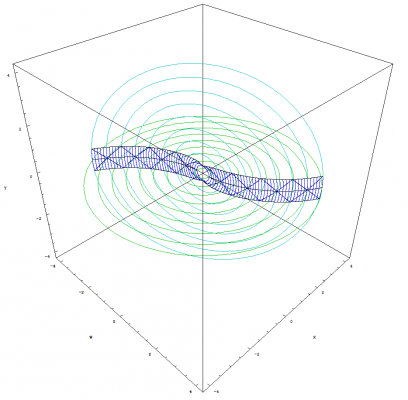
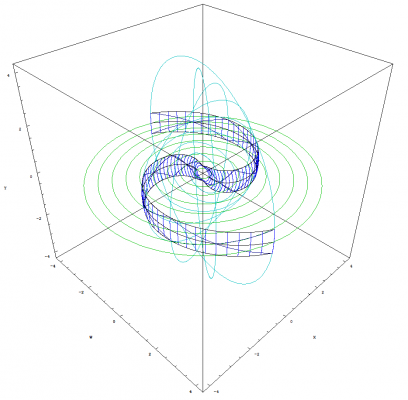
Hi Michel, I can render some different views of the graph for you. But I will try and explain what you are seeing. 1.) Mathematica renders the graphs inside a box. I can remove this box if you like. It is only there to show the axes and provides a ruler. 2.) I'm sorry about that effect. I simply set the view such that the axis lined up that way. It removed a lot of clutter while keeping certain lines that I wanted to display. 3.) The green and aqua rings represent the expansion of the sphere which are growing at a constant velocity. Those rings also can be viewed as temporally displaced views. The blue strips, which represent the clocks, encompasses those triangles structures you are talking about. I can remove all of the reference points around the trianglular paths if you like. They are there to show you how everything stays aligned with the sphere. If you look at the triangle structure in the blue strips, they are getting wider and wider for the images that show acceleration. The acceleration you see in the above graphs does not mean that the 4D sphere is expanding at an accelerated rate. The sphere is expanding at the speed of light. It is the clocks, that are traversing across the surface of this expanding sphere, that are accelerating as shown in most of the images from the previous post. I also forgot to mention that I plot the up and down path of photons for each clock. That is why you see the diamond shape paths inside the blue strips.
-
As promised Michel, here are some more images that show how bodies remain temporally aligned. This image shows one clock moving away from the other at a constant velocity: This image shows one clock accelerating away from the other: This image shows both clocks accelerating along what we perceive to be the X axis: This image shows both clocks having a ridiculously extreme acceleration:
-
That definitely gives me something to think about. Hi Michel, the following image shows the clock that is moving outward with positive time, accelerating along what we perceive to be the X axis: That is why I labeled this section, "On The Temporal Uniformity of Accelerating Bodies". We clearly see that all bodies will remain temporally aligned regardless of thier motion. The point I am trying to make is that time dilation is not some form of temporal displacement that allows us to disappear from our view of the universe and reappear at a point in the future. Time dilation only slows down or speeds up clocks. As stated before, all clocks work by some form of oscillation. The effect that we perceive to be a dilation of time, is nothing more than our atomic processes slowing down or speeding up which does effect our motions and aging process. That is how time dilation is viewed in Temporal Uniformity. I will post more images tonight that demonstrate accelerating bodies : ) Tommorow we will begin to discuss time dilation. We will only include velocity and not acceleration as defined in SR. After we have covered time dilation, I will post detailed images of the spiraling singularity and we can discuss its properties.