
Danijel Gorupec
Senior Members
-
Joined
-
Last visited
Everything posted by Danijel Gorupec
-
What then makes the right time to start lifting restrictions - did CharonY suggest that this should be determined by random testing instead of the targeted testing? It seems to me that number of new cases per day is never an important criteria. It is more important how quickly and effectively a state can micromanage the spread. What do you think?
-
So, some countries and provinces are reopening already... Will this make a pressure on others to reopen too? I mean, capitalism still works: those who can produce their products will find new customers, those who cannot produce will lose their regular ones. So no, I wouldn't claim success only because my country still has roughly 97-98% of population intact by the virus(*). (* I just multiplied confirmed cases by 50 - this gives 2.5% of population).
-
This part interests me: If it turns out that immunization is very inefficient (very short-term), what options do we have? What strategy would work best?
-
I think, iNow and Strange, that you are talking about morality. Morality is great, but I don't think it has a power to resolve conflicts of rights. There are over 7.5 billion morality schemas in this world, which one to apply? Morality is great because it effectively decreases the probability that we will have conflicts of rights in the first place. However when conflicts of rights arise, you should not resolve it by looking into your own morality schema. You should look at the law. (You should suppose, just to be safe, that your own morality schema is wrong.) However my post was not even aiming that far. I was just commenting that MigL statement might not be that useful to make decisions. I know he will not accept it, but I would suggest a more practical motto: "your right stops, once it is breaking the law". No man would accept such a dull motto.
-
I noticed that you often say this, but it does not tell that much to me. What are 'rights' and how do your rank them when there is a conflict? Do you really think that your statement makes decisions easier? StringJunky is being a bit more specific - he mentions the 'existential threat'. But still, I don't find this that much helpful. Is it the imminent existential threat or just any existential threat (like polluting the air)? In my opinion, we are only left with the law (and even law is not clear all the time). Something either is or is not in accordance with the law. Mentioning additional 'rights' beside the law just adds to confusion... I mean, this is what the law is -> our recipe to resolve rights priority. When we feel that we should clarify rights priority it should be done through the law.
-
I share your concerns and thinking. We discussed some of it even in this thread and it seems that the plan is "slow down the spread of the disease and hope for a cure/vaccine". I am not sure if this can be called a 'plan' at all as it includes the 'hope for' component. As I see it, there are two general strategies governments are going for: a) keep the spread as low as possible; wait for cure/vaccine... This is a bet that cure/vaccine will be found quickly. If cure/vaccine is indeed found quickly, this will save most lives. However it imposes heavy toll on economy and might only be possible for a short time. Some countries that started this way are already reconsidering. b) keep the spread within tolerable levels; increase capacity of hospital system; wait for cure/vaccine... This is a bet that cure/vaccine will only be found after some time. Disruption of economy is lower and can be tolerated longer. I think that this is a more complex strategy and would be difficult in some societies (it depends a lot on citizen discipline; police enforcing is not that effective). We cannot eradicate the virus any more by quarantining people or by social distancing. As far as I know, no country is implementing a 'plan' that does not include finding the cure/vaccine eventually. The 'heard immunity' plan may take too long to realize (countries may not be capable to increase its hospital capacity ten fold and speed up the process). Even if the number of cases is 50 times more than is reported, the 'heard immunity' is not close yet (Italy has 200 thousands confirmed; say, 10 million infected. But it needs about 40 million for 'heard immunity'. So, one more year of current heavy measures). And this only if we bet that the 'heard immunity' is possible. If the cure/vaccine is not available in 1-2 years, I think we will simply learn to live with the disease. The average life-span might shorten a bit. If the vaccine is found sooner, it should be administered by priority (it might also depend how rich is your country). Medical staff is probably first to be vaccinated. Seniors too... But even knowing that there is a cure/vaccine, will cause a relaxation of measures before the cure is available to general population.
-
Sure. I didn't mean it that way. What I meant is that member states pay fee to WHO because, among else, they want to be guided into certain harmonization (at least I hope so). However WHO failed to provide workable and attractive plans and/or initiative that would help states to establish this.
-
To move away a little from the current discussion... I don't think the WHO's greatest sin was inadequate reporting from China. I can understand this (China keeps strong control over information flows). But it seems that between epidemics WHO failed to establish standards on how to collect and report disease statistics. Now we have non-comparable data all around the world. How can epidemiologists (and economists and politicians) make informed decisions using this data? This is the source of my disappointment with WHO.
-
Imo, this is only a way to blame someone else for being unprepared for covid-19. But I don't live in USA, so I might have a wrong perspective - Trump might be more cunning than it seems to me. (And not that I am very impressed with the way WHO handles the covid-19 situation either.).
-
What is your personal option.... would it be worth investigating whether flu+covid co-infection affects the outcome? And more importantly, what hinders such investigations? Are novice scientists discouraged to interfere / without ideas / need more time / have more interesting thing to do / or just afraid? I ask because it seems like an ideal job for young recruits.
-
We might have cases even today where hospitals spread the thing (being overcrowded and lacking protection gear). I was suspecting this might be happening in Italy because the virus seemed to spread strongly even after applying rigorous public measures. Now finally the spread rate started to respond to the measures, so maybe it was not hospitals after all. What do you think? By the way, did we finally stop the Spanish flu by developing a vaccine or by 'heard immunity"?
-
If it turns out that the viral load at exposure significantly determines the outcome of the illness, then I think it would be fair to recommend to all people who are at risk to wear masks even for their own protection (not only for protection of others). Of course, this comes with educational lines how to do it properly. As you can see, even on this forum, we talk a lot about mask. In my opinion, this is a because unclear messages were received from professionals. I hope for clearer recommendations eventually. And I hope epidemiological profession will note this small issue into their textbooks.
-
Thanks StringJunky and CharonY... But I was not able to understand what do you exactly mean by 'initial viral load' - would this be exposure load or a measured load at (or near) onset of symptoms?
-
I can only guess dimreeper is not a member?
-
If I remember correctly, there were some concerns about the name. The WHO tried to avoid people calling it 'Chinese virus', so they gave it a name. But nobody calls it that way because... well, because nobody calls a pig 'sus scrofa' too.
-
Hmm... Wikipedia says: "Coronavirus disease 2019 (COVID-19) is an infectious disease caused by severe acute respiratory syndrome coronavirus 2 (SARS-CoV-2)" https://en.wikipedia.org/wiki/Coronavirus_disease_2019 That would mean that COVID-19 is the name of the illness (or disease, is this the same?), while SARS-CoV-2 is the name of the virus. (bad names, if you ask me - I guess, intentionally bad names)
-
Me again... Is there a specific term for number of viral particles (viral load) one receives during exposure? I read that it might influence the severity of a viral disease - is this like a rule or holds only for some diseases? Or it just affect the delay in onset of symptoms, not the eventual severity? (Well ok, if one gets rabies then the eventual severity is invariably the same. I am asking about diseases more like this corona stuff. )
-
Thanks. Another thing... I cannot find any data about the increase in total number of deaths (whatever is the name for it). For example, I calculated that in Italy, on an usual day without pandemic, there should be about 2000 deaths. Now, in times of pandemic, they report 600-700 deaths due to virus only. But I cannot find if the total number of deaths is just the sum, or less (or even more) than this. Anyone of you have some idea?
-
You mean like general population health?
-
I understand. Then, when everything is over, are we to expect relatively small difference in mortality between counties? If so, then the current number of deaths might be a better indicator than the number of confirmed cases to show how much is the disease spread in some country. On the other hand, if we are to expect large differences in mortality, what might be possible reasons to influence it so much?
-
Sorry, is you answer for transmission rate or mortality rate?
-
(Sorry for watering down the nice flame we had on this thread.) What is your opinion how can the reported mortality rate be so much different from country to county?
-
Thank you very much, Strange. Finally a discussion I was looking for (funny, but I find it to be a relief - At least I know that other people are aware of the issue, I felt alone until now).
-
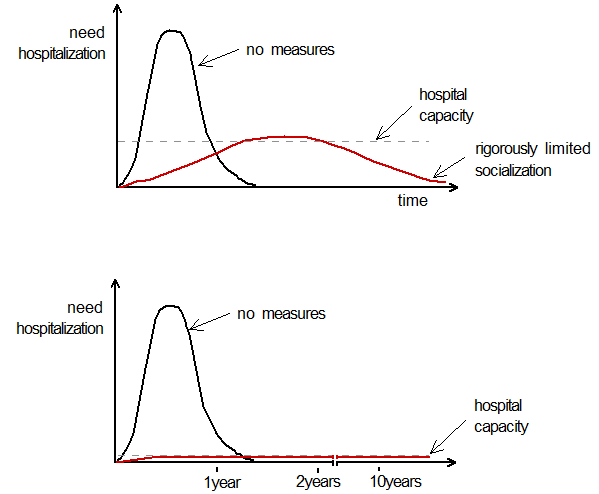
I know this... when I said that 5000 new cases per day, I didn't mean that all 5000 will end in hospitals. I meant that from 5000 new cases, the number of hospitalized is already overwhelming the Italian hospital system. (Also, my calculation of 11 years of quarantine is based on 20M people, not all 60M Italians). Nobody commented how long we can cope with heavy measurements like currently forced in Italy. They show us the first graph, but it seems that reality is more like the second graph. Hospitals have much lower capacity than I ever thought, so measures must be rigorous to keep such a low number of new cases. My government forbade me to do my work - I guess they are planning to sell monetary reserves and maybe even print money. But this are all mid-term solutions. The long term solution is to let me work again, but then how they plan to keep the number of new cases low enough for the surprisingly weak hospital system. As I said, I see no actual plan.
-
No.