
HbWhi5F
Senior Members
-
Joined
-
Last visited
Everything posted by HbWhi5F
-
If yes what does this mean ? What would the graph look like ?
-
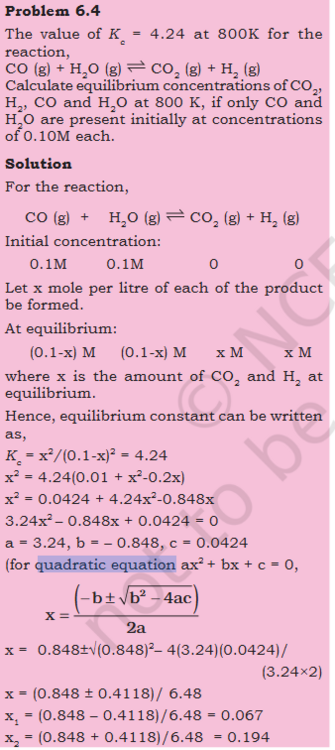
What makes me think this - Here RHS is substracted from both sides and x^2 terms are also combined. then both sides are multiplied by -1 that seems like cheating, just flipping signs.
-
Problem"explain entropy as a" is copied as "e x p l a i n e n t r o p y a s a". sometimes it "seems" like homoglyph-like character. example - letter "a" and the Cyrillic letter "а" there are random line breaks everywhere. Scientific symbols are not copied or copied as . specially super/sub-scripts. Sigma Symbol is not copied at all. Sometimes selecting is hard selecting formula selects everything or otherthings Superscript +/- are not copied. Arrow is not copied always, seems like sometype of DRM the book it using 2 different looking arrows. There is sometimes what seems to be hand written Symbols I copied "minus in a circle in superscript" to https://www.soscisurvey.de/tools/view-chars.php and it shows as U+F030, which https://www.compart.com/en/unicode/U+F030 as it for private use Notes/QuestionI have 2 problem -Not able to copy correctly Prepare pdf for LLM SituationText is copiable not using OCR. The text is already copiable but I want to add OCR layer to it how ? Make OCR ignore footer/header and page number Example Pdf - The pdf is free to use for personal use but illegal to print. https://ncert.nic.in/textbook.php?kech1=5-6 What I Foundhttps://github.com/datalab-to/marker 3. What is the best way to convert the pdf to flashcardI tired https://anki-decks.com/app/dashboard/ but it limited to 25pages and doesn't ask the important things (doesn't understand the context for science to get formulas and tables) symbols are not working - Pdf weirdness image Does this has to do it Unicode and pdf software ?
-
@MigL What is the law called ? Seems useful but never taught
-
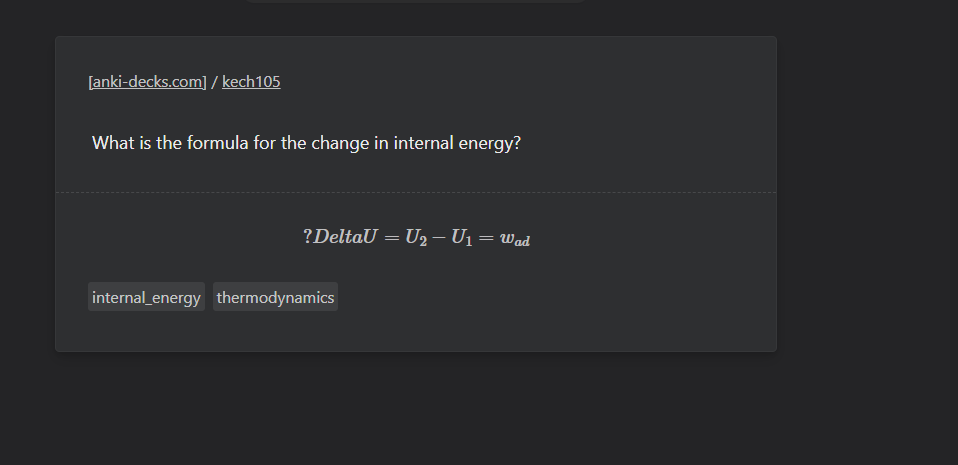
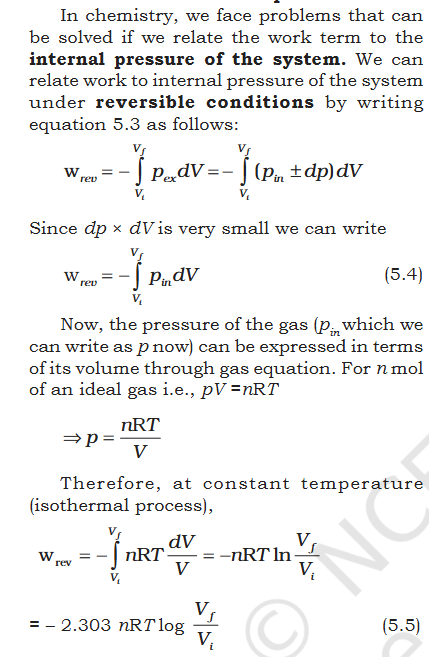
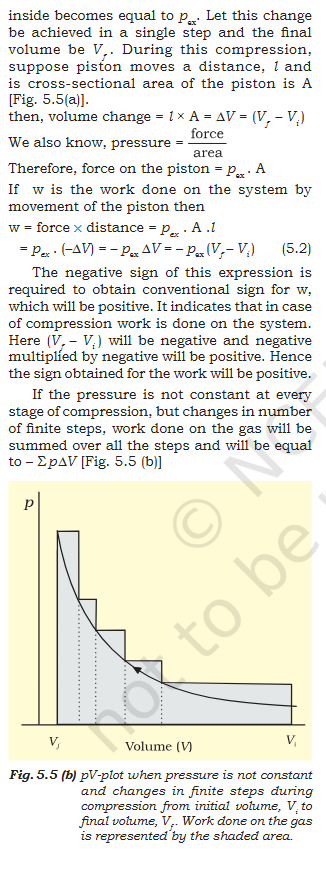
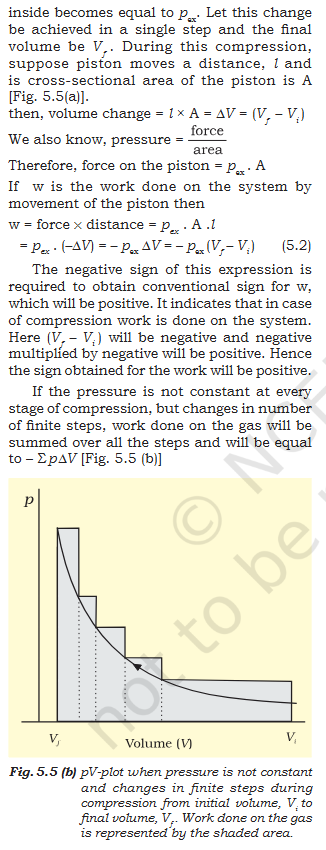
@exchemist why is it more when done in finite steps ? The same process takes more energy ?
-
@exchemist why is it negative and book says process is endothermic ?
-
@swansont This is from NCERT Class 11 Chapter 5 @MigL Studying
-
"Heat added to a system at lower temperature causes greater randomness than when the same quantity of heat is added to it at higher temperature. " this can mean 2 things heating a colder object causes more randomness or supplying same amount of heat slowly causes more randomness I think the 2nd one because ∆S = qrev/T
-
Book says - "(f) Enthalpy of Dilution It is known that enthalpy of solution is the enthalpy change associated with the addition of a specified amount of solute to the specified amount of solvent at a constant temperature and pressure. This argument can be applied to any solvent with slight modification. Enthalpy change for dissolving one mole of gaseous hydrogen chloride in 10 mol of water can be represented by the following equation. For convenience we will use the symbol aq. for water HCl(g) + 10 aq. → HCl.10 aq. ∆H = –69.01 kJ / mol Let us consider the following set of enthalpy changes: (S-1) HCl(g) + 25 aq. → HCl.25 aq. ∆H = –72.03 kJ / mol (S-2) HCl(g) + 40 aq. → HCl.40 aq. ∆H = –72.79 kJ / mol (S-3) HCl(g) + ∞ aq. → HCl. ∞ aq. ∆H = –74.85 kJ / mol The values of ∆H show general dependence of the enthalpy of solution on amount of solvent. As more and more solvent is used, the enthalpy of solution approaches a limiting value, i.e, the value in infinitely dilute solution. For hydrochloric acid this value of ∆H is given above in equation (S-3). If we subtract the first equation (equation S-1) from the second equation (equation S-2) in the above set of equations, we obtain– HCl.25 aq. + 15 aq. → HCl.40 aq. ∆H = [ –72.79 – (–72.03)] kJ / mol = – 0.76 kJ / mol This value (–0.76kJ/mol) of ∆H is enthalpy of dilution. It is the heat withdrawn from the surroundings when additional solvent is added to the solution. The enthalpy of dilution of a solution is dependent on the original concentration of the solution and the amount of solvent added" Question What is the convention here I get the idea of dilution. Why it says to substract then goes on to add one side and subtract the other ? "It is the heat withdrawn from the surroundings when additional solvent is added to the solution." - the value is negative that means heat is given out ?
-
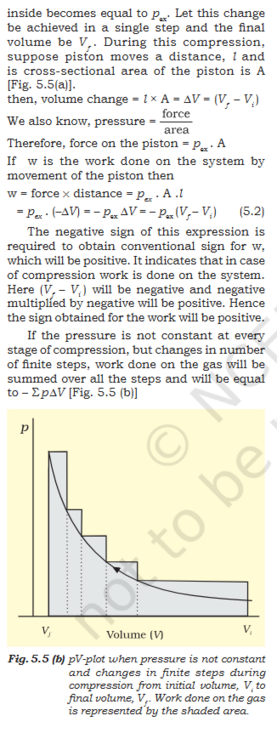
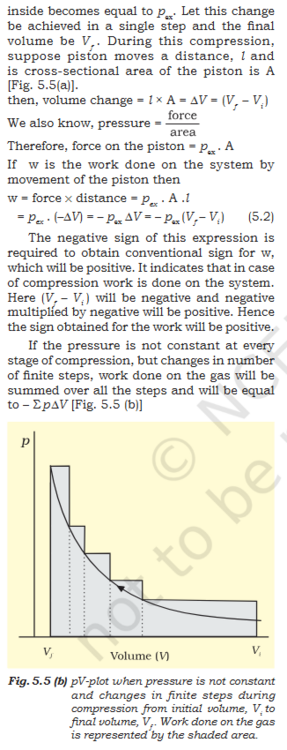
Book- "5.2.1 Work First of all, let us concentrate on the nature of work a system can do. We will consider only mechanical work i.e., pressure-volume work. For understanding pressure-volume work, let us consider a cylinder which contains one mole of an ideal gas fitted with a frictionless piston. Total volume of the gas is Vi and pressure of the gas inside is p. If external pressure is pex which is greater than p, piston is moved inward till the pressure inside becomes equal to ex. Let this change be achieved in a single step and the final volume be V f . During this compression, suppose piston moves a distance, l and is cross-sectional area of the piston is A [Fig. 5.5(a)]. then, volume change = l × A = ∆V = (V f – Vi ) We also know, pressure = Therefore, force on the piston = pex . A If w is the work done on the system by movement of the piston then w = force × distance = pex . A .l = p ex . (–∆V) = – pex ∆V = – pex (Vf – V i ) (5.2) The negative sign of this expression is required to obtain conventional sign for w, which will be positive. It indicates that in case of compression work is done on the system. Here (V f – V i ) will be negative and negative multiplied by negative will be positive. Hence the sign obtained for the work will be positive. If the pressure is not constant at every stage of compression, but changes in number of finite steps, work done on the gas will be summed over all the steps and will be equal to – Σ р ∆V [Fig. 5.5 (b)]"
-
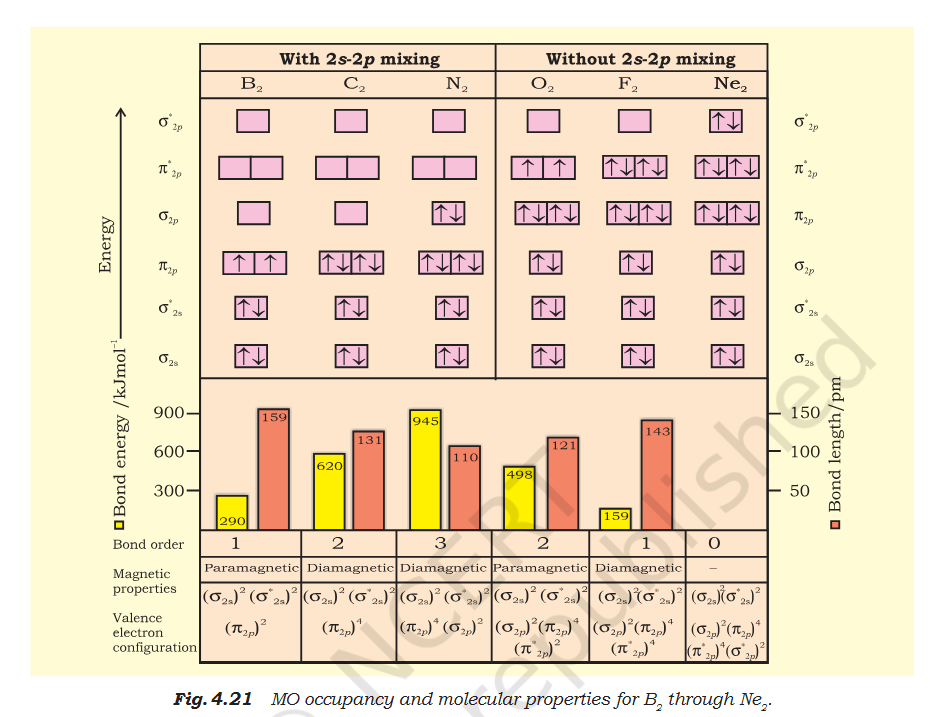
@studiot Yes I would like to know about molecular bonds I didn't understand molecular bonds also I think c2 should form 1 sigma 1 sigma antibond 1 pie bonds and no antibonds but according to the mainthread (book) it froms 2 pie bonds .
-
@Stuart electron-electron repulsion ?
-
@studiot I think you meant atoms. Yes I understand s p d are 3d spaces where electron are like to be found (ie wave function).
-
@exchemist Please recommend resources to learn molecular orbitals
-
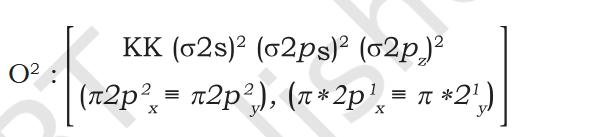
Book "4. Carbon molecule (C 2 ): The electronic configuration of carbon is 1s2 2s2 2p2. There are 12 electrons in C2. The electronic configuration of C2 molecule, therefore, is The bond order of C2 is ½ (8 – 4) = 2 and C 2 should be diamagnetic. Diamagnetic C2 molecules have indeed been detected in vapour phase. It is important to note that double bond in C 2 consists of both pi bonds because of the presence of four electrons in two pi molecular orbitals. In most of the other molecules a double bond is made up of a sigma bond and a pi bond. In a similar fashion the bonding in N2 molecule can be discussed. O2 5. Oxygen molecule (O 2 ): The electronic configuration of oxygen atom is 1s2 2s2 2p4. Each oxygen atom has 8 electrons, hence, in O 2 molecule there are 16 electrons. The electronic configuration of O 2 molecule, therefore, is From the electronic configuration of O2 molecule it is clear that ten electrons are present in bonding molecular orbitals and six electrons are present in antibonding molecular orbitals. Its bond order, therefore, is Bond order = [Nb – Na] = [10 – 6] =2. So in oxygen molecule, atoms are held by a double bond. Moreover, it may be noted that it contains two unpaired electrons in π ∗2px and π ∗2py molecular orbitals, therefore, O 2 molecule should be Paramagnetic, a p r e d i c t i o n t h a t c o r r e s p o n d s t o experimental observation. In this way, the theory successfully explains the paramagnetic nature of oxygen. Similarly, the electronic configurations of other homonuclear diatomic molecules of the second row of the periodic table can be written. In Fig. 4.21 are given the molecular orbital occupancy and molecular properties for B2 through Ne2. The sequence of MOs and their electron population are shown. The bond energy, bond length, bond order, magnetic properties and valence electron configuration appear below the orbital diagrams. " Question Seeing it in atomic orbital perspective the molecules electronic config should be KK 2s2 2p4 ie 1 filled and 2 single filled orbitals. But according to the book there is no single filled molecular bond or anti-bond so the molecule is diamagnetic. Is the atomic bonding and molecular orbitals totally unrelated ? When Pie bond is formed doesn't both atoms' orbitals needs to be acting i.e. Px of Atmos A acts with Px of Atom B ? There Px of 1 Atom and Py of other Atmos forms 1 molecular bond each ? O2 Question Why does O2 form 1 bond and 1 antibond ? O2 form a double bond and complete the valance but the book shows 3 bonds but says double.. Explain "Moreover, it may be noted that it contains two unpaired electrons in π ∗2px and π ∗2py molecular orbitals"

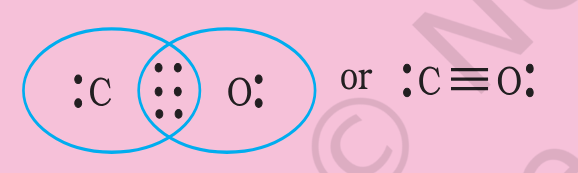
 It is not homework. I was thinking about it and can't seem to find a situation there it is incorrect. This equation surely tells interesting things when graphed. @MigL When X>Y 10-4 = 6 |Y-X| =| -6| = 6 When Y>X 4-10 = -6 |10-4|=6 Ok lets modify, when Y>X, |X-Y| =|Y-X|Question is how multiple molecules are possible with different atom ratio ? Do they leave lone electrons ? I don't get the math is it some other phenomenon ?CO3 (-1) charges - C -2 O +2 on top and x2 O -2 ? NF3 should also have charges indicated ? x3 F has -1 each and N has -3. In HNO3 left O doesn't have charge it should be +2. N has +4. RIght O should be +2. H should be +1 In O2 they both share 2 eletrons to become noble but that also makes each O, -2 charged right ?Update: How is unequal sharing of electrons is possible ?
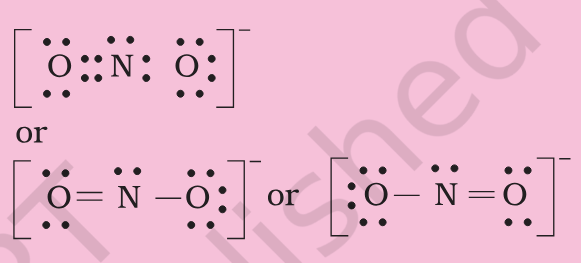
 This O3 Lewis Diagram looks weird - why does atom with 8 electrons positive, why is atom with 4 electrons neutral, why is atom with 6 electrons negative In CO3 -2 Why there is a -2 charge ? What is happening in HNO3 ? N is positive that means it is 5 electrons short of Nobel config. Why there is a negative charge on bottom oxygen ? Are these Lewis Diagram possible or covalent and electrovalent bonds ? [NO2]- is there 1 electron extra on oxygen ? [NO2]-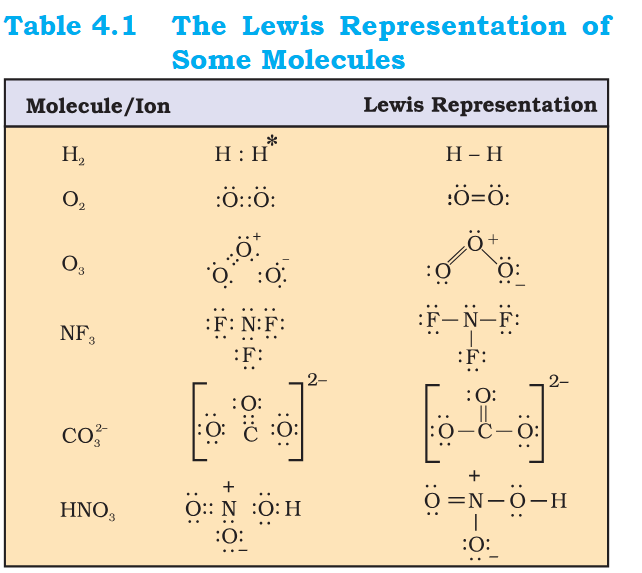
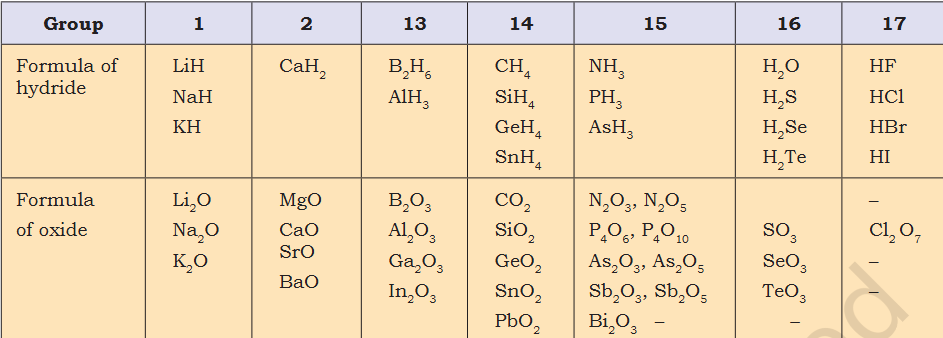
 I get grudgeful though when studying wasting my energy and time. Intrusive when studying and day-to-day tasks they are not that bad.Periodicity in valence - among representative elements, the valence is either equal to the number of electrons in the outermost orbitals or 8 - minus this number What is 8 ? There can be a max of 6 electroins untill p shell and 3 in s shell
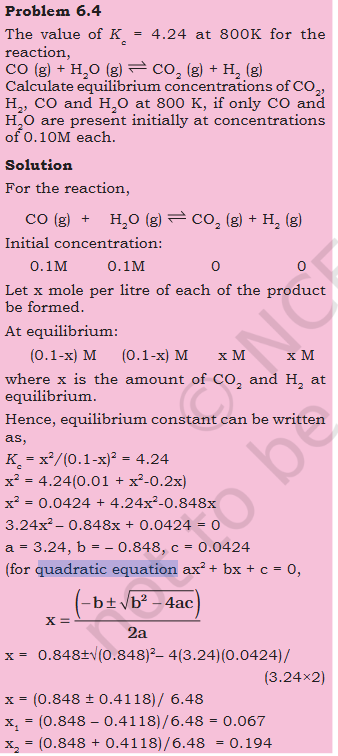
 If not, when it is ? Can the make it a function to understand the nature of the formula ?
Important Information
We have placed cookies on your device to help make this website better. You can adjust your cookie settings, otherwise we'll assume you're okay to continue.