
Genady
Senior Members
-
Joined
Everything posted by Genady
-
I see how \( P_n R^2\pi = n r^2_n \pi + P_n R^2_n \pi \) is correct in the first case, but not in the second one because in the second case the radius \( R_n \) partially covers the circles in the outer layer.
-
Exactly. This is the solution:
-
Yes, to take such a view the "bird" would need to get into a higher-dimensional embedding space.
-
2D sphere is a geometrical model, not a physical model of the 3D space of our universe. I've suggested it as a tool to help in understanding how it is geometrically possible to be edgeless and bounded. It was not to suggest that our space is a 2D sphere.
-
This does not affect geometry or topology. It is not an analogy. It is a model. 2D sphere is not hollow. 2D spherical surface in 3D space, is.
-
I think so. For an edgeless but bounded space imagine a 2D version, a sphere. For an edgeless and unbounded space - I don't see a problem. It's just like a number line but in 3D.
-
I don't know. Absolutely. Metric determines curvature. It does not determine topology. Depends on other properties, e.g. homogeneity and isotropy. I don't know.
-
Take a 2D flat surface, like a flat sheet. Its intrinsic curvature is identically 0 everywhere. Roll it into a cylinder. You get a different topology, but it has the same, 0 everywhere, intrinsic curvature.
-
As I see it, time travel and time inversion are two different things. The former involves "time mixing", i.e., the traveler's body maintains its time while being transferred into a different time of its environment. Of course, the time travel into the future is very much possible - e.g., the SR twins.
-
No problem. However, in this case, my 'Yes', before the 'but', is to a different question, too, and should be ignored as well.
-
Yes, but this is not how the age of the universe is defined. In the definition of the age of the universe peculiar motion of the observers is removed. The cosmological time is the time of co-moving observers, i.e., observers for whom the CMBR is isotropic. All these observers find the age of the universe being the same (~13.8 billion years).
-
No. Timelike intervals in SR are timelike in ALL inertial frames of reference. And spacelike stay spacelike as well.
-
Right, no need to do this. We can transform from one coordinate system to another. Such transformations transform coordinates of events. Axes do not transform. That's why I don't understand the meaning of
-
Unfortunately, I don't understand what you mean here. (Each observer has their own proper time.)
-
... I'd toss a coin.
-
Do I understand correctly that they do not talk about measuring time dilation due to a passing gravitational wave but rather about changes in the background time dilation due to a motion of the sources of that time dilation?
-
Yes. Yes. It is a linearized GR approximation.
-
I've looked at the derivation again. In simple terms, it boils down to the fact that gravitational waves are transverse waves in spacetime. So, in coordinates where they move along t- and x-axes, they perturb the metric in the orthogonal y- and z-axes.
-
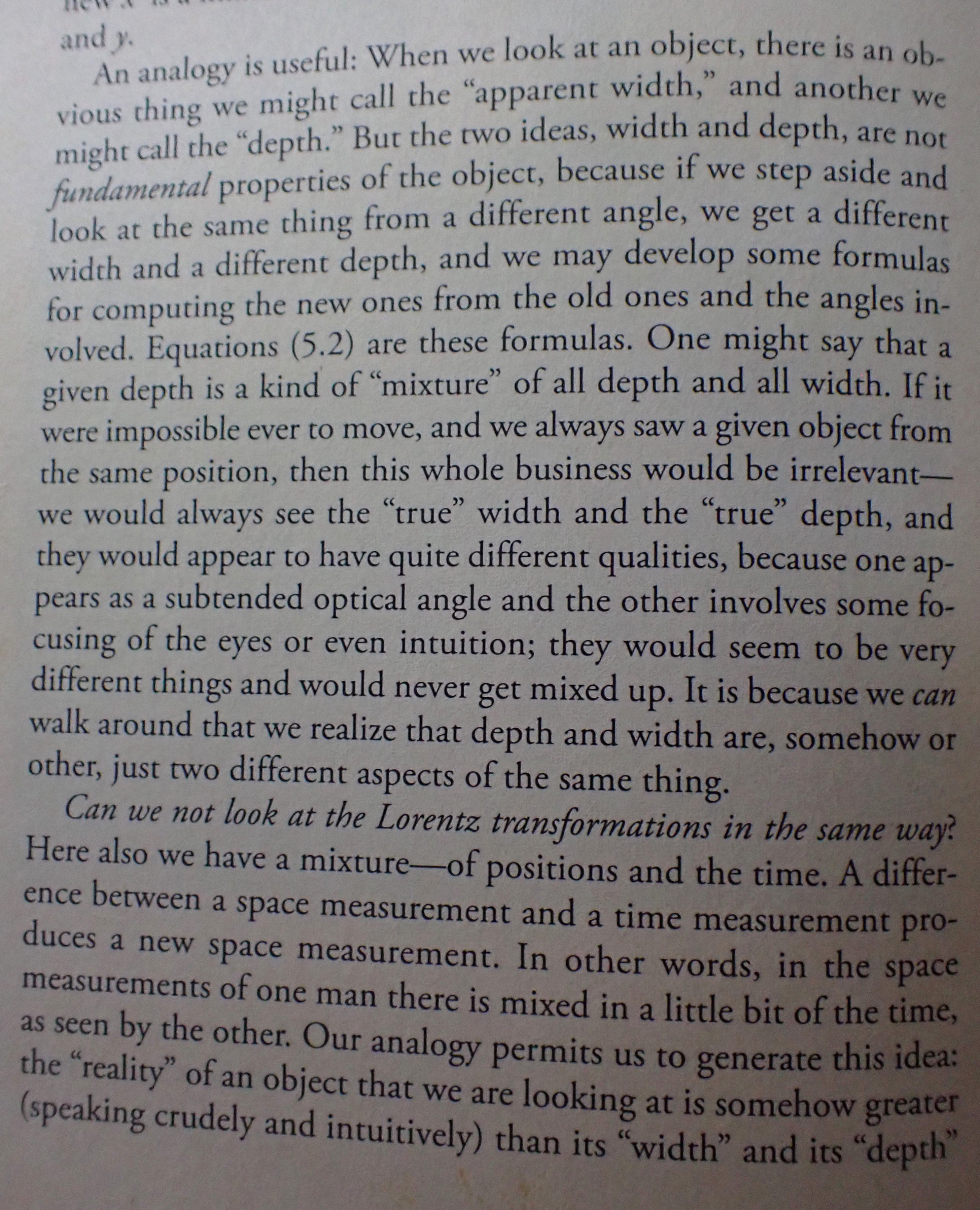
Here this analogy has been developed somewhat further: This comes from:
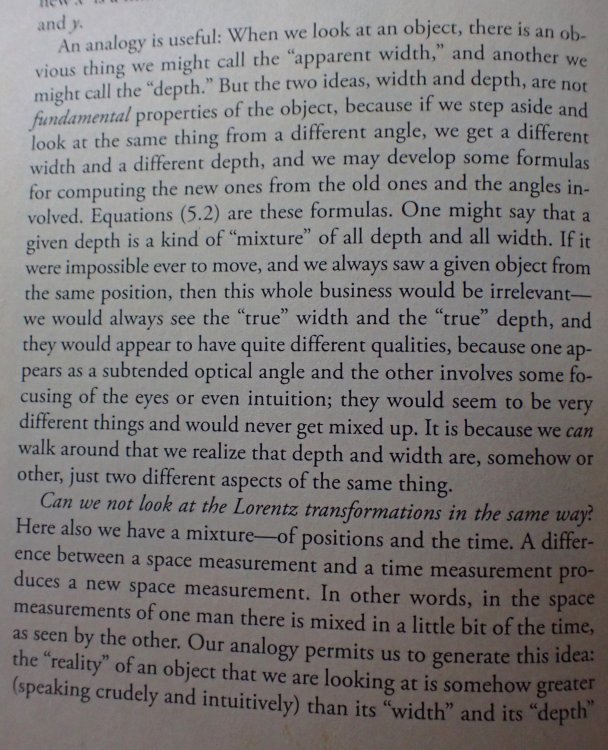
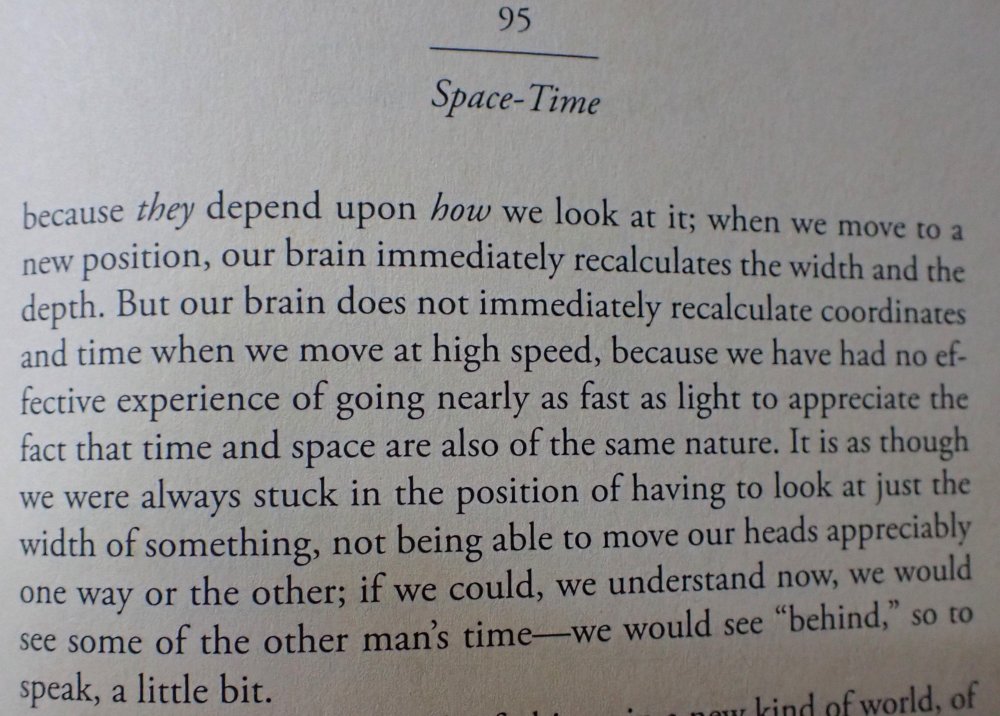
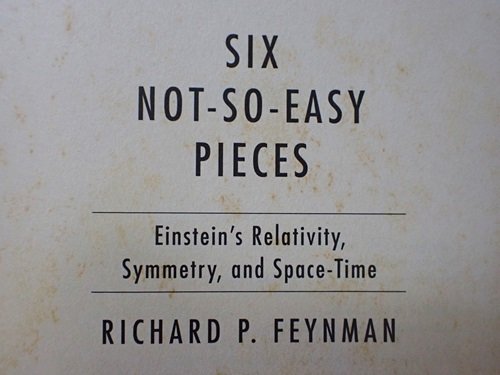
-
... should have been posted in the Speculations, by definition. Leave my stream alone.The reply was: It does not actually answer the question, "how fast". To answer this question, one needs to take the derivative, \( (\frac 1 {1-t})' = \frac t {(1-t)^2} \). This grows infinitely when \(t \rightarrow 1 \). Thus, the answer to the question "how fast is 'fast enough'?" is, "infinitely fast".I don't think so. I don't assume anything about how a depends on t . I only refer to how the distances depend on a .Energy is just a time-like component of 4-momentum.Yes, what is spatial and what is temporal depends on frame of reference. In the approximation that I refer to, the frame of reference is fixed in such a way that the gravitational waves are small perturbations in flat Minkowski spacetime which move along, say, x-axis. Then, they cause length contractions and expansions in the y- and z-axes.

Important Information
We have placed cookies on your device to help make this website better. You can adjust your cookie settings, otherwise we'll assume you're okay to continue.