Genady
Senior Members
-
Joined
Everything posted by Genady
-
(deleted - not important)
-
As Leonard Susskind used to say, "If one electron is in Massachusetts and another is in California, they are not in the same state."
-
My 5¢ or rather



-
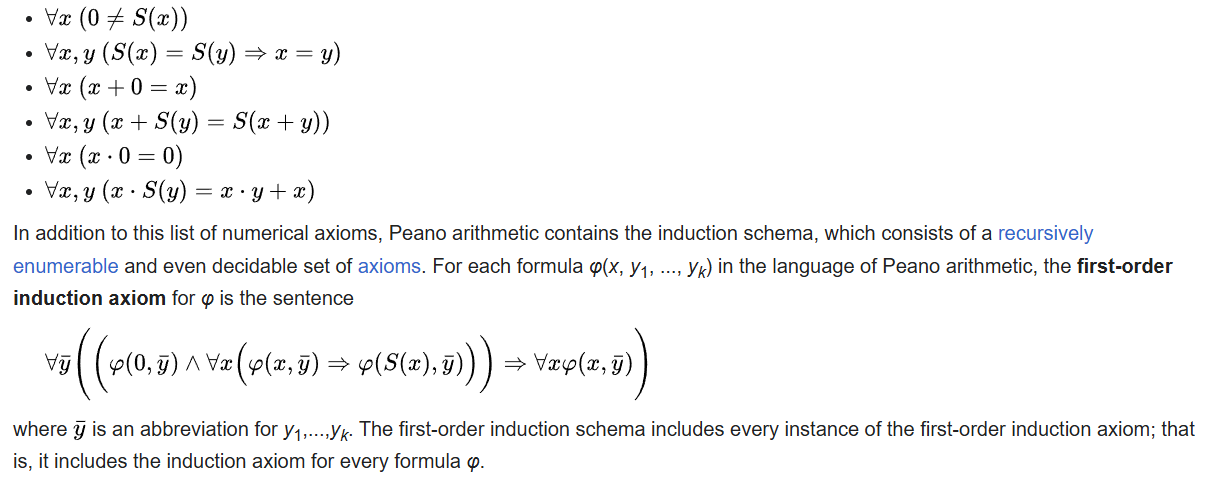
Here is an explanation: Peano axioms - Wikipedia
-
Well, the answer is simple albeit probably surprising. There are infinitely many axioms in that list, three posts above.
-
Here are How many axioms are here? If the answer were "seven,"

-
No, I mean axioms of natural numbers, the ones that govern the arithmetic of 0, 1, 2, 3, ...
-
That's a good system. I want to see.
-
This is why I've clarified that I specifically mean natural numbers.
-
How many axioms are there in a theory of natural numbers?
-
A bit of a mess here: "A Canadian journal has issued corrections on 138 case reports it published over the last 25 years to add a disclaimer: The cases described are fictional." "The articles usually start with a case description followed by “learning points” that include statistics, clinical observations and data from CPSP. The peer-reviewed articles don’t state anywhere the cases described are fictional." "The versions on PubMed Central also do not bear any indication the case reports are fictional." A medical journal says the case reports it has published for 25 years are, in fact, fiction – Retraction Watch
-
Interestingly, in my personal experience from several companies I worked for, from small firms to huge corporations, the BS existed for clients. I didn't see it anywhere inside.
-
Right, that's what I mean. Also, to skip all the "philosophical" BS.
-
This is another common myth though.
-
The goal is relevant; the intuition is not.
-
Not only "emergent geometry" requires definition, but "fixed geometry" as well. It is not clear without definitions that these two properties are exclusive.
-
Exactly! And as I pay taxes in two countries I get to vote in both.
-
This out of context quote does not tell me that "Einstein struggled with the idea that geometry shouldn’t be a fixed stage."
-
Did he?
-
I assume that the same correlation holds also for marketing BS, political BS, pop-sci BS, etc.
-
Susceptibility to BS and stupidity are correlated. "Employees who are impressed by vague corporate-speak like “synergistic leadership,” or “growth-hacking paradigms” may struggle with practical decision-making, a new Cornell study reveals." "In a work setting where corporate jargon is already the norm, it’s easy for ambitious employees to use corporate BS to appear more competent or accomplished, accelerating their climb up the corporate ladder of workplace influence." "Workers who were more susceptible to corporate BS rated their supervisors as more charismatic and “visionary,” but also displayed lower scores on a portion of the study that tested analytic thinking, cognitive reflection and fluid intelligence. Those more receptive to corporate BS also scored significantly worse on a test of effective workplace decision-making. The study found that being more receptive to corporate bullshit was also positively linked to job satisfaction and feeling inspired by company mission statements." Workers who love ‘synergizing paradigms’ might be bad at their jobs | Cornell Chronicle
-
Sorry, forget about it. OT.
-
Isn't it true for all people? How is it different for autistic people?
-
I didn't know that,
-
"Results show that, compared with the non-autistic population, as represented by standardized norms ... and typically developing (TD) control groups ..., individuals with ASD exhibit significantly lower math scores ... and greater variability." https://medicalxpress.com/news/2026-02-closer-mathematical-abilities-autistic-people.html