
Genady
Senior Members
-
Joined
Everything posted by Genady
-
@geordief I don't think so. Those people will get out of school with knowledge and skills while others will not. Those people will be better at job interviews. They will succeed in jobs where others will fail. Degrees don't matter - job performance does.
-
There are people who want to learn. These people don't have any reason to cheat. They do their homework to learn and to practice what they learn. They take exams to see if they got it. They look for mentors. Educators work with these people.
-
Why would I?
-
I think that educators' job is to educate rather than to assess academic abilities. AI is not a problem in that.
-
Got it, thanks. But you see why it is confusing.
-
OK. I thought that "anything" means "whatever". For example, "anything" can be "not-B" or false. Evidently, it can't, but why?
-
What is a meaning of the words, "P(B) given anything"? I understand what P(B|A) means when A is an event that occurs or not, or a statement that is true or false. However, "anything" is neither, or is it?
-
I think I know. The cups will never get over the turning points on the very top and on the very bottom of the upper and the lower wheels. This is because regardless of how the cups are attached to the belt, it takes h longer way for the upper weight to reach the top of the upper wheel than it takes for the lower weight to reach the bottom of the lower wheel. See, for example, this: Thus, to get to the turning point the device needs at least Mgh extra energy. But, as @Lorentz Jr has derived above, this is equal to or more than the energy that all other cups can supply. So, the device will stop before reaching that configuration. QED
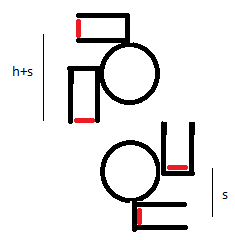
-
Here is where I'm not convinced. Let's say the energy lost in the weights falling into their new position is K. The total energy is then, ρhAgD - 2Mgh + 2Mgh - K (?)
-
@Saber I have to admit that the answer which for years I thought solves the puzzle, I have doubts about it now . I want to see where you and @Lorentz Jr go. If it turns to be the same answer, I'll share my doubts and we'll resolve them, hopefully.
-
That density has an effect if a body hits the water on high speed, but if it enters slow enough then the only force it needs to overcome is the buoyancy.
-
That was an unnecessary complication.
-
If the membranes are flexible but not stretchable, it will not happen. They would accelerate until they reach velocity when the water resistance balances the gravity and buoyancy forces.
-
In the words of Alan Guth, the BB theory does not say what banged, why it banged, and what happened before it banged. No, it's not complete.
-
Moreover, after we learn consciously a new skill and become good in it, it moves into our subconsciousness releasing the consciousness for other tasks. E.g., driving, playing an instrument, reading, etc.
-
I think I understand now what you are talking about. In this case, I also know which forum this thread belongs to. The forum called, Speculations.
-
This is actually known quite well. So well that it is used to convert brain signals to movement of artificial limbs in amputees.
-
The above expression doesn't make any sense to me. I guess something got lost in translation. Can you rephrase?
-
You have placed this topic in the Psychiatry and Psychology forum, but your questions seem rather be focusing on brain function. Are you sure it shouldn't go to the Neuroscience forum? On the other end of the spectrum, maybe it belongs to the Philosophy forum? This is how unclear it is what you are asking about.
-
In addition to the difficulties caused by sheer complexity of the brain, we cannot make experiments on a functioning human brain, except few in very limited cases. This makes the research very difficult and the data collection very slow and often just incidental. This is a big reason why, as @zapatos said, we're not there yet.
-
How long?
-
I think it can be done with living plants with shallow roots. Planes can carry passengers and luggage. Adding some mats with plants on them would take away some of that capacity, but still doable. These planes, just like these cars, wouldn't have an ideal aerodynamics, but you wouldn't do it to a fighter jet anyway.
-
Here it is done with cars - you can do the same with planes or parts of them: grass covered car - Bing images
-
Here is an article that, at least partially, balances the one in OP: We are all playing Covid roulette. Without clean air, the next infection could permanently disable you | George Monbiot | The Guardian
-
Unfortunately, it is not necessarily so. I've met people who cannot see a motion in different frames. They just don't get it.