Genady
Senior Members
-
Joined
Everything posted by Genady
-
There would not be photons either, because electro-magnetic wave needs 3D. Without photons, charged particles would not interact. Thus, there will be nothing to hold atoms intact. There would not be objects, just a chaos.
-
Photons interact with electrons. These 'de-energized photons' would interact with electrons, pick up some energy from the electrons, and would not be 'de-energized' anymore. They would be regular photons, which would be detectable.
-
You can do the same here.
-
I don't see how having number of a referenced post instead of a link to the referenced post, would solve these two problems.
-
I agree, the boxes make it a mess. But one more click eliminates them: when they appear there is an option underneath, "Display as a link instead", underlined. Then, instead of this: it appears like this: Maybe the staff could change the function, so the latter is a default rather than the former?

-
Right, but why would I use a reference other than for others to read the referenced post? If this is the purpose, the link makes doing so much easier than a number.
-
Thank you! Why would we need the post numbers then?
-
Thank you! This is much shorter than how I was doing it. Didn't notice that "posted ... ago" is a link.
-
The other three languages I know have the same feature. (But this is OT, perhaps.)
-
If the numbering is not technically possible, then maybe there are alternatives available? E.g., an easy way to link to a post.
-
Yes, it would be helpful. OTOH, I can just say, "You claimed earlier, that ...". If this is true, but they object, they perhaps do not argue in good faith. Otherwise, they can rephrase what they said, clarify, modify, etc., and go ahead.
-
@kba, Thank you. I got the answer to my question:
-
bs
-
Oh, yes. Another long list. But this is technology, not science.
-
Yes, there are too many differences between English in science and out. Such comparisons should not be considered here. "Horizontal" differences are almost the same. How about wave-particle duality in QM? Historically, it was talked about quite a lot, but I don't think it is mentioned anymore. Not as an important concept anyway.
-
That does not count. They did not speak English then. 😉
-
Symmetry: from a simple geometrical meaning to invariance under transformation.
-
How about geometry? From a study of shapes and figures to a study of coordinate invariance.
-
Good examples above. Here is another: metal in chemistry vs metal in astrophysics (any element but hydrogen or helium).
-
This sounds like common vs scientific names of species in biology.
-
This is not a question in physics. Perhaps, in history of science. But not in physics.
-
As noted in another current thread, hundred years ago science textbooks used to talk about "destruction of heat". This language is not used in science today. I think, there might be many other examples of interesting evolution of scientific English, not involving changes in underlying physics. The first came to my mind, "mass". Not long ago (but after 1905) it often was used with a qualifier, e.g., "rest mass", "relativistic mass". Today, it is just "mass" meaning "rest mass", in all (almost?) textbooks, presentations, papers. Other interesting examples?
-
Copyright date does not necessarily invalidate the principle, but it often invalidates the verbiage. Language evolves, including the one used in science.
-
Well, thank you for letting me know. I'll take a note and will not waste my time anymore.
-
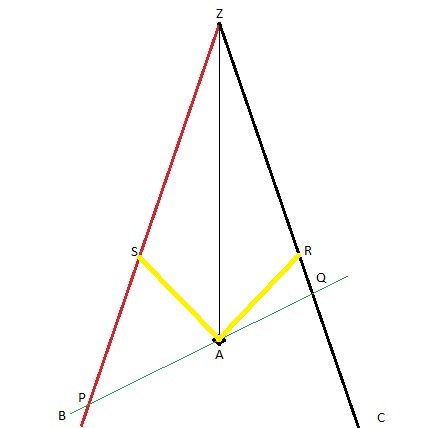
Here it is. R is where C receives the signal, and S is where B receives the signal: