
Genady
Senior Members
-
Joined
Everything posted by Genady
-
Good for you. It took me longer.
-
Logic? Who needs logic?
-
I have Master degree in Computer Sciences and have learned and used more than a dozen of programming languages, and I don't see how you conclude that they "aren't 4 dimension." Can you help? I have also Master degree in biology and know quite a lot about DNA. I still don't see how you conclude that it is "3 dimensional." Can you help? Your last paragraph is not an answer to my question: is it?
-
What exactly do you disagree with in what I said there? You don't need to, but you can.
-
Spacetime has 4 dimensions. It does not exist as a 4th dimension. How do you know this? How do you know this? Time is a component of spacetime. How do you distinguish between locally real and relatively real?
-
It certainly floating. The floating masses of it are clearly visible at a distance. Sargasso Sea is more than thousand miles to the NE from us and against the Gulfstream. Our sargassum is not from there. The Sahara dust is well known here. The Amazon seems to be the culprit. I also saw a report saying that our sargassum floats here from Trinidad. It fits.
-
The OP question sounds to me akin asking, Can you be a football player and still like ballet? Regarding the OP question as it is, the answer depends on what kind of scientist and what kind of belief. For example, I don't see a problem with a Jewish crystallographer observing Sabbath. OTOH, I see a problem with a geologist believing that Earth is 5 thousand years old.
-
OK, I assume the vagueness of the article title is a click bait. The fish is rare regardless of it walking on its "hands".
-
After the light reaches our eyes and after the signals go through our nervous system and through all the computations in the brain, our final perception at the end of the process is present. Plus, although I cannot see it, but something is happening in Andromeda in this very moment while I am typing this comment. It is present.
-
Yes, but was not here until 4-5 years ago. It appears couple times a year now. Hmmm, I'll take Sargassum...
-
Yes, frogfish and other walking fish are quite common in Bonaire. That is why the article title looked wrong and misleading to me. But then I thought, maybe I just read it wrong (as English is not my native language.)
-
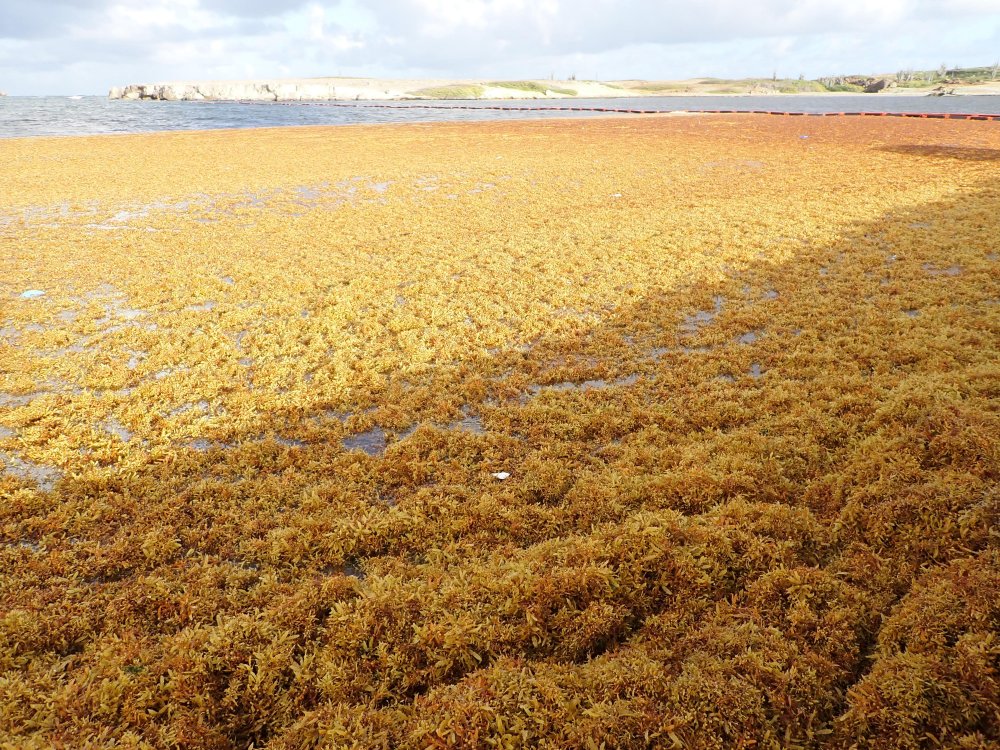
You might know about unusual amounts of Sargassum appearing in Caribbean in recent years. Here, in the Southern Caribbean we also started to get it and it is not good at all. Here is how it looked this morning in a lagoon on the windward side of the island: I don't know details but guess that this phenomenon is a consequence of the climate change, which causes changes in water temperature distribution and currents. Any thoughts?
-
The title of this thread is a title of recent article (Photographer Nicolas Remy captures image of the rare spotted handfish | CNN). How would you read it: the photographed fish is rare, or a fish walking on its "hands" is rare?
-
I don't see what makes you think so.
-
Eating things that taste good is a basic bodily function.
-
Everything except basic bodily functions.
-
Not exactly. I'm saying that we do things for various reasons, and pleasure or pain are responses for our success or failure to do what we wanted.
-
Isn't it the other way around? I.e., whatever we're determined to increase gives us pleasure when it increases, and whatever we're determined to decrease gives us pain if it doesn't decrease.
-
As it was two days ago: https://www.scienceforums.net/topic/128859-physics-in-troubles-the-real-equation-of-force-is-f-ma-and-not-f-dpdt/?do=findComment&comment=1230793 (there is a link inside this link)
-
If it is, at least it's short.
-
You have misunderstood. I am not in a discussion with you. I just contributed couple of comments to the thread, but I did not refer to you in those comments, as you can check. You are free to ignore them. I am not looking forward to your reply.
-
Well, it is more OT, but I was also tired of meeting people thinking that it's OK for their neighbors to be sick without medical insurance because they have different views on how tax dollars should be spent.
-
Maybe it's just semantics, and in fact CWII and WWIII aren't very different.
-
Moreover, the kinetic energy E = mv2/2 = mvv/2 = Pv/2 Since P is not conserved, E is not conserved. Tha law of energy conservation is wrong. The entire Physics must be rewritten now. How exciting.
-
BTW, the law of momentum conservation is wrong, too. You see, as the mass of the chunk of ice goes down, its momentum goes down as well. So, the momentum is not conserved.