Genady
Senior Members
-
Joined
Everything posted by Genady
-
-
However, it tries to alter an existing definition. It does not define a new term, but rather redefines an existing one. Without a reason, such redefinition is not valid.
-
I don't see what makes it so different. Do you? I rather think that it is another yet unexplained property of a system and that it is a consequence of the system's structure. Another analogy might be a programming language. It consists of a finite number of simple instructions. When put together in a certain way they calculate number pi.
-
Not necessarily. It looks quite straightforward to me: reductionism allows for a whole to have a property which the parts lack. For example, a composition of non-white colors makes white color. Compositions of sinusoidal functions make functions which are not sinusoidal. Molecules have properties which atoms lack. Similarly, some composition of some unconscious parts makes something conscious, why not?
-
How do we know this? This does not contradict reductionism. Why wouldn't it be possible to predict consciousness based on a knowledge how the unconscious parts are arranged?
-
It rains here today. Our aquarium water gets partially changed: (the surface as seen from below)

-
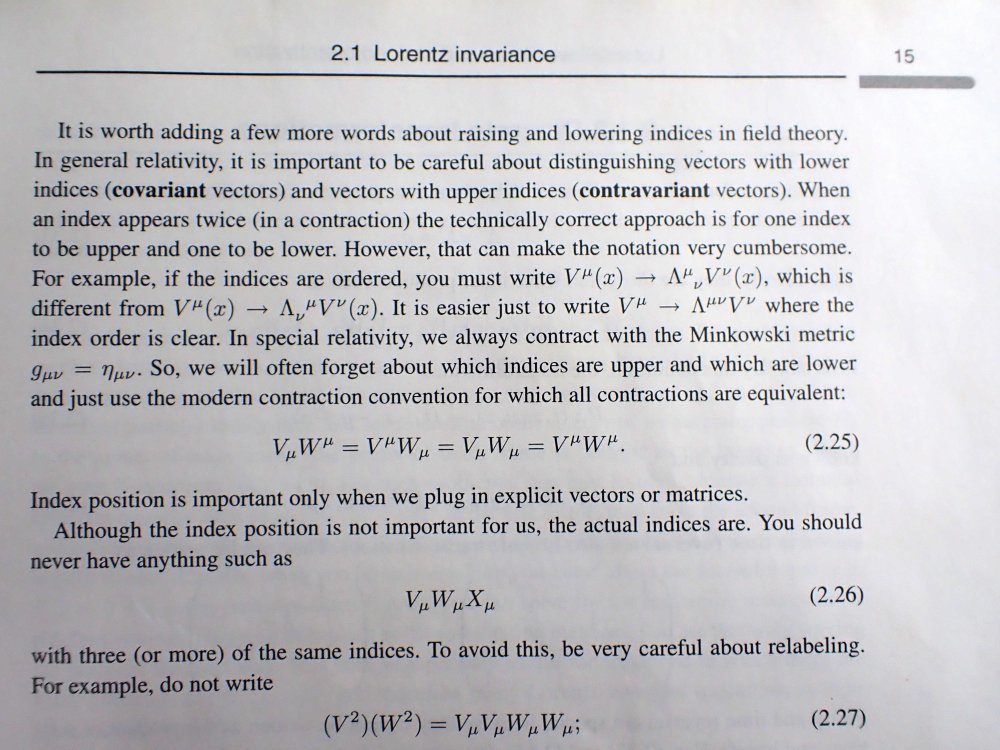
Here is a different approach: Quantum Field Theory and the Standard Model: Schwartz, Matthew D.: 8601406905047: Amazon.com: Books
-
Simple - no, but not an approximation either. It is an exact matrix multiplication. Frame dragging comes with gravity, not with coordinate transformation.
-
Yes. I saw that quote about "science without religion..." used by religious zealots out of this context too many times. 🤮 OK.
-
Yes, I'm a simple guy.
-
I don't know about others but have read several biography books about Einstein. I understood that he was not religious.
-
They are different, I think. Consider Bab = Bacgbc = Bdcgadgbc ≠ Bba Bab and Bba are transpose of each other, like Bab and Bba. No difference if the tensor is symmetric. edit: the thread was open on my screen for way too long, so this is x-posted with the entire exchange above. Still, the last remark, about symmetric tensor, is an addition, I think.
-
I'm glad to hear this. Good luck to you!
-
This is irrelevant.
-
If you are satisfied with these responses, then there is no need to present the rest of your theory.
-
No. Just present the first paragraph of your manuscript and ask members for their response.
-
For other reasons, but not because RT requires it to exist. The reasons can be easily found in many sources. They don't match with non-relativistic predictions as well. Present the first paragraph.
-
No, it does not.
-
Here is one of THEM: VINCENT VAN GOGH (1853‐90)* ARTIST AND ADDICT - BETT - 1954 - British Journal of Addiction to Alcohol & Other Drugs - Wiley Online Library
-
Sea Robin. They walk on "fingers".
-
Here is one taking a walk

-
They come in different colors here, too. What is interesting, they know to stay on a sponge which matches their color. I'll look in my pictures for a different frogfish and will post if I find one.
-
Speaking of the devil... Here is a fresh photograph of our own walking fish, frogfish. Not very rare but often gets unnoticed because of the wonderful camouflage. Taken by a friend of mine, much better uw photographer than me.

-
These letters and numbers that you refer to, are meaningless on their own. But when you consider what they mean when they are executed by a computer, you shall see that each elementary step of execution of a program has 4 independent variables: 1) a current state of computer registers, 2) a current state of computer memory, 3) a state of the registers that replaces the current state, and 4) a state of the memory that replaces the current state. These four variables make the computer program at least 4 dimensional. DNA molecule has 3-dimensional structure, but it is not enough for DNA to function. To do anything, it has to dynamically change. This adds a new dimension making it 4-dimensional. Congratulations about it. But if you research Google or Youtube and alike, then large part of these hours is wasted and even is counterproductive. If you want to study for real, you need to study from textbooks.
-
Nice picture. And it's just a beginning. +1