

Dhamnekar Win,odd
Senior Members
-
Joined
-
Last visited
Everything posted by Dhamnekar Win,odd
-
This answer refers to r=4 objects and n=2 cells question. We know A(r,n) =A(4,2)= 14 , My answer to A(r-k,n))=A(4-k, 2)=7 Is this answer correct?
-
[math]A(4-k,2)= (-1)^0 \cdot \binom{2}{0} \cdot(2-0)^{4-1} + (-1)^1\cdot \binom{2}{1} \cdot(2-1)^{4-2} = 8-1 =7[/math] Is this answer correct?
-
My attempt to derive general formula for A(r,n) =[math]\displaystyle\sum_{k=1}^{r-1}\binom{r-1}{k}\cdot A(r-k-1,n-1)[/math]
-
Author said to change order of summation and use binomial formula to express A(r, n+1) as the difference of two simple sums. So, I did it. As regards derivation of equation(1) using combinatorial arguments, author didn't write anything about that in his book. So, I don't know how to derive it.
-
If I put r=2, I get answer=3. If I put 4=3, I get answer=7. If I put r=4, I get answer=15. Now what is your suggestion?
-
I changed the order of summation and the expressed A(4,1+1=2)as the difference of two simple sums [math]\displaystyle\sum_{k=1}^{4}\binom{4}{k} \cdot\displaystyle\sum_{v=0}^{1}(-1)^v\cdot \binom{1}{v}\cdot(1-v)^{4-k}-\displaystyle\sum_{v=0}^{1}(-1)^v\cdot \binom{1}{v}\cdot(1-v)[/math] Now, what we can do?
-
That's what the author want to suggest. How can we change the order of summations in the answer which we got using formula (1) so that we get the answer 14?
-
Using formula (2), we get [math] A(4,2)= \displaystyle\sum_{v=0}^{2}(-1)^v\cdot \binom{2}{v}(2-v)^4=14[/math] Using formula (1), we get [math]A(4,2)=\displaystyle\sum_{k=1}^{4} \binom{4}{k}\cdot\displaystyle\sum_{v=0}^{1}(-1)^v \binom{1}{v}(1-v)^{4-k}=15[/math] Now, how can we remove the difference of one between these two answers?
-
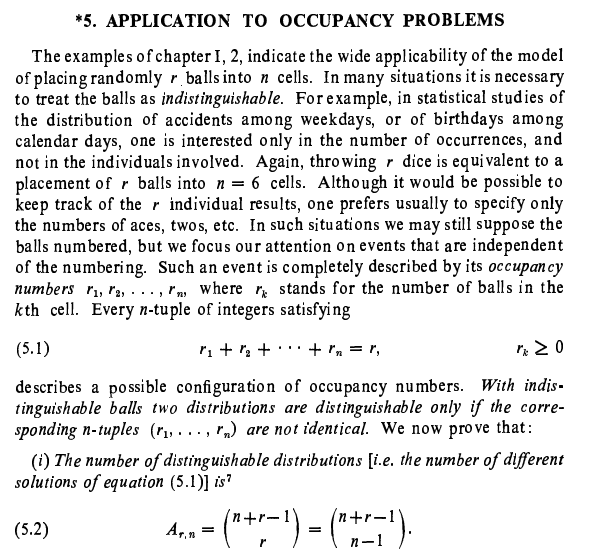
I am trying to derive the formula (1) by combinatorial argument, but I didn't succeed. My difficulty to understand the Author's suggestions: 1) This is a classical occupancy problem. Assuming that all [math]n^r[/math] possible placements are equally probable, the probability to obtain the given occupancy numbers [math]r_1,...r_n[/math] equals [math] \frac{r!}{r_1! r_2!...r_n!} n^{-r}[/math] Here, we are concerned with only indistinguishable particles or objects. In Physics, this probability is known as Maxwell-Boltzmann statistics. Now, suppose, we have to put 4 objects in 2 cells. The number of distinguishable distributions of 4 identical objects into 2 cells is [math]\binom{3}{1}=3[/math].|***|*|, |*|***| or |**|**| But if we use formula (2) we get 14 as answer |**|**|, |**|**|, |**|**|, |**|**|, |**|**|, |**|**|, |***|*|,|***|*|,|***|*|, |***|*|, |*|***|, |*|***|, |*|***|, |*|***| . In case of A,B,C,D objects, we get |AB|CD|,|AC|BD|,|AD|BC|,|BC|AD|,|BD|AC|,|CD|AC|,|ABC|D|,|ACD|B|,|ABD|C|,|BCD|A|,|A|BCD|,|B|ACD|,|C|ABD|,|D|ABC| Using formula (1), we get [math]A(4,3)=\displaystyle\sum_{k=1}^{4}\binom{4}{k}*\displaystyle\sum_{v=0}^{2}(-1)^v*\binom{2}{v}*(2-v)^{4-k}=35[/math] I think this answer assumes distinguishable cells as well as objects. Now I don't understand , on what basis , we can say that this formula is derived assuming indistinguishable objects?
-
I did those computations for case(1) r=2, n=2 and case(2)r=2 and n=3. For case(1) The number of distinguishable distributions of 2 indistinguishable objects putting into 2 cells is 1 (equation or formula 1) and the numbers of distinguishable distributions of 2 distinguishable objects putting into 2 cells are 2(equation or formula 2) For case(2) The number of distinguishable distributions of 2 indistinguishable objects putting into 3 cells is -1 (equation or formula 1) and the number of distinguishable distributions of 2 distinguishable putting into 3 cells is 0(equation or formula 2) So, now how can we change the order of summation and use the binomial formula to express A(r, n+1) or in our case A(2,3) as the difference of two simple sums?
-
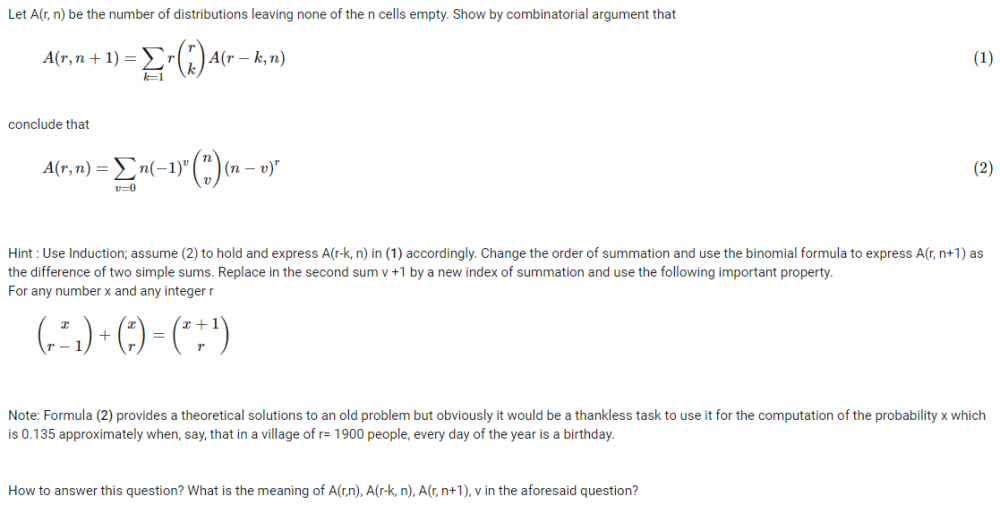
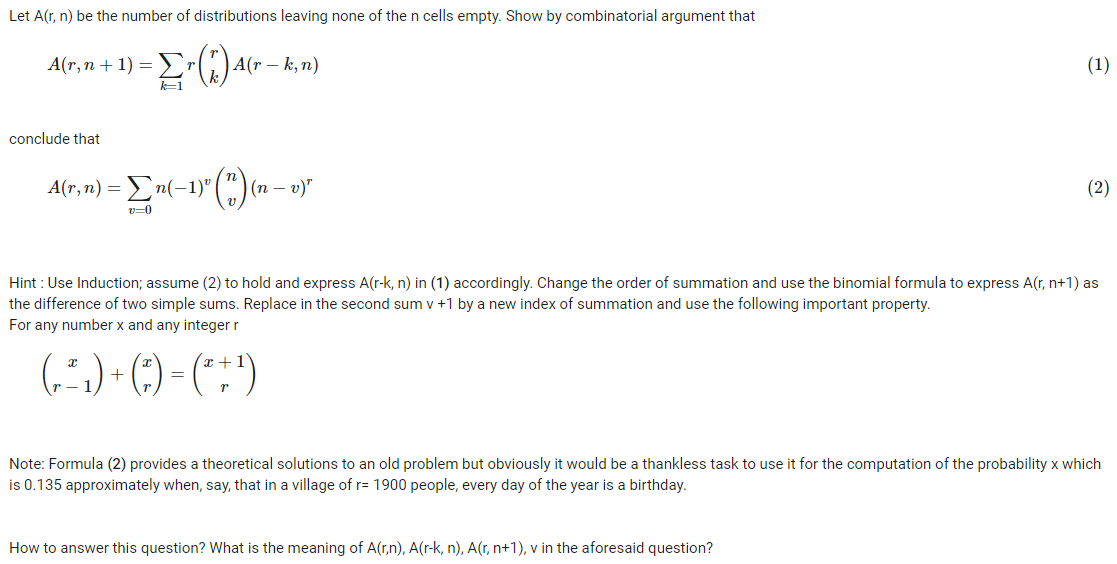
Assuming equation(2) to hold, how to express A(r-k, n) in equation (1) accordingly? How to change the order of summation and use the binomial formula to express A(r, n+1) as the difference of two simple sums as feller suggested? How to replace in the second sum v+1 by a new index of summation and use the following important property of binomial theorem [math]\binom{x}{r-1} + \binom{x}{r} = \binom{x+1}{r}[/math]?
-
The proof of the above formula was given in the book on probability by W.Feller

-
Did you go through the corrected equation (2) in my last post? v and k are the same variable i-e we are to select v or k cells from the n cells. That's it.Please read my post under the heading "Elements of Combinatorial Analysis". Source " An Introduction to Probability Theory and Its Applications" by W.Feller, Chapter 2 and 4.If I am not wrong, both formulas are meant for the computation of number of distinguishable distributions of indistinguishable r objects putting into n cells so that none of the n cells remains empty.Corrected equation (1) [math] A(r, n+1)= \displaystyle\sum_{k=1}^{r} \binom{r}{k} A(r-k, n)[/math] Corrected equation (2) [math] A(r, n) = \displaystyle\sum_{v=0}^{n} (-1)^v\binom{n}{v}(n-v)^r[/math] Then the author W. Feller says to replace in the second sum v + 1 by a new index of summation and use important property of binomial theorem which I wrote in my original question
 Some more information : This problem refers to the classical occupancy problem (Boltzmann-Maxwell statistics): that is, r balls are distributed among n cells and each of the [math] n^{r} [/math] possible distributions has probability [math]n^{-r}[/math]
 How to use the given math hint to answer this question?
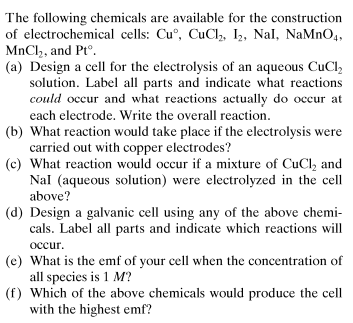
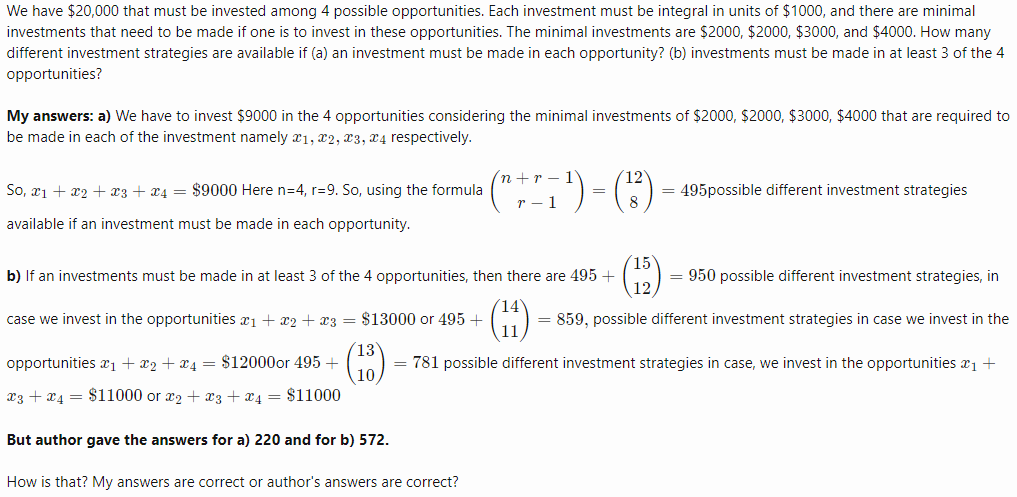
 I have made mistakes in the computations of answers to question (a) and (b). Corrected answer:(a) [math]\binom{n + r -1}{r}= \binom{12}{9}= 220 [/math] where n=9 and r = 4 Corrected answer:(b) [math]220 + \binom{15}{13} + \binom{14}{12} + 2 \times \binom{13}{11} =220 +105 +91 + 156 =572[/math] Hence, author's answers are correct.How to answer all these following questions? I am working on all these questions. Any chemistry help, or even correct answers to all these questions will be accepted.
 In the above second question, [math] \nabla r , \hbar [/math] means gradient r (position vector) and reduced Plank's constant respectively.Momentum is used to sense the amount of force applied to a moving object. With the help of Momentum, you can know the nature of the applied force on an object. Momentum is usually represented by the product of the mass and velocity of a moving object. But in this case of quantum mechanics, the equation of momentum will be different. How is this computed? How is this momentum computed in Quantum mechanics?




Important Information
We have placed cookies on your device to help make this website better. You can adjust your cookie settings, otherwise we'll assume you're okay to continue.
Account
Navigation
Search
Configure browser push notifications
Chrome (Android)
- Tap the lock icon next to the address bar.
- Tap Permissions → Notifications.
- Adjust your preference.
Chrome (Desktop)
- Click the padlock icon in the address bar.
- Select Site settings.
- Find Notifications and adjust your preference.
Safari (iOS 16.4+)
- Ensure the site is installed via Add to Home Screen.
- Open Settings App → Notifications.
- Find your app name and adjust your preference.
Safari (macOS)
- Go to Safari → Preferences.
- Click the Websites tab.
- Select Notifications in the sidebar.
- Find this website and adjust your preference.
Edge (Android)
- Tap the lock icon next to the address bar.
- Tap Permissions.
- Find Notifications and adjust your preference.
Edge (Desktop)
- Click the padlock icon in the address bar.
- Click Permissions for this site.
- Find Notifications and adjust your preference.
Firefox (Android)
- Go to Settings → Site permissions.
- Tap Notifications.
- Find this site in the list and adjust your preference.
Firefox (Desktop)
- Open Firefox Settings.
- Search for Notifications.
- Find this site in the list and adjust your preference.