

Dhamnekar Win,odd
Senior Members
-
Joined
-
Last visited
Everything posted by Dhamnekar Win,odd
-
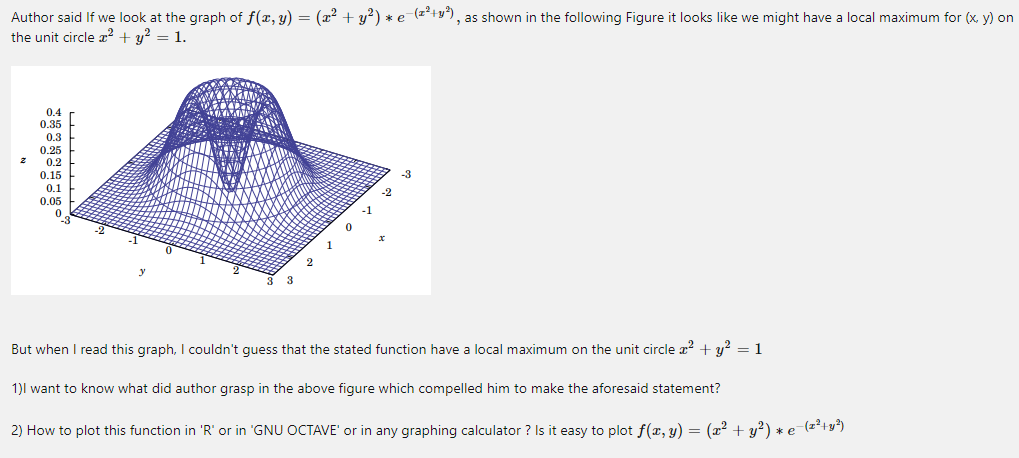
Sufficient conditions for a critical point at (a, b, c) to be a local maximum or local minimum of a smooth function f(x, y, z).i-e [math]\nabla {f} (x,y,z)=0[/math]. How to define D in case of three variables namely x,y, z.
-
So, we will get the same first order correction for [math]1-\epsilon[/math] Isn't it? In which R package De Jong function is available ?
-
Hi,
-
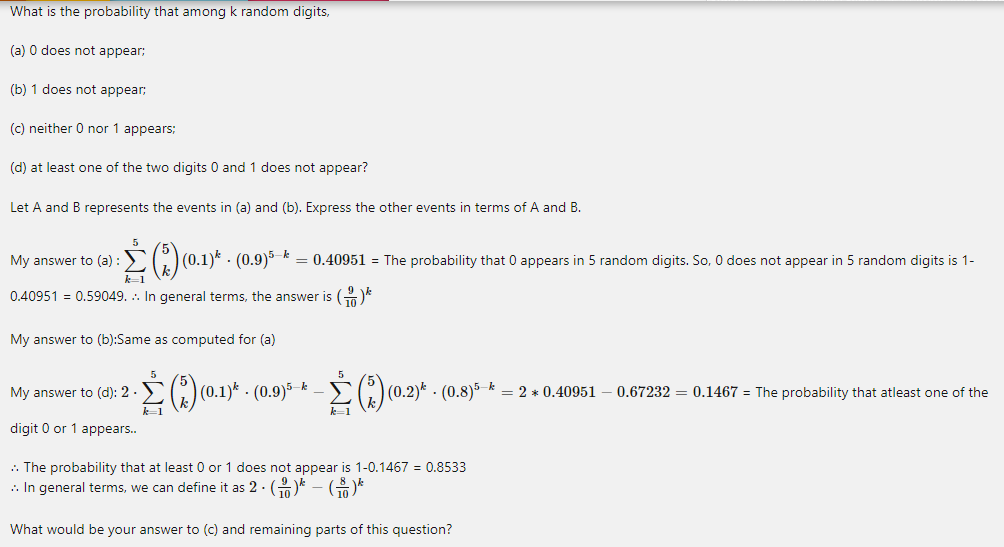
Rectified answer to (d): 2* (0.9)k - (0.81)k
-
Rectified answer to (c) if k =5 :[math]\displaystyle\sum_{k=1}^{5}\binom{5}{k} (02-0.01)^2 (0.81)^{5-k}= 0.6513215599 [/math]= The probability that either 0 or 1 appears. So, neither 0 nor 1 appears is 1-0.6513215599 = 0.3486784401 = (0.9)5 × (0.9)5 So, we can express event (c) in terms of A and B as A*B or P(A)* P(B). QED.
-
Answers to (a) and (b) are correct. [math](0.9)^5 \cdot (0.9)^5 = 0.3486784401 = (0.81)^5 [/math]whereas answer to (c) is (0.8)5 if k=5 So, there is minor difference of 0.1 in the probability in the answer to (c). I don't understand how did that arise?
-
All the digits 0-9

-
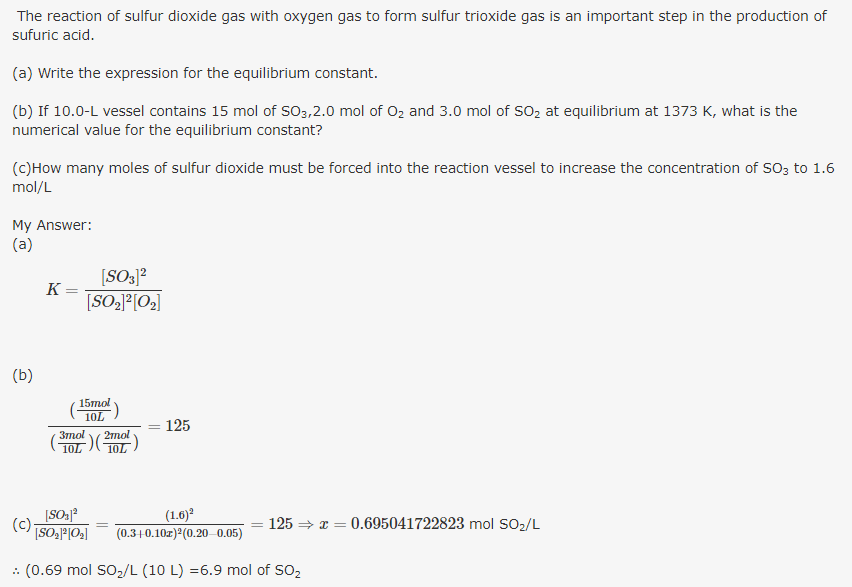
In hypergeometric distribution, n= population of n elements, r = sample size, n1 = elements recognized as having some defined criteria, n2 = n - n1 = remaining elements other than n1 . We seek the probability qk such that the sample size r contain exactly k recognized elements provided [math]k \geq 0, k \leq n_1 [/math] if n1 is smaller or [math] k \leq r[/math] if r is smaller. In such a case the probability [math]q_k =\frac{\binom{n_1}{k}\binom{n- n_1}{r - k}}{\binom{n}{r}} \tag {1}[/math] Now, I want to calculate n=8500, n1 =1000, r = 1000, k = 0 to 100. Inserting these values in (1), calculation of summation is very difficult. In such case, how can I use normal approximation to binomial distribution to find qk ? Do you have any clue or hint?I am working on question (d) for answering it. Any chemistry help will be accepted. Do you know the correct answer for question(d)?
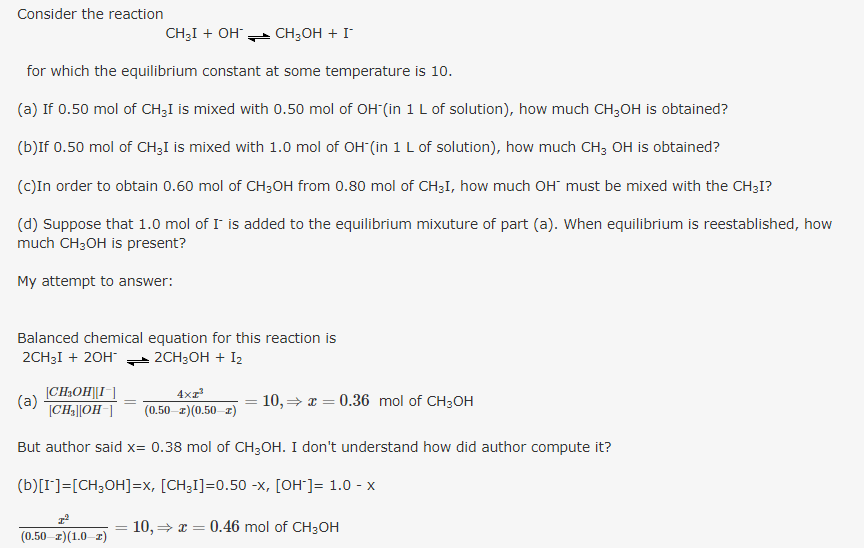
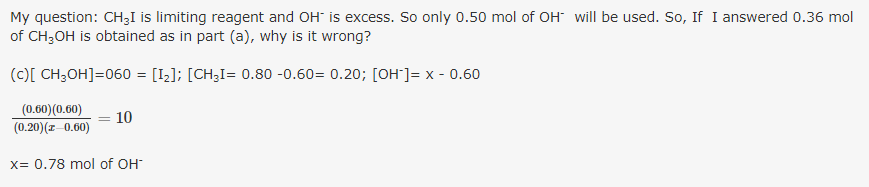 Whichever and whatever computations of Kc you use, eventually, final answer would be 0.17 mol /L SO2 should be added to the existing 0.2 mol/L SO2.My corrected answer to (c) is [math] \frac{[1.6]^2}{[ 0.3 - 0.1 + x]^2 [0.20 - 0.05]}=125 \Rightarrow x = 0.17 [/math] mol SO2. ∴(0.17 mol SO2/L) (10 L)= 1.7 mol of SO2.Please visit hereYes, I forgot to square the concentration of SO3 in the numerator and the concentration of SO2 in the denominator of the fraction in (b). But R.H.S. 125 is correctly computed. But what is your opinion about my answer to (c)?
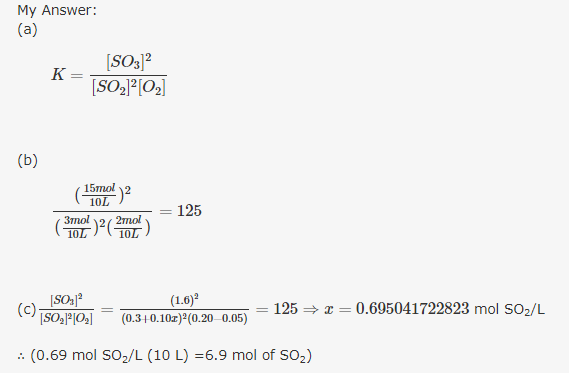 Are there any badges here for members?Are these above answers correct? specifically last one (c)?
 SOLVEDa) In how many parts, we can divide an infinite plane by n straight lines of which no two lines are parallel and no three lines are concurrent? b) In how many parts, we can divide an infinite space by n planes of which no four planes meets in a point and no two planes are parallel? How to answer both these questions? What are the answers to these questions? I am working on these questions. Any math help, problem solving hint will be accepted.This problem is " SOLVED"Thanks for your reply. I am working on the question 9 and statement in your reply to prove it practically as well as theoretically.I know the answer to question 8. But how to answer question 9.
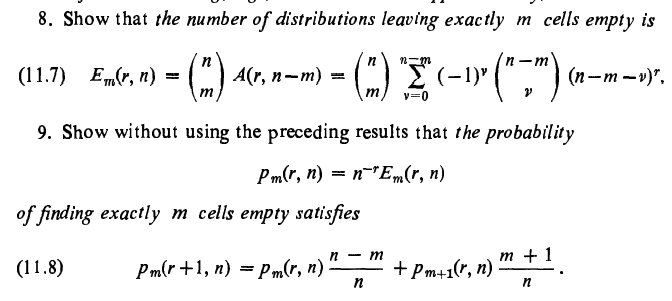 I tag this question as "SOLVED"So, Eventually I did it. Using formula (1) we get [math] A(4,2)= \displaystyle\sum_{k=1}^{3}\binom{4}{k}\cdot \displaystyle\sum_{v=0}^{1}(-1)^v\cdot \binom{1}{v}\cdot (1-v)^{4-k}=14[/math] Using formula (1)we get[math] A(4,3)=\displaystyle\sum_{k=1}^{2}\binom{4}{k}\cdot\displaystyle\sum_{v=0}^{2}(-1)^v\cdot \binom{2}{v} \cdot (2-v)^{4-k}=36[/math] Using formula (2) we get [math]A(4,2)=\displaystyle\sum_{v=0}^{2}(-1)^v \cdot \binom{2}{v}\cdot (2-v)^{4}=14[/math] as expected Using formula (2) we get [math] A(4,3)=\displaystyle\sum_{v=0}^{3}(-1)^v\cdot \binom{3}{v}\cdot(3-v)^{4}=36 [/math] as expected. Thanks for your guidance.But as per formula (2)r=4 and k=1 , which results in [math] (-1)^0 \cdot \binom{2}{0}\cdot(2-v)^3[/math] Formula (2) = [math]A(r-k,n) =\displaystyle\sum_{v=0}^{n}(-1)^v\binom{n}{v}(n-v)^{r-k}[/math]So, for [math] k=1, A(3,2)=(-1)^0 \cdot \binom{2}{0} \cdot (2-v)^{4-1=3}[/math] Is this correct?

Important Information
We have placed cookies on your device to help make this website better. You can adjust your cookie settings, otherwise we'll assume you're okay to continue.