
VenusPrincess
Senior Members
-
Joined
-
Last visited
Everything posted by VenusPrincess
-
If you believed something was true, but also knew that others would be demoralized and angry at you for sharing that truth, should you stay quiet or lie about it instead?
-
I am claiming that the greatest barrier to equal opportunity in education in 21st century Western countries are morphological differences in the neurological system. There are plenty of people in our fine universities, unfortunately most of them are morons and will contribute little to human knowledge. It's not because they didn't eat enough broccoli growing up, and it's not because an evil force is preventing them from reading their books. It's because they don't have the neuroanatomy to succeed. By the way, I think something like 50% of kids today attend some sort of institute of higher education after they graduate from high school. That's way too many. Perhaps 0.5% of people are capable of making meaningful contributions to intellectual fields if they devote themselves to study. Why are we admitting so many genetic morons into our schools? They take up space and make moronic monkey noises.
-
No offense but you should work on your reading comprehension. My post suggests that neurons found in people with type I (N370S homozygote) Gaucher's disease would possibly have an increased number of axonal branches and a corresponding increase in the length of the axon plexus. I used the Ashkenazim as an example since they have a reputation for high academic achievement.
-
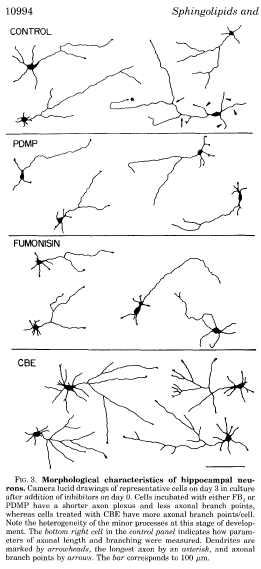
It sounds to me like you are ignoring the possibility altogether, in other words you are potentially rejecting reality because you don't like it. How can you deny the relationship between the morphology of an organism's neurological system and success? From the Wikipedia page on Gaucher's disease: From A regulatory role for sphingolipids in neuronal growth. Inhibition of sphingolipid synthesis and degradation have opposite effects on axonal branching: Again from the Wikipedia page on Gaucher's disease: I'm sorry if this makes you uncomfortable, but welcome to the brutal reality. Life isn't fair. A diagram from the linked article below:
-
You have implicitly decided. It seems like many "progressives" have decided that morphological differences related to skin color and skull structure, i.e. the outward physical indicators of race, supersede all other others when ensuring equal opportunity. Your focus on outward morphological differences is wrong headed. The morphological differences which are responsible for differences in achievement are most likely found within the neurological system. If those differences are passed down in conjunction with and therefore correlated with outward morphological differences then the problem is not with the outward differences, but with the neurological system.
-
If people do not behave in the same way it is because there is a morphological difference between them. That is the fundamental source of inequality. It's also impossible to fix, and there is no reason to either. Should we alter the genetics of the potato so that it will have the same morphology as a dog? Why? Why should organisms be equal? To what end? Give up on this childish dream of equality and accept reality.
-
This is just wrong. There are many branches of thermodynamics and there is no strict assumption of equilibrium unless you choose to study a branch that makes that assumption. Also wrong. Convection currents in the atmosphere reach altitudes far beyond the placement of our thermometers, yet they also pass through areas near the surface. You cannot make conclusions about the heat content of an atmosphere with turbulent flow and convection currents by merely averaging measurements at the surface. The global average temperature anomaly is not a robust estimate of the atmosphere's heat content. I didn't respond since your reply was overly wordy, fairly irrelevant and pedantic. What was your point? That some obscure equation that incorporates the average surface temperature could be useful? Well we know Mars and Earth have atmospheres, and we know which gases they are composed of. So I guess we don't need the obscure equation you mentioned. Reading comprehension? My point was about the uselessness of calculating a global average temperature, that it has no thermodynamic validity, and more specifically I mentioned afterwards that local trends may not match the global trend. The point does stand. Not sure what "the graph that clearly shows temperature increasing over the last ~140 years" has to do with my point.
-
Sorry, I read the text on the graphic that referenced the pre-industrial average and assumed that it pertained to the graphic. The point still stands.
-
I assumed the global average temperature deviation focused on the latter as well. Your own link shows how useless a global average temperature is from a practical perspective. A graphic on that page shows that the majority of months in North America had for the most part cooler temperatures today than during the pre-industrial average: The question is about the usefulness and predictive power of that statistic. If you can't even define what you are trying to measure then you can't even begin to answer that question. You cannot use temperature measurements to deduce the statistical properties of a thermodynamic process if you cannot establish a valid thermodynamic connection between the measurement and the process. You haven't even gotten as far as clearly defining the process you are trying to measure, much less established a connection between the measurements and the process.
-
Policy makers rely heavily upon the global average temperature anomaly to make conclusions and decisions. If they did not then your strawman claim might be valid. Monitor the trend in what? The averaged temperatures of a turbulent gas measured over wide spans of time and space which have highly heterogeneous pressure and surface conditions is supposed to be an estimate of what exactly? Within the next 100 years people will look at back at this as junk science. Yes. It tells us nothing about dependence on latitude, time of day, season, local weather events. It's useless. The average surface temperature on Earth is ~15 ºC, but it can range from -80 ºC to 50 ºC depending on time and location. This demonstrates a poor understanding of thermodynamics. We cannot hope to measure tiny deviations in the energy content of an atmosphere by averaging surface temperature measurements over wide spans of time and space which have highly heterogeneous pressure and surface conditions.
-
Yes. To illustrate how ridiculous it is to summarize in a single number the heat in an entire planet's atmosphere consider if we were engineers designing a rover to land on Mars. There are a million questions we could ask regarding temperature, including: How hot could the rover capsule's heat shield get as it cuts through the atmosphere? What are the 90% (typical) and 99.99% (extreme) confidence intervals for the temperature at the locations where we intend to operate the rover? How do the temperature confidence intervals depend on season? How do they depend on time of day? What weather events can create local disturbances in pressure and temperature? How often do they occur at the locations where we intend to operate the rover? Does their frequency change with season? What is the cloud cover like at the locations where we intend to operate the rover? How does it influence temperature and availability of solar power? Dependence on season and time of day... And I could go on and on and on. If you told me the average temperature on the Martian surface was -60 °C that would be utterly useless for our efforts to engineer a rover to survive on Mars. A useful understanding of the thermodynamics of planet's atmosphere simply cannot be summarized in a single number. It contains very little useful information.
-
You really are a nihilist. Irrationally so. Why are you so jaded? Faithless electors are not common, so yes your votes do matter. Ignoring problems with not accounting for the covariance between state outcomes, do you think the probability weights are very far off?
-
The global average temperature deviation (or anomaly) is used by climate scientists to justify their concern over man-made climate change, but if that calculation of the global average temperature has no thermodynamic validity then its use is questionable, just as the calculation of the average temperature of my car has no thermodynamic validity; it is not representative of anything material without more information.
-
If I have time I might implement something better, could be interesting to see how it affects the estimate. I didn't neg you. People might be interested in trying their own probability weights which is why I shared.
-
I think I did it out of habit, it may have been important to exclude sample =1.0 in some other application where I did something similar. But here you are correct, I don't think it's necessary to add the 1.0 On a side note the implementation is flawed in a few ways. From stackoverflow: But I don't think it's worth spending the extra time to fix it. I can't imagine it will have a huge impact on the estimate which is just a fun back of the napkin type calculation anyway.
-
Not you I guess. You're too smart to care about stuff like this. You're a proper nihilist like all great intellectuals.
-
The FiveThirtyEight model is currently giving Biden an ~87% chance of winning. My own model gives Biden a ~74% chance of winning, details below. I ran 1,000,000 simulations Monte Carlo style, where the outcomes in each state are independent of one another. I split states into five categories: 1) Safe Republican - Assigned a probability of 1 to vote Republican 2) Safe Democrat - Assigned a probability of 0 to vote Republican 3) Won by Trump in 2016 but leans Democrat (Maine 2, Michigan, Pennsylvania, Wisconsin) - Assigned a probability of 0.4 to vote Republican 4) Won by Trump in 2016 and leans Republican (Florida, Iowa, Ohio) - Assigned a probability of 0.6 to vote Republican 5) Formerly safe Republican but could possibly flip (Arizona, Nebraska 2, North Carolina, Texas) - Assigned a probability of 0.9 to vote Republican After 1,000,000 simulations these were the results: Republicans: 234295 Democrats: 741461 Ties: 24244 Total: 1000000 Just in case anyone wants to play around with the probabilities here is the header file: #ifndef STATE_H #define STATE_H #define LEANDEM 0.4 /* Trump won in 2016 but leans democrat */ #define KEEP 0.6 /* Trump won in 2016 and leans republican */ #define FLIP 0.9 /* Polls indicate may flip democrat */ struct state { char* name; /* name of state */ int votes; /* number of electoral votes */ double probr; /* probability of voting republican */ } states[] = { "Alabama", 9, 1, "Alaska", 3, 1, "Arizona", 11, FLIP, "Arkansas", 6, 1, "California", 55, 0, "Colorado", 9, 0, "Connecticut", 7, 0, "Delaware", 3, 0, "District of Columbia", 3, 0, "Florida", 29, KEEP, "Georgia", 16, 1, "Hawaii", 4, 0, "Idaho", 4, 1, "Illinois", 20, 0, "Indiana", 11, 1, "Iowa", 6, KEEP, "Kansas", 6, 1, "Kentucky", 8, 1, "Louisiana", 8, 1, "Maine 1", 3, 0, "Maine 2", 1, LEANDEM, "Maryland", 10, 0, "Massachusetts", 11, 0, "Michigan", 16, LEANDEM, "Minnesota", 10, 0, "Mississippi", 6, 1, "Missouri", 10, 1, "Montana", 3, 1, "Nebraska 1", 4, 1, "Nebraska 2", 1, FLIP, "Nevada", 6, 0, "New Hampshire", 4, 0, "New Jersey", 14, 0, "New Mexico", 5, 0, "New York", 29, 0, "North Carolina", 15, FLIP, "North Dakota", 3, 1, "Ohio", 18, KEEP, "Oklahoma", 7, 1, "Oregon", 7, 0, "Pennsylvania", 20, LEANDEM, "Rhode Island", 4, 0, "South Carolina", 9, 1, "South Dakota", 3, 1, "Tennessee", 11, 1, "Texas", 38, FLIP, "Utah", 6, 1, "Vermont", 3, 0, "Virginia", 13, 0, "Washington", 12, 0, "West Virginia", 5, 1, "Wisconsin", 10, LEANDEM, "Wyoming", 3, 1 }; #endif Here is the main loop: #include <stdio.h> #include <stdlib.h> #include "state.h" #include "time.h" #define NDISTRICTS 53 #define RUNS 1000000 main() { int dem; int rep; srand(time(NULL)); double sample; int demwins = 0; int repwins = 0; int ties = 0; for (int i = 0; i < RUNS; i++) { dem = 0; rep = 0; for (int j = 0; j < NDISTRICTS; j++) { sample = (double)rand() / (RAND_MAX + 1.0); if (sample < states[j].probr) rep += states[j].votes; else dem += states[j].votes; } if (dem > 269) demwins++; else if (rep > 269) repwins++; else ties++; } int total = demwins + repwins + ties; printf("Republicans: %d\n", repwins); printf("Democrats: %d\n", demwins); printf("Ties: %d\n", ties); printf("Total: %d\n", total); }
-
How could this happen though? Women evolved under the constraint of having to successfully gestate children. It doesn't matter how smart you are, and it doesn't matter how strong you are, if you are a woman and you do not successfully gestate children you cannot pass on your genes. Combine that with men's ability to produce many offspring and you have two distinct selection processes for men and women; one which filters out women who have traits that jeopardize their likelihood of successfully gestating children and another that favors high variance strategies that allow men to impregnate many women. Keep in mind that the development of certain brain structures could be expensive calorically. It doesn't make sense for a woman to develop a brain that consumes 1500 calories a day since that would just drain her fat storage without much benefit, but it might make sense for a man who is a traveling merchant to do so since his work requires intense cognitive function (arithmetical ability, social and verbal wit, high working memory).
-
Climate scientists are concerned with deviations in the average global temperature, but what does an average temperature mean from a thermodynamic perspective? Temperature is inherently a local measurement of molecular kinetic energy, and therefore an average temperature across a large region seems to have little meaning in a thermodynamic context. At best we could try to demonstrate that global average temperature is a predictive metric for some other variable of interest, but the burden of proof would be on us. I could calculate a weighted average by volume temperature of my car by measuring the dimensions of various devices and parts in the vehicle along with their temperature and then taking their sum weighted by their proportion of the car's total volume. For example perhaps the air in the cabin is measured to be 25 °C, the air underneath the hood measured to be 50 °C, the temperature of the oil is 200 °C, etc. After taking all of the appropriate temperature and volume measurements I might calculate that the average temperature of the car is 100 °C. But what does that tell us? Is that a useful metric? Now assume that I told you that the average temperature of the car increased to 101 °C. Should you be concerned? Well your first question might be where did the temperature increase, and when/why did it increase. If I told you the air in the cabin increased in temperature to 40 °C you would be correct to be alarmed, since that temperature would be uncomfortable or perhaps outright dangerous to the occupants. However if I told you that the temperature of the oil increased to 250 °C you may then ask when did the temperature of the oil increase? If I told you it increased when you put your foot down of the throttle for a period of time then you would not be alarmed at all since it makes complete sense for the temperature of the oil to increase when the engine is throttled. We can see here that the average temperature of the car contains little useful information. From this metaphor we can see that an increase in average temperature weighted by area/volume is not necessarily useful, and that we need more information to understand what is really going on. Has there been any research in this area?
-
According to the Copenhagen interpretation a quantum system remains in superposition until it is observed. If God was omnipotent he would be all knowing, implying that he observes all. However since the cat's state remains in superposition we can infer that it has not been observed, and therefore God is has no knowledge of the cat's state. That contradicts the initial assumption that God is omnipotent, but if God is not Omnipotent then he is not God at all, and therefore God does not exist.