
MSC
Senior Members
-
Joined
-
Last visited
Everything posted by MSC
-
This is a good example of what we would call a white lie. When people are talking about lying, they are really only talking about one form of falsehood. It often ends up being a catch all term for all falsehoods. If you present what you believe to be the truth with a clear argument and justification for believing in that claim, by way of logical consistency and preferably evidence, you should not stay quiet about it or lie about it. To be clear though, just because you are not lying about what your belief is, does not mean you are not just wrong and engaging in a falsehood. However, if your argument runs the risk of being dangerously misconstrued, you have a duty to stay silent and be careful about who you are speaking to about it. Once you've said what you say, it is out there in the world and it is your epistemic responsibility to make sure it is not misinterpreted in a way where an outcome that you did not want comes to fruition. Like an argument being used to advocate violence against a group, or an argument that claims superiority of one group over another, which can be misconstrued as justification for said violence. If you believe you can make an argument for a moral claim and are confident it will not be misinterpreted to ill effect, then by all means speak it from the hilltops. Reality does not have to match your confidence however and you can still choose poorly. This is why Wittgenstein only released one book while he was alive and why he detested people taking notes of what he said in casual conversation. Words are dangerous. Talking about ethics, is very dangerous and is very high stakes. A lot of people do not appreciate or understand the gravity of this. It's one thing to be wrong when making claims about what the answer to a mathematical problem is, being wrong in ethics, can have some very far reaching consequences. Nietzsche for example is often greatly misunderstood and misinterpreted to ill effect for him and his readers.
-
No but I snapped at you before and misinterpreted what you were saying so I wanted to make it up to you and treat you more respectfully. Oh I know what you mean, in America it is just crazy, the airports were jam packed of people travelling to be with their families for thanksgiving and it was quite a shock to me, I haven't seen my family in two years and some people here can't manage a single month without spreading the virus everywhere. 😕
-
I do value accuracy in discussion, when and where possible. That being said, achieving that can be difficult when you don't know who you're speaking to that well or when you're strapped for time. Sometimes you have to sacrifice accuracy, in favour of accessibility. I do appreciate the questions the the criticisms though. I suppose I do mean a broad definition of education but it is good to highlight the dichotomy between the two formats, institutionalised formal academia and access to materials for informal learning. So on the one side of that are things like school policies, formats, teaching methods and philosophies. On the other side, library, internet, work and life experience etc. So you are right. We should diversify and expand our current discussion by delineating not precisely what we mean by education, but delineating what education can mean in different contexts and asking the questions of each of those contexts. This way, we are looking at and evaluating the different barriers towards different styles and formats of education and figuring out what factors are at play and if any can be found in all contexts of what we can mean by 'Education', and which ones belong only within certain contexts. As for your query about whether or not the attitude I had when I wrote the OP was a good way to address people. By that I'm assuming you mean the emotionality and accusatory nature of it. Probably not the best way to start a discussion but then I've always worn my emotions on my sleeves and I am also of the opinion that sometimes you have to consciously show how you are feeling rather than bottle it and pretend you don't have any. We can agree to disagree on that front. Asking me to change the past or not feel nor express my emotions is probably a waste of time. Changing the past is beyond my control, whether I express any emotions is beyond others control. I might be doing it consciously to make a point or I might genuinely be having trouble regulating. Either way, whether or not it is conducive toward creating open and constructive dialogues, depends on context. Personally I don't mind if people are angry or emotional when they are speaking to me, so long as they aren't calling me or others names, shutting down conversations, using thick concepts or are being judgemental for the sake of dehumanising someone. However, if someone is going to tell me, I am behaving like an asshole, they better have a logical argument as to why, else I'll not bother with them as me and my self esteem have better things to do than listen to someone who is not only feeling emotional, but making it personal, inciting and spiteful. You know the types I mean, the one's who say something really insulting or accuse you of something with no evidence and then shut down the conversation and give the silent treatment for not agreeing with their summary that you are some unchangeable evil asshole. Shock horror, wonder why. Anyway, I only came back here to reply to you, I have one more comment to make on another thread, then I'm out of here until the New Year. Enjoy the Holidays
-
Ahhh I see now where our wires have crossed. My poor word choice and lack of expansion. I am really sorry for misinterpreting you. Forgive me, real life intrudes and my effort here suffers for it at times. In Scotland, there are means tested grants, bursaries, loans, allowances for disabled people, single mother specific grants etc. Creches and other facilities have also been implemented in some colleges and universities, all the ones in Edinburgh and definitely one in Glasgow that I know of 1st hand. So for some, but admittedly not all, fees, textbooks, and living costs are paid directly to students in the form of bursaries, allowances and loans. This includes travel costs for those who need it and live further than a mile or so away from the university. These funds go to the people who, upon the conclusion of an income means test, are identified as needing the help in order to have an opportunity to enter into higher education. Also, at 16, EMA, that is educational maintenance allowance is given as a stipend to students who remain in education, as they can leave of their own volition at 16 when they are in the 4th or 5th year of highschool. This was £120 a month when I was sixteen but it's probably went up a little bit with inflation over the years. At 18, you're eligible for a bursary to continue higher education. So who are the individuals who are not eligible for these sorts of financial aid? The people who by means testing were found to be from a wealthy enough background that they could pay their own way. All of that being said, in the greater context of the thread, you raised interesting points about loss of opportunity for work and personal computer/laptop. Yes, most students who are not living with parents take on part time jobs to pay for these sorts of things. Their Bursaries, are not enough to cover it all. There are probably some good arguments to be made about how much students should be given. Colleges and universities here do have a large amount of onsite computers that are always free for students to reserve or access if they are free. That point is a bit moot under covid though and even if you booked a day off in a computer lab, the school does not cover that travel fair so unless you have college that day, you have to spend your own money. Now when I was at school, full time students weren't eligible for housing financial aid from the government. I think that might have changed now but I'll need to double check. So in conclusion, upon your direction I'll revise and clarify my claims. In Scotland, if you're a citizen or permanent resident and you can't afford an education, you can get one. However it does not pay for all the costs associated with it unless you're a spartan minimalist with a laptop, or living with parents. Most students have to take on part time jobs. Students in the US do the same, the difference is that students in Scotland won't have massive amounts of debt they can't pay when they are finished, unless they were dumb enough to get a credit card or something? But then their debt isn't to their school. So I should have expanded when I said cost and I will retract statements where I implied all costs are paid for. https://www.mygov.scot/student-bursaries-grants-scholarships-loans/
-
Agreed. I apologise for those who feel or have felt mine. I have a long fuse for ethics but when it blows, it blows.
-
What were the alleged falsehoods again? That the scottish education system runs at zero cost for the student? I didn't say it runs at zero cost all in. Someone has to pay for it, it just isn't typically the student. Which was the nuance in my original comments. What other falsehoods are you alleging? As for the slapping you with a wet fish, I'm sorry, I had just read that eugenics comment from another user and it made my blood boil. Not your fault at all. Growth and proficiency is a really interesting debate and is key to education. Growth Vs Proficiency This link goes over the basics. For those who might have been unaware, this was the debate that Betsy Devos got completely railroaded for having no knowledge of during her committee meeting judging her suitability for education secretary. If you want to talk about education, it's best to be aware of the ins and outs of this debate.
-
Thank you. I'll stay.
-
Once the eugenicist has been banned, I'll return and continue these conversations. As it is, I can't take being here anymore. No you did, but then half of my responses and questions have been blatantly ignored and I really cannot be bothered with tackling your false equivalencies. Nobody has even touched upon proficiency and growth models, nobody wants to discuss school systems other than the US. Therefore this conversation is a waste of my time. But as always, I'm worse than the eugenics advocate right? Bye. Thank you to everyone who did take this conversation seriously. Eugenics and racism. So it was an agenda. Bye.
-
Or you should work on explaining things better. If I misunderstood it was because you were unclear. I'm not an expert in Gauchers disease nor did I claim to be. I don't even know if you are or if you're using the disease to fit some agenda you have. However you're conflating academic achievement with organism success and making moral conclusions that this must in some ways dictate who even gets to have their academic success measured to begin with in order to determine who academically achieves the most. Be clearer, what moral claims are you making here? Judging others on whether or not they understand how an off topic disease works or relates to moral value when you've made no effort to explain your position clearly won't score you points with me. So if you've got something to say, say it with clarity instead of beating around the bush and expecting everyone to read your mind.
-
Prove it's a possibility, then prove it's a reality. You've done neither. That's one of the things it's about at least. Not Venus Princesses use of one particular disease to infer a reduction in moral value of Ashkenazi jews, based on their propensity to have a certain disease and then calling that ridiculous claim 'a brutal reality'.
-
Your focus on using difference as a justification for an unfair status quo between peoples, misses the point of what ethics is about. I also don't think you truly understand the idea of neurological diversity. It sounds to me like you're saying, whoever comes out on top must just be neurologically superior, if it happens to be white rich people, they are obviously superior. Not accounting for force, subversion, intimidation or violence at all. Not accounting for neurological differences between every individual and it being constantly evolving and changing based on environment. Last comment, can't take you seriously princess.
-
It mentioned race and color. Black being a race and a color. You're coming off as pedantic and nitpicky a little. The point is, XIII is the legislation that freed black slaves. Due to the historical fact of the time that only black people were legally kept as slaves in the US, not whites. XV then references race in relation to prior conditions of servitude, because historically at the time, the ex slaves, were black. What point are you trying to make to me? That the legislation made all slavery illegal broadly? I know, hence why I said the EP and amendment XIII did not contain explicit language about race. It doesn't change the fact that the only slaves that were freed due to XIII, were black because only black people were legally kept as slaves until that moment, in the US. The only reason I went off-topic with this was because of misunderstandings in regards to the law as it is written and the historical context they were written in. The only thing at this point that could change the legal requirement of some schools to use affirmative action, would be for congress to undo amendments explicitly relating to protected characteristics and/or the bill of rights.
-
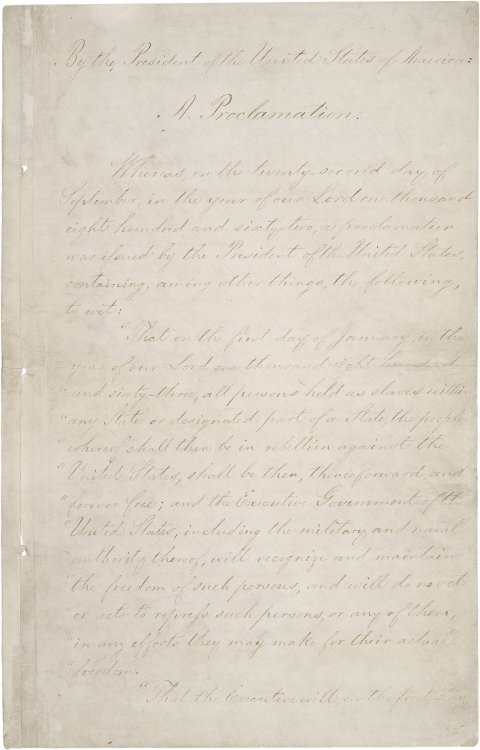
No, it does not. The XV amendment was the first to explicitly mention slavery and race in the same amendment, the connection I was referring to. The XIII does not mention race at all. The Emancipation Proclamation did not end slavery in the USA. The XIII Amendment did. Here is the text for that: No mention of race until the 15th amendment. So I don't understand your criticism. But hey, maybe you can find a mention of race within the original EP document? Here it is.
-
I agree that the emancipation proclamation did not identify blacks. However, the XV amendment does. This is just one example of an amendment that specifically mentions race in relation to a previous condition of servitude. The XIII amendment also gives congress the power to enforce the article, which led to the later legislation of XV. It's also important to note, that just because XIII does not state "black slaves" it does not change the fact that in the USA there was no legal trade of white slaves. Therefore XIII was the counter to the legal slave trade within the US, which was entirely based on race. The reason the black slave trade was viewed as legal, is because black people were viewed as not human and therefore had no human rights like white people do. XIII was essentially about classing them as human and ending the practice of slavery because it was against their rights as humans and citizens of the US. The piece you shared about the Canadian land residential school system is really interesting. An example of where the road to ruin is indeed a good intention. I don't know if I would say affirmative action is consequentially the same, too soon to tell. Ultimately the goal of affirmative action is to reach a balance where it is no longer required in some places. That being said, I can see how it can be used by some to just tip the favour away from one group to another. If that is going to happen, it probably won't for a long time and hopefully when things are at a point where they are more equitable for all involved, the brakes can be put on and equilibrium can be maintained via a minor adjustment or two here and there. Regular servicing in your vehicle analogy. As it is, we can't stop people taking race and other things into account in the negative, individually or collectively, so what makes you think we can stop it happening in the positive? If racism is rampant and hard to stamp out, won't the true be the same of it's counters and foils? Is this neutrality or apathy?
-
I'd like to hear an answer to this question too. It seems like MigL is making a deontological claim that the consequences of racism and affirmative action do not matter in determining whether or not taking certain aspects of a persons background into consideration is wrong. Basing a decision on a single factor is always bad, no matter the outcome, seems to be the claim. However we can make the same claims about only taking into account grades since they can in some respects be more of an abstraction for income disparities. In comparison, the consensus amongst others is based on consequentialist arguments, that outline that until the prejudiced have less power and control over bringing about harmful consequences for disadvantaged and neglected peoples, there has to be an affirmative action reaction to that as it's natural foil. To put the consequentialist position more clearly, if there was no affirmative action, it would not make racism disappear. Until Racism and other forms of negating actions through prejudicial discrimination cease, we cannot avoid the negative consequences of them. Which means we have to pragmatically counteract or we enter into a state of moral devolution as everyone runs away with their prejudices and biases completely unchecked. As INow pointed out earlier with the Popper intolerance paradox, to not attempt to counteract intolerance with intolerance, would be the death of tolerance. If there is no deterrent for harmful and self-harmful intolerance, then it won't ever stop and will make things worse. Wittgenstein would probably argue that the meanings of words are colored by the context they are used in. Not subjective life experiences. There are also definitions to words in ethics which have a consensus on what certain words should be taken to mean in certain contexts. At least, that is what later Wittgenstein would probably say. I'd also argue that there are words in physics, or interpretations of quantum mechanics, that are defined as coloured by the subjective experiences of the observer. The Copenhagen interpretation is one. That would be delving a little bit to deeply into the philosophy of language for this particular thread though. I'd also add that we all seem to be arguing for different moral objectivist viewpoints. On that front, I've had a realisation that the position you ought to be arguing from when it comes to affirmative action; is not to deem it as racist, but to describe what the cons or shortcomings of it are. Making people in majority and privileged groups feel alienated is definitely a con. As that could indeed cause individuals who had no racial animosity to cry foul and start to develop said animosity. That anyone should feel left out of education, is hard to swallow, that anyone should feel alienated by actions that are meant to bring more of us together, is saddening. In the end though, the type of learning environment I want, is one that has the world in it. I want to be amongst all different kinds of people from all different backgrounds. That way I am exposed to more learning. I'd find a school extremely boring and tense if there was any type of racial clique in the majority unless you're literally in a place where there is no other ethnic demographic living there, places like that are fast becoming rarer in this internationally connected world and generations upon generations of mixing and moving across the planet. I think our survival as a species depends on diversity of thought, which you can't really have with only one type of people. I probably will keep on commenting about this because I could go on and on as more people reply and share their thoughts. I appreciate everyone's continued engagement with this thread, despite the negative vibes I was putting out when I wrote the OP. Sincerely.
-
So in what way is it wrong that I said "over the last few decades"? Are you not being a bit overly pedantic? I am aware that this is a science site, however this is also within the ethics section of that site. If I am limited to only discussing science, moral psychology aside, then you're effectively asking me to put a muzzle on certain meta-ethical modalities and methodologies. I am a cosmopolitan ethicist. That requires expansive use of logic in order to relay myself as clearly as I can. However I suffer from diarrhea of the mouth at times so probably don't do myself any favours when I at times get lazy and become less precise than I mean to be. Forgive me. So long as people don't throw the baby out with the bathwater when I inevitably make mistakes. We are all here voluntarily and there have even been times where I've commented in this thread while having a beer or two. It would have been disingenuous if my argument and details hadn't been more nuanced than that. I specifically meant zero costs for mostly Scottish applicants. Obviously there is always a cost to be paid by someone for resources and man hours. However there is something to be said with how some colleges spend their funding and manage it. But I suppose you can say that anywhere. Oh and yes, I attended Scottish schools, primary, secondary and college. As I said before I was a student representative in two of those schools. In the ideal world, both. At our stage of moral development? I'd settle for the former... For now. I agree that right now, world as it is, impossible. I don't know if I'd say equality of result is impossible or possible. It certainly seems that way. I am glad you talked about equity, meaning fairness. For all my talk of equality, I feel it lies in how we apply fairness. Why I say I don't know if it is impossible, is just accounting for different criteria to meet the required educational milestones across different fields and occupations. I'm also accounting for futures where advances in educational psychology, medicine or evolutionary changes to the human physiology might make a world of equal opportunity and lets say scaled consistency in result if not equality which is silly when talking about result. I'll admit to that no problem. It is an ethical conundrum to be sure, I wouldn't say it is a dilemma as we aren't being forced to choose between two options. Ultimately the biggest issue with ethics, is that scientific experiments in that field are costly to carry out. Law is the closest we have to something which can present as experiments in ethics. Sometimes a government will decide to test out UBI or free housing but it takes time and money to do that. Moral psychology and neuropsychology are potentially on the verges of breakthroughs, if they can sort out the reproducibility problem and funding/priority issues.
-
A fair observation and I don't want to mislead people about how education works in Scotland and how it is different from England. The devolution of powers from Westminster to Hollyrood (The Scottish Parliament) powers over how education works in Scotland. In the past few decades, this has led to many rapid and different changes in law and policy. Up to and including numerous changes to grading, certification and unit names. These rapid changes left many of my generation in the middle of some of the most confusing and at times blatantly experimental education decisions. For starters, it was decided somewhere, without our consent that our specific year would sit our English standard grade exam, a year early. With no explanation. Now, Scotland offers a great deal, but offers it poorly if that makes sense. Education is free, bursaries with no obligation to repay are attainable. You can get an undergrad degree without spending a penny of your own money on your education. It is not perfect however, now I can only relay 2nd hand knowledge about a handful of Scottish higher education facilities and first hand knowledge about 3. Up to and including relevant statistics on the student body makeup and pass rate for 1 (although I could probably find the same information for most Scottish schools easily enough). I have been a student representative in highschool and college. Most of the students who needed my help, were old, disabled, black, poor, gay and there was even an addict. This was more so in college. I was doing all of this, even though I was homeless and couch surfing at this time. The sheer amount of not just alienation and discrimination but complete lack of responsibility in some of the staff was just shocking to me. Lines of communication were terrible, one person would promise to help a student only to be told by management later that they were not to, applying for funding took a long time and was removed from individuals just for attending a funeral they had informed their tutors and admin about. Faculty were often jaded, resentful and pessimistic. Due to the fact that the drop out rates were so high among those demographics because the admin seemed to just make their jobs harder. Then there is the SQA, they handle qualifications and certifications, sending out the holo signed certificates, degrees and diplomas etc. Absolute cluster fuck, priorities for them seem to be hard to pin down. Getting in contact with them is difficult but at times people have been left after sitting through college exams and courses to have nothing to show for it at the end. That all being said and so I'm not talking generally about all Scottish Schools, I can only relay my mine and others experiences within associates level courses and colleges. That and I'm emotionally close to the situation there to be completely free of bias so take what I say with a grain of salt as mine and others experiences of a few schools and may or may not apply to most of the others. Now, my intent with this discussion isn't to single out and focus on the US. It is to look at education holistically, how it operates in different places and what the pros and cons are of different approaches. I'm a cosmopolitan after all. Sometimes that will mean talking about the US Federally subsidised education and state differences. Sometimes I'll mention Scandinavian growth models. In the end, I can only talk about what people herr want to talk about. So far it's predominantly US centric but I have tried to steer the conversation a little bit at times. The thread is about barriers, not a barrier. I'm glad you asked about Scotland though I would be open to hearing about how it might work in other places. I know nothing about Asian education or the differences between Asian demographies. Same with Africa, although I hear some good things about Australia in terms of philosophy departments at least. Peter Singer for example is brilliant in my honest opinion. Maybe MigL could describe his College experience in Canada too and how it differs from now? That all being said I am limited in how much I can provide to the discussion and know less about educational science, ethics and philosophy than others. I didn't say I cannot sometimes fall into a hypocrite hole. That is the definition described to the letter that I was referring too. Blind men can't fly planes, pedos can't work around kids or not be monitered heavily in or outside prison, racists ought not to be in positions of authority when it comes to make admission decisions. Some are though, just like there are heavily biased people in those positions of authority. I agree with the sentiment that we are all the same human race, with differences in features that only really define our physical appearance, not our character. In an ideal world there would be no requirements in place that we consider ethnic demographies at all when it comes to these sorts of things. Unfortunately, prejudiced people do not play by the rules and can still make their way into these positions of authority. How do we counteract the misalignment with multiple individual drivers? That's why people who are willing to act as agents of affirmative action, to counteract the effects of their more subversive colleagues in the same field, are currently a requirement in some places that seem to be battlegrounds of racial tension, like the ivy league schools. Ultimately we share the belief that education should leave no one behind. We disagree with the modal quality of that shared value. Now, I'm willing to bet that for some schools in certain places, being managed by certain people, affirmative action is not a required policy. This means one of your ideals is possible within certain contexts. However, some places cannot legally function without out affirmative action policies due to management differences of a different set of certain individual people. Meaning in some places, without affirmative action, your ideal is not possible and the only way to get closer to it, is currently through affirmative action. However let's ask the question; what would be better than affirmative action in advancing equality of opportunity within schools at all levels for all demographics? Come on Boffins Sketch. This is me right now haha hope this lightens the mood here somewhat and gives people a laugh.
-
Also, I'm sorry I upset you MigL. I had just woken up and had not had my coffee yet. I could have been far more diplomatic.
-
I did not intend for what I said to be a straight up accusation, but a suggestion that you aren't using language effectively enough to portray what I'm sure to you feels like a good point to raise. I'm not directly attacking what you say, I'm assuming you are indeed arguing in good faith but that explaining what we are misunderstanding about your points thus far are probably creating more misunderstandings. Ethical debates are not easy, it's important to understand that it may seem like we are both only taking snippets of what the other is saying and ignoring the rest. In your defense I write a lot and it takes me a long time to write my responses. In the end people do kind of have to wade through and grab only a paragraph or two. From my perspective, because you're arguing from an obscure and hard to follow definition of racism and prejudice I have to focus on that, I'm not dismissing the rest of what you are saying. I just can't follow it without figuring out how your use of these words are being utilised within the context of the full conversation back to the OP. The best way to describe this misunderstanding I think, is to say that we are on the same game board, but one of us is playing checkers and the other is playing chess (I know INow, more chess talk, sue me!) Now, a few comments back, I made an attempt to illustrate that it is entirely possible to be acting on a prejudice without being racist. This is due to us all having biases. Implicit and explicit. By implicit I mean they can be unbeknownst to a person. We all here when it comes to racial bias, fall within the implicit bias camp. Meaning, not racist but we do have the capacity to delude ourselves when we think we are speaking from a place of care for a different racial group. Hell, Albert Schweitzer was potentially one of the most progressively minded people of his time when it came to racial disparities, but even he was paternalistic and called black people the younger siblings of white people. Still familial, but overly paternal. Implictly biased. No one here feels you are a racist MigL. On the contrary, I think you are extremely intelligent and beneficially progressive. Like me, you are human though, which means like me, you can be either wrong about something or not explaining yourself well. I do also like that although ethics and philosophy aren't your AOE, you do contribute to the discussions and hold your own. Let me ask you something, and this is something I'd really appreciate your focus on. Are all forms of discrimination wrong? Just what you believe and we won't judge you. I'll even come right out and say no. I don't think all forms of discrimination are wrong.
-
No, I'm describing holistic review and how affirmative action works. I'm falling into no trap. However your definition of racism and prejudice seem to be becoming a bit of a logic trap for you. You were the one who mentioned an imaginary scenario between two similar students who's only difference was race, I'm simply telling you that no such students exist because of the amount of things that are looked at in a holistic review admissions process. Well then if it's only to be based on academic standing, then that puts the advantage squarely back into the hands of the wealthy. Since they get more resources, extracurriculars etc than anyone else and are more likely to have stronger grades than those from the poorest families because of this. I thought you wanted to fix the vehicle? Not ignore that it needs realignment and allow it to keep veering off to the right? I also took the time to write a lot more than that but you're ignoring half of what I say then picking out little bits as if they are all I've said. Not cool. No, they should have no bearing on whether you get an education or not. Yet the prejudiced keep on taking these things into account to deny an education to many people. This happens in places where affirmative action is a joke, like Scotland. But according to you we're not allowed to fix it by acknowledging handicaps or differences in any way. The playing field is massively uneven I think this will be my last comment because I am starting to feel like you are misunderstanding and misrepresenting what I say and are trying to convince us that somehow our efforts to not discriminate are going to lead to prejudice. Who's prejudice? Will affirmative action make white people more prejudicial to black people? If so, that is weak minded and ignorant of them to do so. Just because affirmative action makes people feel a certain way, does not mean those feelings aren't justified. Produce evidence that affirmative action leads to unjustified discrimination of majority privileged groups. Until then, your feelings towards it are unjustified. There is no reverse racism going on. What does seem to be going on, is that certain groups of people get upset when you try to help other groups or right past wrongs. MigL, before you respond, please look up the concept of epistemic responsibility. If you think you are putting your point across poorly then it's best you try and refrain from commenting as it is dangerous to leave certain arguments lying around for people to misunderstand. Right now though, the people your arguments mirror, are the prejudiced. I'm sorry.
-
I do understand what you are saying, although while you are driving, the best solution to drive straight, is to compensate to the left. You can't realign the vehicle while it is moving. It's important to understand though that ultimately affirmative action is a policy that competitive schools have to utilise in some form in order to be operating within thr confines of the US constitution. The history of affirmative action is not static and neither is the form of the policy. Since the affirmative action executive order was enacted by the Kennedy administration, in regards to the workplace, it has evolved to cover medical care access and access to education. If we are equating schools to a vehicle out of alignment, then you'll probably be pleased to hear that when the vehicle is not moving (when the school is closed during holidays) policies are being revised and altered, staff are getting more training and guidance, unsuitable staff are removed and replaced. This includes affirmative action policies. Another key thing to learn, is that of the 4000 higher education institutions in the US, only a few hundred of those are highly competitive for places. If you want to argue that some schools don't need affirmative action, they agree with you, as evidenced by the fact that not all schools make use of such policies. The reverse racism argument was used in the Fisher vs University of Texas case. Fisher sued, arguing they had been refused admission because she was white, the real reason it turned out, was that at the time, Texas had a rule that the top 10% of their graduating class would be given automatic admission. Fisher was 82nd out of 674 students in her graduating class. She wasn't rejected from her first choice college because she was white, her grades were the problem. As for the scenario wherein two students, once compared and all things being equal besides race, that would require similar financial background, same age, same gender, same grades, both clinically able, both presenting themselves the same way with the same aptitudes and writing the same essay as each other, saying the same things in their interview, evoking the same feelings in staff and faculty who meet them, both not legacy students... What do you think the statistical likelihood is that such a thing can actually happen? That two applicants can mirror each other so completely that the only difference between them is their race? I very much doubt there is only one difference between two students, even if those students were twins. I've even heard of siblings getting extremely angry and vindictive toward each other because one got into the dream school and the other didn't. Affirmative action did not come into play in the case of siblings, perceived ability and presentation did. Now I'm not one to ignore evidence, but so far I've seen none that convinces me that affirmative action is just reverse racism. On the contrary, there have been plenty of legal challenges made to affirmative action, so far none have stuck, not even in the Supreme court. One thing that becomes quickly apparent when you read the case law, is that all the claims by applicants saying their chances for getting into their highly competitive dream school, destroyed by affirmative action, have all been rejected because they were simply not prepared or the competition was really fierce. They didn't get in because someone "stole their place" they never won a place to have it stolen by anyone in the first place. To be clear though, it's already been agreed by most of us here that there should be an available education for everyone that wants one. I do not doubt that people of all races, genders, ages, classes and creeds have been rejected from schools, when they do deserve an education. This goes back to the problem I identified earlier, logistics and resources. There are not enough teachers, staff, classrooms, labs, workshops or materials to go around so that everyone has equal access to education. Now, I think online education is addressing some of the problems, but you can only get so far without personal human mentorship. Another potential way of addressing problems with equal access to education, is reducing how long people spend in education before achieving certification and qualification. If undergrad was taken down to 2 years, you can have double the courses running, meaning twice the amount of places available over a 4 year period. With the technological advancements at our disposal, why should we not discuss how certain parts of education can be streamlined and delivered more quickly?
-
Even an evolutionary trait can turn out to be maladaptive or it can become that way due to other changes. Evolution is random, it's not the case that every evolution must in some way be or always be beneficial to the lifeform that evolves thar trait. You're also portraying the objective identification of biological differences as racism. Which it isn't. As an example, it wouldn't be racist of me to point out that black people are more at risk of developing sickle cell anaemia than white people, this is true. The racism would come into it if I then claimed this propensity to have an increased risk for one medical problem makes black people genetically inferior to white people. It doesn't. I also disagree with your characterisation that race is the primary deciding factor of whether or not someone is given a place in college. Sometimes it may come down to deciding on race, but that isn't racism in and of itself and is being considered relevant for the purposes of fighting the history of intolerance black people have been subjected to. As I side earlier, the reason that we even have to pick and choose who gets a place in higher education is a logistical problem that would need to be overcome in order to not have to do that. As it is, if the student body demographies do not approach percentages more in line with the actual demographic makeups of the locations the schools are based, that is a but of a tell-tale sign that things are not equal. It really would and I do appreciate your advocacy for other viewpoints and perspectives. It should be clear that I disagree with the looting and protesting, I think it's not helpful to the plight of black people and it made a lot of people have negative feelings toward BLM. That being said, it happened and I cannot change that. When we ask the question; how can we avoid it happening again? I get the feeling that cracking down on the black community harder and the efforts made by the administration to demonise, attack and generalise peaceful protesters as radical anarchist rioters probably isn't the best strategy to use when actually trying to de-escalate. So targeted reparations are racist? Acting in a way to seek forgiveness by acknowledging past wrongs, is wrong? Maybe we should all just be colour blind and pretend that we don't see any differences between one another at all? It is how we act, when faced with difference that defines whether or not we are acting in a good way. Pretending not to see the difference is just apathy. Yes, we do execute murderers. It's called Capital punishment. That's becoming rarer now and mostly we just lock them up. Stealing time from them for stealing all the time of another. We take away freedom and time from caught thieves, money too. The eye for an eye line refers to revenge, justice is not about revenge. It's about deterrence, punishment and reformation. Making the punishment, fit the crime. I'm a little confused at to what conclusions you are making about affirmative action, racism and race. If we were to go with what appears to be your definition, then we've all been very racist in the conversation ourselves. Is that what you're trying to say?
-
The day I first started commenting here was probably when it started! Thank you though. You don't give out compliments often, so I do appreciate it quite a bit.
-
Can I take offense to that? I'm in that last demographic. I don't feel offended at all really, but reductio ad absurdum is fun. That's exactly the sort of thing I'd expect to hear from one of you Z people, he said in mock offense. Yet actions are also based on morality. I'm glad you brought up antagonism. Let's say the killing of George Floyd was an antagonistic act, which it probably was whether racist intent comes into play or not. Were the protests and at times riots that happened afterward also antagonistic or were they reactionary to a prior antagonism? I actually much prefer talking about class but then maybe that is because talking about race makes us all feel uncomfortable. I think we can all acknowledge here that racism does in fact exist and it is a major problem and can be a barrier to education, for everyone. As it can be a barrier to financial security. When we are talking about discrimination, there are two kinds worth mentioning. Implicit and explicit. When we discuss racism, we are discussing racial in-group biases specifically. This I feel, is where a lot of misunderstanding and poor use of language on both sides can make things a lot worse. We as a species have a habit of forming a dynamic multiplicity of in-group biases, implicitly and explicitly. What this means in legal terms, is that bias is a cause of the act of discrimination. It can be implicit or explicit, direct or indirect. To me, this means that not all who are guilty of racial discrimination or any other form of discrimination, are guilty of malicious prejudice or racism. Every human has biases to overcome and it is no easy thing, as it means admitting that you are flawed. Some people would rather die than face the truth that they or someone they idolise, can in fact be flawed. The best way to think about affirmative action, is to consider the social model of disability, wherein people are viewed as disabled by external environment. This means that with reasonable adjustments, a disabled person can be made just as able as everyone else. Affirmative action is just recognising the disparities between social mobility between different groups and building a ramp to those that need a ramp instead of making them walk upstairs. At least that is what affirmative action should be like, the ramp comparison isn't meant to call anyone disabled because of their colour and is just a metaphor. Now, one concept that is often discussed within education is the idea of universally inclusive and beneficial, structural changes to the learning experience and environment. Universal enrichment. An example of this can be anything from a ramp, to an app that teaches kids facial expressions, originally designed for autistic children but found to also be a useful tool for teaching their peers about body language in universally inclusive classrooms. One of the current barriers where class is concerned, is internet access. Due to covid, online learning is completely inaccessible to the poorest households. So maybe we should move on from race and discuss the financial and logistical barriers that does not currently allow for their to be a good quality education for everyone who wants one. I think we can probably all agree, that a world where there is a good quality education, available to everyone who wants one, is something that would eliminate the need for affirmative action in the first place. Even where higher education is subsidised or "free" like in Scotland, there are only so many places on every course offered by colleges and universities. Of those courses, not all of them are universally inclusive in setting, format, method, philosophy or individual staffing choices. At this point I'm probably rambling but this is something that really matters to me. It's extremely important to have discussions like these where we state an ideal, and ask how we can achieve it. What does the ideal school system look like and how do we get closer to that ideal?
-
How many different barriers have we discussed now? A fair few it seems. How do people feel about the growth models of Scandinavian schools vs the proficiency models in the US and UK? As just a few examples as I'm less familiar with the systems of other places, although I can also teach a little bit about the history of the development of primary education in New Lanark a few centuries ago. This question is more about the underlying philosophies of education, the modal form they take and the pros and cons of the differing approaches. Just thought I'd tag to ask if you've ever visited New Lanark yourself auld yin? The grandkids would love the schoolroom there. It's a really good Scottish Heritage site!