
joigus
Senior Members
-
Joined
Everything posted by joigus
-
I'm assuming you mean Alice and Bob are at different points in the same inertial frame? @Eise introduced a reference to a paper in which the detectors are moving, which would correspond to what you're saying literally. The conclusion seems to be that the projection postulate is weakened by the results. Let me go back to Alice and Bob being distant, but in the same state of motion. Both Alice and Bob tell nothing to each other about what polarisation direction they're going to measure (that way we guarantee that nothing physical is getting through.) If either Bob or Alice told the other one what they're gonna do, and they can trust each other, that's another matter. You can even bring to the problem whether Alice trusts Bob --or viceversa. That's nothing to do with the physics of it. And I'll be "brutally" clear: Can a woman ever trust a man? --if you will. Alice measures Sx (x-projection of spin.) It produces +. Question: What can she tell from that? Answer (think about it, @bangstrom😞 Nothing: Zilch, nothing at all, überhaupt nichts, nada, nada, pues nada. What has Bob measured? I don't know. In fact, I don't trust him. What has Bob obtained as a result of his measurement? I haven't the faintest idea. In a nutshell: Alice needs infinitely many experiments to --at least-- know Bob has (even!!!) performed a measurement. In fact --I can argue this-- she cant can only tell --after an eternity-- precisely what component of spin Bob has measured. I'm not sure I'm answering your question, @MigL. (My emphasis.) Truly ignorance is bold and knowledge is reserved --Thucydides. That's all I have to say to your suggesting I'm a novice and you're the "expert" explaining to me how this all works. I told you I don't know many details of TIQM --I'm not particularly interested in it--, but building up some makeshift acquaintance with it in order to rebut your WAG assumptions is certainly not much of a challenge. Here: From: https://en.wikipedia.org/wiki/Transactional_interpretation The wave function: W-A-V-E F-U-N-C-T-I-O-N. AFAIK, TIQM is for electrons, protons, neutrons... Any particle that, for some regime, satisfies the Schrödinger equation. It is not a theory of light. It basically purports to be a theory of electrons and the like. I don't think anybody has tried to apply it to anything other than semi-qualitative discussions of quantum paradoxes. Photons are dealt with, not with quantum mechanics, but with quantum field theory. The WF theory, OTOH, is a theory of half-advanced, half-retarded classical EM fields, the electrons being classical relativistic particles. It is, therefore, a field theory of light. I forget whether it allows you to give any meaning to radiation reaction and electron self-energy. I think you put it by hand. Am I right? You tell me, you're the expert!! 🤣 QFT is a theory reminiscent of the WF theory in that you have the amplitudes half-advanced, half-retarded, but for all fields: matter fields, and radiation fields. In every one of these theories, you need to impose boundary conditions to the waves, so the resulting wave is relativistic-causality-compliant and, of course, propagates locally. In none of these theories could you have, eg, a spherically symmetric solution purely sourcing into (instead of out of) a point. Can you do that with any of them without violating the boundary conditions? Here, boundary conditions all over it, FYI: Again from: https://en.wikipedia.org/wiki/Transactional_interpretation And all known conservation laws are local --continuity equation. If they're talking about conservation of momentum, energy, and angular momentum and probability density, then it's local to the bone. You're very likely disgracing a theory that's probably much more serious than you make it look. Now, I can see very easily where you get confused. It's easy if you're clueless about the maths and just follow the words. More from https://en.wikipedia.org/wiki/Transactional_interpretation: (My emphasis.) Wow! So it is non-local. Or is it? @bangstrom wants it badly, for some reason, but no. Hold your horses Mr. "expert." What do you find when you click on the magic words "non-local"? (Wikipedia again) This: Which, as discussed ad nauseam, is only because quantum mechanics is essentially, undoubtedly, unmistakably non-realistic. Not because it is non-local in any way. You keep getting starry-eyed by these words "non-local." Do you not understand the implications of the Kochen-Specker theorem? (Rhetorical question.) QM is local. Gell-Mann has told you so. Feynman has told you so. Coleman has told you so. Zeilinger has told you that he prefers "non-realistic" to "non-local" --thanks to @Eise Hossenfelder has told you so. Swansont has told you so. MigL has told you so. Eise has told you so. I have told you so. Take care, Joigus
-
TIQM is not a theory of light. WF theory is. QFT is not. This one (again): You said, It isn't EM, and Cramer calls it a transaction. Oh. What the hell is it? Will you finally stop talking about what it is not or how some people call it, come clean, and tell us what it is?
-
This is based on TIQM, which you have declared yourself not to believe in before. Solutions to any wave theory based on advanced waves establish boundary conditions that guarantee that no signal can be "advanced" when everything is said and done. WF theory: absorber at infinity; QFT: Feynman-Stueckelberg propagator that guarantees fields commute or anti-commute at space-like intervals. I don't know TIQM in detail, but I'm sure it imposes boundary conditions to guarantee relativistic causality. Otherwise it would go directly into the trash can. You're clutching at straws just in order not to answer to an embarrasing question. At what point will you be done with the stubborn denial of an experimental fact?
-
Wrong. Wrong. Obscure at the very least. Not very meaningful. Totally meaningless. Could you, at least, answer Swansont's question, please?
-
So you're proposing they do, what, 100000? sequential measurements, to check that particle after particle that were, what, 500 miles away of each other?... are "decohering" with each other(!!!???) so there is no interference pattern? What are you measuring that decoherence against? After many hours have passed you conclude every time something instantaneous must have happened every single time? Decoherence can be checked for components of the wave function that hit on pretty mutually close spots of a screen. It's a property of collectivities of particles, not of pairs of particles. How do you check 500-mile-away wave functions must have decohered? How do you prove interfering patterns are lost between things that are, by now, 500 miles away? You clearly don't understand what decoherence is about. Particles don't decohere with each other. That makes no sense. The quantum state decoheres with itself, like in the double-slit experiment. The statistics of many experiments tell you that.
-
Exactly. Zeilinger is pointing to a widespread confusion. Zeilinger's choice of words is "eerie." Clear symptom that he's not enamoured of the idea. I must say that, even today, some physicists dare not speak out about this, or very openly at all, and choose to sprinkle their language with words like "somehow," "seems like," "said to be," etc.
-
No. Your statement is logically fallacious: https://en.wikipedia.org/wiki/Begging_the_question Sorry, I thought you knew what "begging the question" means. It means you're asking to concede precisely the point that is under scrutiny. Example: Freedom of the press is one of the most important hallmarks of a modern, open society because modern, open societies value the ability of the press to report what’s happening. I hope it's clear why your misunderstanding of "begging the question" makes this discussion very difficult. If you're allowed to stick to one word, and you claim the right to repeat its use by decoupling it into different wordings of it, loosely synonymous, then it's never gonna end. Once your premises are stripped to their bare minimum, you will be going like this: I meant by non-locality what I meant by non-locality. Why? Quantum non-locality. That's the one I mean. And by "interaction" I mean what I mean by "interaction." Not a satisfactory logical posture, is it?
-
Here's the sloppiness and ambiguous language again. The observation is not random, it's a choice. The outcome is random. Now, "random" doesn't mean anything much. What kind of "random"? What probability distribution?: The average is zero. =0 The dispersion is maximal. = 1/2 (equally likely to get +1/2 or -1/2.) OK? This is called begging the question. I could let you off with a warning but, hey. No. Start again, please.
-
Ah, OK. Thanks both. Here's what I've found: And then, The second one didn't improve the search much in this case, because it returns all posts where the member is a contributor, it seems. Clicking topics was enough.


-
Thanks a lot, @studiot. I was wondering if you can filter further from that. Like "content started by." Do you happen to know of any way to do that?
-
Yes, according to Hossenfelder. http://backreaction.blogspot.com/2021/09/the-physics-anomaly-no-one-talks-about.html Thinking about neutrinos again... Could it be that very heavy leptons corresponding to an extended family of flavours were copiously produced in early stages of the universe, but decayed so long ago there are no traces of them to be found? Being very massive, they could be out of reach in laboratories. But their flavours would still be there, potentially explaining the anomaly, and their slight masses accounting for dark matter.
-
Hello. Is there any way to look up for content started by a particular user? Thanks in advance.
-
Not exactly. It has to do with an expansion of the classical EM field away from the sources that are not point-like (charges and currents.) Look, eg, at the field from a dipole antenna: https://en.wikipedia.org/wiki/Dipole_antenna It falls off as 1/r with the distance. Neutrinos are a completely different matter. There is no way that you can study neutrinos with a classical approximation, as you can do with EM field. They have spin 1/2. They are always highly relativistic. They're always left-handed. They change flavour ever so slightly. So, as you get away from their source, an electron neutrino mutates into a muon neutrino, and so on... They're very quirky on a series of levels. Anomalous deviations from predictions of the standard model being one of them. Here's a quick but high-quality low-down of the whole thing: And there certainly isn't a multipolar expansion for the neutrino field, as it has no sources. It sources itself, so to speak. You can have quantum wave functions --I suppose-- serve as analogues of radiation from a source point by, eg, having them diffract from a narrow window... Non-linearity may be very important in many, many contexts. GR is certainly non-linear. It's important from the start in the strong interactions. Even in QED you have non-linear effects of sorts, because at very high energies, photons can scatter off each other. But one has to be very careful stating in what precise sense one's talking about non-linear effects.
-
Referring to, (My emphasis on both.) Thank you: It's so nice to have such attentive and deep-thinking readers on this thread. I'll let @Eise, @swansont and yourself (+1) do all the conceptual clearing up from now on, as long as the point gets across. My word, you folks really are no-nonsense thinkers. I'll gladly accept the humble role of "finessing up" the points to make them more and more obscure, which is my thing, from the looks of it.
-
Multipolar expansions of the field: 1/r: radiation, as wide-range as you can get, without getting into GR. 1/r2: monopolar, narrower-range 1/r3: dipolar, even narrower ... Van der Waals (Casimir effect,) etc. You said "spin." Don't look now, but that's quantum, in a way that cannot even be thought of as classical.
-
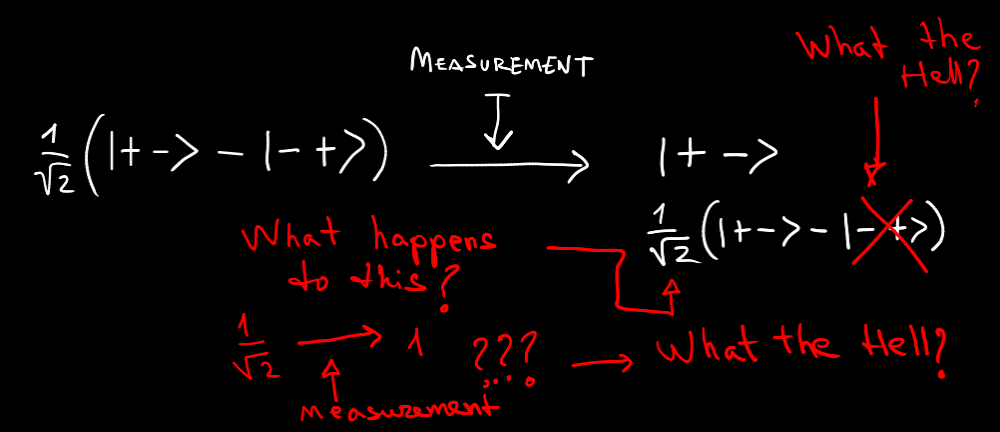
Hold that thought, please. That is the heart and soul of the problem. I'm hoping by Hannukah/Christmas we will all be able to agree on a common ground. Where do classical data come from in the formalism of QM? Bell's theorem --and its extensions-- tell us that if you want some "internal classical data, mutually-commuting hidden variables" to be able to hold the information that corresponds to the eigenvalues we later measure, all along, while the quantum state is propagating, they would have to implement that non-locally. So what happens when we actually perform a measurement? The environment-chosen, einselected in Zurek's parlance, data have to be implemented in the quantum state in a way that's nothing to do with QM (the Schrödinger equation.) That would be non-local. That's what quantum-teleportation people call "classical data." So, when you say, You got it backwards. It's the components of the quantum state that have been experimentally discarded that must die now => They non-locally disappear. They must magically slip out of existence. Schematically: Because you can never measure anything concerning something that --following Copenhagen's old-school-- slipped out of existence, and because your fancy-schmancy quantum state was never an observable in the first place. How can you tell? This cross-out red scribble is all there is to your "non-local interaction." Of course, there's presumably nothing of the kind. I must acknoledge I'm confused by the word "contextual" in KS-theorem. I will have to take a deeper look at that, and your help will be much appreciated. What I know about it is that, for dim > 2 in space of quantum systems, you can actually build 3 mutually commuting operators --thereby compatible observables--, such that their expected values constitute an algebra closed under addition and multiplication: <ABC> = <A><B><C> <A+B+C> = <A>+<B>+<C> From this critical dimension of 3 upwards, you cannot obtain these averages over commuting (classical, sharply-defined, yes-no, etc) hidden variables: A(v), B(v), C(v). How that tells you something about the context, your guess is as good as mine. I tend to see it as "ontological." You cannot obtain them except for certain judicious choices of A, B, C, that is. Bell's flavour all over it.
-
This is not true. I think I was the first to mention the no-communication theorem. It deals with quantum-mechanical states. Period. In the mathematical formalism of quantum mechanics, how do finite sums and products introduce non-locality? IOW, how would the continuity equation be violated, how would the Lagrangian contain an unbounded order of spatial derivatives? IOW, how would any coupling of any form relating \( \varphi_{1}\left( x \right) \) and \( \varphi_{2}\left( x+a \right) \) be justified in the Lagrangian, or the Hamiltonian?
-
Exactly. They've experimentally proven the completely local non-reality of quantum mechanics.
-
Yes, it's come up on that thread. Thank you. We're now discussing how this does not imply that there's no locality, as you say. There's only one die-hard non-localist, I believe.
-
Don't forget the Monty Python version, which is sermon on the mount + noise. Blessed be the cheesemakers. And why not?
-
Wrong! Did you read what I wrote? I hate to write the same thing 100 times. Sorry. Your comment was previous to my comments.
-
I already have, plus I have accepted @Eise's definition as good enough, as a sacrifice in order to reach a minimal common entendre here. For better or worse --for worse is more like it-- I will have to avoid resorting to mathematics. I will use pictures, plus reference to mathematical symbols. Are you OK with that? Careful here, because an equation can be perfectly local, while violate relativistic causality. Non-local => Relativistic causality is violated But, Relativistic causality is violated =/=> Non-local In words: "relativistic causality being violated does not imply non-locality. Non-locality would be much, much, much, incommensurably much worse. And I'm telling you this knowing full well that relativistic causality is considered sacred by most physicists post-Einstein. It would imply that --in certain simple contexts-- you could make "something" instantly disappear "here," and at the same time appear "there." If you accept this standard, we can go on. If not... Well, the best I can do is recommend you to go back to intermediate physics books and learn about it: Local conservation of charge density, angular-momentum density, probability density (QM), energy, etc. You may well ask: Is it the probability amplitude that's disappearing "here" and appearing "there" instantly? We can tackle that question if you want.
-
More comments: You can't solve the dynamics, energy splittings, etc. of internal electrons with the non-relativistic Schrödinger equation. You have to use the Dirac equation and do an expansion series with different relativistic corrections, like the Darwin term, mass-velocity term, etc. If it has many electrons, you really have to go to a whole different level, with the Slater method, etc. So it's more complicated than you want it to be.
-
What do you mean "more canonical"? Something is either canonical or it isn't. You can't be more presidential than being a president. Here it is. I seem to be right about this: https://physics.stackexchange.com/questions/20187/how-fast-do-electrons-travel-in-an-atomic-orbital According to Andrew Steane, Oxford Physics professor.
-
The KG equation does not represent electron clouds. It represents the dynamics of creation/annihilation of charged/neutral, as the case may be, spin-zero particles, as @Markus Hanke told you. Very internal electrons might. I'm not sure about that now, but I'd expect them to have a sizable fraction of the speed of light as expected value.