
Ghideon
Senior Members
-
Joined
Everything posted by Ghideon
-
That seems to be an incorrect application or interpretation of the formula. Maybe you could try asking a question instead? For instance something like "Does Newtonian physics predict any behaviour, for instance acceleration, for massless objects?" or "Does the formula F=ma work for massless objects such as photons? "
-
How does your model explain the observed behaviour of gravitational waves? For instance the observation of a cosmic event* in both gravitational waves and light. Such observations are predicted by general relativity and as far as I know adds observational evidence in support of the theory. *) Example: https://www.ligo.caltech.edu/page/press-release-gw170817
-
As far as I know this forum is focused on mainstream science; forum members may provide arguments backed up by established mainstream theories without providing all the underlaying supporting evidence, observations and mathematics of the mainstream theory. Note that rules does not prevent a member from presenting material that goes against the mainstream and in this case the member has to provide supportive evidence. Example: Conservation of momentum may be used in an argument about mechanics without detailed explanation and evidence how and why momentum is conserved in physics. If a member argues in favour for a reactionless drive that breaks the conservation of momentum then the member is free to do so as long as a model and supportive evidence is presented. Example: Material that was speculative at one time may not be so at a later time. Had I posted an idea about a database structure that allows full trust in the decentralized and distributed public transaction ledger it would probably have been suitable for the speculations section if I posted it in 2001. Today, when blockchain is an established technique, it may be discussed in the mainstream sections. Note: I assume discussion is done good faith in the above examples.
-
Quick try at a different approach:
-
There seems to be contradictions in your reasoning. Per your argument "the Singularity" does not exist, only some approximation of it.
-
I was hoping for some reference to a scientific paper or text book. That could help finding where any misconceptions or misinterpretations come from. The context = your topic, the whole thread. You only mention length contraction. At high relative velocities, where length contraction is not negligible, relativistic effects has to be taken into account also when calculating kinetic energy (or momentum). If you have a setting where length contraction large enough to have an impact then you should not use newtonian physics for kinetic energy and momentum, it will result in wrong predictions.
-
Why do you speak of only length contraction and never mentioning time dilation in this context? Can you support that claim with a reference to relativity? From the point of view of the passengers on the train they, and the train, are not moving. And from the same point of view (the passengers on the train) an object in the trains path will appear to be moving towards the train and strike the train.
-
Doubt is part of science as far as I know; how do you falsify your idea? Just curious; what does "lost orbit" in your idea mean and how would it happen?
-
Ok: The above text then becomes: "There is no physical speed or movement of any sort in General Relativity. Frame of reference has no physical meaning; it can not change anything." That can't possibly be correct?
-
Then there is also an equal and opposite force inside the box. The forces cancel each other and there is no thrust. A rocket accelerates ejected mass by some force F and the equal and opposite force from the ejected mass on the rocket accelerates the rocket. The system consisting of ejected mass + the rocket conserves momentum. In your case there is nothing ejected and no interaction with anything outside of the box; conservation of momentum means the center of mass of the box can't accelerate no matter how it is internally composed. Quick note on the initial question: The problem is finding a scientific theory that allows a reactionless drive and explains how it operates; it is impossible according to currently known physics. But scientifically performed tests that verifies the drive and a theory would probably be worth a Nobel prize, that would solve issues with money I guess.
-
If the walls have enough thickness or suitable material so that there is absolutely no interaction with the outside, is the drive still working? Also please have a look at my post regarding Newton above, feel free to ask questions if if is unclear.
-
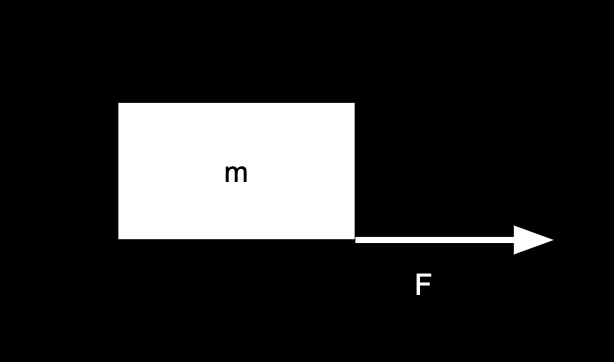
No problem, we can do a simple analysis without those details! Here is a simple illustration. The white box contains the thruster and it's power source*. For further simplification the box is put into space far from any gravitational forces; no external force acts on the box. We can then neglect friction, gravitation, strain due to cables etc. According to Newton the box motion is described by the equation F=ma where F is an external force acting on the box, m is the mass and a is acceleration. If I understand your claim correctly the thruster inside the box will, in this scenario, accelerate the box? According to Newton if the external force is F=0 it follows that a=0 and the center of mass of the box will not move, no matter how the internals of the box and the internal forces are organised. This simplified picture assumes that the box is ideally sealed; there is no exhaust**, radiation or any other interaction. The description implies new physics beyond what is currently known. *) Assuming the thruster requires electricity the box contains a large enough battery fo a short test. We do not need to go into any engineering issues for that at this time. **) An exhaust implies it works as a rocket
-
Ok! Thanks for clarifying. Can you write the basic equations of motion for the system? If I understan it correctly there is a device (trolley + thruster) that accelerates (acceleration a>0) without external force (Force F=0). If the device has mass m that means that equation F=ma does not hold. Please clarify if I've misinterpreted the setup. A picture may help, no need to expose the internals of the device, just a box showing it in isolation and what force (if any) that ar involved.
-
As far as I can tell your description also applies to an electric car or an electric train. If that is true then there is (1) an error in the measurement, (2) some external force not accounted for or, far less likely, (3) new physics on a very fundamental level. There needs to be a lot of evidence to consider the 3rd alternative. That explanation seem incompatible with the laws of physics; Newton's laws does not allow that to happen.
-
The article I quoted was a clarification of a common misconception Your opening post is about missing baryon problem. Because solving missing baryon problem means finding the baryons in standard Lambda-CDM model of cosmology, where the total mass–energy of the universe contains 5% ordinary matter and energy. Thus, dark energy plus dark matter constitute the other 95% of total mass–energy content. As far as I can tell your article speaks of missing pieces of the 5%. That means your speculation/discussion about dark matter does not apply to the results in the article.
-
I used Gravity Simulator available at testtubegames .com*, it did not require me to download anything or do a registration. Google for "gravitation simulation online" or "Gravity simulator sandbox online" for various alternatives. That is not possible in these kind of simulations as far as I know since celestial bodies will always mutually attract one another. It sounds like you wish to try something else than gravity; if so you may require a custom model. *) Disclaimer: I have not done any check of the quality of this site or used any other content than the simulator.
-
Not sure I understand but here is a quick simulation I created using an online tool, It's purpose is to briefly illustrate the dynamics mentioned by other members. There are three stars of identical mass; the top one having two planets to illustrate a "solar system" and the bottom two stars are acting as "gravity wells". Initially the planets are moving while the three stars are at rest relative to one another. Note that the system is not stable. Also note that this is not an attempt at presenting a realistic or existing configuration of celestial bodies. clip3.mp4 In this specific case one planet is ejected from the system while the other is beginning to orbit around one of the gravity wells. A small change in initial setting would have impact on the system's development.
-
I think it is so vaguely written that it may be interpreted the other way around in some cases? If external radiation is entering a black hole or some other body the radiation is never re-emitted from then a tiny amount of energy/mass is added and hence there is a tiny increase in gravity. Note! My note is not intended to add credit to the opening post or invalidate @Phi for All's analysis, it's meant to highlight how rigorous language and models are required in science. Something OP seems to miss.
-
The security of RSA relies on the practical difficulty of factoring the product of two large prime numbers, the "factoring problem". So far this thread does not contain any intelligible description of a new method for factorisation and certainly no improvements over the current state of the art methods. No-one seems to understand your approach towards factoring but still there are several members that have explained why it can not work. Five pages into the discussion I’m pretty confident that there will never be any useful description provided. Equations and associated claims have been dismissed by simple counter examples. The result is that my current level of confidence in RSA is not changed by anything provided in this thread and my best guess is that my opinion is shared by a. wast majority of users of RSA encryption.
-
That is a different question, not related to system of units. If I, the designer, was located somewhere where gravitation is different than on earth it would not affect the design of a space probe; the design would be determined by the space probe mission and not my location. If the space probe would be operating on a planet with different gravitation than earth that would have an effect on the design. I have not studied space probe design enough to have any detailed opinion how to design for a planet more massive than earth but intuitively it would be more difficult to land softly and harder to launch into space from the planet's surface. I would have to take that into account when planning the mission, its objectives and designing the probe and other systems. And in all the cases above I would use our current system of units (metric or imperial but not a mix of them).
-
Maxwell's electromagnetic wave equation: 1865. Max Planck's solution to the black-body radiation problem: 1900 Einstein's explanation for the photoelectric effect, that light is composed of individual packets of energy called photons: 1905 Dirac using first-order perturbation theory to explain the phenomenon of spontaneous emission: 1927 (emphasis mine) What does "just as" mean, for instance when transmitter and receiver are separated by some distance? Are you suggesting a replacement for relativity, information exchange at infinite velocity, something else? https://archive.org/details/dynamicaltheoryo00maxw/ https://en.wikipedia.org/wiki/Quantum_mechanics http://myweb.rz.uni-augsburg.de/~eckern/adp/history/einstein-papers/1905_17_132-148.pdf https://en.wikipedia.org/wiki/Quantum_field_theory
-
Yes it does. That's one reason I prefer to use a particle model* when that model predicts how light behaves. You seem to move backwars; trying to use older models even when they fail to match observations . Why? *) And of course I would use a wave model when that is appropriate. And to explain for instance the phenomenon of spontaneous emission I would study quantum electrodynamics and fields rather than the earlier models.
-
Did you miss that in the linked article, and in your quote, Hossenfelder uses "particle" when appropriate? (And also "wave" when appropriate.) If Hossenfelder calls the photon a particle in those circumstances where light is best modelled as a particle, that’s good enough for me.
-
The photo electric effect is one example. The experimental results disagree with classical electromagnetism. Continuous light waves, according to the classical electromagnetism, transfer energy to electrons, which would then be emitted when they accumulate enough energy. Study of the photoelectric effect led to important steps in understanding the quantum nature of light and electrons and influenced the formation of the concept of wave–particle duality.* As far as I know Planck and Einstein got one Nobel prize each for their contributions regarding properties of light that the wave model failed correctly to predict. If you disagree with the mainstream science, Plank, Einstein and the Nobel committee's decision feel free to provide an alternative explanation. *) See https://en.wikipedia.org/wiki/Photoelectric_effect and references from that page.
-
Because some of the properties of light and some interactions between light and matter can't be explained by treating light as a wave. Planck* got a Nobel prize for his discovery that energy (an hence light) is quantised: "in recognition of the services he rendered to the advancement of Physics by his discovery of energy quanta."**) *) Not Plank **) https://www.nobelprize.org/prizes/physics/1918/summary/