exchemist
Senior Members
-
Joined
-
Last visited
Everything posted by exchemist
-
This sounds like pompous bullshit to me, but I’m not a medical expert. Who are the authors?
-
I remember reading that it is a myth that you would be spaghettified. I think.
-
I was amused to see that Sam Bankrun-Fraud also went in for this TESCREAL crap.😁
-
I’m now fairly convinced his entire exercise is begging the question by assuming at the outset the truth of the proposition he wants to prove.
-
Changing the model is exactly what is being pursued, both through MOND and through extensions to particle physics. Waving your hands with woolly notions of some time lag phenomenon that you have not even described coherently, let alone modelled mathematically, does not really help. What, exactly, are you proposing, please? Describe it clearly and show how the rotation curves can thereby be accounted for.
-
Reported as spam.
-
But none of the processes you mention suddenly change the amount of mass/energy present. So there will not be any sudden change in the gravitational field to propagate outward at c. You can certainly get gravitational waves of course, due to large masses in relative motion, and waves these propagate at c, but the effect of them is very small. No one has been able to attribute the anomalous rotation curves of galaxies to any such effect. If you think otherwise it is up to you do the maths to show what all these astronomers have missed, not just wave your hands.
-
White noise conveys no information.
-
Your alien scenario is not possible in reality though. Mass and energy can be interconverted but their gravitational effect is the same. There is no known mechanism by which gravity can be suddenly switched off, reduced or increased.
-
No, virtual particles appearing and disappearing is a random process. It does not signify any kind of information: it's white noise, if you like. There's nothing "encoded" there.
-
Oh I see. well, Doppler shift gives you a fix on the speed towards or away from you, and you can presumably do that using 2 points on opposite sides of the galaxy that are roughly equidistant from you, so the light you are using came from the galaxy at roughly the same point in time, i.e. when the galaxy was the same age. As for gravity, it is only changes in the gravitational field which propagate at the speed of light. So since the mass stays pretty constant, the field won't be changing significantly.
-
There's an article here, from a couple of years ago so largely pre-AI, about Yanis Varoufakis's concept of "technofeudalism". Personally I can't really follow his own exposition of this very well, as it tends to be dressed up in Marxist gobbledegook, but this article explains the idea: https://www.abc.net.au/news/2023-11-05/what-is-technofeudalism-and-are-we-living-under-it/103062936 I quote the passage that struck me most forcefully: Ethics Centre Fellow Gwilym David Blunt said policy makers need to do more to hold tech billionaires, such as Jeff Bezos, Elon Musk and Mark Zuckerberg, accountable. "The curious thing about these people is that you often find the term "libertarian" associated with [them]," Dr Blunt said. "But they're not libertarians, they're very much authoritarians, they're not interested in freedom for everyone. They're interested in themselves from over-regulation — they're overlords, wanting to be free of constraint like feudal overlords of the past as divine right of kings." Dr Blunt warns that society is too wedded to cloud technology, in a way that only rewards the tech billionaires. "They view themselves arbitrarily as geniuses [and] we are buying into it one click at a time, affirming their power," Dr Blunt said. Dr Blunt said that we give online marketplaces "the power to shape our desires" by agreeing to their "terms of social cooperation".Blunt argues that these algorithms are shaping the way we interact with each other which ultimately erodes democracy. "All these things are shaping the way we interact with each other and there's no accountability," he said."Power is slowly centralising in the hands of a few people … this is crushing the bases of democratic society, because we are creating a hyper-concentrated source of economic power that can't be checked by the state because it's transnational." I think this expresses the discomfort a lot of us feel about Amazon, Google, Meta etc, and the more general move to providing more and more products and services on-line by faceless organisations that are hard - or impossible - to contact in the event of problems and which are increasingly pervasive, monopolistic and manipulative.
-
Not in the least. That axiom is a mere assertion, made by your AI. The inexorable link you seek to establish between reason and causality seems to me to be an example of question-begging. You are assuming at the start the thing you wish to prove. If we start with a different axiom, viz. that not all events in nature need to have a direct cause, then the resulting chain of reasoning would be quite different, but would still be reasoning. And that is the assumption implicit in QM. People have evidently been able to reason perfectly well on that basis (using non-commuting operators, Fourier transform relationships and so on).
-
I think there is a lot of hype around AI. It has the smell to me of the dotcom bubble about it: guys like Sam Alt-Right trying to talk up his own share price. I doubt it will replace half the jobs the proponents claim. So from that viewpoint it may turn out to be socially manageable. I see the main dangers as being those I indicated in my previous post: contamination of public knowledge with rubbish, further encouragement of extreme politics and conspiracy theories, and psychological harm from giving people even more temptations to spend time on-line alone. (I read a report in the FT last year that 25% of British teenage girls have had some kind of contact with medical services over mental health issues by the time they are 21. And that's before AI hit the scene.) In my opinion on-line social media are largely responsible for the threats to democracy from populist extremism that we see all around the world, because of their algorithms' tendency to give people more of they already see and spread shallow, one-sided or simply false material. LLMs have the potential to make this worse, as they too are programmed to ingratiate themselves with the user by giving people what confirms them in their opinions. And they do so with seeming authority, because....well, it's AI so it must be right. I really think society needs to wake up to the damage being done by the internet. AI will turbocharge that.
-
That does not address @swansont ’s point about axioms, though.
-
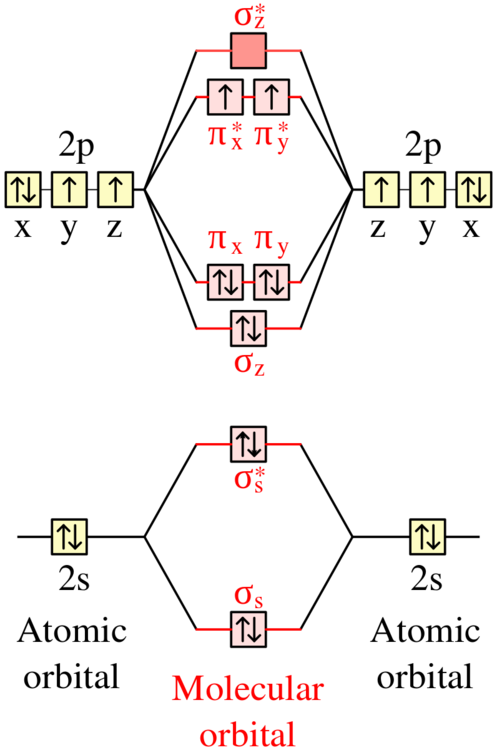
I always think it helps to see an energy level diagram for this. Here is diatomic oxygen: You can see that 3 out of the 4 p electrons on each atom contribute to one σ bond and two π bonds. This would make a triple bond, BUT for the fact that there are still 2 p electrons left over. These go into the next lowest energy vacant orbital which is π*, antibonding. There are two of these of equal energy, so they can occupy both singly, as that will minimise their mutual electrostatic repulsion. So you end up with a double bond (because the π* cancels one of them out) and 2 unpaired electrons, which makes the molecule paramagnetic. In the case of nitrogen those extra electrons are not present, so diatomic nitrogen does indeed have a triple bond - and is diamagnetic, having no unpaired electrons.
-
How would you see information being "encoded" in a vacuum?
-
How can you have a product of information? Unless you just mean more information.
-
Why does this matter? Sure, when we see light from a distant galaxy it was emitted in the past but there is, so far as I am aware, no suggestion the rotational behaviour of any given one is different from others at different distances, i.e. seen at different stages of the evolution of the cosmos. That being so, there is no evidence that the laws of physics have changed over time. So the problem of dark matter remains one to be solved on the basis of present day physics. Isn't it? Why then would the time the light was emitted be important?
-
This variability in quality of LLM AI may be part of the trouble. Ordinary people simply won't know which ones are considered more reliable and which ones are dodgy. Especially as various platforms have their own in-house or chosen AI, to which users are directed by default. I suppose eventually a body of lay knowledge may grow up that enables the public to discriminate between them, but right now it seems to be a Wild West in which nobody knows, apart from some IT geeks. And I bet even they don't agree. For instance @Sensei was trying to impress me with the chess-playing ability of one of these. But who, in the general population, gives a f*** about chess? Certainly not me. I'm concerned with the degradation of public knowledge and critical thinking. And then there is the effect on people's psychology of spending yet more time on-line, interacting with a robot, very likely owned by some tech bro billionaire with a cavalier attitude to social responsibility, or even a political agenda, instead of with real people. (I see Open AI is being sued by the parents of a 16yr old boy who committed suicide after being allegedly encouraged by Chat GPT.) The good news I guess is that sections of the media are getting on the case now, so an element of caveat emptor (caveat requireror?) thinking may be starting to emerge.
-
I was, I now realise, playing with Rovelli's idea that QM entities only become "real" in the course of an interaction. In between, who knows? We say an electron has a charge, mass, spin etc. because when it interacts, that's how it behaves. But how can we know if it has a continuous existence in between? There's a wave function that describes how it will interact, but that's just maths.
-
Your own citation points out the energy cost of training data is enormous. So your figure is clearly misleadingly low. Mine was based on an article about LLMs in the Financial Times. Glad you agree how bad Chat GPT is, though. 😄
-
I think Pauli's statistical thermodynamics argument would knock just about any hidden variable theory on the head though, wouldn't it? If there's some hidden variable that makes some "bosons" different from others, then we would not get the Stat. TD phenomena we observe. Furthermore, if you pull down the entire structure of QM, which you would by abolishing the (observationally successful) concept of non-commuting operators, you leave science with less than it has now, rather than more.
-
Yeah. And that enquiry has used 10,000 times as much electricity as a simple web search engine, to come up with that useless crap.
-
Yes we have to thank a Persian, writing in Arabic during the Abbasid Caliphate, at the time of Charlemagne, for algebra.:https://en.wikipedia.org/wiki/Al-Jabr)