
exchemist
Senior Members
-
Joined
-
Last visited
-
Currently
Viewing Topic: What are you listening to right now?
Everything posted by exchemist
-
The service I am performing to science here is to call out egregious ballocks when I see it.
-
Why do you consider it necessary to duplicate this gibberish?
-
An air conditioner is a heat engine running backwards, you moron (KICK 😁). You put mechanical work in, via the electric motor, and it creates a hot side and a cold side.
-
What a stupid, disingenuous rant. A heat engine running backwards is a heat pump, as I think you know perfectly well. And don't try the Galileo Gambit here. I've told you before, several times (KICK 😁), you are not going to overturn 150 years of engineering experience and thermodynamic theory with some badly done Mickey Mouse experiments in your garage.
-
Yes, it does seem all rather uncertain. I was told for years that even though my total LDL+HDL+triglycerides was high, it was OK because the ratio of LDL:HDL was low. But recently I've been told, thanks to some new algorithm used by UK doctors, the total itself comes into the calculation of risk and so I've been put on statins. But perhaps you can clear up one point. Neither LDL nor HDL are actually cholesterol. They are colloquially called "cholesterol" because of something to do with the way these molecules bind, transport and deposit cholesterol in the body, I think. But it is rather hard to find a clear description of what goes on, on the internet. Can you summarise how this works?
-
I think @swansont's idea of rate of change of momentum is the simplest way to think about wind exerting a force of a wall. You have a stream of air molecules hitting the wall and rebounding. The harder the wind blows, the more of these you have in unit time. F = ma is also F = d (mv) /dt i.e. rate of change of momentum with time. So faster wind means more momentum change in unit time, which means greater force. Pressure is just force per unit area.
-
I have the same feeling. There are the hallmarks of crankdom all right (principal ≠ principle, affect ≠ effect, "the 3rd dimension" ≠ 3 dimensions, etc.) plus of course the nonsensical notion of entropy being conserved. But I can't yet place it. What do you mean by "electron valence" and what is meant preferring a lower value of this, whatever it is? If - hazarding a wild guess - you mean what determines the preferred oxidation states of elements, this has nothing to do with energy conservation. (It has more to do with entropy, actually.)
-
OK fair enough, what I meant was photon scattering off the nucleus bit. The video uses the Bohr atom of course to visualise atoms, which is misleading and no doubt part of the problem with the animation. If it had shown blobs it would have been better. The guy's been a lecturer at Notre Dame and does research at Fermilab, so he will no doubt understand it properly himself. But this just shows how hard it is to give an explanation without walls of Greek and bracket notation etc.
-
He obviously can't mean that and he does not say that. It will be just a defect of the animation in the video, which certainly does seem to be suboptimal. But @joigus's point about forced oscillations having the same frequency as the forcing is a far more serious objection to his explanation, it seems to me.
-
The key thing to watch is not cholesterol, which the body makes for itself anyway, but lipoproteins which carry it in the blood, in particular LDLs, low density lipoproteins. Eggs are not high in those.
-
Wasn't the Hercynian the one that gave rise to the metamorphic rocks of Brittany? I looked up serpentine. It is apparently a metamorphic, hydrous mineral with principal composition (Mg,Fe)₃Si₂O₅(OH)₄. There is actually even something called Lizardite, named after The Lizard in Cornwall, which is up at the mostly Mg end of the range of composition. A lot of these minerals seem to be green, I presume due to the presence of Fe²⁺ - one would not generally expect Mg compounds to be coloured. A lot of serpentine type minerals seem to cleave easily in either one or two planes, the latter giving rise to the asbestos family. I don't think I've ever seen serpentine. Perhaps it's time I took another trip to the Geological section of the Natural History Museum. They have specimens of just about everything there and the geology section is quiet and peaceful, as all the beastly school parties focus on the dumbed down, pop-sci dinosaur and earthquake exhibits😆! Some of the minerals are very beautiful.
-
Oh yes the Troodos mountains. I recall reading about oceanic crust/upper mantle being exposed there. It seems there is as yet no consensus as to how it is that bits of this denser material end up on the surface, rather than being subducted. https://en.wikipedia.org/wiki/Ophiolite
-
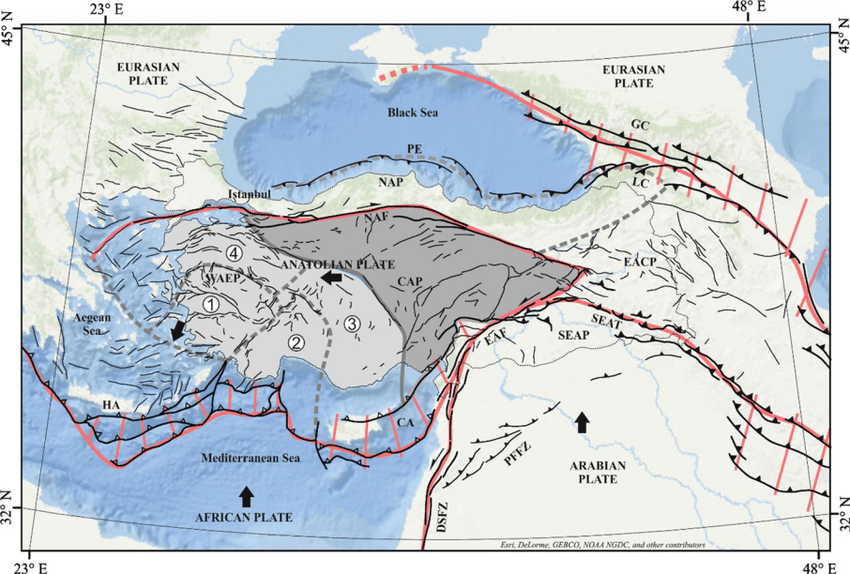
Yes, I presume each dot is a movement measurement and the colour shows how much, though not the direction. Here's a map that makes clearer what plates are involved and the plate boundary faults: The EAF is the East Anatolian Fault (the North one, NAF, can also be seen), where the earthquakes took place. The Arabian and African plates are pushing broadly North and the Anatolian plate is being squeezed between them and the Eurasian plate like a pip, sideways, to the West. I was interested to see a converging margin marked, which accounts for the curious catlike shape of Cyprus, with a "tail" pointing off to the North East, i.e. towards the earthquake fault. There seem to be some slight trenches in the sea bed around it. In the bottom centre of the map the DSFZ, the Dead Sea Fault Zone, can be seen extending Southward. This links up with the Gulf of Aqaba, the Red Sea and the African Rift Valley.
-
I'm not terribly interested in the details of your machine. I know you love to bog people down in that sort of thing, to obscure the essence of the scenario. I've been through that experience with you before. So no thanks. I'm just telling you that, if it creates hot and cold from an intermediate temperature, there is an energy input, of some sort, somewhere. That's just a fact (KICK😁). So if you are doing an energy audit, you need to look for what that might be (presuming your device works, that is).
-
The point is that any heat pump requires an external energy input. It can be mechanical work, as provided by the motor in a domestic fridge, or it can be something else, say, electricity in the case of a Peltier device or something. But heat will not spontaneously flow against a temperature gradient. Energy input is required to make it do that. So if your device - regardless of what it is and how it is constructed - gets heat to flow against a temperature gradient to produce a hotter side and a colder side where there was none before, there has been an energy input somewhere. By the way, the reason you get attacked, by me and others, is blatantly obvious to anyone with a smidgeon of intelligence. You are obsessed with trying to overturn one of the best-established and best-validated principles in science and - in particular - dodging all the patient explanations that have been made as to why you can't do that. So stop playing the victim, when it is you that has chosen to wander about with a huge "KICK ME' sign strapped to your arse.
-
Ah yes, I can see the telecoms information would be harder to get by other means. It will be interesting to see what the authorities disclose about their findings from the debris.
-
Is there a source for that hypothesis , or is it a personal speculation? I suppose it is possible it was indeed a stunt, or test, to sow confusion and watch reactions, but that does not seem to account for China having a whole fleet of them, sent to all corners of the world.
-
@toucanamentioned that. We know it seems important to them. We don’t know why, though. What does it do that satellites don’t, for instance?
-
You understand me well! Indeed, as a chemist what interests me is what happens at the level of molecules, or the electron orbitals in a giant structure such as glass. Also the link with spectroscopic properties, which I found so eye-opening. From the discussion so far I would hazard a guess that what we have may be a bit similar to what happens in bonding, when the spherical potential of an isolated atom is replaced by, say, the tetrahedral potential of something like methane. You can then get mixing of the atomic orbitals of the spherical case to form new combinations, appropriate to the new symmetry - the so-called orbital hybridisation: s + 3x p -> 4 x sp₃ in the methane case. With light passing through a medium, the electric field is antisymmetric, so the temporary induced polarisation could maybe be expressed as a transitory mixing of (spherical) states of different symmetry. This looks very much like the "transition dipole moment" involved in an absorption event.
-
No we accept the c.19th laws of thermodynamics based on 150 years of subsequent theoretical support for them and 150 years of subsequent experience. But if you want to claim Newton's Laws of Motion should be thrown out, just because they date from the c.17th and are thus a bit old, be my guest.😁
-
Indeed, I am not saying that. As I said in earlier posts, Lincoln's portrayal of it is that there are two component waves, that due to the light itself and that due to the secondary forced oscillation of the medium's electrons, and what actually takes place is the resultant, from the superposition of the two components. This is unavoidable as the two components will willy-nilly interfere to produce a single combined waveform.
-
Making clear that Xi may not have been aware of the flight also lays the ground for a later rapprochement, by offering him a ladder to climb down. He can fire a few military people and get back to the agenda. (I too was struck by the similarity to the Gary Powers affair.)
-
How remarkably uninformative. Are you a 'bot?
-
No, I'm sure Lincoln is not referring to an electron wave function. He is speaking in terms of a semi-classical model, in which the collective forced oscillation of the electrons in the medium sets up a secondary electric field wave, moving with the electric vector of the light but more slowly, and the superposition of the two leads to a reduction in phase velocity. The important part of the video comes in the final 3 minutes. The rest is background explanation of what refractive index is, why some of the popular explanations are wrong, and so forth. By the way, I'd like very much to hear your simpler explanation, if you care to summarise it. I find this an interesting topic and I feel I'm on slightly shaky ground relying just on what I recall from Peter Atkins at Oxford in 1974! But maybe I can get the gist of it from your posts up to this point. I'll read them carefully. I like this a lot. It contains the idea that energy is borrowed from the light by the lattice electrons, which quantum mechanically can - I think - be thought of as mixing in a bit of, mainly, the nearest excited state (in transition frequency). This is the exciting piece, to me, as it explains the link between the magnitude of refractive index and the proximity in frequency of absorption bands in the spectrum of the medium.
-
I think Lincoln is saying the motion of the electrons creates a secondary oscillating electric field (a forced oscillation, actually), moving slower than that of the incoming light and that the resultant speed of light in the medium arises from the superposition of the two electric field waves. I am unable to say for sure whether this classical-sounding explanation is the equivalent of the QM explanation that I think I recall. But it sounds as if it may be. This is actually quite an interesting and tricky subject.