exchemist
Senior Members
-
Joined
-
Last visited
Everything posted by exchemist
-
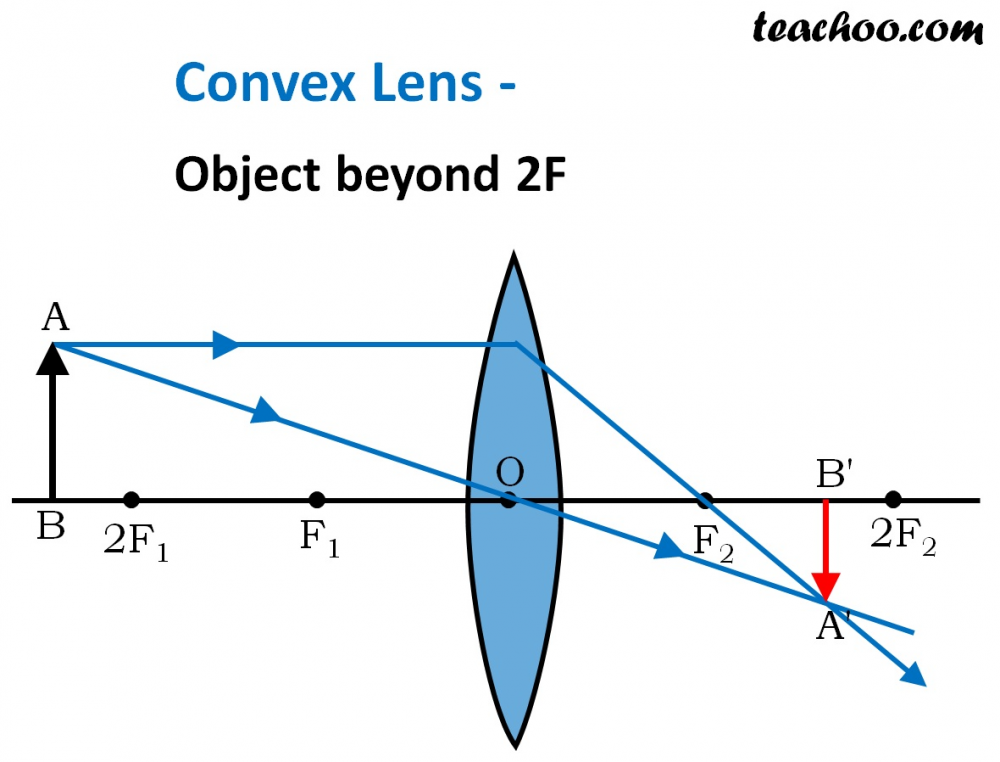
For a start, aiming a laser at your eye is an idiotic thing to do, as it is likely to blind you. NEVER do that. Secondly, it looks as if your problem in understanding here is that you do not know some basic optics. The role of the lens in the eye is that it allows an image to be formed, whereby all rays of light from each point in an object that reach the eye, regardless of exact direction and regardless of which point of the the lens they strike, are focused onto a single point on the retina. This property of lenses results in the formation of an image of the object on the retina, rather that just an undifferentiated blob of light. In the diagram below the upright black arrow is the object. two light rays from the tip, going in different directions and hitting different parts of the lens, are shown. The lens makes these converge, to form an upside down image of the tip of the object, at a certain distance behind the lens. That is what happens in your eye. A laser is a bit special in that all its light rays are parallel. That causes the lens to focus all of them onto the same point. So a laser aimed at your eye would look like an extremely - in fact dangerously - bright single point of light. That's why it can blind you.
-
What has buoyancy in water got to do with this problem?
-
But he has a point. It took me a while to decide whether you were asking a serious question or just being facetious. In fact, I'm still not sure.
-
There is now a pending lawsuit in Australia, from a man who was wrongly accused by ChatGPT of a criminal conviction for fraud. And this article in today's Guardian makes chilling reading: https://www.theguardian.com/commentisfree/2023/apr/06/ai-chatgpt-guardian-technology-risks-fake-article. Just when you thought the churning of false and mad stories around the internet could not get any worse, it is given a further boost by being actually fabricated by this bloody Artificial Stupidity robot. The sheer irresponsibility of these people is just amazing. (And of course we have a live example of how it can't be trusted on science, on this very forum.)
-
Hopeless, as they are immiscible with water.
-
I should have thought, rather, that it tends to follow an asymptotic curve, developing further all the time, but in smaller and smaller optimisation stages.
-
The study of what it is that makes the other sciences exhibit the patterns they do. Physics is the scaffolding on which the other sciences are erected.
-
Can’t be that or the magnetic pressure would be a function of how the field was applied.
-
Is a superconductor different, and if so why would that be?
-
I've come across an explanation , which I don't fully understand, for why a superconductor in a magnetic field experiences a force (the Meissner effect). It is said that eddy currents will be triggered in the superconductor which will form a perfect mirror image of the magnet, with like poles adjacent, so a repulsive force is generated. What I don't follow about this is I thought eddy currents were generated by a change in magnetic flux density, not by a static field. Does anyone know more?
-
To be honest I think to make progress in understanding this topic we should forget ChatGPT and have one of our physicists talk us through the Meissner-Ochsenfeld effect a bit. ChatGPT is basically as thick as mince and just plagiarises stuff it looks up on the web that it hopes is relevant, based on some algorithm. There's no reason to expect it to be able to do this stuff properly. But does it give you references for where it gets its formulae from? If we can read those sources we might get somewhere. Meanwhile, I've had another look at the Wiki article, which gives a remarkably simple formula for something called the "magnetic pressure" that a magnetic field exerts on a superconductor. This is Pmag = B²/μ₀, where P is force per unit area at the superconductor/field interface, in Pascals, B in Tesla. Here's the link: https://en.wikipedia.org/wiki/Magnetic_levitation What happens if you plug in the numbers for the Earth's field?
-
Doesn't the last of these just make you go orange - and become rash?
-
I don't see Russell on the list. That seems a curious omission. @TheVat's list is more the sort of thing I would have expected - though it is Eurocentric, I suppose.
-
OK, as this is homework, we ought to go through this in stages to help you understand, rather than just giving you the answer. First, do you understand why the aluminium ring jumps? Second, in the version with two rings, typically the second ring differs from the first in one important respect. What is this and why do you think it might make a difference to its behaviour?
-
Will it experience a force?
-
That's what I would have thought. But it would be nice if someone would care to summarise the Meissner-Ochsenfeld effect and what force it can generate. All I know is that a superconductor repels a magnetic field from its interior, but why this produces a force, in what direction, and of what magnitude for a given field strength, is something I have never studied. I had a quick look on Wiki but it was not very informative.
-
I know, but I read the query as assuming such waves could ignite it, so to disabuse the poster of that notion I tried to explain how gunpowder was actually ignited in practice.
-
No it was the felt hammer, inside the piano, that was painted. There was a bang, a certain amount of dust and dead ladybirds - and an eerie pause in the singing.
-
One snag I can think of is that the angle of the Earth's field is steeply inclined. So instead of just floating up or staying where you were, I would have though you would shoot off or slide down at an angle. But I'm not familiar with Meissner-Ochsenfeld effect so I'll have to let someone else check the robot's maths.
-
Yes, a few problems with your question. Firstly, radio and sound waves don't exert a force - or not to any significant extent - and secondly a force will not ignite gunpowder in any case. You need essentially to set fire to it somehow. You may have seen sailors firing c.18th cannons in films, for instance. That's why we call it "firing" them. A special match was used, applied to a hole in the gun and that would set it off. There was later something called the "percussion cap", in which a small amount of mercury fulminate, Hg(CNO)₂, was used. That is a highly unstable compound that will explode if struck sharply. This could be used to ignite the gunpowder. So with that system, applying a force, by hitting a capsule of this, could indirectly ignite a charge of gunpowder. There are other explosives that detonate when receiving a shock, most notoriously nitroglycerine, but also less hideously dangerous things such as picric acid* and nitrogen triiodide, both of which I have made at school, hem hem. But back to your question, there isn't actually the problem you imagine with gunpowder, so there is no need for your proposed solution. By the way, if you want to stop gunpowder from burning you just wet it. (In fact historically this was the basis of an early HM Customs and Excise test for distilled alcohol. "Proof spirit" was the weakest solution of alcohol in water which, when used to wet gunpowder, would not prevent it from burning.) * A friend of mine at university had a funny story about a school practical joke, involving painting the hammer of a single piano key with it, the key in question being played only in the bridging passage between two verses of the school song. You can probably imagine the effect.
-
If you mix up sugar yourself, though, you will need to measure or calculate the density for yourself. If you are prepared to do that, you could simply buy Lyle's Golden Syrup in the supermarket and use that.
-
I presume it has to be miscible with water. If so, would glycerol fit the bill?
-
Is Translate that bad?
-
Hovercraft eels ouant tobacconist bouncy bouncy.
-
What are you talking about?