
Trurl
Senior Members
-
Joined
-
Last visited
Everything posted by Trurl
-
That is a biological definition. But with ai, robots and computers wouldn’t different definitions of living apply.
-
Well in evolution if a cell is designing an evolved self isn’t there instructions or nucleus that is designing this evolution? Something has to take place to “design” something new. What else would cause such a unique and specific change? Also why are plants considered living? Do they have a conscious that moves their bodies to light? Or is the plant just made out of reactions to its environment?
-
Man had advanced over the years. So a group of scientists agreed to challenge God to show that they can build a man out of dirt. The scientist giggled at the idea because it was so easy. Then as they started, God called out, “Hey, that is my dirt.”
-
I was just thinking tonight that We are made in God’s image according to the Bible. And He spoke the World into existence. He spoke. I does not say he thought the World into existence. So as we have a mind that thinks and decides what to say, it seems he functions the same way. My question is if we ever create a conscious intelligence (like A.I. or computer learning) would you reevaluate your ideas on creationism?
-
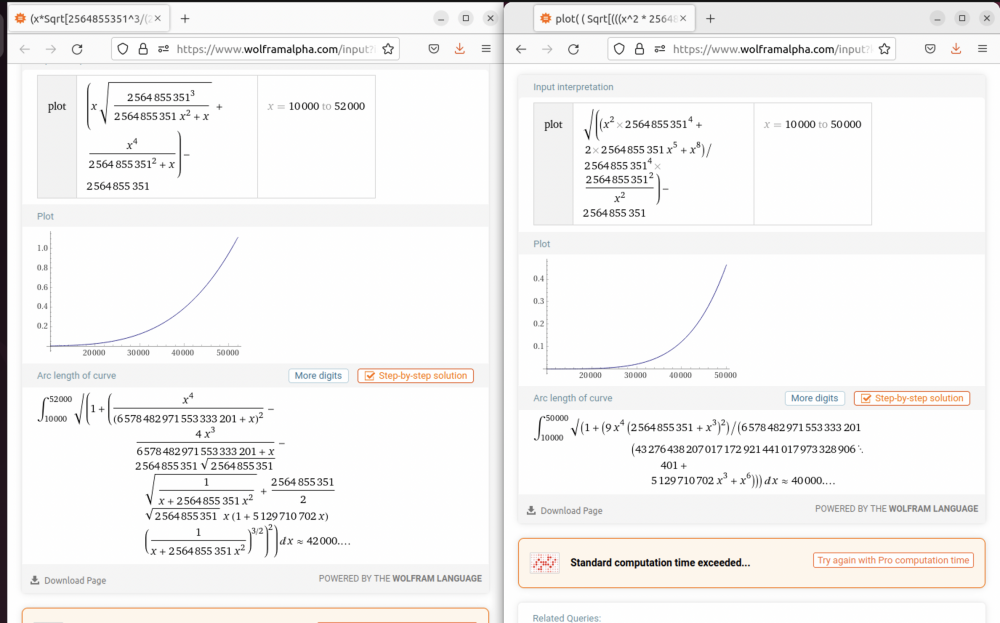
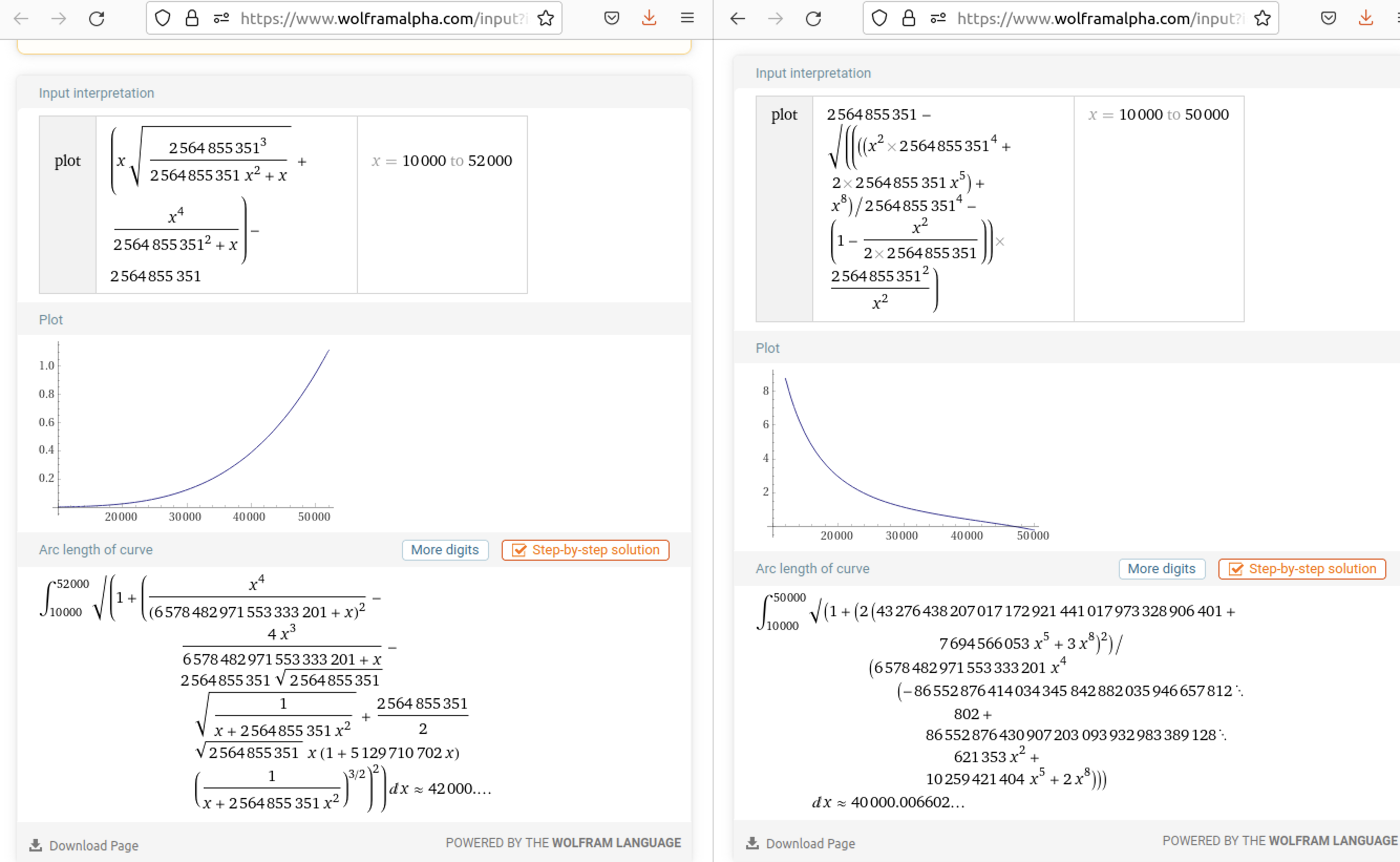
Ok, so the work is over. But I have one question which is Did anyone find it useful? I know 2564855351 is easy to factor with computers. I take the values from 1 to zero from the right to left and test. A 10^9 is reduced to 10^4. I know it doesn’t seem useful. But I haven’t worked with hundreds of digits. The precision of the numbers close to zero (a pnp==pnp) is untested. My programming skills are terrible. But I see what the theme is: “If it does factor semiPrimes it is more than just theory. You should be able to produce the factors.” But it leads me back to the question is it useful? When I thought it up I thought it was gold dust. I cannot factor very well with it. But I am a terrible programmer. I have read about the discovery of determining how many Prime numbers there are under a given number. The thought is that it would lead to a pattern. It never did. However, it led to patterns of series that produced large Prime numbers. I’m not saying the Pappy Craylar Conjecture finds a pattern in Prime numbers, but it is a simple method of predicting factors, approximated (where the graph is between zero and one. Well, it is on to other projects for me. I posted so much because I believed in my hypothesis. I leave you with my corrected equations screenshot. But if anyone does find a use for the PCC: Post it here!
-
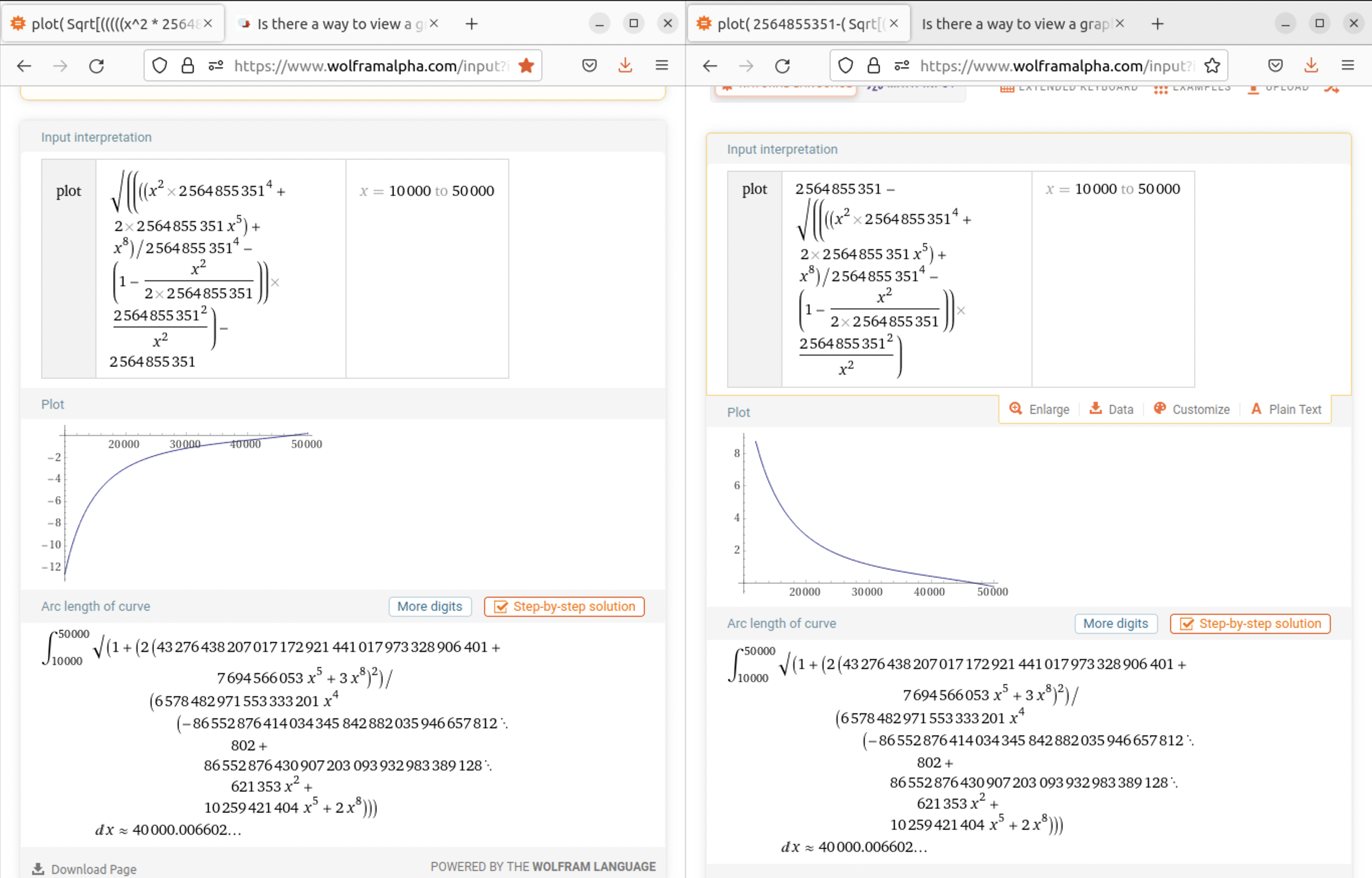
(x*Sqrt[2564855351^3/(2564855351*x^2+x)] + x^4/(2564855351^2+x)) - 2564855351), (x from 10000 to 52000) _________________________________________________________________ plot( 2564855351-( Sqrt[(((((x^2 * 2564855351^4 +2* 2564855351*x^5) +x^8)/ 2564855351^4) – (1-x^2/ (2* 2564855351))) * ( 2564855351^2/x^2))] ),(from x= 10000 to 50000)) Paste these in Wolfram's Alpha computation bar. If it times out you need Pro. This was my final attempt. That is why I stopped posting. The graph of these equations are in different windows. Alpha would not give me enough space to combine them. But x should be the factor where (if) they intersect between 1000 and 50000. I am working on a better presentation and file format. Alpha correct the parenthesis, so I didn't mess with it. I didn't want to break it.This is what the links that don't work look like. Remember the musing about the NSA cryptographer and the graphic artist?😜
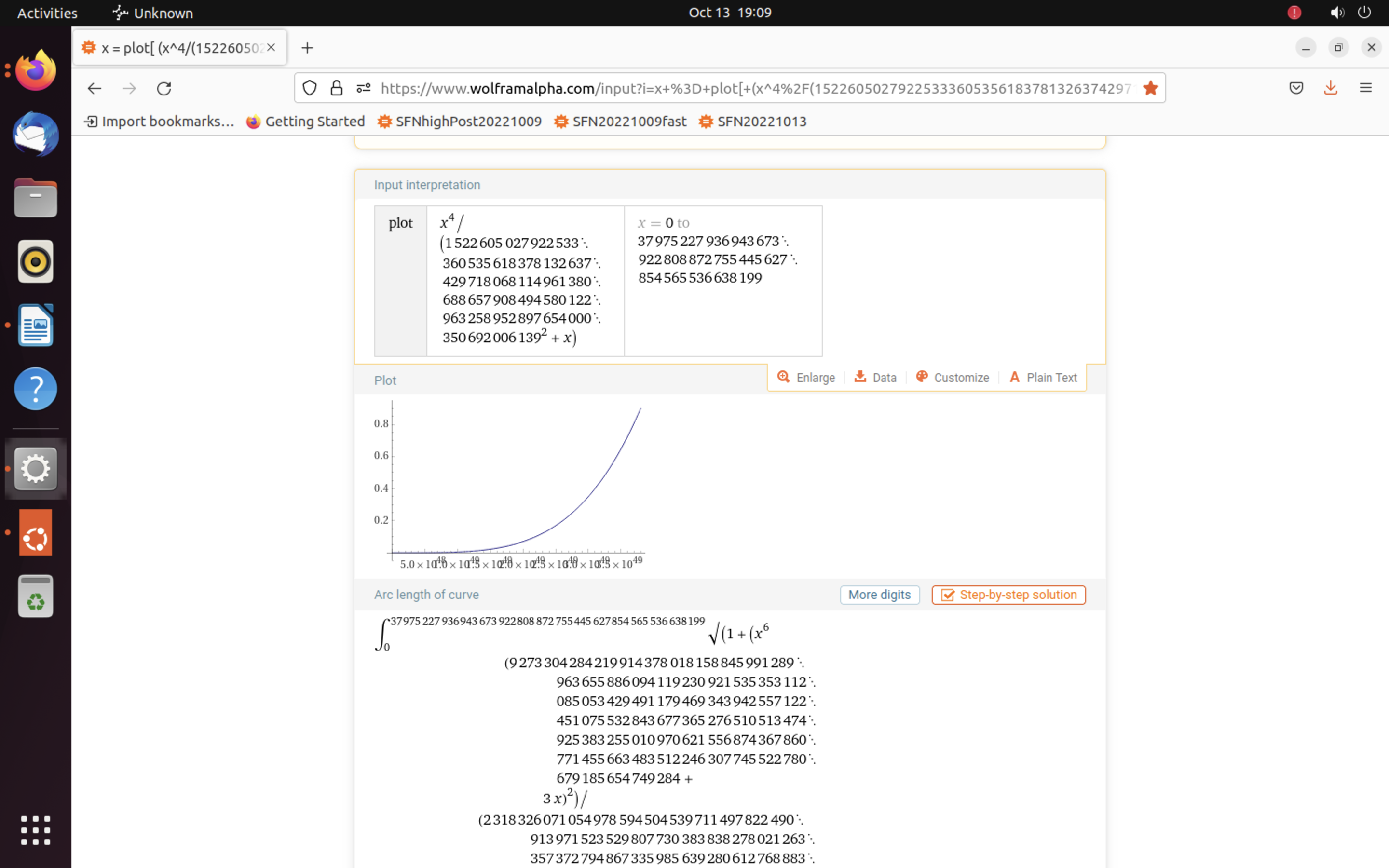
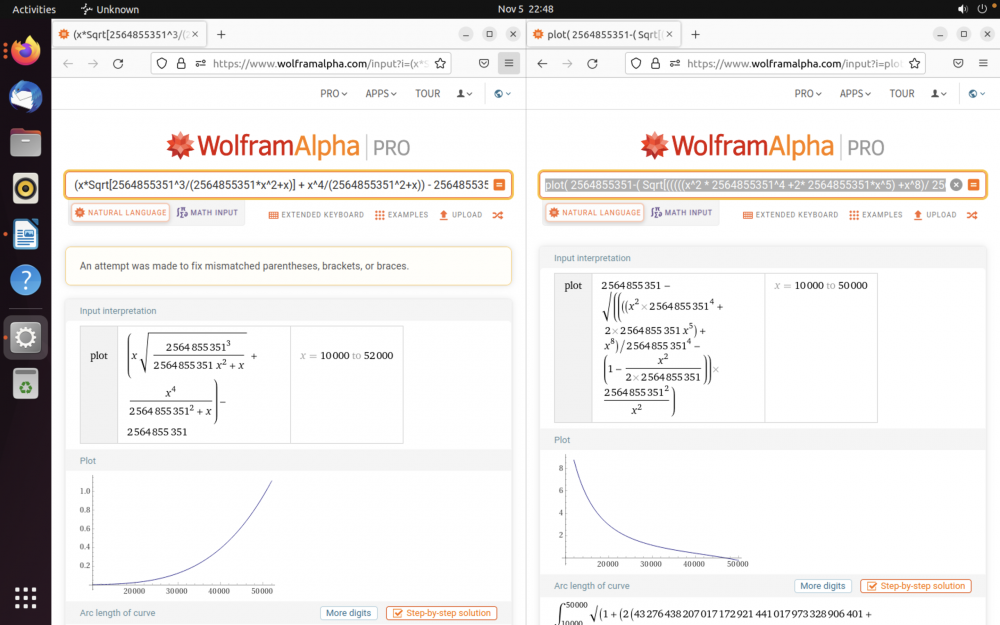 Yes, most attempts at finding patterns in Primes fail. I gave it a solid effort. The one thing that bothers me is that I only needed to know where y on the graph equals N. If you plug in N and plug in the already known x it equals N. That is why I never gave up. I thought it would be easy to analyze the graph. I conclude here. This is why I keep going. https://www.wolframalpha.com/input?i=((41227*Sqrt[2564855351^3%2F(2564855351*41227^2%2B41227)]+%2B+41227^4%2F(2564855351^2%2B41227)) 41227 is the only x that will produce N. As seen. I just wish there was a way to solve the equation for x for real numbers.You are right I cannot factor a large Prime. But the fault is mine and not the Pappy Craylar Conjecture. I don’t know of any math software that will let me find x on the graph while y equals N. I believe the PCC is finding the factors, but for me it is impossible to find an answer on the scale of the graph. Do you know of any graphing programs. I could also fix the loop, but I don’t know the advantage of just looping the equation versus looping division. You could guess at the position of x because the PCC equation would tell you if you were higher or lower than the correct value. I found the error. So an N of 85 will occur where x equals 5, exactly with no error. But when you try and solve for x in the equation the square roots stop the equation from being solved. But until I can say f[x} = N, where y = N. I cannot solve the graph without typing in the correct scale. And the scale is hard to find with several hundred digits N. So RSA remains safe for now. I have put a lot of work into this problem. Good thing this isn’t my thesis or I’d fail. But I leave you with one more graph. That is 85 = 5*17: https://www.wolframalpha.com/input?i=plot((x*Sqrt[85^3%2F(85*x^2%2Bx))]+%2B+x^4%2F(85^2%2Bx))%2C+((85^2%2Fx%2Bx^2)%2F85*x-(x^3%2F85))+from+0+to+20 One more. I don't think it is the correct factors, but it was a true test of the PCC method. https://www.wolframalpha.com/input?i=((x*Sqrt[2564855351^3%2F(256485531*x^2%2Bx)]+%2B+x^4%2F(2564855351^2%2Bx))%3D%3D+((2564855351^2%2Fx%2Bx^2)%2F2564855351*x%2B(x^3%2F2564855351))I will be taking a break after a weekend crunching numbers. I don’t know if it is the Pappy Craylar Conjecture’s fault. I thought finding lines that intersect would be easier. Go figure. I graphed xthefactor = x, in the first graph. https://www.wolframalpha.com/input?i2d=true&i=plot\(40)Cbrt[Divide[\(40)Power[x%2C3]+Power[2564855351%2C2]\(41)%2C\(40)+Power[2564855351%2C2]%2Bx\(41)]%2BDivide[Power[x%2C4]%2CPower[2564855351%2C2]+%2Bx]]\(44)+Sqrt[\(40)Divide[\(40)Power[x%2C2]*+Power[2564855351%2C2]\(41)%2C2564855351%2Bx]\(41)+]+%2B+\(40)Divide[Power[x%2C2]%2CPower[2564855351%2C2]%2Bx]+\(41)+from+0+to+50000\(41) The second graph is N=N. Where x should be the factor at N for both plots. Here the PCC looks promising. I just don’t know of a way for the computer to give me the intercepts and the scale of the graph so I can read it. https://www.wolframalpha.com/input?i=plot((x*Sqrt[2564855351^3%2F(256485531*x^2%2Bx))]+%2B+x^4%2F(2564855351^2%2Bx))%2C+((2564855351^2%2Fx%2Bx^2)%2F2564855351*x-(x^3%2F2564855351))+from+0+to+50000Yes, it does not look good for the Pappy Craylar Conjecture. But let's hope it has potential like the Pittsburgh Steelers. The Steelers has offensive weapons, but can't produce offense. The PCC cannot be solved by solving for x only knowing N. But if you place it into a plot it may prove useful. I am still working on the challenge. I want a usable process that will find x fast and accurately. This is what I have. But I can't get the loop to work yet. It is a Hail Mary for the PCC. clear [i, pnp] pnp= 2564855351 i=3; while[ ((((pnp^2/i + i^2) / pnp * i) – (i^3/pnp)) << pnp, Print; i=i+2]Ok. Challenge accepted. It may take me a while, but here is my method: Plot 2 graphs. One has already been plotted. y=x^4/(N+x) and where it crosses y=(((N^2/x)+(x)/N*x) – N It is that simple. Not an exact result, but a good estimate for ball park figure. I will start on Monday. I can’t use Mathematica because it has an recursion warning. For some odd reason Wolfram alpha will draw it. All I have to do is to draw the 2 graphs on same plot. And it will prove or disprove the ability to factor RSA.Ok this is the steps I will take for this challenge. I want to run this idea by you. I may not have the computer skills to analyze the graph in Mathematica. I will graph this equation as I already did. \[ frac {x^4} {N^2+x} \] I can't get the latex to work so it is the above (x^4/(N^2+x)) I will take all values on the y-axis where x equals zero. (As before) Then I will take the x value where y equals zero and put those values into this equation: \[ N=\frac{x\left(\frac{N^2}{x}+x^2\right)}{N} \] And graph. Where the y axis equals N is the semiPrine factor x. Does this make sense. I can’t tell. It is confusing but it may work? It is simply. Can this possibly work?Yes I know you say the graph doesn’t show anything we don’t already know. That is why I showed you the graph. But testing 10^49 to 90^49 you clam is tribal to testing numbers 10^100. You could argue why don’t I just test the bottom half of 10^100. You may be successful or maybe not. But the point is I just did it mathematically in real time. And if I could estimate the error in the expression I could do it in one calculation. But the purpose is not to destroy RSA anyway. The Pappy Craylar conjecture might not destroy RSA. It is a pattern in factorization. It is a significant step in the pattern. If you look at the database numbers on error I posted, you will see the error has potential to find patterns. And if you followed along I think you know the equation isn’t trivial. So I don’t mind if you say I can’t break RSA. But you have to admit it was a good attempt. And you don’t know what other ideas I have. But I appreciate the critic. You tested the problem. Before it was an idea which no one I know could test. Supposedly Primes are impossible. Right or wrong I needed someone to test it. And it may not be wrong just not precise enough. For future explorations It is important to note the statistics of the curve of the graph of those values with a y axis value of zero.You only have to test those odd numbers whose y value is less than one. I know the graph isn’t very descriptive. I need a “real time” plotting software. But as I show by cheating, I arranged the test value to the answer. As you can see y equals zero when x is the answer. I understand you say that numbers below 25% are too small. But they also have y-axis values below zero. So if you are crunching numbers you would start on the right and divide into N until a factor is found. Instead of numbers of 10^10 you are testing 10^50 and most of the time the right most y-axis zero value is the number. If you want a more mathematical explanation you would have to analyze the zero y-axis values with calculus. RSA is still protected because of the computation of the values on the number line. But as long as you can square pnp, RSA is significantly less secure. But don’t believe me. Test the number line. Look for y-axis equals zero. Start on the right and divide into N. RSA can hide in security of large numbers, but the reason the Pappy Craylar Method works is because it works on all Prime numbers. The small numbers test and so should the large. x = plot[ (x^4/(1522605027922533360535618378132637429718068114961380688657908494580122963258952897654000350692006139^2+x)), {x, 0, 37975227936943673922808872755445627854565536638199 }] https://www.wolframalpha.com/input?i=x+%3D+plot[+(x^4%2F(1522605027922533360535618378132637429718068114961380688657908494580122963258952897654000350692006139^2%2Bx))%2C+{x%2C+0%2C+37975227936943673922808872755445627854565536638199+}]
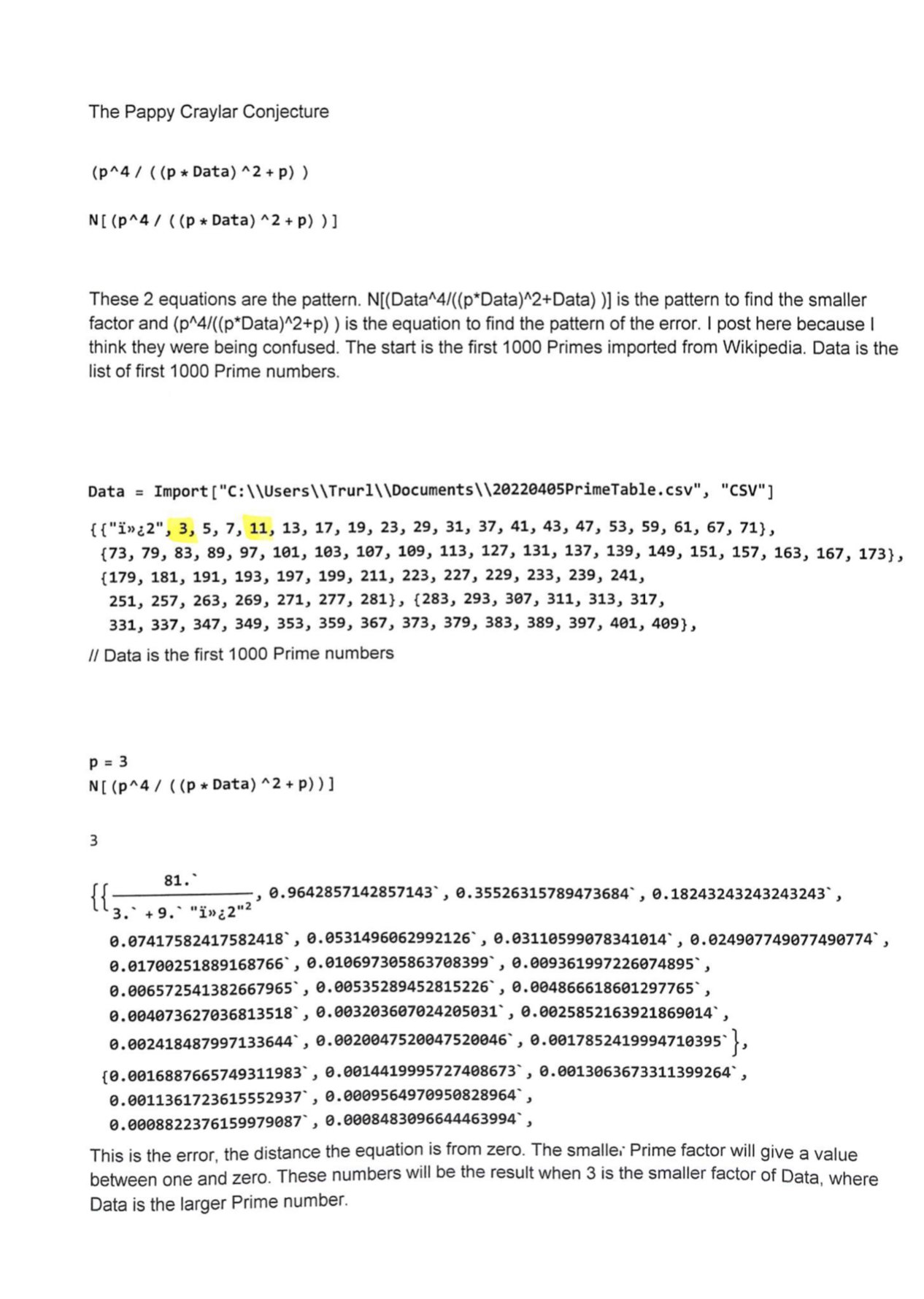
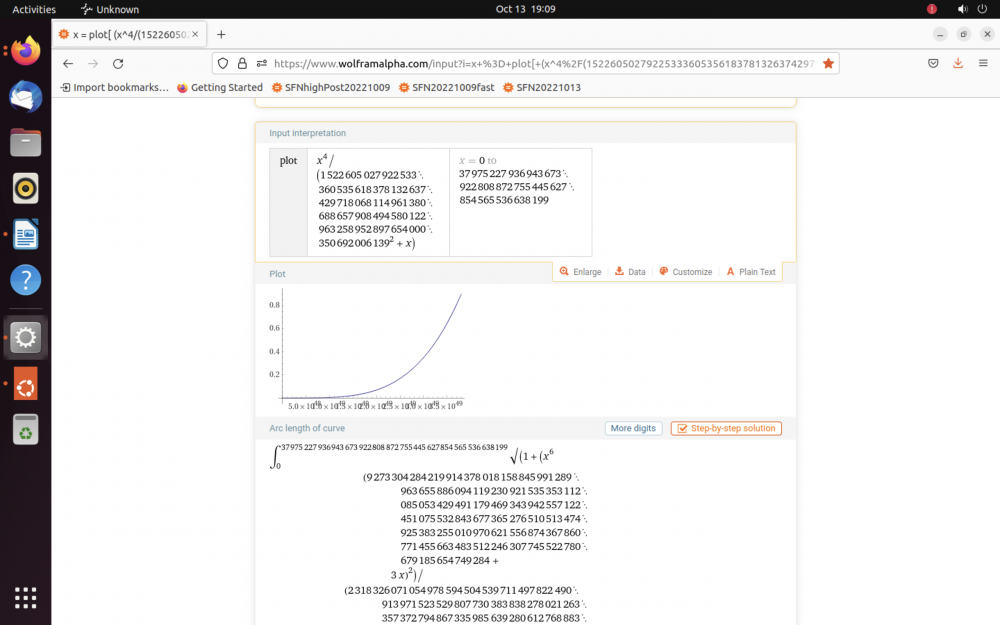 The plot is the answer. The y axis is expression x^4/(N^2+x). When the expression equals zero the y axis is also zero. So when the y axis is between zero and one then x at that values of the y axis that are less than one is all that needs tested. Start at the right of those x and divide N by x until you find the correct Prime factor x. The graph does in seconds what takes hours. No. We see the answers on the plot because we are testing x in the equation. The graph will show an answer knowing only N (pnp).Here the link is. https://www.wolframalpha.com/input?i=x+%3D+plot%5B+%28x%5E4%2F%281522605027922533360535618378132637429718068114961380688657908494580122963258952897654000350692006139%5E2%2Bx%29%29%2C+%7Bx%2C+0%2C+10%5E51+%7D%5D Here where y = zero x^4/(N^2+x) = y x on the graph where y = 0, is the smaller factor q So it should work with large numbers. I know I know the answers before computation, but where y = 0, x is a possible Prime factor. Loads in seconds. According to Wikipedia “It takes four hours to repeat this factorization using the program Msieve on a 2200 MHz Athlon 64 processor. “ Note. Look at the graph. I not sure about all the numbers.You are correct. I am simply calling the difficulties of factoring N the one-way-function. The difficulty of the Prime number factorization is what makes RSA work. I claim the Pappy Craylar method can make it 2 way. That is the claim of breaking RSA. I believe you call that one way or trap door function. Or N or NP. RSA seems impenetrable because we can’t find a pattern in Prime numbers to test. The PC method says forget for a moment in testing all known Primes. Instead look at how numbers are factored. Prime numbers can hide but factors can’t.I will explain better. I keep talking about Prime numbers because I focused on the N=p*q part of RSA. It is where my work began. I focused on p and q. If p is so large that would determine the size of q. In RSA we are given N and it is a challenge to factor, thus a one way function. This is my focus. I figured let’s put N in terms of p alone. So I wrote an equation that would use N and compare (subtract N -N calculated) N in terms of N and p. And it worked. Except there was always a slight error when subtracting N - Ncalculated. An error between zero and one. So eventually I solved the error or at least found how it was calculated. This error is why the expression is between zero and one. That means the expression to be useful in breaking RSA there is a need to test all values between zero and one. (I don’t know how complex that is with hundred digit numbers.) That is how many p’s (you know p as x) there are when the main equation (or expression) results in a value between zero and one. (Again N-Ncalculated approaches zero.) I believe factoring N is the key to find a pattern in Prime numbers. Because a pattern in factoring correlates with a measurable pattern that can be graphed. Picture this: If p is small q is large. If p is large q is small. I made an equation that would approximate N with an unknown p. And since N is the know we will match unknown p’s until the value makes the known and unchanging N true. Because of the error the N=N is between zero and one.Division Is 0.25 your lower limit because y approaches pnp? To me it seems like we are solving something different. 3 in my equation would be smaller and smaller as the SemiPrime increases. But 3 has infinity large SemiPrimes. That is why in a status update that if you could factor SemiPrimes you could test for Primality. But the trouble is all the 3s then the 5s and the 7s all lead to infinity SemiPrimes. But you would only need one number to factor and graph. So if 3*Prime# is between 0 and 1 then they are Prime. However the problem is that the expression often has many values between zero and one. That is why it isn’t perfect. But that doesn’t mean it isn’t useful. RSA uses large Primes but SemiPrimes use all Primes. But remember I’m a graphic artist not a cryptographer. I have done some reading. Basically the code is open source. My method is not mathematically complex. I am simply isolating x as compared to pnp. That expression between zero and one is just pnp minus pnp estimate. That is why with 100 digit numbers x of 3 is very small and falls into the test area but if x of higher values don’t test to be the correct factor 3 is possible. Download the complete spreadsheet and test for yourself. I’m am glad you are challenging my work. That is why I put it here. I very likely could be wrong. But look at the stumbling block our ancestors gave us. They want a pattern of Primes but it’s impossible. But once you start down the rabbit hole you can’t stop. But it means everything to computer science. While I was in school I did busy work with a cryptographer. I really didn’t appreciate his job. But it was pretty serious stuff. He had to get a polygraph and testing for weeks. I think I’ll stick with open source crypto.For values where the expression (the main equation) will equal a number between 0 and 1. As pnp gets larger the x value will become smaller. For example if an x=5 is less then 1 when put into the expression for a pnp test value of 85 and we keep the pnp=85 but try x=3 the expression is still between 0 and 1. That is what I show in the spreadsheet. That smallness is the error (distance from zero of the expression) that occurs. Sure we can have a million digit SemiPrime with a factor of 3. But as pnp increases the expression becomes close to zero which in turn y becomes larger. But y cannot become larger than pnp.That is fair constructive criticism. It is a bold claim to make to break RSA. If the Pappy Craylar conjecture was true RSA and any ciphers that relied on factoring, Prime numbers, or logarithms would have to have larger keys. Yes I know that as pnp gets larger the number of values less than zero, increase. I don’t see this as a flaw. It is just how the numbers fall. If pnp was a hundred digit number it is still possible 5 could still be a factor. So does it apply to the pnp value of RSA? It isn’t perfect, but I am not aware of any other tool to take its place. But it is useful in RSA factoring because there are 4 times less numbers to test. Maybe even less number are possible if a pattern is found. You would test lager odd numbers first. But as you test values there are hints to how large the test value should be. For example with a pnp of 85, 3 would be between 0 and 1 but 85/3 isn’t a whole number. If I was crunching numbers, I would test the higher numbers first. But the second thing to note is what happens with larger numbers. Will the distance between large numbers become smaller or will there be more zeros with more numbers to test? That is why I post this thread. I think I have a simple enough pattern that may challenge RSA. I post this picture to show the less than zero values of the Prime number 3. Yes it approaches zero as pnp increases. But you forget as x approaches zero the corresponding y value approaches pnp.
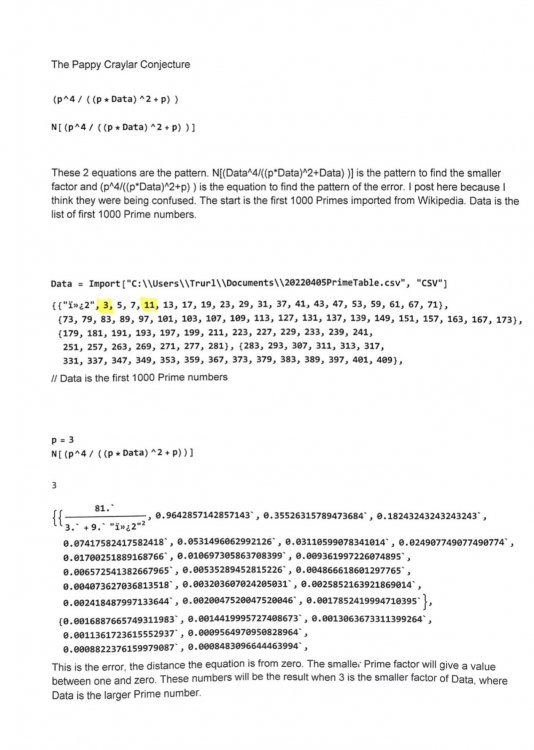 Pnp is known. Which happens to be x*y. The question is what x with known pnp will be close to or moving away from zero. The given pnp will only be true (within error) when x puts the equation near zero.Should say x is smaller factor of SemiPrime pnp.



Important Information
We have placed cookies on your device to help make this website better. You can adjust your cookie settings, otherwise we'll assume you're okay to continue.