
Trurl
Senior Members
-
Joined
-
Last visited
Everything posted by Trurl
-
I too am interested in scientific computing. I have a degree but there is a ton of stuff I don’t know. Do you mean science problems or data science? The web is full of science problems but finding resources for data science seems more difficult. I want to crunch primes or test multiple patterns in numbers. Some stuff Wolfram Alpha helps. But I want more control like in a programming language. I know Mathematica and Excel and Python can help. But there is also a problem of finding data unless you are creating your own. YouTube should have some stuff but I haven’t found a good video on number crunching. So if any knows how to program a program for recursion or factions let me know. Where you thinking mining crypto?
-
Looks like a protractor to me. It is going from 0 to 90. It does have many scales but it just looks like it is made for a map. There are many things it would be able to do on a map. Like taking the scale on the map versus actual distance. That is my guess. What other pictures did the search engine show that were similar?
-
This is just first inspection. But a kind of intuition starting point. Thus it probably doesn't work. But I just needed a starting point to test where I think zeros could occur. And where if they didn't occur would show. I believe zeros could only occur with even numbered fractions. But then again what do I know. In memory of Pappy Craylar: Hypothesis on critical zeros on Riemann Zeta Function Non-critical zeros have been found at an x-value of ½ Possibly forming an isosceles triangle. What if we were to expand this to all even powers. That is ½ , ¼ , ⅙ … towards zero and ½ + ½^(½^n)... towards 1? This fraction combined with and complex number would alternate between positive and negative values cancelling out to form zero. First we should test values at ¼ that are a similar isosceles triangle to ½ non-trivial zeros. If we can not find a trivial zero at these values it supports the Riemann Hypothesis.
-
http://www.dtc.umn.edu/~odlyzko/zeta_tables/index.html https://mathworld.wolfram.com/RiemannZetaFunctionZeros.html https://m.youtube.com/watch?v=sD0NjbwqlYw&pp=QAFIAQ%3D%3D https://m.youtube.com/watch?v=d6c6uIyieoo These are the best explanations I have found so far. It is enough to get started. I still don’t understand the displacement of Prime numbers as it relates to the zeta function. My attempts in my post “Simple Yet Interesting” I encountered complex numbers and I also had decimals and fractions. I am looking back here the Riemann Zeta function also deals with those. So I’m wondering why a was searching for a perfect integer. I have some trials I want to test for zeros. The complex numbers are a game changer. Well I moved on to a new problem. Unfortunately it too is related to Prime numbers. Proving it wrong I would need to find a nontrivial zero. I don’t have a clue how to prove it is always true. If that is even possible. My goal is to learn and perform my own zeros tests.
-
Can no one explain the distribution of Primes according to the Riemann hypothesis? All that I have seen or read is that the importance of the Riemann hypothesis is the distribution of Primes, but no one explains why it works. This is different from my last project. The reason I want to know is the same though. Is it a correct statement that: *the Prime Factorization problem (RSA) *the discrete logarithmic problem *elliptic curve cryptography All rely on factorization and Prime distribution? My goal is to start a different math project. I just want to find zeros and start with zeros that already exist. In my post “Simple Yet Interesting” someone asked why I was factoring semi-Primes to hopefully solve RSA. As most of you know, that is the basis of RSA’s one-way-function. That was what the cipher was based. All I tried to do was take the semi-Prime and see why it couldn’t be factored. I want to take the simplest concept of the Riemann hypothesis and see why it is I cannot find a zero. I am going to attach a paper I wrote 11 years ago. It was a simple outline. My instructor corrected grammar and citation format. I argue that it is a good outline of cryptography for only having to be a 3 page paper. Let me know what you think. Is it that bad? I get frustrated when I research something and the comments the instructor leaves on my paper is, “the comma comes after the parenthesis.” Is the paper a good description of how cryptography evolved? TrurlCryptoSurveySFN002.docx
-
Can anyone explain in one paragraph or equation how the Riemann hypothesis implies a pattern in Prime numbers? The hypothesis an easy enough to follow the problem, but the pattern in Primes is not clear to me. I’m sure a Google search may be helpful, but I wanted to work it through on my own. I find it helpful to take one small part if the problem and see what it does. Take the book Practical Cryptography. It explains all the ciphers. They are all open source. Doesn’t mean you can solve them but it lets you see the inner workings. That is what I need an explanation of the patterns in Primes in the Riemann hypothesis. I hope you understand why I just don’t google it. I want to search for nontrivial zeros. And I want to keep it simple.
-
I was watching a lecture series on science and religion. The instructor mentioned the Conflict Model. In this model religion and science are in conflict. Evolution vs Creationism. Observation vs. History. But the instructor said these polar opposites were once part of the same reasoning. Before the 19th Century, science and religion were often related. I don’t care what you believe. I am a person and have my own views. I just think people are being influenced a bad way. Instead of respecting each other and different views, we are trying to impose our views on others. Not that that is always wrong, but look at the government. Democrats can agree with Republicans. People can’t agree on masks and so forth. What would be the advantage of so much hostile division? I don’t know. I hypothesis it is a way to justify wars. In my speculation it is like: kill and displace millions then leave a mess and say it was too expensive. In this speculation, it is not clear what the true mission is. I will leave with a thought on a video game. In Metal Gear Solid 4 you spend 15 hours fighting Liquid (the name of the opposing enemy). And it turns out that Liquid actually saved the world. So you are the bad guy. I know some of you won’t know the classic game reference, but if you do it is a good topic of discussion.
-
So all three ways are equal? You are right all 3 should be explained so you know what the equation is doing. Did the instructor plug and chug or was it derived? Obviously the equation is easier. I think the instructor’s goal was to find the frequency and create an equation that could be reused. My question is if you graph the sine wave and take the angle between those points, how are you sure the drawn sine wave is the same as the equation wave? I mean did you form a curve that is equal value for value of the equation and do all points align? Would you have to make new “measurements” for each point to “shape” the modified sine wave to the actual modified sine wave? I said the equation was easier. I meant easier once you know what is what. If I was in that class I would be confused too. But that is why I am asking questions. I never took physics 102 and I know how important this is too electricity and radio waves.
-
Klapaucius, uh um, I mean Ghideon, You act as there is noting of value in this tread. Sure, breaking RSA would be quite a feat. But you must admit there is no other method that does it. There is no guarantee the Pappy Craylar Method works. And I have moved on to other projects. However, we had an active discussion that may lead to something that might find a different approach. You see, The Pappy Craylar Method is based on the fact that if you increase the size of one factor you must decrease the other. And since there is only one way the Semi-Prime factors go together, the equation to find the factors eliminates possibilities. Sure, the number of possibilities isn’t only one and sometimes the possibilities are further or closer to zero. But until a solution exists, the method leads to the ability to guess the factors by trial and error. See my construction of the 2 graphs that intersect at 5. Of course, I already new the answer, but don’t you find the PC method simple yet interesting? In[89]:= pnp = 85 x = 5 Show[{Plot[(x^4/(pnp^2 + x)), {x, 0, 10}], Plot[(pnp - (x*Sqrt[(pnp^3/(pnp* x^2 + x))])), {x, 0, 10}]}] Out[89]= 85 Out[90]= 5 In[109]:= Clear[pnp, x] pnp = 8637 {Plot[(x^4/(pnp^2 + x)), {x, 0, 3}] Plot[(pnp - (x*Sqrt[(pnp^3/(pnp* x^2 + x))])), {x, 0, 3}]} Out[110]= 8637 Does this work for every Semi-Prime? Maybe, maybe not. This is all I have to share. I am moving on to other projects. So, unless some idea comes along, I will not post. Is my last message Simple, yet interesting?
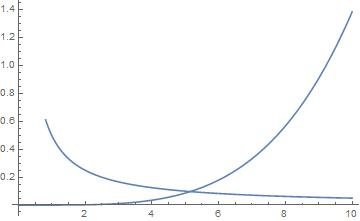
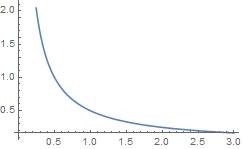
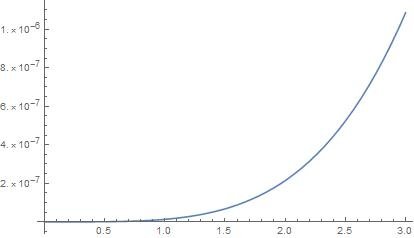
-
You must tell me why RSA is not affected by this thread. We can agree that RSA was based on the Prime factorization problem. That is factoring Semi-Primes into the Prime factors. So you must not trust my algebraic equations that estimate where the factors of semi-Primes occur. That is the basis of my work. I think I have stated what they do. But in your test where N=p*q where do you not believe p cannot be found knowing only N? \(q\sqrt {\frac {\text {pnp}^3} {\text {pnp} q^2 + q}}\)
-
@Ghideon I know you are not going to like my explanation, but q/N is enough to get an estimate of N. Yes I know it is true for all numbers, but using the reciprocal of p and q helps determine where they are positioned on the number line. For semi-Primes my hypothesis is that q/N will reduce to 1/p. Then take 1/p and multiply it by N. You could argue that it is no more useful than recursive division. However, it does give an estimate of where y lies on the number line. And it could further improve estimates of x when determining how far (N minus p) is from (N minus p calculation). I know it seems dumb. Why did we divide in the first place if a simple q/N could solve the solution? And it is a high possibility it doesn’t work. But I am saying the simple solution to the semi-Prime factors problem is helpful. That is: not helpful for a beautiful math equation, but helpful when trying to find a hack to defeat a problem that was never a one-way-function from the start. Clear[pnp, q] pnp = 85 q = 17 Simplify[(q^2 - (pnp*q^2 + q)/ pnp)] Out[139]= 85 Out[140]= 17 -(1/5) ___ ___ ___ ___ ___ ___ ___ ___ ___ ___ ___ ___ ___ ___ ___ ___ ___ \ ___ ___ ___ ___ ___ ___ __ In[142]:= Clear[pnp, q] pnp = 85 q = 19 Simplify[(q^2 - (pnp*q^2 + q)/ pnp)] Out[143]= 85 Out[144]= 19 -(19/85) ___ ___ ___ ___ ___ ___ ___ ___ ___ ___ ___ ___ ___ ___ ___ ___ ___ \ ___ ___ ___ ___ ___ ___ ___ In[146]:= Clear[pnp, q] pnp = 293*3 q = 293 Simplify[(q^2 - (pnp*q^2 + q)/ pnp)] Out[147]= 879 Out[148]= 293 Out[149]= -(1/3) ___ ___ ___ ___ ___ ___ ___ ___ ___ ___ ___ ___ ___ ___ ___ ___ ___ \ ___ ___ ___ ___ ___ ___ ___ _ In[150]:= Clear[pnp, q] pnp = 293*3 q = 291 Simplify[(q^2 - (pnp*q^2 + q)/ pnp)] Out[151]= 879 Out[152]= 291 Out[153]= -(97/293) In[154]:= N[-(97/293)] In[155]:= -0.3310580204778157`* 293*3 Out[155]= -291.
-
Why? Because it is p^2 minus p^2 derived. Same with second equation. It is just how I derived the equations. Does it work? I don’t know. But I am simply comparing patterns in division. Obviously you tried test values. Did it work with your values? i will run more test values. Let me know if you have any more questions or your test values don’t work.
-
Note: These are 3 separate groups of equations. They are separated by lines. \[p^3 - \frac {N^2 p^3} {N^2 + p}\] ___ ___ ___ ___ ___ ___ ___ ___ ___ ___ ___ ___ ___ ___ ___ ___ ___ _ The above equation should be close to zero, but sometimes the error is closer to 1 \[\frac{N p^3}{N^2+p}=\text{fraction}\] because q = N/p \[\frac{\text{fraction}}{q}=\frac{\text{fraction}}{\frac{N}{p}}\] \[N \sqrt{\frac{\text{fraction}}{\frac{N}{p}}}=p^2\] ___________________________________________________________________ The above equations are the second example. \[q = \sqrt {\frac {N q^2 + q} {N}}\] square q \[q^2-\frac{ \left(N q^2+q\right)}{N}\] In the case where N = 85 and q = 17, \[q^2 - (N*q^2 + q)/ N\] is 1/x or 1/5 or 0.2 \[0.2 * 85 = x\] or 5 in this example These are 3 separate groups of equations. They are separated by lines.
-
Here are my equations to review. There are quite possibly hundreds of variations. This is what I meant by isolating x and y in the equations. I mean isolated p and q separately, knowing only N. There are 3 equations. I am just getting used to Latex so I hope this is readable. If necessary I will post corrections. But it is these 3 separate equations I want you to test. p^3 - (p^3*N^2) / (N^2 + p) \[p^3 - \frac {N^2 p^3} {N^2 + p}\] ___ ___ ___ ___ ___ ___ ___ ___ ___ ___ ___ ___ ___ ___ ___ ___ ___ _ The above equation should be close to zero, but sometimes the error is closer to 1 (p^3 *N) / (N^2 + p) = fraction fraction/ q = fraction / (N /p) Sqrt[fraction / (N /p)] * N = p^2 \[\frac{N p^3}{N^2+p}=\text{fraction}\] ___________________________________________________________________ The above equations are the second example. q = Sqrt[(N*q^2 + q)/ N] q^2 - (N*q^2 + q)/ N is approximately 0 In the case where N = 85 and q = 17, q^2 - (N*q^2 + q)/ N is 1/x or 1/5 or 0.2 0.2 * 85 = x or 5 in this example \[q^2 - \frac {0\text {approximately}\t ext {is}\left (N q^2 + q \right)} {N}\] Final equations are a proposed method for finding q, knowing only N I have been working with the first equation for awhile. The other 2 are based on the first, but still need tried. There is nothing fancy here. I am just comparing how numbers divide.
-
The new "y isolated" equation does not work. It was based on the "x isolated" equation, but does not work. Does anyone see a way to isolate y knowing only pnp?
-
\frac {\text {pnp}^3 y^3 - \text {pnp} y^2 + \text {pnp}} {\text {pnp} y^3 + y^2} Yes that is exactly it. But does it work? I think it works, but does it prove useful? I call "N": pnp and "p and q": "x and y" Given N (I call pnp) we estimate x. And in the latest post I am trying to find y, the larger factor. \frac {\text {pnp}^3 y^3 - \text {pnp} y^2 + \text {pnp}} {\text {pnp} y^3 + y^2} \frac {\text {pnp}^3 y^3 - \text {pnp} y^2 + \text {pnp}} {\text {pnp} y^3 + y^2} \[\frac {\text {pnp}^3 y^3 - \text {pnp} y^2 + \t ext {pnp}} {\text {pnp} y^3 + y^2}\]
-
(y^3 * pnp^3 - y^2 * pnp + pnp) / (y^3 * pnp + y^2) = pnp^2 y is now isolated as x was. Ready to simplify. No, you uncovered a weakness of the PC method. That is that the error varies between 0 and 1. The first SemiPrime was close to 94. I factored the second to be sure. But by working with the equation for years that it could be a smaller Prime factor. The trouble is without knowing the true error testing numbers less than 94 in the example, narrows the selection but not more useful than division. We need exact results and not an estimate. But does that exist? 3 possible solutions: Isolate y and compare to x Investigate the curve of the graph of the equation between 0 and 1 Find a pattern in the error. An error not spanning such a large range. 3^4/(8637^2+3)=0.000001732 3 < 94 but the number of importance is 0.00001732. It causes 3 to be hidden when starting at 1 and not zero. Questions are good. It is quite possible I am wrong. But I see something or I wouldn’t have put so much effort. From Wikipedia: Semiprimes are highly useful in the area of cryptography and number theory, most notably in public key cryptography, where they are used by RSA and pseudorandom number generators such as Blum Blum Shub. These methods rely on the fact that finding two large primes and multiplying them together (resulting in a semiprime) is computationally simple, whereas finding the original factors appears to be difficult. In the RSA Factoring Challenge, RSA Security offered prizes for the factoring of specific large semiprimes and several prizes were awarded. The original RSA Factoring Challenge was issued in 1991, and was replaced in 2001 by the New RSA Factoring Challenge, which was later withdrawn in 2007.[7] https://en.m.wikipedia.org/wiki/Semiprime
-
Ok. I'll try two examples: 8633, 8637. Both are semi primes. NSolve [( x^4/((8637)^2 + x)) == 1] x≈-92.935 x≈92.935 NSolve [( x^4/((8633)^2 + x)) == 1] x≈-92.914 x≈92.914 @Trurl Is this helpful for someone looking for the prime factors of the numbers 8633 and 8637? If so, how? Yes the numbers are too close to estimate. But I still have faith in the Pappy Craylar method. After all 3 < 92 and 3^4/(8637^2+3)=0.000001732 Which Is close to zero where the error is supposed to be near anyway. Remember when I said we needed to test the logarithmic curve of 3*5; 3*7; 3*11 and so forth to find the error change as 3*Prime number increases? I know your smart and are looking for holes in the PC method. That is what you are supposed to do. But I know you are smart enough to understand it. A fix to to great number of possible estimates is to isolate y as x is isolated. Then we will see a better picture of what is happening when SemiPrimes are factored.
-
y^2 = ((pnp*y^2+y)/pnp) This is one of many isolated y’s. I have much more to share. But I want readers of this to see how simple the equation is. Remember that this thread is called Simple yet Interesting. 😒
-
I will post here how the equations were derived if anyone is interested. My question to you is: Do you agree the Pappy Craylar method is significant to factorization? My second question to you is there a list of all the ciphers that use SemiPrimes? The hash ciphers the message but to have public keys you need a one-way function. But do one-way functions exist? I read on the web the question of whether math is created or discovered. Something that hasn’t been solved is impossible to it’s discovered it is not. Was it your understanding that was discovered? I cannot factor without error. So large SemiPrime increase in range between zero and one. But if I can post here with the derivation of x, maybe a similar equation can be found for y, the larger factor.
-
Thanks @Sensei and @Ghideon The error from the equation to x^4 changes as the 2 Prime products change in the distance between the factors. But much of the usefulness of the Pappy Craylar method relies on the X factor being exact. I prose isolating y (the larger factor) as x has been isolated. The distance between x and y should prove useful. Again thanks for the help with large digits. Now we have a meaningful test of the PC method.
-
PNP = 85 NSolve [( x^4/(85^2 + x)) == 1] 85 {{x -> 9.22249}, {x -> -0.00294118 + 9.21954 I}, {x -> -0.00294118 - 9.21954 I}, {x -> -9.2166}} Clear[x] NSolve [( x^4/(35794234179725868774991807832568455403003778024228226193532908\ 190484670252364677411513516111204504060317568667^2 + x)) == 1] Clear[x] NSolve [( x^4/(35794234179725868774991807832568455403003778024228226193532908\ 190484670252364677411513516111204504060317568667^2 + x)) == 1] Clear[x] NSolve [( x^4/((6863*7759)^2 + x)) == 1] {{x -> 7297.26}, {x -> 0. + 7297.26 I}, {x -> 0. - 7297.26 I}, {x -> -7297.26}} Clear[x] NSolve [( x^4/((6863*7759)^2 + x)) == 0.8] {{x -> 6901.32}, {x -> 0. + 6901.32 I}, {x -> 0. - 6901.32 I}, {x -> -6901.32}} I don't know why but Mathematica won't solve my large RSA number. Above are 3 different attempts. PNP=85 at 1, you have a value of 9.22249. This means the unknown x is less that 9.22249. Ignore the imaginary numbers because you should be only concerned with the real numbers. You can be sure that those weird values (often imaginary) are not the Prime factors. Thanks for the reply, Ghideon. I think it is clear it works with small values. But as PNP gets larger, the error does not increase. The errors are the same. The error differs as the distance from x to PNP changes. I don't yet know the error or the precision of float points. Mathematica should be able to crunch it. Look at the 3rd program paragraph. I tested an error of 0.8 from 0 to the computed value of the equation. I have never programmed hundred digit+ numbers. I think Mathematica will handle the calculation but as I show in the 2 program paragraph above it just refuses to compute. I thought that maybe someone on this forum would know how to program a hundred digit number and not have a error in floats. I know it is possible, but to use floats without rounding requires a program. I have looked for such programs in C++ but it was so complex. I chose Mathematica to have a ready made program, but it must not see the 100 digit number as a number. But the problem is logic and not number crunching. If I am correct and the equation: x^4/(85^2+x) error is always below 1 then we could pinpoint x.
-
I too have had such writing problems. You are writing for a message board now and it is informal. For essays you have to outline your ideas. Write a draft. You think faster than you write that is why you outline with brief descriptions. Easy to understand points are a must. If you jump between topics which make sense to you and not the reader you will never get a point across. Simplify. It is like I know how it works but how do I explain it. You are just trying to form ideas and put them into grammatically correct sentences at the same time. Slow you pace and write ideas on scratch paper. I was taking a master’s class in adult education. They told me I was writing musings for the internet. I thought the ideas behind the writing was the most important. But presentation of the idea is a tricky art. Knowing science is one thing but teaching it is it’s own art. Same with writing. Clarity and explaining your point is more important than trying to explain everything at once. Too many ideas to ideas is usually good. You just have to record them before you lose them. Document with a journal.
-
Your work on dividing the sphere is interesting. As a graphic artist I appreciate all the lines drawn on the volleyball. What are your applications? The one I think of is antenna signal propagation. The shape of impedance and conductance on the antenna would be the division of a sphere that changes size and shape. If you use the division of the sphere as a reference, you have the 3D way to explain electricity, magnetism, and waves; like a sine curve is a reference to the 2D.
-
Clear [x, pnp, f]; pnp = 85 For [x = 3, (x < (pnp/2)), (x = x + 2) ; f[x] = x^4/(pnp^2 + x) If[f[x] < 1, Print[x]] ] 85 $RecursionLimit::reclim2: Recursion depth of 1024 exceeded during evaluation of If[f[5]<1,Print[x]]. $RecursionLimit::reclim2: Recursion depth of 1024 exceeded during evaluation of If[f[7]<1,Print[x]]. $RecursionLimit::reclim2: Recursion depth of 1024 exceeded during evaluation of If[f[9]<1,Print[x]]. General::stop: Further output of $RecursionLimit::reclim2 will be suppressed during this calculation. Clear [x, pnp, y]; pnp = 85 For [x = 3, (x < (pnp/2)), (x = x + 2) ; y = x^4/(pnp^2 + x) Print[y]] 85 y (125 Null)/1446 (2401 Null)/7232 (6561 Null)/7234 (14641 Null)/7236 (28561 Null)/7238 (10125 Null)/1448 (4913 Null)/426 (130321 Null)/7244 (194481 Null)/7246 (279841 Null)/7248 (3125 Null)/58 (531441 Null)/7252 (707281 Null)/7254 (923521 Null)/7256 (1185921 Null)/7258 (300125 Null)/1452 (1874161 Null)/7262 (2313441 Null)/7264 (2825761 Null)/7266 Well I think the syntax is correct now. Mathematica does not want to do what I tell it. I showed the Null because if you divide those values without the Null you get the answer. I am only looking for x values that f[x] <1 (near zero). Again if anyone can tell me how to perform math on hundred-digit numbers let me know. Mathematica would handle it, but the recursion error is in my way. I'm so close. I want to be able to just cut in past pnp and find the zero values. Also note the equation is simplified. That is thanks to an unanimous post. Mathematica simplified in one keyword what I was unable to do on paper. I think I'm going to turn to free Linux opensource math programs. Thanks Sensei for promptly answering my post. I think the problem is that Mathematica expects an integer value, but I have seen it use decimals many times before. It is just frustrating when the computer language doesn't do what you want. But I don't mind if someone programs it before I do, because that may lead to the Pappy Craylar Method being proven true.