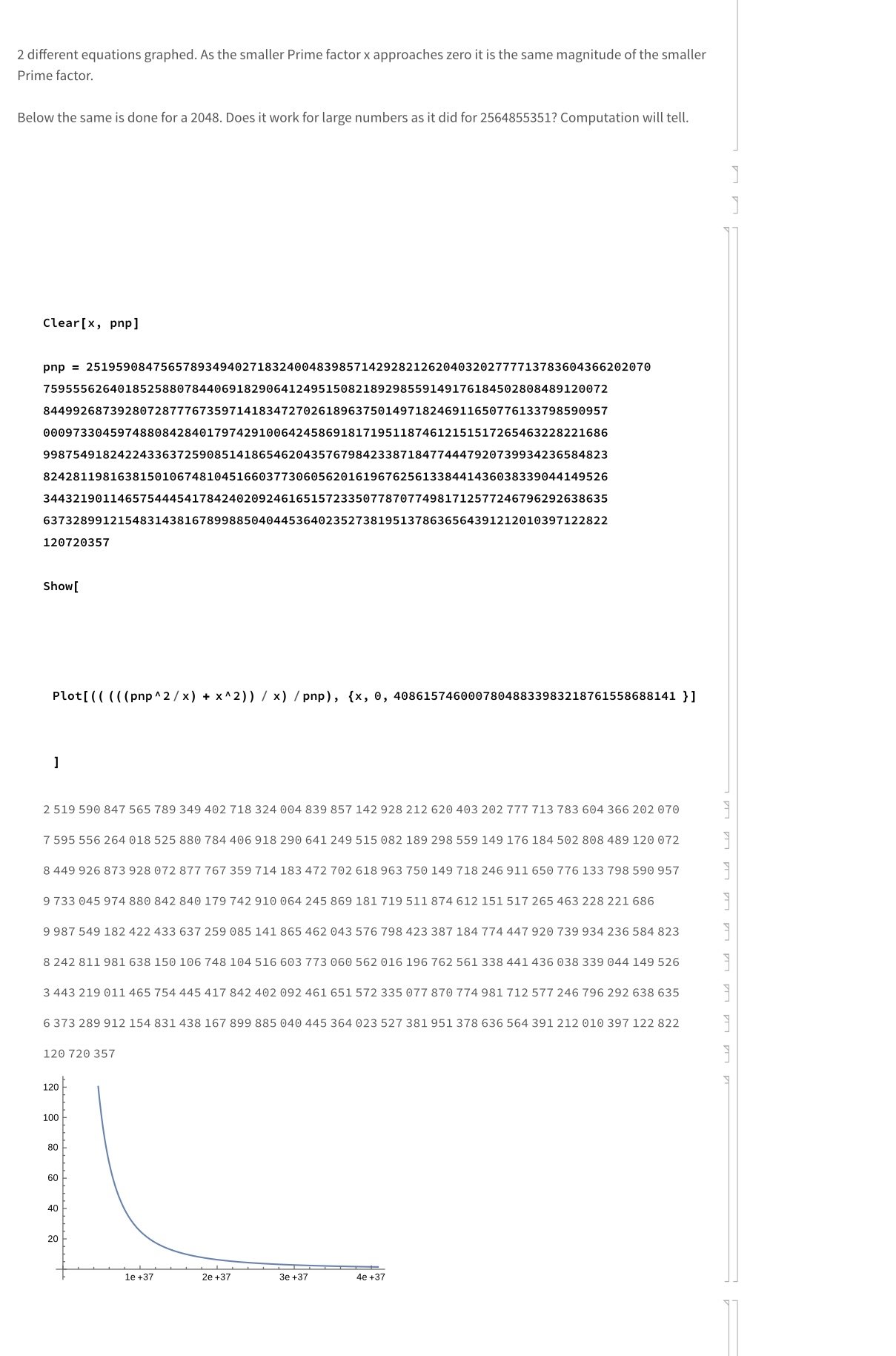
Trurl
Senior Members
-
Joined
-
Last visited
Everything posted by Trurl
-
“If you can’t explain it simply you can’t explain it.” Remember the Iraq war with weapons of mass destruction? Obviously the U.S. had a strategic reason to be there. The Senators all voted for it. But they tell the media it’s wmd. Likewise the Israelis want to occupy the land that surrounds them for defense in a larger conflict. Their wmds are freeing the hostages. For Russia they have invaded Ukraine. I don’t know the reasons behind this war. The media hasn’t given the Russia’s view. I say Trump will fix it because he is going to make a deal. We are going to compromise and may lose many resources but the result is peace. Camela would spend trillions on the war machine. We will continue to arm Ukraine for what? So they can be killed slowly. Camela has no plans for peace. Look what the Biden administration did in Afghanistan.
-
I think everybody here is arguing the same thing, that is they don’t like war. I think the pager thing is great that they targeted the leaders and not bomb the entire city. But if they did that to our leaders we would bomb them. I'm going to make a prediction. A prediction the forum won’t like but looking at history is true. If Harris is elected we will become more involved in these wars. Trump will fix it. Israel is our ally but shame on us for turning our head while they kill 40,000 people. Joe Rogan once said on his podcast that they wanted to impeach Trump for something stupid. He said we’d have to impeach G.W. Bush for all his wars. In the Steve Jobs bio they interviewed WOZ. Woz said the company grew but Jobs was ruthless. (Paraphrasing here.) But Woz wonders if it could be done any other way. That is the question we should ask ourselves. We look to live better but we are killing each other. Can’t I live even better. Why are we killing millions of innocent people that have nothing to do with the military threat. I just wanted to add that Israel’s intention is probably not to cause mass casualties. They probably cleared out the Strip to gain the strategic ground. In doing so they stop the enemy’s path into the country. Again they should have ask is there any better way to do this without killing civilians. But this move may have saved lives on both sides by deterring more conflict. This is pure speculation by me. But I want to believe this is the reason for the military operation.
-
I’m quite serious about a one way ticket function where the public key is built into the public encryption algorithm. The idea would solve key distribution and add security. You could say that Eve the attacker could just reverse what Alice chose to encipher but it is more secure than that. Alice would encipher the message with any random key and these random numbers would have substitutions and super positions only Bob knows. Alice would encipher her message according to her own random key but the algorithm would encipher the text before it was returned to Bob. I know that it sounds like a possible protocol but as far as I know no one has tried it yet. Which could be because it doesn’t work. Is this how cryptocurrency works? Is this how bitcoin is traded anonymously? I don’t know how the ledger works. But a system like this gives most of the power to Bob.
-
Is posting links to files permissible? I ask because I have Mathematica files on the web that can be downloaded safely and securely. I have been inserting the Mathematica files into the code on SFN, but for clarity I would like to share the notebook files themselves. I posted the following idea as a teaser. I believe the protocol would work. But could someone invent math to make it secure? My odometer turned 10099 to 10100 to 10101; then 100999 to 101000 to 101001 An odometer is like a combination lock, Caesar Cipher, Pagoda, M209, Enigma Machine. But what if the odometer was set to an equation. Different combinations of the cylinders is crackable. That was proven by history, I guess. It would be strong encryption with secret keys, but how would you ever share a private key for asymmetric encryption (public key)? 100899 100900 100901 But what if we took the one way asymmetric encryption and put it on its side. The odometer would be a way. Instead of a public key Bob gives away an odometer in the form of an algorithm. He tells Alice to encipher he message by turning the algorithm (odometer) to encode the message with any key she turns into the odometer. Bob has taken the time to substitute numbers along this odometer. For example number 10 on the odometer could be substituted with a 2. (This could be a substitution in numbers or revolutions.) Eve only has access to the numbers that Alice encoded and a partial algorithm that is public. The key is unique and not symmetric because Alice picked a random key and only Bob knows the substitutions of the numbers on the odometer. Will this equal public key protocol? I don’t yet have the math. I did not want to attach this to the Simple Yet Interesting post because the idea is nonsense. But reading it you should start to wonder if it is in fact possible. It may work but would need some math magic to make it strong against deciphering.
-
I just read my short story of Einstein again. Does it make you laugh? It is like a serious philosophical discussion in every paragraph and that discussion makes Einstein sound simple minded. It reads like: “I am Einstein. I make bomb. Germans should not have bomb. It could blow up.” It is like the 1960’s Batman tv series. Einstein spells out his every move, but in doing so looks like a blundering idiot. You are right it is silly. But the more you read it you will find a science fiction philosophy in every paragraph.
-
I wanted to share a great story that I didn’t write. Do a web search for: John Titor This story is as real as science fiction gets.
-
I’m glad you liked it. I think good science and good science fiction go hand in hand. I think science is the art of discovery and science fiction is how it relates to our lives and humanity. I probably wouldn’t be interested in science if it wasn’t for Spider-Man and Dr. Victor von Doom. It is still challenging to write good stories. Presentation of the story is everything. I just wanted to update my opinion of Einstein’s thought experiments originating in science fiction. I don’t believe it. I know that most ideas aren’t purely original, but these thought experiments have to originate with Einstein. Does anyone agree?
-
I’m going to share a very abstract idea but thinking as a scientist you may like it. I don’t believe in the god of Spinoza. Einstein mentions the mind of God and searches for its secrets. Which makes sense so far. But I would disagree that this God would not be involved with people. These people are of his creations. I picture this God creating everything and having total control over all. To this God it would be like the Matrix. We could visualize him as a programmer of the World. Physics to him would be like a computer model running a set of rules or instructions. This way you could have infinite events happening all at once and they would run on their own. But they would be interesting but after a while they would be boring to God. So God created life. Individual minds that act in the World. These individuals are what make the world interesting. God would know what he thinks of the World but now he has descendants as numerous as the stars in the sky to share it with.
-
Well I was listening to Ch. 2 ; 29 min in Walter Isaacson’s Einstein and it turns out “the light on the train,” “riding a light wave,” and even Einstein’s religious views are from science fiction writer Aaron Bernstein’s ideas. The mathematics of General Relativity is Max Planc’s. Einstein was a know it all jerk. He disrespected his instructors and couldn’t see other points of view. History is not perfect. And there can be different interpretations. I have only listened to 2 chapters. But what do you guys think about this side of Einstein? I have never read this side before. An imperfect guy who did great things. Helped by others. Thrown into situations he couldn’t control. And prevails. Reads science fiction. Excellent candidate to be a Biblical character. Or at least a character in a science fiction short story.
-
I just wanted more opinions of the story. I don’t know if my instructor read science fiction. I wanted to know if it was telling the story or a poor execution of writing concepts. A lot of fiction written today reads if it was written by AI. It has the characters but the story is structured to fit 300 pages. I saw on author on Conan say that he wrote a book only to have the editors reword it. I think this leads to a lot of generic fiction. But who am I to complain. Writing good stories is challenging. Just conjecture. Einstein is always described as a pacifist. But when the Germans want to kill him, Jewish people, and everyone who disagrees I just feel he’d be convicted to help in any capacity he could. I believe he is too smart not to work in nuclear physics. I don’t see any university he works as not be focusing their resources on the war. And we only know Einstein for what history gives him credit for. I was reading a book called Code Girls. Those women don’t get credit for their work mostly. I believe we are told the truth about the patent office and relativity but I don’t think this would be the end of Einstein’s work. Sure he worked on Unification and argued with Bohr, but if his theories laid the concept or the first step for nuclear physics why not focus on nuclear physics and not unification? As a pacifist he would not work building weapons, but he could make sure this knowledge is used for good and not destruction.
-
But if you read my story which is science fiction the story reads better if you know the setting. It is not historically accurate. This is just how I designed the setting. I do not give written instructions that is the setting. Perhaps no one picks this up and hates the story. I can understand why the reader wouldn’t like me augmenting Einstein. He is fine the way he is. But I change the story to create questions and debates about science, how the Russians developed a bonb soon afterward. To me the atomic bomb is like the gun crisis in the U.S. Once you have them you can’t take them away. And if you could go back in time would you kill the inventors or the ones who misused them? Personal I feel by reading Einstein had a bigger role in WWIi. It is just conjecture. But why during WWI did a group of scientists risk their lives to measure the light bent in the eclipse. Was it just to prove Einstein right or did that knowledge have practical applications to the war? I have other thoughts too. But I think my story reads better as a piece of science fiction. The only trouble is if someone did not know the history of Einstein and didn’t realize it is fiction, it would be fake news. That is not my intention. I am only trying to draw attention to the ethics behind science and what man discovers or creates.
-
Well I am not qualified to explain Einstein’s theories. I purposely gave him a better understanding of nuclear physics. I didn’t personally know nuclear physics. Obviously no one liked my story. But it is more of a conspiracy story. Many picture Einstein as E=mc2. But history paints him of a pacifist. I gave him a bigger role in WWII because he is a genius but somehow in the history books he doesn’t know all the theory could be weaponized. He fled the Germans. He was fortunate but even though he didn’t practice Judaism his people were prosecuted. Don’t you think Einstein would aid the Allies anyway he could. I don’t have any books that describe Einstein’s role in WWII. One another note, I placed Einstein on a train but I probably didn’t describe that science well. The whole observer on train. I wanted to draw the attention that Einstein was probably played a bigger part in WWII than history portrays. This short story was not historical Einstein. It is comic book Einstein. Maybe the made up science is silly, but there is deeper questions to ask beyond the science. I know nothing is supposed to go the speed of light. But if it works for Star Trek it works for me. But if I write about the historical Einstein where is the story? I would like to have others share their fan fiction. Write an abstract that would lay out the story of Einstein or anything scientific in fictional form. It is challenging. There is so many plots of the Allies and Axis teaming up to fight alien lizards. But sometimes a bad story is overlooked if it requires the reader to examine it further.
-
I believe alternate history is making a fictional history while historical fiction keeps the original history and tells a story based on fact. Historical fiction could have Einstein thinking. We don’t know what Einstein was thinking but the author could introduce one of his essays and have that be his thought. I chose a man who claims to be a time traveler to put the story together. I hint at the time traveler deciding to kill Hitler or kill Einstein. There is a debate on who is easier to kill. The one with knowledge or the one who uses the knowledge for evil. You could say kill Hitler the bad guy, but which choice fits the needs of the time travel? Also the time travel is a cliche, but it is better than aliens.
-
Yes, it didn’t turn out. I think the trouble is Einstein’s life is already great. If I choose a generic scientist would it read better? I wanted Einstein’s influence in WWII to be more involved. Not only did he stop the Germans from developing nuclear fission, he stops them. All the while sharing the benefits with both the U.S. and Russia. I tried to include a lot of symbolism and questions I have of the entire period. It is alternative history not historical fiction. But I think the story elements are good for a short story. It is the written presentation that fails.
-
Here is a short story (fiction) I wrote for a creative writing course in 2010. The instructor called it disappointing, but it is a short read and I think you will like it. 9 Simply Unified Bobby Joe Snyder ENG340 Creative Writing 10-20-10 Dennis Nilson The sun is rising in the east. It is a busy morning rush which is why he chose to ride now. The people are like atoms circling through the rectangular aisle, bouncing off one another, occasionally releasing a charge off the train. They go to power some unknown meaning. When you are working your hardest as a physicist no one even notices. Your best work comes at the least expected time. It appears if you were day dreaming, while you’re working on unification. So you try and explain your thoughts and it leads nowhere. There aren’t many other physicists on the morning commute. It is hard to think of science with the political situation in Germany. This train is going across the land so beautiful it doesn’t represent the minds of its people. But one could spend all day pondering it and not get anywhere. If only ethics where as simple as physics. He ponders his groundbreaking ideas. “The speed of light is a constant. My example of the train showed that time was different for different observers. It was a ride late at night. If a conductor shines a lantern towards the other end of a train the observer on the train will see the light in a faster time than an observer on the ground, who sees light travel the length of the train car plus its distanced moved (Time Magazine, Dec. 31, 1999, pg. 80).” He ponders further, “I wish to find a unified theory of everything, but the only way to do it is to find a way to travel the speed of light. What if the speed of light was constant, but you could travel faster than light. Would you pass through time? Maybe if we looked at the speed of light as a state of matter. If one travels at the speed of light what would they see? Would they feel their body gaining infinity larger mass, or would they bounce of matter like we know light does? Would they be affected by other light?” “Light and time are just as much a mystery. The more we try and explain them the more dead ends of more complex questions we reach. I thought about how if you excited an object to behave as light, so that it is light. It would experience different laws of physics. The object would be traveling light speed, but would it also experience phenomena moving relative to it at light speed. So the speed of light to light would be the speed of the original light squared. This would continue to do so until infinity with new properties of physics being discovered at each increment of the previous light squared. But my theory is too dangerous to release to the World. I see the beauty of the hills and castles. This is a beautiful land,but do those who rule it deserve such revelation of a new World, when they are quite content to destroy this one. But I say nothing. After all I am only one man.” “Mind if I sit here,” a young gentleman asks? “Hey aren’t you Albert Einstein?” “The seat is empty, that is, at this exact time.” “So what do you know about time Al?” “Enough to know few in the World are using it wisely.” “I agree. Makes me wonder how wise people would treat their time if they could travel the speed of light.” “What did you just say?” “Oh, I’m just a fan of yours. It is just that light and time are such mysteries.” “My friend, who are you, and what are you doing with my theories.” “I am just a time traveler. With an important message for you Al. This is a time period in which those who choose to lead want to destroy what they think is imperfect. What God designed, man tries to perfect, but what is perfection, and who is the judge, but the one who judges us all. Those that see the World’s beauty and amazement are content to be pacifist, because they feel one person can’t change the World, but you already knew that didn’t you Al?” “You expect me to believe you’re a time traveler?” “History tells me. I only know what history tells me, Al. Take this ring. You’re a bright man wear it until you can prove I’m not a time traveler.” The traveler hands Einstein a ring with a wide emblem. Einstein thinks and reluctantly puts it on. “It is all relative after all. Isn’t it?” The traveler remarks then continues. It’s all relative to kill Hitler even though it might be easier to kill you, Einstein. If I were to kill you, there might not be a nuclear bomb, and all that dangerous knowledge would be lost. Of course, it would also be a loss to the world, too. Without the technology in the right hands, Hitler would still win. Kill Hitlerwithout the right people having the technology and his Army still could win. The results will change with either chess piece. Evil will still exist and technology will still progress. I want to save the pieces I have and put the most evil king in check to keep the whole world in check. This is game theory at its finest, so it is with time. This is War. Who else to better decide what to do with the theories than the man who invented them?” Ten days later on a busy morning commute. Einstein rubs his newly gifted ring. As he digs deeper into hole of thought, “I know that if someone had the right amount of power, say very easily from the atoms of an atomic explosion, they could arrange the force and atoms into a pattern, a pattern that would excite matter to the speed of light. No one, especially the traveler, if he is a time traveler, should know this. Why must I know this? In my quest to explain the World I have learned its deepest secret. A secret that is the reason secrets are kept.” Einstein stands up slowly, like his legs are supporting a head that just had weight added to it. “I have a plan. I have a plan.” He moves to the first passenger car of the train. He sees a dark haired beauty sitting alone in a seat reading a Bible. “This is my contact.” He sits beside here and she gives him a girlish smile. “You know American Spies make the sexiest women.” She smiles and asks, “What have you got for me?” “I have my theories on atomic weapons and how to accelerate to the speed of light. It is all in this ordinary lecture document that has a piece of microfilm in a stamp hidden on the document. Something I stole from the patent office.” “What is your payment,” she asks? “I only ask residence in your country for me in my wife. Just take this document to your President.” Al leaves and heads toward the back to the passenger car 2 cars behind the one he was originally in. He spots a red headed women reading the Bible. “What book are you reading?” She gives a full smile and says Psalms. “Do you believe in God Al?” “Of course he created all things I wish to learn. But I’m glad you didn’t say the Book of Revelation, with the state of the World, that is. You know Russian Spies make the sexiest women. Here is the microfilm hidden on the document. I only ask in return for a warm welcome of me and my wife to enter your country. Be sure the president gets this.” He heads back to his original seat. It appears that a man is now sitting in his seat. He makes eye contact, but the man’s face does not hide his hostile intentions. “I hope he doesn’t know my actions,” Einstein thinks. He breaks eye contact but cannot act innocent under these conditions. He moves to the front of the car hoping to hide in a different car with more people or at least let the conductor know someone is after him. He walks quickly down the aisle and spots another man at the other end of the car pursuing him. He gets to the other car and stops the conductor. He tells him of the strange men, but before he can get out another word the conductor forces his arm behind his back. He feels the pain as the conductor puts him into a squatting position. His limbs are practically immobilized. He realizes there is no escape. These men want his information, he just knows it. “Think.” “Think you overconfident fool. You thought you could solve this situation by thinking. It is time for action. There is a time when a man must defend himself by brute force and not his intellect. This is that time!” Einstein bends forward, getting his free arm to the floor. He is now off his back and throws a punch with his free hand. The punch itself is weak, but he is aiming for an eye. The man lets out a wail of pain. But mind or matter, brute force will not save the day. Two men enter the car and club Einstein over the head. Thud, then blackness of space with the slowing down of time, Einstein is defeated. He wakes up with his head throbbing. He has to wake up and get a sense of direction, but he fails because he is in a total black cell. He yells at the top of his lungs. Nothing, no answer just an echo echoing of the slab of rock for walls. He digs into the rock with his finger nails. To what feels like ten days later, he hears a voice. “Are you ready to work now Dr. Einstein? There is nothing like confinement to make a stubborn scientist type talk.” “Get me out of here! What do you want?” His voice is groggy and he is disorientated. Two soldiers pull him out with a rough tug. He is talking but not making much sense. “Unification, unification is the answer to nothing, if not everything. Let the world be unified. Unification occurred on the train. That must be why they’re after me.” “Yes Dr. Einstein,” the higher ranking officer allows him to collect his thoughts. “We are very interested in what you know about unification, especially as it applies to light. To be blunt, we have the technology you always dreamed of, right here, and if you agree you could lead a team that would bring unification to life. Of course, if you don’t agree we will be happy to change your mind in ways that can be very persuasive.” The officer commands the men to take Dr. Einstein to the lab after he stops by the bar. Einstein follows still trying to catch his thoughts. He sees a dimly lighted lounge area with several beautiful women in robes. Einstein is very much a lady’s man, but he doesn’t mix pleasure with the fate of the world. That would just prove corruption and corruption has no place when the entire World is in jeopardy. “I’m a scientist not a playboy,” he says. Let’s go straight to the lab. So that is how it went for the first 30 days. Einstein was introduced to a nuclear device that was being tested by the Nazis. He wondered how they had gotten the device and advanced in technology so rapidly. How did they know about his theories of light other than those he published? He thinks to himself “I am an intelligent man, but never claimed to be better than anyone else, even with my fame. These soldiers think they have the right to meet any of their desires, including killing people and controlling the World. My options are limited. I’m a prisoner and I’m in a dilemma. Everything we do in the World begins with a thought. Thoughts are how we interact. But now I need God’s help, for I cannot think my way out of this situation. It is beyond me. I feel powerless after all I am only one man.” Einstein prays, “God I do not claim to be a religious man, but I do believe in you. You created all the things I wish to understand and help man reach new heights. Now I face a situation where my theories won’t explain the answer. God help me, simply help me, and more importantly help the world.” It is the day of the test, which will use an atomic device in a protected chamber. The goal is not for a bomb but the controlled release of the atom’s energy. Einstein is nervous. He has no option but to comply and perform the test. There is a countdown. Five minutes. “Do you realize there is no way to stop this thing,” Einstein says to the head officer. “Just as there is no way to stop Germany,” the officer replies. “Do you realize what goes through a man’s mind when he is out of options? Of course you don’t you’re a mass murder, but what happens is he chooses the option that is all or none. He chooses the worst thing in hopes that he can avoid it.” “What do you mean Dr. Einstein?” “See, I’m a thinking man. I deal with theory. So as we calibrated the nuclear device I began to wonder what would happen if atoms accelerated a mass to light speed while decreasing its speed to a negative light speed.” “You’re insane you’ll kill us all.” “No, I’m not insane, just desperate. But won’t it be interesting to see what happens.” “You mad scientist I’ll kill you.” “Too late I already choose that option. Now I’m a killer just like you, but look at the bright side we’ll get to see the controlling of light first hand. It’s every scientist’s dream.” With that last sentence the atomic device is activated. The negatively charged atoms are lined into a pattern by being joined with positive charges. The atoms align instantaneously. The entire base is accelerated to light speed and at the same time slowed to negative light speed. The result is a phasing effect that splits all molecules, similar to the reaction of a nuclear bomb, but much more efficient. It eliminates the molecules and atoms completely. The base is gone and so is Germany’s nuclear research. Einstein emerges but there is no rubble or dirt or dust. Einstein notes that all the atoms are gone, because they were released as energy. Then he stands puzzled and wonders, “Why did I survive.” It is theoretically impossible. The whole base was set to disintegrate. He spots a tunnel, which is not an ordinary tunnel. Suddenly, the traveler comes through the tunnel in a 1930 car. This is unbelievable. This tunnel is a warp in the fabric of time. It is an anomaly. “So do you need a ride or not. I’m going to the train station. Looks like you haven’t been home for a while. It is time to celebrate. Let’s get some wine.” What begins on a train ends on a train. Einstein thought that was fitting. “How did I survive,” Al asks? “It was the ring,” the Traveler explains. “It is its own atom pattern organizer, one that organized your body’s atoms and saved you. As the base when to light speed and negative light speed at the same time, you went nowhere. So what was it like to observe atoms being phased?” “I didn’t see much. I was too disoriented.” “So you missed out on a scene. At least you destroyed 20 years of German research. Oh, and the spies made it back to their respective countries. You see in the original history Hitler got the atomic bomb and light speed technology. Of course, if you would not have invented them he would still have his scientist’s technology of jet engines, space rockets, and possibly an atomic bomb. So you see I was always working in your best interest, but when solving one problem we created another one. But there was an overall benefit of stopping Hitler. We have to weigh our decisions to stop Hitler, but at the same time his own decisions affect ours. In my time we have a branch of mathematics called game theory. It is supposed to show optimal decisions. You were just in a game where brinkmanship was the only answer. You proved this by doing the absolution worst option. You risk everything, but won and gained everything in the process. As for the spies they made it home. Now there is a stage mate. There will be an arms race but it will keep the whole world in check.” Now I must go, but remember one man can make a difference and do some good, just as many individuals decide individually to be wrong.” Einstein had no words. What was there to say that hadn’t already been done? He looked at the train window where it all began. “Our actions begin with our thoughts.” References: The Complete Idiot’s Guide to Understanding Einstein Gary F. Moring, 2000 The Great Courses; Games People Play: Game Theory in Life, Business, and Beyond Professor Scott P. Stevens Time Person of the Century Edition; Dec. 31, 1999; Vol. 154 No. 27
-
Ghideon, I have already provided examples that my equations work. Granted I have made many mistakes but the underlying them that calculated N = given N remains unchanged. I am finding where the equation equals zero to find the magnitude of N. Then I test by factoring. When I put the RSA 2056 bit Prime in the equation Mathematica only used the first 75 resulting in a magnitude of 10^37. The size of this RSA number makes it more difficult to work with. The purpose is not to have unreal expectations of finding a pattern of Primes. That has been done before. You start by smashing your head against the wall in an attempt to find a pattern by estimating the distribution of Primes. Then when you make progress you die and the maid burns the paper your proof is on. It is not that I don’t believe or am not interested in the Stanford work, I am just interested in making my ideas work.
-
You are right 10^37 is too small. But the computation is fixable. The equation only used 75 digits of a 617 digit number. It can be corrected.
-
I will research how they are factored. But I did not do research, only original research. I haven't looked at it yet, but those mathematicians at Stanford are above me. It would probably take months to understand them. And are they correct. I will research them. Thank you for the link. I would say the problem with my numbers is that I was only factoring the first 75 digits. Computation gets confusing when the numbers get large. I would say to you on the code I have just posted below in this thread, "Prove it Wrong." Just as I have to prove it right, to me the numbers seem to be working. You could say the first number was wrong, but I don't think it is. My hunch is that you thought the magnitude of the smaller factor I proposed was too small. If there was an algebraic run to multiply a^n and b^m factoring would be much easier. But as far as I know no such rule exists. Read this code I post. I don't know the answer. I don't think anyone can say an answer. This is the distraction of my equations. But if they work it would change how we think about Prime numbers. Clear[x,y,g,pnp] pnp=2519590847565789349402718324004839857142928212620403202777713783604366202070\7595556264018525880784406918290641249515082189298559149176184502808489120072\8449926873928072877767359714183472702618963750149718246911650776133798590957\0009733045974880842840179742910064245869181719511874612151517265463228221686\9987549182422433637259085141865462043576798423387184774447920739934236584823\8242811981638150106748104516603773060562016196762561338441436038339044149526\3443219011465754445417842402092461651572335077870774981712577246796292638635\6373289912154831438167899885040445364023527381951378636564391212010397122822\120720357; x=40861574600078048833983218761558688141 y=(((pnp^2/x)+x^2)/pnp) 40861574600078048833983218761558688141 634833803913729274149046560006110105341653987032644347139491065463960765590983014594270745280490943612524425735691584192357714405134539298334254086508463781769463545365966990230877020139587494264115931259401035776266879854280637911181600802763300680148655445534314280852835966547981430518726074134498756877075347610533912610882082571593792533386863778600058303720971034349799390014347520048267237872419333149303301358190482052097820150373855848496280186985832493081485651076553227345540702399208519938470313956044554498336151298425477716733509134466593458008908417427074091201531204090188340432250521346783546450569186626944925787846341539066839302955697556953200935562068268509147390847569567813190953745889578796065991456608595094775372274724035820106046753346703202092454091532620276574400974810603033731667772333116072331674764649360687392789065558184319741482042496890297790135396659502960271951214593374229349810409021779095513702571776210723562008955029462000296608359090753780513193581054298210353890469163174127612293185453114099745606391072987998065659734323866602790265365503491919975152225157252257325443440549579867786230870245990843625165669247214878065515035182695333007699122793085682845204420142443354543637937394670/1029544493794833810362719399813336867927292796870105985767066638600787949056122326854257679972284970010944308811790024149299718090777560077453412457010521445303837785995429144256429395104047108858051197839406607192157326592513109026780645546804565855787882246931691946026121697600798370743023310919920240496366458210984067304416868633515308096356298816579415040357140823932519476960953659465709561744424103986576674496903092964092709805027103183570967574475083485410490451939386941577863721438385490436407675487353298659477292651598896919377654472607793847335861184927553234887906511137785877776276042420931844038131417543652262939192664076316610833186337 N[y] 6.166161906939770 × 10^578 x*y N[%131] 2.519590847565789 × 10^616 Still working. Let me know what you think. I will have access to the Wolfram files ready soon.
-
@Ghideon I need more hints unless you are saying the number isn’t Prime. If it isn’t Prime it would be close to the actual Prime. I know 38 digits does seem small divided into a 618 digit number. But as I have shown 2 of my equations point to it. So far no one knows what it is. The equations work for 2564855351. Maybe they will work for larger numbers. I’m interested in seeing how you proved it wrong. Right now I have no way of knowing but division.
-
Thank you Swansont for the quick fix.😀
-
Hello, The 9th page of simple yet interesting has multiple posts over and over. The single post was the intended to reply to Ghideon. The rest was a loop, that I don’t know why it happened. So could you leave the post and delete the copies? Thank you, Trurl
-
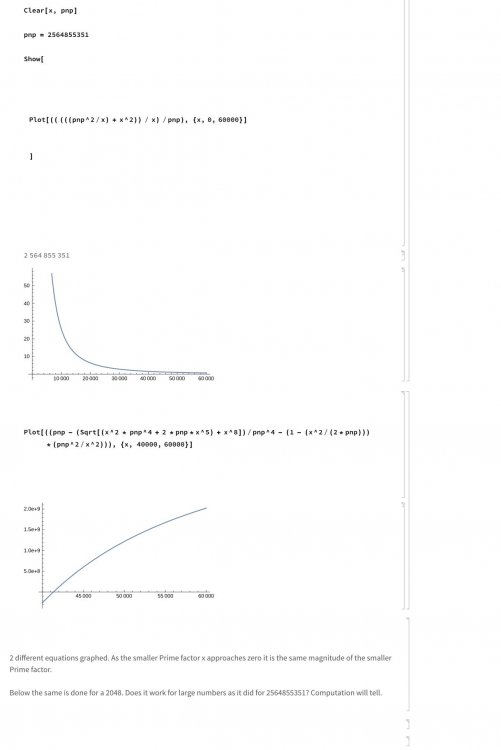
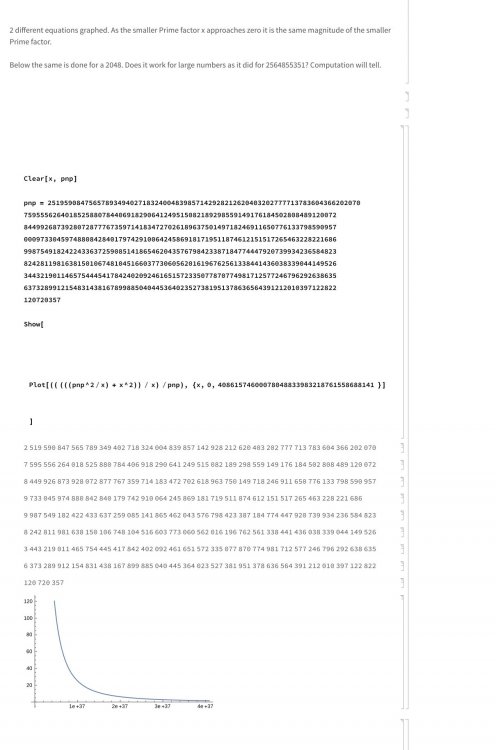
My guess is that you proved my “suggested factor” not to be prime by factoring the “suggested factor.” That is ok because my factor is of the right magnitude. That is if my equations work for large numbers. As the graph approaches zero x approaches the smaller Prime number (in theory). I think I know one more way to test so give me until I post again before you reveal your method. It is late and I need more time to respond.
-
Read into it a little more. I am not saying that just because Einstein is a just man he is a Christian. I am saying how he changed the world and his attitude towards life reads like a character out of the Bible. He warns of the dangers of nuclear fission, he runs from the Nazis, he reveals wonders of the physical world, he tries to relate the physical world to the spiritual world, and he is a role model, and he respects everyone’s beliefs and unites people. it may not be that he excepted Jesus into his life, but given the right arguments I don’t think he would completely dismiss it. He wasn’t perfect but there is only one perfect person in the Bible. Also he had less wives than David. @Ken i respect your opinion, I disagree but I don’t have all the answers. There are a lot of scammers. But you have to test your beliefs. Einstein couldn’t except quantum mechanics. He said God does not play dice. He would not except something that he didn’t have proper evidence for. But it isn’t just a matter of intellect. If no one shows you the right evidence you can’t make an informed decision. Exposure to the wrong evidence is going to make you suspicious of evidence that is the legitimate fact. I think it was Michio Kaku who said the question to ask a physicist is, “Could God have designed the World any other way.”
-
Sorry I didn’t address you. I think your interpretation of the chaplains letter is fair. But remember some still take the letter to the chaplain as a personal God. I know you said I was projecting Christianity onto Einstein, but much of it was to provide an example. I wanted to see if someone else saw an correlations with belief in a personal God. As I said Einstein is a just man and many of his essay concur with Christian values. To me it would be cool if he was a believer, but I understand if he was not. Heck, with his life he could be considered a saint or prophet 😆 That is why Time made him an of the century. I called his life blessed but we will call it purpose driven well lived life. As far his writings go he never claimed to be a Christian. But his actions such as the scientific discoveries, running from prosecution, warning about nuclear bombs…he is similar to characters from the Bible. Yes much of my examples were based on the man Einstein was and not him stating what he believed. I have read bio’s where the state he was a believer in God. God does not play dice. Why would he say that if his God wasn’t personal. By that I mean the God of Spinoza worries about the position of subatomic particles but not people. I would like to read an article by Einstein calling his God Spinoza. I know Einstein was influenced by Spinoza, and Joigus posted a definite quote against a personal God. I don’t know the context. I guess if Einstein said it it was what he believed. But I still find fault in the god of Spinoza. For what purpose is Einstein working on solving the mysteries of the universe if he doesn’t have a significant purpose in that universe? I mean the God of Spinoza created us then has no interest in his creation. Einstein created relativity. He would defend his work because he is its creator. I don’t think a personal God makes the universe less interesting. Einstein used the word God in his essays. That is going to cause debate. IMHO Einstein failed to address this issue because he didn’t want to effect his work. He was too busy working on a theory of everything. No matter your view on the subject someone will always find fault. And everyone loves and respects Einstein. He knows the importance of his positions. By that I mean he may not believe in a personal God, but he respects the beliefs of those who do.When he says a personal God is something he cannot take seriously, could it mean he concerns himself with the creation of God (Spinoza) and does not wish to invoke himself in human religious practices or rituals? Like the John Lennon song, “Imagine no religion.” After all the religious prosecution of WWIi it is reasonable not to be religious. It would not mean he didn’t believe but maybe find relief in trying to discover the beauty behind how the universe works. In his situation I would not want to deal with anthropological dealings of man. You guys no more about Einstein than me. And nowhere does it say Einstein prayed. Eise your interpretation of the chaplain letter is good. You reflect that Einstein was being spiritual. Christianity is a religion is a religion, but Christians are called to be spiritual and not religious. Einstein could have told the chaplain your son is in heaven just as if the Chaplain would hear from a religious figure. But Einstein is not a religious authority. Instead he decided to share something personal on what he believed. It may or not point to a personal God but what he is saying is our lives matter. There is more to what we are concerned about in our lives. Personal God maybe; probably not. Einstein probably wouldn’t tell us anyway. But looking at his life, actions, and writings any thing is possible.
-
I concede that it is not provable that Einstein was a Christian. But there is indication that he believes in a personal God. And that belief in a personal God is applicable to many religions. That is Jewish or Christian or other faiths I don’t know about. And it isn’t just me who states he believed in a personal God. He mentioned God a lot and it is debatable that he was talking about the God of Spinoza or a God of creation. But it doesn’t mean there are not Christian themes in his writings. He has articles that talk about building a nation for the Jewish people. You are right Einstein was too smart for that. He isn’t going to trash a good idea if it came from a Christian, Jew, or atheist. And you are right Christianity is a religion. But Christians are supposed to be spiritual. Einstein was a just man. He is going to agree with Christians on many topics. He may not mention Jesus but they share many traits. What bothered me about this thread is that no one thought Einstein lived a blessed life.