Skip to content

Generalizing similarity test to non-symmetric matrices, tensors?

Featured Replies

There is this basic similarity test Tr(A^k) = Tr(B^k) for k=1..d for symmetric matrices allowing to conclude existence of orthogonal O such that AO = OB.

Practical question is how (if possible?) to generalize it (finally to tensors, but at least) to non-symmetric matrices e.g. including transpositions.

Checking Jacobian criterion for Tr(A^k (A^T)^l) = Tr(B^k (B^T)^l) for k=1..d, l=0..k-1 at least for up to d=5 has sufficient number of independent invariants (d(d+1)/2) - is it sufficient condition in general dimension? If not, how to extend it?

Used Mathematica code using Jacobian criterion to find the number of independent invariants, assuming upper-diagonal as in Schur decomposition, getting d(d+1)/2 as required up to d=5:

d = 5; M = Table[If[i > j, 0, Subscript[a, Row[{i, j}]]], {i, d}, {j, d}];
inv = Table[Tr[MatrixPower[M, k].MatrixPower[Transpose[M], l] , {k, d}, {l, 0, k - 1}];
MatrixRank[jac = Table[D[Catenate[inv], v], {v, Variables[inv]}]]

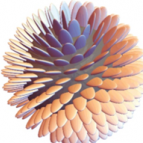
Motivations ( https://arxiv.org/pdf/2601.03326 ), especially if reaching also for tensors, is complete shape description up to rotation e.g. for chemoinformatics, medical imaging:

enter image description here

Edited by Duda Jarek

  • Duda Jarek changed the title to Generalizing similarity test to non-symmetric matrices, tensors?

I reckon this must be worth +1 just to introduced to Gaussian splatting.

  • Author

Yes, one direction here is considering more sophisticated primitives than in gaussian splitting, e.g. multiplied by polynomial.

But direct question is about better rotation invariants than e.g. spherical harmonics - offering only rough description modulo rotation, while here should be complete.

Studying your article will need some heavy lifting, but here is an extract.

Keywords: machine learning, feature extraction, rotation in-

variants, shape descriptors, multivariate polynomials, tensors,

shape similarity metric, medical imaging, image recognition,

chemoinformatics, 3D scene understanding, Gaussian splatting

Create an account or sign in to comment

Important Information

We have placed cookies on your device to help make this website better. You can adjust your cookie settings, otherwise we'll assume you're okay to continue.

Account

Navigation

Search

Search

Configure browser push notifications

Chrome (Android)
  1. Tap the lock icon next to the address bar.
  2. Tap Permissions → Notifications.
  3. Adjust your preference.
Chrome (Desktop)
  1. Click the padlock icon in the address bar.
  2. Select Site settings.
  3. Find Notifications and adjust your preference.