kristalris
Senior Members
-
Joined
-
Last visited
Everything posted by kristalris
-
2. Quoting a Post We also have a system that allows us to quote another post from the forum - the software will automatically add in the name, time, and date of the post quoted as well as putting a link to the source. Within one thread this is a one click job - a. click the quote button at the bottom right of the post you wish to quote. Hit "return/enter" or use your mouse to move the cursor outside of the quote box, and then start typing your response. You can see the link button that appears on a post quote - clicking this little curved arrow will take you directly to the quoted post. END QUOTE OOPS again. Bit of a John Cleese moment gallantly fighting it out with this unwilling machine. When this digibeet hits the quote button (or even multi-quote button) I get the entire quote box. It used to be possible to simply put the cursor on the spot where I wanted to snip double enter and the box split. This doesn't work anymore. Now I'm trying to understand what is meant by above quote. When I get an entire quote box by hitting the quote button and I need to edit this in more quote boxes is that what is meant by multi-quote? Because that doesn't work either. When I hit the little arrow I end up in the quoted post and then what? How do I get back to my intended reply box? Let alone not getting anything to appear were my cursor is at as you say. Now I guess someone is going to tell me that I should par rules have referred to the help desk. Anyway: help (please).
-
https://www.youtube.com/watch?feature=player_embedded&v=pQHX-SjgQvQ The medieval help desk https://www.facebook.com/photo.php?fbid=601817826572591&set=a.157796790974699.40772.157750900979288&type=1&relevant_count=1 When you use it on your feet you'll certainly also believe that you are able to walk on water.
-
Well I don't see that as the point of the thread. The thread title and OP must be placed in a scientific context. So the title in that context is correct as a start of an honest inference. The OP is incorrect in the idea that science at all can deal with truisms. It doesn't per definition.
-
To keep my reaction to your question as short as possible and intelligible for those not following the other discussion part of my answer is in this thread as you know: http://www.scienceforums.net/topic/80193-the-bayesian-machine/?p=779504 In further answer to this specific question on relevance: everything you guess or know to be because many you know agree that it’s a scientifically accepted fact or that you deem it to be commonly held to be true that is larger or smaller than a LR of 1 is relevant. It is not circular because it’s testable: i.e. you can check whether others accept your guess, for instance that nurses hardly ever if at all kill patients against their will or in conflict with the rules. A guess presented as a guess is scientifically valid. An honest guess is possible reality.
-
EQ Nope: the rule is: observe ALL (you reasonably can) then guess in order to formulate a testable most probable hypotheses in the logical language required/ dictated by the amount of relevant data (and thus not by any communis opinio on that matter) and then test and observe. And keep on repeating this process. No Hollywood. So the title is correct and the OP wrong.
-
EQ The reasoning you do here is: I’m always right so the other must be wrong => absolute proof. Even a mathematical proof stating something like 0 = 0 like you do with the prior odds doesn’t constitute absolute truth (= absolutely no exceptions or assumptions whatsoever). What 0? Absolute zero? What is that then? Does it even exist? Even as a thought? Indeed what is absolute proof? It is something you need to get your OP in order. But you are then outside science. As I stated - without having to wave my hands - all along. Not only outside science on the basis of a short cut stating it is evidently wrong, which in fact is nearly the only Monty Python act you do, but also via extensive not in any way properly rebutted by you argument on my part. Indeed only shy of actual full blown mathematical proof. It is easy to claim that Bayes is irrelevant especially if it is indeed Bayes that proves you wrong. You didn’t even know that any argument verbal mathematical or whatever can be dealt with via Bayes. If that is so how can it ever be irrelevant. And again you flunked your Bayes for no, when you fill in anything for the LR even looking at what it should be your OP is busted. Because indeed once you’ve done the analysis it might indeed be that all the subsequent LR and the prior odds are 1. I.e. irrelevant. Or are extremely smaller than 1 disproving the probandum on a given norm. Sorry mate Bayes doesn’t use 0 other than when using infinity. The latter in science can only be had as an assumption. So you got that wrong as well. So no mate you don’t get further than Monty Python arguments and nitpicking. Concerning the latter what is the essential difference in this context between a priori and the prior odds BTW in your opinion?
-
EQ Well you seem to imagine you are part Moose or were you not quite yourself when posting the image of yourself that is possibly true. Indeed a Moose isn't a centaur. In science (= rules of the site even if philosophy extends outside of science)you simply may not say as an argument the a priori is the posterior as the OP does. It is a circular argument and thus a fallacy. (The mathematics proving this at the deepest level is Bayes.) Deterministic reasoning that is involved trying to prove the OP doesn’t cut it because it inherently must presume that the involved error is acceptable such as being negligible. Yet the latter is again probabilistic. You can’t circumvent this without claiming to know the absolute truth. Do you scientifically claim to know that? You are allowed shortcuts if not contested and you are not allowed to go into a Monty Python act. Furthermore it may be assumed and even demanded that the opponent in a scientific debate is of good faith. I.e. you are not allowed to act as if you imagine something to be true if you already know it isn’t. Imagining things true and subsequently investigating it via hypothesis testing and observation is at the heart of science, namely to test incorrect a priori notions even if they – and especially in fundamental research – are in conflict with the a priori paradigm. The mathematics show the correct way to do this and that is indeed doing what the title says believing that if you can imagine it that it can possibly be true. That is what currently certified crackpots like Einstein, Newton, Columbus et cetera did, and showed that that furthers science enormously. The OP is wrong in practice and in theory because it can mathematically be proven wrong .
-
Do you have absolute proof that you can't be a centaur? What is a centaur absolutly exactly? Could there be stipulative definitions on what a centaur is? Could it mean a methaphore of something that you actualy possibly can be? Even taken it to be an magical / mythical beast then still where do you want to get the absolute proof from that you aren't possibly to be one? Well, absolute proof aside: a priori the chance that it can't be true is extremely larger than the chance that you can. There is further more no more evidence availeble to provide any other likelyhood ratio so on a norm held by most if not all scientists what you immagine is possible yet only to an extremly laugheble small degree and on any scientificaly held norm falsified shortly after the possibility you imagined it to be true emerged. Proving the title true and the OP false. EQ Is this anywhere within the realm of science? You've lost me with the: "you can't get evidence from worlds which never happend." You can. Namely seeing either evidnece that contradicts this or the observation that no evididence is Obvious either way. See the centauer. Q EQ According to the rules of the site we are within scientific bounds? What within science can "possible" mean by definition than possibly so and thus probably not?
-
OH touchy are we? Sorry mate but you are making a complete illogical hash out of it. This stems from your idea that philosophy is some sort of exercise that can be done outside of science i.e. logic. And indeed it can as you so aptly prove. Contrary to you then, I’m a layman concerning deep religious and philosophical thoughts that can’t be made to fit logic in any way. It’s not so much me being a layman on philosophy but your apparent lack of understanding logic i.e. Bayes. Look mate, if it doesn’t fit Bayes it doesn’t fit logic and thus doesn’t fit science. Period. You seem to contest this, even though it’s basic science. http://en.wikipedia.org/wiki/Bayes'_theorem#History http://bayes.wustl.edu/etj/prob/book.pdf Now you can falsify this by showing one example that of a true / untrue statement that can’t logically be dealt with via Bayes yet can be dealt with any other tool of logic and / or mathematics. Again Bayes is as far as mathematics can stretch in order to comply to what is logically possible. Other tools of logic such as say deterministic reasoning have a far smaller scope. I.e. you have to then accept the fault rate. With Bayes the fault rate is the smallest possible. But you have then to fill in intuitively as a hypothesis that can be tested what you believe possible. Thus exactly that what you pose in the OP the work of crackpots. So Einstein believing SR was possible before he studied physics and got the mathematics for it was an unscientific crackpot and afterwards a genius crackpot all the same. Furthermore you seem to think that there is something in science besides logic and its tools and observations. All of science proper is built around that. The rest is pseudo-science. Alas a lot of that roaming about within the universities and acclaimed scientists of the world. So what the hell are you talking about when you think there is something more or other? Above that you keep on hashing up absolute truth (seemingly only possible in pure mathematical situations) and reality that you – with the exclusion of crackpots – know of. And again good old Bayes even covers absolute truth, so you excluding Bayes excludes all logic and thus science. Bayes has no boundaries in its possibility to describe any truth. Other than that it is very cumbersome to work with if applied correctly. Now simply admit to being wrong, for you are. Oh and BTW your last sentence is a strawman. An hypothesis is - per definition - ultimately what bayes makes of it. And that is not what you make it out to be. I.e. a fallacy of hindsight or authority.
-
Gees, Thanks for your reaction. Posted Today, 07:55 AM Kristalris; After reviewing your last post, I had a lot to think about. Most of the problems with your argument are not due to bad reasoning; they are due to misinformation. This is a commmon problem in the Philosophy forums, and not your doing, as this misinformation is perpetuated by the current attitude toward philosophy. I am probably not the best person to explain this to you, but you deserve a reasoned explanation rather than ridicule or condescention, and I don't see a lot of philosophers cueing up for the job. My knowledge of philosophy has been gained informally, so you will have to accept my layman's simplified version. It is my hope that I can explain this problem without offending you or the scientists, so please consider: kristalris, on 12 Nov 2013 - 09:55 AM, said: I’ll start my reaction to the above here. Did you notice that the General Philosophy forum is in de Science Forums under scientific rules? I think this is the crux of the problem. Philosophy has never been under scientific rules, science has always been under philosophic rules. You may have heard the statement that, "Science is a child of philosophy."? But you have never heard that philosophy is a child of science, which is because science got it's rules from philosophy. Well of course I have yet this is the part of philosophy that is part of science. There is also a religious forum that thus looks on religion through the spectacles of science: i.e. the specs of Bayes. So if you like to philosophize outside Bayes be my guest, but then please don’t claim that you are reasoning logical. So yes I a priori already acknowledged that philosophy is broader than science. Outside science you have IMO the right to believe what you like, be it religion or philosophy. So outside the realm of science the OP could be held to be correct. Like the absolute truth of God in high heaven if you like. Although science and philosophy share a common root, they are very different disciplines, and this difference is what is not well understood. Consider that philosophy started out as a discipline that studied what is real and true, then early on philosophy found that some things that are real and true are "fixed", others are not. These "fixed" truths are true to all people no matter the perspective and no matter the time; such as, a book which is a "fixed" truth. A book will remain a book from one day to the next no matter how many people look at it, it will still be a book and will still be in the same place unless some cause moves or changes it. As more and more was discovered about "fixed" truths, an entire discipline evolved to study these "fixed" truths. That discipline is science, and the "fixed" truths are now called facts. Science studies the facts of reality. Sorry mate but there never has been a single book that has been in a fixed place I’m sure. Then you would have to provide a fixed reference place to what that book was fixed. The only thing mathematics and logic does is provide the existence or non-existence or partial existence in the measurable change. That doesn’t then exclude the possibility to dream up anything you like and a priori consider the possibility that it is true. That as such has nothing to do with the mathematics. Philosophy continued to study truths that are not "fixed" and the unknown. A truth that is not "fixed", is a truth that is relative to perspective and/or time, as time can change truth and each different perspective can have it's own truth. The unknown is extremely difficult to study because it is just too easy to imagine what we wish the "unknown" to be and rationalize our imaginations into supposed truth. So the discipline of philosophy must adhere to much more strident rules, that science does not have to deal with. Philosophy studies the truth of reality. Indeed, what I just said. IMO meta physics is science and philosophy at the same time as long as the relationships you assume can be described correctly accurately in compliance of everything you hold true. Although the study of probabilities is based in science, math and fact, the results of the calculations are probable--not truth. Probabilities study predictability for purposes of decision making, control, and power as regards the unknown. This is not a study of reality or truth. Like I already stated Bayes can most certainly even cover absolute truths. You fill in infinity. I.e. since the cave of Plato we know that we will never reach an absolute truth other than by guessing. (= Bayes BTW) Even the question whether there is an absolute truth :God or whatever: I believe a never to be known deterministic begin state at any given point in time and a subsequent game of Yin and Yang between pure chance and deterministic boundaries, we will never know, other than getting very close to that absolute truth via Bayes and accurate scientific observation. Being the latter on Occam then better (more probable) than having a God and also much better than having something from nothing magic by Krauss et all. The latter misusing mathematics. Quote This follows from Bayes itself when you take the broadly accepted probabilistic rule of Occams razor. The simplest most easy way of dealing with a problem using the least assumptions is – probably (=Bayes) best. This may well be true, but it is also true that one can always find a solution to a problem while considering only one assumption. That assumption is that the problem fits the solution. (chuckle) Philosophers are sticklers about reality and truth, so we like the solution to fit the problem, which can sometimes complicate things, but we really do like truth, so we put up with the complications. Apart from in pure mathematics will you find this truth, other than maybe guessing correctly the absolute truth of a TOE in such an accurate way that all subsequent predictions meet the following tests to that degree of accuracy. But that is Bayes again. Quote So the Bayes formula taking in as non-garbage the rule of Occam shows that I as a lawyer given the goal of Just law to try and keep the order within democratic and Just boundaries, shows that we lawyers as a rule should only use mathematics in the courts in exceptional cases. And if we do to do it right by bringing in the correct mathematical expert to get it right. Instead of trying to keep the order by using Bayesian nets etc. (edit: Because they are to bloody slow in order to keep the order. In law we don't have the luxury of finding the truth using ten scientists to take ten million dollars in order to find the truth in ten years. Science on the whole can.) The same argument goes – yet to a lesser degree - for using normal language in philosophy. I retired from law and would like to discuss this, but it would take us off topic. So another time. Quote It is not democratic it is a logical / mathematical dictate. This then answers your question on “if” and on a hypothesis. The route/ formula requires to put it in that order, and so always to come up with a testable hypothesis. Probability does not equal truth, at most it equals "close to truth--probably". So no it does not answer my question on "if". Bayes theorem is also not fact, it is theory. Truth can be based on fact, but it can not be based on probability, and can only be considered on theory. Not true again just fill in infinity. Bayes accepts you assuming for instance that the universe is infinite. Given then this absolute truth you can see if it can be made to fit the rest of your observed of assumed absolute truths. Logic and mathematics are inherently about taking absolute truths. So Bayes in fact also dictates that you take the universe not to be infinite to see how that can be made to fit the picture. Quote The Bayes formula is a mathematical tool and thus not the truth. It is a method for finding the truth. That applies for mathematics on the whole BTW. The Bayes formula can even do absolute truth you simply apply infinity. Here you are mixing science and philosophy again. Mathmatics is a study of facts that can find more facts, but that does not mean that these facts will find a larger and unknown truth. And there is no such thing as "absolute truth". It does not exist. In order for a truth to be "absolute", it would have to be true in all times from all perspectives, so it would be a "fixed" truth, which means that it would be a fact. Try going into the science forums and telling them that you have found THE ABSOLUTE FACT. Let me know how that works out for you. (chuckle chuckle) Well Bayes would answer there either is or isn’t an absolute truth. You will have to investigate both. The one that fits best is ultimately maybe even to be taken as the absolute truth op to a point and baring any future observations that are observed not to fit this absolute truth. I.e. Law of Everything. What you by excluding Bayes are on about is, I guess that there is room in philosophy for illogical reasoning. Well, like I said there is, but then you are outside science. I’d like to philosophize inside science. Bayes is the ultimate arbiter of logic, logic cannot be stretched further . No Bayes = no logic = no science = no scientific philosophy. Claiming science then = pseudo-science. Bayes + all known (to individual see OP) or known observations to science on the whole (or in part by norms held in certain fields) = correct scientific procedure in the first and science in the latter. => OP =/= science or scientifically valid philosophy. Quote Now that doesn’t mean that you are not allowed in science to take quick and dirty shortcuts. As long as you say so: “I’m speculating” makes it scientifically valid; as the speculation forum correctly shows. It is true it is a speculation then. It may be true that it is a speculation, but that does not make it a philosophical truth. This may be part of the problem that blurs the distinction between philosophy and science. When science started to speculate, it may have also started to view philosophy as speculation. Speculation is based in some facts; philosophy is based in some facts. Speculation deals with unknowns; philosophy deals with unknowns. Speculation is often pseudo-science; do people think that philosophy is pseudo-science? Maybe. This may be how the comparison got started. No, like I stated earlier Bayes deals with all that. Philosophy holds a very high standard for truth and speculation does not meet that standard. You may believe in an illogical and or un-observed truth but not in science. Quote And possible means a probability when translated to Bayes. (EDIT2 Because (small =) possible + (larger =) likely = 100% or small possibility / large possibility = probability. Yet it is of course far more complex then that, hence then the need to revert to mathematics in order to explain in full.) But possible does not mean a probability in philosophy. Quote So anything you can imagine can be true. Here you are playing a word game that destroys your logic. The sentence was, "If I can imagine it, it is possible". It was not, "If I can imagine it, it CAN be possible." This is yet another example of changing the problem to fit your solution. Philosophy studies that which is real and true, so we can not adjust reality to fit with our solutions. The original statement is not true. Oeps, I guess I got the wording of the OP wrong. Meant it to be the same. Anyway the conclusion stands. (I don’t see that much difference between the one and the other but I meant the OP wordings.) Quote The problem is that those scientists who know they are bad guessers don’t want this to be true. Maybe so, but this is still about "guesses" and probabilities, it is not about truth. This is a philosophy forum and we deal in truths. The statement, "If I can imagine it, it is possible." is not true. It is a word game. Edit oeps: the statement given by you is correct and the OP isn't is my position. Well, we agree that the OP is not true. And indeed it is a word game. To a degree. Even if you take the entire OP it remains incorrect. Ultimately we will reach the limit of what we can measure and observe and logically via Bayes can string together. Even then there will be the Bayes / Plato cave. Edit 2: The point I think is also central too your error in reasoning is that you mix up deterministic reasoning with Bayes in the sense that you think a la Rutherford that deterministic is superior in a way. Correct Bayesian reasoning in no way conflicts with correct deterministic reasoning or any other correctly used "language"of logic. Yet it does have a much broader scope, unless you accept an extreme error rate using deterministic reasoning. That is logic. So it even reigns over verbal logic as opposed to mathematical logic. Language that we are using is nicely vague and works thus better because faster in lots of area's. The example given in law thus is not off topic. The scope of the OP is namely implicitly stated infinite. That Bayesian probabilistic reasoning thus rules all of science isn't in conflict with the fact that it is an extremely marginal affair for the times you actually have to resort to it. Consider: If the statement, "If I can imagine it, it is possible." were true, then I could imagine that it would be true for me and false for you; therefore, anything that you imagined would become impossible. But being the clever person that you are, you could simultaneously imagine that everything that you imagine is true, but everything that I imagine is false; then neither of us could imagine anything that would be possible. But then Harry Potter, who is more clever than both of us combined, could see this problem and immediately imagine that everything he imagines is possible, but everything that anyone else in the world imagines is not possible, so he would win. He would be King of the World, Almighty God, the beginning and the end--a solipsist. But I thought you agreed that solipsism is nonsense. What do you think Monty could make of this? Montgomery renowned for his sense of humour would probably of laughed his head off. K.
-
Kristalris; If we are going to continue this discussion, it must be between us and not include negative comments regarding other member's abilities. I do not always agree with YodaP, but have read enough of that member's posts to come to the conclusion that YodaP has a good mind and an understanding of philosophy. So I have no wish to debate the merits of any third-party member's posts, and would like to keep this between us. Because you ask me this so adequately I will. And I agree with your opinion on YodaP. I simply took the OP as a condescending crack at crackpots and I took the same tone in reply playing the condescending crackpot as a reappropriation. Because if we (in general) are in discussion it should be on equal grounds. The problem that I have with your argument is that you seem to interchange the word "probability" with the word "possibility". They are not the same. Now if the original statement was, "If I can imagine something that fits within the parameters of science and Bayes probability theorem, it is possible!". Then I might have to agree that this is possible, but that is not the case. The original statement, "If I can imagine it, it is possible" sets the parameters of "possible" under the parameters of "imagine". Imagination has no parameters. And according to you, imagination is garbage and does not fall within the rules of Bayes Theorem, as follows: Quote A truism doesn’t exist in the Bayesian formula other than an incorrect garbage in prior odds assumption namely what you (implicitly) imagined. So I don't agree that Bayes Theorem even applies in this case. kristalris, on 11 Nov 2013 - 4:21 PM, said: On a scientific norm solipsism is IMO indeed nonsense. Though baring absolute truth where our solipsism and religious i.e. non-scientific norms are at, we immediately come to Bayes. And then anything can be true by this - unanimously – in science held to be true formula, in which it is so that anything is possible and testable per definition. I certainly hope you will forgive me for this observation, but it appears as though solipsism, the religious "God" idea, and Bayes Theory have something in common. They have each taken an idea that they "imagine" to be true and applied logic to this idea in order to rationalize it and make it appear to be real. This is not reality. (chuckle) Quote The scientific i.e. Bayesian formula requires ANY scientist to ALWAYS walk the route of the Bayes formula. (Or the other given routes deterministic et cetara Lucky for me, I am not a scientist. I am a philosopher. Did you notice that this is the General Philosophy forum, not the General Science forum? I’ll start my reaction to the above here. Did you notice that the General Philosophy forum is in de Science Forums under scientific rules? Now if it is science then the rule: if it ain’t Bayes it ain’t science applies. The Bayes formula fits everything that mathematics can solve. It has the largest scope and will render if used correctly even deterministic reasoning. Now that doesn’t mean to say you should always use Bayes. This follows from Bayes itself when you take the broadly accepted probabilistic rule of Occams razor. The simplest most easy way of dealing with a problem using the least assumptions is – probably (=Bayes) best. So the Bayes formula taking in as non-garbage the rule of Occam shows that I as a lawyer given the goal of Just law to try and keep the order within democratic and Just boundaries, shows that we lawyers as a rule should only use mathematics in the courts in exceptional cases. And if we do to do it right by bringing in the correct mathematical expert to get it right. Instead of trying to keep the order by using Bayesian nets etc. (edit: Because they are to bloody slow in order to keep the order. In law we don't have the luxury of finding the truth using ten scientists to take ten million dollars in order to find the truth in ten years. Science on the whole can.) The same argument goes – yet to a lesser degree - for using normal language in philosophy. In an argument different personalities like – as in sales even require - different ways of reasoning. Some like nice short black and white deterministic reasoning. I’d say even the greater part. Most don’t like Bayesian ramblings. I.e. when arguing about the Dutch topography taking into account the workings of the sun and the moon. Because you can’t understand the one without the other, witch to a narrow deterministic mind is an irritating challenge. Quote It is not democratic it is a logical / mathematical dictate. This then answers your question on “if” and on a hypothesis. The route/ formula requires to put it in that order, and so always to come up with a testable hypothesis. The fact that the formula requirments dictate a testable hypothesis indicate that the formula is self serving and somewhat circular, so I would question it's ability to find truth. This formula seems to be a statistical game of probabliities, designed to predict reality, but it does not define reality -- or truth. The Bayes formula is a mathematical tool and thus not the truth. It is a method for finding the truth. That applies for mathematics on the whole BTW. The Bayes formula can even do absolute truth you simply apply infinity. Now that doesn’t mean that you are not allowed in science to take quick and dirty shortcuts. As long as you say so: “I’m speculating” makes it scientifically valid; as the speculation forum correctly shows. It is true it is a speculation then. And you are in science not allowed to get into a Monty Python act. You then have to take it to the next level. And that always will be the arbiter Bayes. BTW when I said “garbage in”that was a shortcut. Translating that into Bayes I said: “as a garbage or non-garbage in”. And possible means a probability when translated to Bayes. (EDIT2 Because (small =) possible + (larger =) likely = 100% or small possibility / large possibility = probability. Yet it is of course far more complex then that, hence then the need to revert to mathematics in order to explain in full.) So anything you can imagine can be true. But be careful with rejecting seeming un-truisms. If someone sais 2 + 3 = 6 given certain evidence on a goal he might still be right. The whole is more than the sum of its parts. The research into our brains more and more goes into the direction that we are all intuitive creatures who are deluded in thinking we are rational. Rational as in deterministic. But Bayes is also rational. We use the Bayes formula more as a logarithm (= adding up instead of multiplying): it looks like a 100% log that you shift over the scales of say Lady Justice. Mathematics will show you that you can do it by multiplying as well as adding, then it fits again. It is thus the task of the open-minded well trained and experienced mathematician to spot this by – as these sort of mathematicians do – what is the problem? What do you think is the evidence? Oh, but how is this then? To subsequently provide the correct formula’s out of the book, or to correctly construct them complying to (intuitively using Bayes + Occam =>) in this case use say empirical statistics or any other form or combination of mathematical tools. I saw a National Geographic documentary the other day where like in a Kung Fu temple a expert football player kept on scoring goals even in the dark: reason the psychologists said Bayes in the brain. Good guessing. We even do that in daylight tracking the ball and predicting where it will be because computing it differently will be to slow. The problem is that those scientists who know they are bad guessers don’t want this to be true. The other problem is that they are in the majority and thus in power. If you were MN / God would you for survival of the species have 80% talent for the lead in R&D 10% talent for the lead in production and 10% talent for the lead in sales? Of course not. The 80% leaders go into production. I hope I have satisfactorily answered your question? K
-
Hi G, thanks for your question. Actually come to think of it it’s even more funny that the breach of immoderate infringement on thread hijacking police has come in as well. I imagined Monty Python possibly showing enormous foresight, and look even this hypothesis proved scientifically accurate. On a scientific norm solipsism is IMO indeed nonsense. Though baring absolute truth where our solipsism and religious i.e. non-scientific norms are at, we immediately come to Bayes. And then anything can be true by this - unanimously – in science held to be true formula, in which it is so that anything is possible and testable per definition. A truism doesn’t exist in the Bayesian formula other than an incorrect garbage in prior odds assumption namely what you (implicitly) imagined. The thing is Bayes absolutely always subsequently goes via the likelihood ratios to the norm and subsequent posterior odds to see if something on that norm is true or not. YodaP thinks he is allowed in the – SCIENTIFIC! – Bayes formula to a priori take the prior odds as the posterior. And say that a truism is something that thus is the case immediately. Wrong, wrong, wrong! The scientific i.e. Bayesian formula requires ANY scientist to ALWAYS walk the route of the Bayes formula. (Or the other given routes deterministic et cetara but on which I’m not allowed to elaborate because querulously off topic and even censored.) But does constitute the proof that YodaP is wrong, absolutely scientifically wrong. As so many scientists BTW that don’t or simply can’t understand this. It is not democratic it is a logical / mathematical dictate. This then answers your question on “if” and on a hypothesis. The route/ formula requires to put it in that order, and so always to come up with a testable hypothesis. That is if you want to state that something is true or not like YodaP did in his attempt to crack crackpots like me. So I place the hypothesis of YdoaP in a scientific context due to the forum in which he placed it. He imagined it was true, yet on his own incorrect norm thinking it was possible, was wrong. That most well trained statisticians/ mathematicians and/or creatively intelligent already knew that what he imagined was falsified (i.e. incorrect) has no baring. It is what he at that moment imagined that is of importance. He can even himself after imagining it possible come to the conclusion that it is falsified. But this I did for him. Now it would be nice if he thanked me for that. Learn from your mistakes. And owe up to them.
-
Well I wasn't aware of that. This begs the question where this off topic post has been removed to and secondly what then YodaP and you think the topic is? As I understand it the topic is about crackpots thinking that anything you can dream up (i.e. imagine) has some probability (i.e. possibility) of via a scientific evidence and proof way of being established as the truth (i.e. scientific fact). Assuming that absolute truth is not the issue here and assuming that science is the systematic i.e. logic venture towards what we collectively to a certain degree hold true then a post providing the - scientific & broadly held - rules on evidence and proof is on topic. Given a scientific norm that is. Especially so when it is in answer to the thread starters claim I only made assertions. To get the issue past the level of "yes it is" and "no it isn't" true that 2 + 3 = 6 as a normal rule of scientific debate I took it to the next level explaining the rules by rule of thumb, preventing thus the opponent from hiding there. If we subsequently remain in the Monty Python level on a scientific dispute, then we must take it to a higher level still of mathematical quick and dirty proof. If it still remains a dispute we go to a full blown mathematical proof. Which latter I can't provide myself yet know others who can. (they being exact scientists might be taken aback at censorship, when being cornered so I hope I wasn't censored.) Relevant Illustrations given are regularly given and not deemed off topic so why now then? I'm not the one breaking the rules as stated by you in the threads concerning them, but YodaP is, in not posing proper argument when challenged. BTW I'm thus only asking the two or three questions and trying to ascertain what you think the order is, by giving my idea on that, being that BTW the broadly held consensus in science as to be the rules of scientific debate?
-
Made no argument? Hilarious: you don't even grasp Monty Python that take the mickey out of your way of reasoning. http://en.wiktionary.org/wiki/possible possible means per definition especially in a scientific context a statistical possibility. If you imagine it it thus is the hypothesized a priori or prior odds. Only logically if you have absolute proof (I indeed assert that you don't state that or want to state that) can prevent you from making the fallacy of hindsight bias. You may thus logically and thus scientifically take - absolutely - anything you imagine to be true. As an hypothesis that is. This stands even if science as such already had the falsification on the highest level of proof possible before you imagined anything. Or if you imagine something that you already know to be untrue. In that case you are of bad faith, because a fraud. I already explained this sufficiently for any high school kid should be able to understand. Now I've even bothered to elaborate. These aren't thus simple assertions but a complete logically fine argument. You really don't get further than: "no it isn't / yes it is" Hilarious. Anyway Krauss et all imagine that something can come from nothing. I.e. believe in magic because it is a contradiction. The imagine that this is possible because the mathematics shows that it is, given certain assumptions such as that c = max is the only way to interpret all the known data. Now what if this indeed proves true? (even though being far less probable than a trillion to the trillionth) Or if it proves impossible? Which on a reasonable norm has already been done, even Krauss acknowledges this stating improbable but true.
-
I haven't given bad rep points much if any. You got one for this one from me. (IMO bad form not to owe up to using this button BTW. So, of course I do such. Question of honour.) Your rebuttal doesn't add up to much more than: http://www.youtube.com/watch?v=kQFKtI6gn9Y Now pose proper argument concerning my argument you left out in your partial quote. You are obliged to by the rules of the site BTW. You pinned this topic so you're stuck mate. Simply owe up to your mistake. Do you need me to provide you an exclusive list of possible ways to logically refute my position?
-
Well, if you can imagine it, it always is indeed possible. This is always true, not only with certifiable crackpots like myself (DSM V as with 50 to 80 % of the population of the world and neigh 100 % for all agreed upon geniuses). It is true until disproven on an agreed upon norm. It is called an hypotheses. Per definition an hypothesis is held to be true until falsified. Your hypothesis that an hypothesis always requires mathematics is thus herewith falsified.
-
Agree with Iggy. And on statistics I came across an old blog http://vserver1.cscs.lsa.umich.edu/~crshalizi/weblog/297.html I don't think much has changed.
-
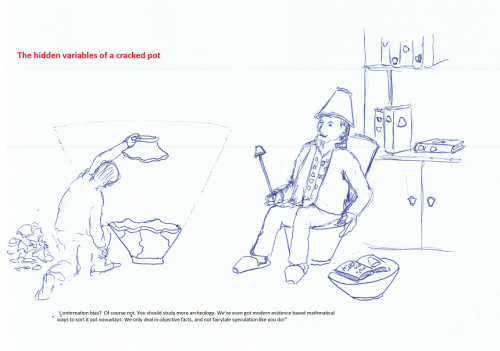
Oeps, sorry, I thought I actually did provide the link to the page. I've just edited it: here it's again http://en.wikipedia.org/wiki/Karl_Popper#Criticism I'll try to use the quote box in future Well it's a bit difficult to ascertain what your pinned topic is: I guess (via an on topic historic continuation what it is on an inherently scientific non speculative topic, that covers this discussion as well) you mean to say in an incomprehensibly elaborate way that there is no room for Bayes in physics? Is that your topic? There is something strange going on with the quote boxes? They seem to disappear suddenly ad random. Quote ydoaPs: I'm actually not wrong at all. The OP is simply a historical survey of the evolution of thought in Philosophy of Science. Each view is accurately represented, and that includes Popper's despite your misinterpretation of what he said. End Quote I gave a direct quote of Popper on the issue that actualy falsifies your position on what you say that Popper stated. I didn't interpret anything. Qute YdoaPs: Your quote: "It is true that I have used the terms 'elimination', and even 'rejection' when discussing 'refutation'. But it is clear from my main discussion that these terms mean, when applied to a scientific theory, THAT IT IS ELIMINATED AS A CONTENDER FOR THE TRUTH--THAT IS, REFUTED, but not necessarily abandoned." (emphasis mine) End quote: You are taking what Popper said out of the context that he himself gave on the issue. Simply take the whole quote I gave what he stated on this issue. Again a clear strawman on your part of Popper. Quote YdoaPs: You're confusing epistemological acceptance with pragmatic acceptance. That's a rookie mistake one can make when they learn about people's position via Wikipedia instead of their actual works. Karl Popper most definitely held that a theory is proven to be wrong and should be rejected wholesale "as a contender for the truth" upon falsification. His view is completely wrong, as shown by the Duhem problem and the more correct version of the Lakatosian Research Programme as put forth by Dorling and Redhead-like I said. End Quote: Argument of authority on your part. I've read more on Popper than you might think old boy, and not just via Wikipedia. Though convenient to refute your position. BTW I don't say or have ever taken the position that I fully agree with everything Popper said. I only state that science isn't only about predictions but about making falsifiable predictions. (Whether it stems from Popper or not is immaterial.) Now you clearly dispute this. That is incomprehensible. Got to go will react further later on. Ah well again an argument of authority on your part. What the overwhelming part of frequentists within philosophy think: i.e. that they can wholesale reject Bayes just shows that they know little about statistics and that is the issue then and not philosophy. Any good statistician could set them straight on this. BTW I learned about this via much more than just Wikipedia and had it checked by the highest authority available (and no I'm not going to prove the latter, I just counter your argument of authority dito.) No-one in his right mind rejects the correctness of the Bayes theorem. The actual issue is stating something on anything with to little data. Can you do so in science? Yes you use Bayes. Period. You are pseudo scientific if you don't know this. Any frequentist / Bayes discussion is only done by those who don't know statistics. Again in the overlap they should both render the same result. So a point of personal preference. When sufficient data are available the frequentist (or even deterministic Rutherford approach) is of course to be used in stead of Bayes. Look into the Lucia de B court case http://en.wikipedia.org/wiki/Lucia_de_Berk to show where a frequentist approach went horribly wrong. Had the first mathematician (professor Elfers) used Bayes instead he would have had a direct pointer in the right direction: a priori do you think that nurses often if at all kill patients? In my world I would guess not and thus require a lot of extra evidence to prove this on a given norm. Bayes the mathematics of common sense. And yes also to be applied on physics questions such as: is there pressure in the system of the cosmos as we observe? At last got it: well this cracked pot picture shows where you use Bayes to fill in the picture. And how you thus falsify other positions that are improbable on the question where to start looking.
-
Rather funny this, continuing a discussion on a locked thread in a pinned one that is a continuation of it. And getting it wrong. Hilarious even. This thread had best be named Effing Popper & Statistics Popper dixit http://en.wikipedia.org/wiki/Karl_Popper#Criticism : Popper wrote, several decades before Gray's criticism, in reply to a critical essay by Imre Lakatos:It is true that I have used the terms "elimination", and even "rejection" when discussing "refutation". But it is clear from my main discussion that these terms mean, when applied to a scientific theory, that it is eliminated as a contender for the truth- that is, refuted, but not necessarily abandoned. Moreover, I have often pointed out that any such refutation is fallible. It is a typical matter of conjecture and of risk-taking whether or not we accept a refutation and, furthermore, of whether we "abandon" a theory or, say, only modify it, or even stick to it, and try to find some alternative, and methodologically acceptable, way round the problem involved. That I do not conflate even admitted falsity with the need to abandon a theory may be seen from the fact that I have frequently pointed out, that Einstein regarded general relativity as false, yet as a better approximation to the truth than Newton's gravitational theory. He certainly did not "abandon" it. But he worked to the end of his life in an attempt to improve upon it by way of a further generalization.[63] So you performed a strawman on Popper. And further more you are clearly not quite up to scratch in thinking there is a useful discussion between frequentist and Bayesian statisticians the one excluding the other. The ones that go into such discussions are effing statistics. These are simply two tools in the toolbox of a statistician, that both should render the same result when used correctly. The one used best is (primarily) dependent on the amount of available data, whereby ("intuitive") Bayesian statistics has a broader application than a frequentist approach, being the latter a more exact approach needing more data. So you're wrong there as well. Now the problem is I've a cartoon as well that I drew myself. Alas I can't figure out how to post the damn thing here.