DavidWahl
Senior Members
-
Joined
-
Last visited
Everything posted by DavidWahl
-
You're right. I assumed a hypothetical scenario where I’d be completely alone and wouldn’t have to deal with others competing for resources, which isn’t very realistic. I strongly agree that, since we benefit from society, we have some responsibility toward it. But contribution doesn’t have to be extraordinary in order to be meaningful. Everyday participation like following rules already sustains society in a fundamental way. For example, properly disposing trash keeps the public clean, activities like buying food ensures economic exchange and talking to my neighbors sustain social cohesion. Yes, while some individuals contribute more actively, a functioning society also depends on ordinary and consistent participation from everyone. Having the time and resources to act isn’t mere comfort, it’s what makes freedom meaningful in practice. They are precursors and without these conditions, freedom only exists in principle but cannot be exercised. Society makes freedom functionally real. Besides, who thinks doing mathematics is comfort? It can be fulfilling to some while others prefer the military than having to succumb to such intellectually demanding activities. A society that allows people the time and space to think, create and explore ideas is exactly the kind of society that sustains and expands its own freedom. It’s not wise to dismiss this kind of use of time as merely ‘comfort’. I see that your vision of a utopia focuses on abundance of comfort such as food, drink and pleasure. You are blurring the lines between comfort and freedom trying to make freedom seem like indulgence. How about we shift our focus from indulgence and focus more on creating a society that is intellectually vibrant, artistically rich, flexible and provides a variety of meaningful opportunities rather than simply satisfying immediate desires? If some our freedom is already constrained by how society shapes us, why not design a society that is mature enough to engage with freedom without abusing it? This stupid "as long as it's not illegal" rhetoric is dangerous. I believe a healthy society is where both freedom and responsibility go hand in hand.
-
If I understand your question correctly, I believe it concerns the subject of free will and for personal reasons, I prefer not to engage with that topic right now. That being said, I think we all recognize that freedom and free will, though closely related, are still distinct notions. Oftentimes, people conflate the two. I see freedom as largely external. It is a condition in which choices are available and we can act on them (regardless of whether those choices are truly our own). A society that provides maximal opportunities for an individual or group is therefore a society with the most freedom. By this measure, I can say with certainty that I have far more freedom than a prisoner because I lack the external constraints they face. In this context, questions about free will do not affect the reality of practical freedom.
-
I completely agree with you on this. Freedom is one of the most misunderstood ideas in modern society. If I wanted to be a free man, I could abandon society entirely and live alone in some distant land. But then I would spend more of my life worrying about survival than actually enjoying that freedom. I would likely devote most of my time to finding or growing food, whereas in society I can use that time to think, do mathematics, or even watch football. Freedom is meaningful only when one has the time and resources to exercise it. Things like refraining from peeing by the side of the road are small sacrifices we make that do not meaningfully affect our broader conception of freedom.
-
That's very plausible, though the only thing that keeps me a bit skeptical is the olfactory part. Based on my limited understanding, one definite takeaway is that the thalamus seems deeply involved in maintaining the coherence of conscious experience. It's likely, what they would say, the conductor behind the illusion of unity and continuity of subjective experience.
-
From what I’ve read so far, it seems like you guys are quite convinced that the thalamus is the primary source of consciousness, not just a contributing part. That’s what I meant by the phrase "centre of consciousness" (figuratively). It also seems like the terms "central role" and "centre of consciousness" are being used interchangeably here, even though they convey very different ideas.
-
@TheVat is right. I see that the usage of the word in this case can be easily misleading if you misinterpret the context. I'm pretty sure the word "central" simply means critical or key here. This shouldn't be confused as it being the "centre of consciousness". The article doesn't explicitly state that the thalamus is the centre.
-
What will I be rewarded with by devoting my life to Nothingness? Will my life come to nothing?
-
I see. Anyways, thank you for sharing this. This is soulful and achingly poetic, enough to make a grown man cry. Now I'm sad.
-
That's like watching the child you raised grow up and die. Do think there's any chance that a chunk of those manuals are still lying somewhere? If I were you, I would've retrieved anything that was left of them and kept it to myself as souvenir...
-
Wow, you're an all rounder, I see. I can barely manage to keep up with one interest. That must've been painful to witness...
-
Yes. Do you happened to be kvian? I was a kvian. It's baffling to see that you're already engaged in advanced ideas at such a young age.
-
Yes, sorry. I vaguely remembered your name when you introduced yourself.
-
Hi Kulraj I'm 20 years old. It's refreshing to see someone from my country that share similar interests.
-
I agree that once actual harm has occurred, it makes sense for traits like ASPD to be considered in sentencing or parole. But I’m still troubled by the question: What do we do when someone shows deeply concerning signs before any actual harm is done? There was a recent case of a teenage boy who created horrifying, disturbing drawings fantasising about murder and later went on to actually murder someone. His father noticed the signs prior to the event but didn’t act likely out of fear of overreacting. Was it right for society to wait? As @studiot also suggested, this issue is far more complex and nuanced than it may first appear. It runs deeper into society. It's not as simple as saying, 'Act only after harm is done,' or 'Don't criminalize traits.' We're dealing with difficult questions now about how to respond to warning signs that don’t yet qualify as crimes but may indicate serious risk. I'm not in favor of pre-crime punishment either but I believe we should at least have a preventive system that allows for early support or intervention when someone shows credible signs of dangerous intent. That way we could protect others without criminalizing mental illness. This is the grey area I believe we need to take seriously.
-
But there's a serious ethical dilemma here. Do we wait for violence to occur before we act even when we strongly suspect it’s coming? If we always wait until someone is harmed, we risk failing the victims who could've been saved, the damage is irreversible. Let's say there weren't any clear and early warning signs like killing the neighbor's dog, then who gets to decide what counts as a threat? How do we go about resolving this without crossing into the line of punishing someone for having a mental illness?
-
This is a good way to show that the dots do cover up the entire circle but what I dislike about this method is that it doesn't say much about the arrangement, it simply ignores it. Depending on the 2D-arrangement we choose, the packing density can change. Besides, I'm not sure that it's safe to assume an array of infinitesimally small circles to be approximately equivalent to a line. What about those gaps?
-
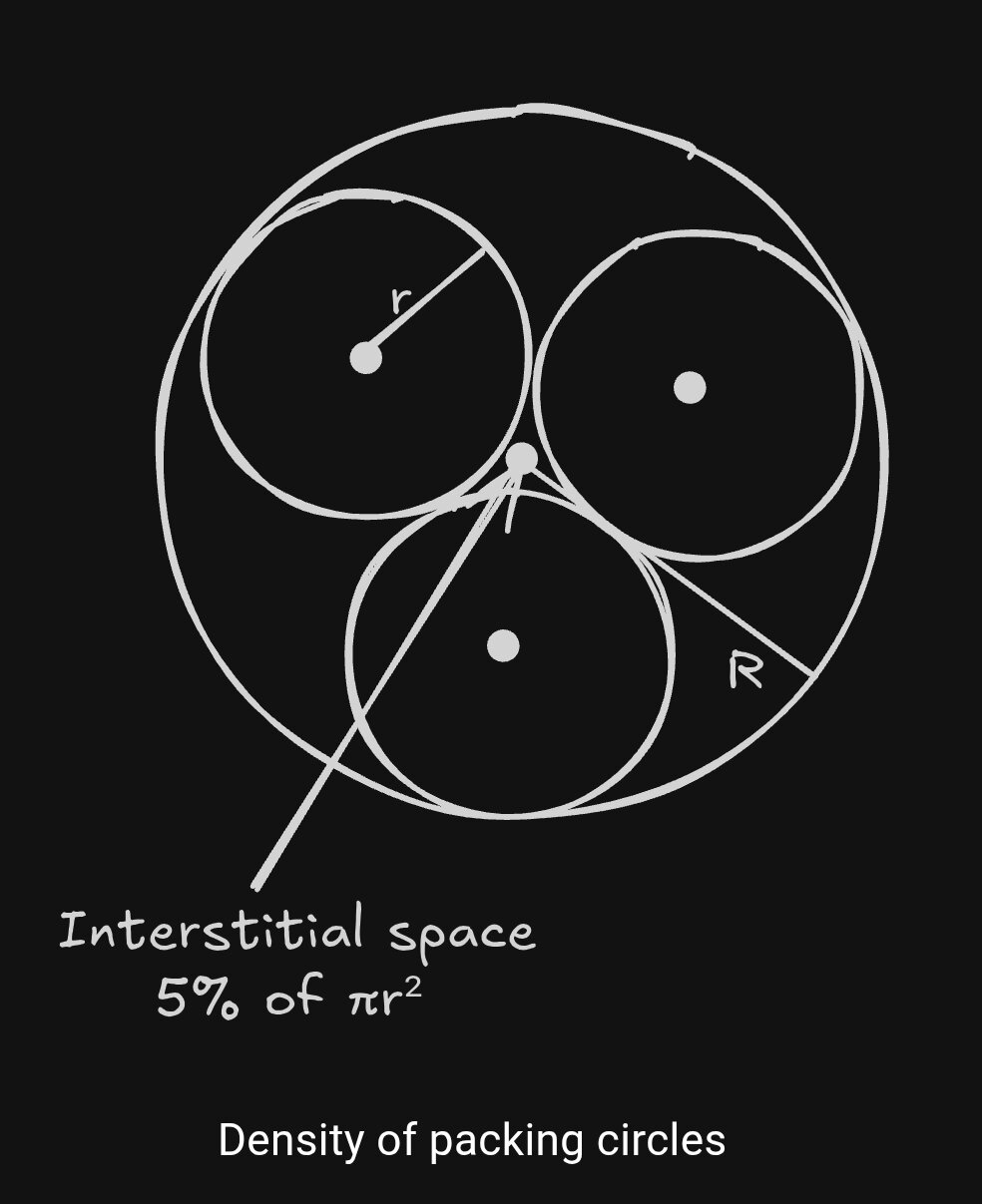
Does someone know this? While I was making a small study on circle packing recently, I came across this problem that left me scratching my brains. I found this problem interesting and wanted to share. It goes something like this: Q) We want to reduce the size of circles and as we do so, fill them up into a different and bigger circle as much as possible (maximum). As the radius of the small circles approaches to zero and fills up the mother circle, 1.Does the packing density approaches to 1 (filling up the entire mother circle)? OR 2.Does the packing density approaches to that of the hexagonal lattice arrangement (i.e. 0.906...) and therefore not filling up the entire mother circle? (For those who don't know, packing density is the ratio of the area covered by the circles to the total area of the space they are packed into. It's a measure of how much space is covered by the circles compared to the total space available.) If you know calculus, in this case, the small circles will behave as infinitesimals and at first, it might seem obvious that the small circles must fill up the entire mother circle. But, if you observe carefully, circle as infinitesimals do not behave like traditional infinitesimals (rectangles) where as the breadth of the rectangle shortens, the gap between the infinitesimals and the curve decreases therefore covering up the entire area under the curve. Whereas in the case of circles, the size of the gaps (interstitial space) remains as significant as the circles themselves making up 5% of the area of the small circle. Therefore, as the size of the circles decreases, both the gaps and the circles equally compete for space. But I'm not really sure if this is still the case when the circles theoretically become point-like. It could be possible that the limiting packing density could be something else entirely.

-
This is something I have come to understand from my own experience; although, specifically in this matter, we don’t have to witness success to know what it demands. I believe we already have all the important information we need. The most valuable benefactor of science will be the one who can fit all the pieces of the puzzle together harmoniously.
-
I agree with everything you said. We don't have a theory of abiogenesis yet but we aren't clueless either, recently there has been significant progress made in the field. I think finding the evidence for the first forms of life would be extremely challenging or maybe even impossible. . Unlike creationists and something we are all acquainted with, the lack of a complete theory doesn’t imply a supernatural alternative by default. Naturalistic explanations continue to dominate with great success.
-
No, they are not. And if they are, it's because you misunderstood my premise and have already formulated an opinion based on a false assumption. That the conditions necessary for life's origin were met at least once and that evidence from history is, to a great degree, logically consistent with our origin. I’m just pointing out that the history of Earth shows a sequence of events that led to life. Whether those events were guided or not is a separate debate. My point is that a contingent natural history doesn’t necessitate a designer, even if it doesn’t exclude one either. Yes, I didn't know what the anthropic principle was when I made the statement at the time. To show that life is possible. I think you're confusing probability with possibility; I should have been careful when using the word "statistical" to convey my topic. Life is possible but how much probable/improbable is another debate. I never stated anything about the likelihood of life. Since we exist, we know that some path (however improbable) led to life; that could be a natural one. Regardless of the likelihood of occurring, our existence is evidence that life happened. Whether it was completely natural or with at least some divine intervention is still an open question. So to settle your confusion: In context, what I meant by "However improbable" is equivalent to "Irrespective of probability". That's a strong argument, but I find the multiverse theory too speculative to rely on when making concrete, evidence-based claims. Well, yes that is exactly what I've been trying to say. My aim was merely to demonstrate that an intelligent designer is not necessary if you tried to argue from the premise i.e. even in the absence of an intelligent designer, it is not impossible for something as complex as life to have occurred. To show that naturalistic explanation suffices and naturalism is currently the better-supported framework because it builds on observable, testable mechanisms. I'm not trying to disregard intelligent design completely but to somewhat neutralise the position on life's origin in this particular case. Arguing on the grounds of the premise is useless because evidence we currently have leans toward naturalistic processes in the origin and evolution of life.
-
I'm only returning the favour...😛 I never said it must. Of course. Generally, it requires intensive labor and great skill to navigate amidst complexities without being lost. And for that, one has to be extremely disciplined and patient, and carry on the process with prudence.
-
Poorly phrased. I didn't know one could deal with external entities inside one's mind. Good thing there's context, so I can still infer your intended meaning. You're right as long as you're talking only about qualia but there's more to consciousness than them; entities that can reside in the imagination but are not necessarily viewed through an anthropomorphic lens. Beyond a single word as common, I don't see how your previous statement has much, if not anything, to do with this one; but yes, you're almost there. If AI gains consciousness and continues to develop, that wouldn’t prevent us from studying the underlying structures of conscious systems (both artificial and biological). We can study those internal structures that gave rise to consciousness. In fact, I believe it could help us uncover more fundamental processes responsible for consciousness beyond the limits of biology and anthropomorphism. Of course, all of this under the assumption that those similarities or components do exist. But even if we fail to do so, I'm sure we can learn many things from this endeavour. Not everything has to be nuanced to appeal to the intellect.
-
Yes, to a certain degree, I can. I don't need to be a dog to understand what it's like to feel hunger or to feel physical pain like dogs do in general because of our shared biological basis. Other than that, I'd actually have to be a dog in order to fully understand what it's like to be one. Forget about dogs and think about a similar case like this involving humans instead. Do you think you can truly understand what it's like to be a homosexual man assuming you're a heterosexual man? Is it possible, purely through the means of imagination and empathy, to understand the feeling of being sexually attracted to a man given that you're biologically/psychologically not androphilic in nature and you've never experienced it firsthand? This case can be applied vice versa. That's only partially true. Scientists still do not fully understand how ai systems work. We cannot always the discern the output of the process because, one of the reasons being, for the same input these systems can give out different outputs. You've misunderstood my question. Human beings are not the only conscious beings in existence. We can program two robots to communicate with each other about what it's like to be conscious and instill a sense of self in them but will that necessarily make them conscious? I think my question is quite honest and clear. I'm still in search of answers. If you find it absurd or difficult to comprehend, I can always extend it's intended meaning through explanations or reframe it in more simpler terms; if you had asked for it.
-
To begin with, I would like to mention that I found this problem very interesting and subsequently, when I read further about it in the replies, I understood what you were trying to say even though you had poorly defined premises that definitely needed more improvement. I'm a highschool student, not a mathematician so I'm not equipped with advance tools or concepts to help you out but as of now with all my efforts, I would still like to make a small contribution to your problem. I must say this is a 'problem that consists even more problems within it' and may not be so appealing to mathematicians but I believe it has some potential in computer science as in someone can build an algorithm to solve this. I've stored my amateur work in the form of a pdf. English is not my first language so please don't mind. I hope you like it. circle packing.pdf
-
Yes I was aware of these facts beforehand. By the way, oxygen is not an energy source itself but is essential for the extraction of energy from organic molecules during aerobic respiration. And by implying that 'this mass extinction lead to all complex life on earth' is simply wrong because it alone was not the sole reason. More accurately it can be said that the rise in oxygen levels combined with mass extinction created the conditions necessary for the evolution of complex life on Earth. I got mixed up and made a silly mistake that slipped out of my notice until you've pointed it out. The correct that I wanted and should have written is: "but eventually life found a way to utilize oxygen for metabolism through cellular respiration although not always exclusively" But after a little reflection, I realised that the above statment would still be an incorrect one. As you mentioned, a lot of organisms died in the process because oxygen was poisonous to them but life didn't instantly evolved to be able to tolerate oxygen and perform aerobic respiration. Some microorganisms (likely ancestors of modern aerobic organisms) already had the biochemical machinery to use oxygen, but most likely this was initially just a minor adaptation. As natural selection goes, when oxygen levels rose dramatically, those organisms that could tolerate or even use oxygen for energy had a significant survival advantage. Since aerobic respiration is far more efficient at generating energy than anaerobic processes, this ability became more widespread and refined through evolutionary processes and is now a dominant metabolic pathway for many organisms. Even cyanobacteria, the main contributors of the oxygen uprise, was one of the earliest organisms that could perform aerobic respiration so that it could metabolize even in the absence sunlight and thrive in the oxygen-rich environment.