
joigus
Senior Members
-
Joined
Everything posted by joigus
-
I should have said "per unit volume" throughout that sentence. Never mind.
-
I'll try to save you some trouble. I can only hope... \( \pi \) is there just due to a convention in the units of charge. Coulomb, I'm afraid, got us all into a mess when he chose the units of charge to be what they are today. He chose the electrostatic force between two charges \( q \) and \( q' \) at a distance \( r \) to be, \[ \left|\boldsymbol{F}\right|=\frac{qq’}{4\pi\varepsilon_{0}}\frac{1}{r²} \] For Gauss, it would have been rather, \[ \left|\boldsymbol{F}\right|=qq’\frac{1}{r²} \] Where did the \( \pi \) go? It was absorbed into the units of charge. It needn't be there in the first place. So there's nothing like "pi in the impedance of the vacuum". In fact, "impedance of the vacuum" doesn't really mean anything. It's just the product \( \varepsilon_{0}\mu_{0} \) that means something, being the inverse square of the speed of light in a vacuum. For decades, Russian books of physics by MIR publishers were based on this system of units, as well as centimetres, grams, seconds. If you do that, units of charge have the funny dimensions of (mass)1/2(length)3/2(time)-1. I once won a bet based on this fact. Of course the \( \pi \) must appear somewhere else. And when you do that it happens to appear in Gauss' law, \[ \boldsymbol{\nabla}\cdot\boldsymbol{E}=4\pi\rho \] The meaning of this is: On the right hand side, we have the average perpendicular component with respect to the total closed surface containing a charge distribution multiplied by the total surface. And on the left hand side we have four times pi times the charge density inside that closed surface. This equation has the property that it doesn't change when you apply an arbitrary rotation to it. It's so-called spherically symmetric. Thereby the \( \pi \). Forget about "impedance of the vacuum", "electric permitivity of the vacuum", and "magnetic permeability of the vacuum" or whatever. This is long-ago-superseded Nineteenth-Century legacy lingo from people who didn't understand relativity. It is a sorry mess and has led generations of thinkers into a whirlpool of nonsense. And it still does. \( \pi \) in theoretical physics always has to do with rotation invariance. Full stop.
-
Agreed. There's perhaps no simple definition of a "degree of irrationality". For lack of a better term, I would call the one based on continued fractions a criterion based on how non-algorithmic the approximation is, the one based on Liouville's numbers a metric definition, and the one based on polynomial equations an analytic one. Which one is more relevant as concerns natural laws? One can only wonder at this point.
-
This kind of says it all, doesn't it. I'm too tired now. Maybe tomorrow.
-
You're right. It's not. It's the most irrational number according to iterated fraction decomposition (or whatever it's called). That's what threw me off and I (incorrectly) included it in the list. Thank you. Continued fractions. That's the name. It's more irrational than any other irrational number, but not transcendental. "More irrational" meaning the next continued fraction approximation is about as bad as the previous one. Meaning, \[ \varphi=\frac{1}{1+\frac{1}{1+\frac{1}{\cdots}}} \] because there's always a 1 coefficient in the next iterative step. Really appreciated +1.
-
I apologise for being a tad sarcastic about Plank and Planck, impute and input, etc. I should know better. It's perhaps worth mentioning that this π has nothing necessarily to do with the other π.
-
There are so many things wrong here. Where to start? First, even though nothing you say here makes much sense, I gather that you have a fundamental confusion between non-commutativity in (pseudo)Riemannian geometry (non-commutativity of similar quantities at different but infinitesimally close points) and non-commutativity in QM (non-commutativity of essentially different quantities at the same point). Also, how in the name of blazing hell is a collection of ones and zeroes a good representation for gravitons? Plus you cannot define a sensible position operator for photons. Let alone gravitons. In a relativistic gauge theory x and p must be replaced for something else, more akin to E and B (electric and magnetic field). Jeez!
-
They are created after spacetime? Mmm... So something happens after time... Your theory is a contradiction fest. Time after time.
-
Pi is not only an irrational number (one that cannot be expressed as a ratio of two integers). It is also a transcendental number. That means pi cannot be the root to any rational-coefficient, finite-order polynomic equation. Irrational numbers are kind of like "the beyond" of the realm of numbers (and ironically most of the numbers that exist). Transcendent numbers would be something like the beyond of the beyond. That's the realm of pi, e, and phi (the golden ratio). It would be highly suspicious that any simple argument gave as a result that pi has dimensions. Dimensional quantities are by their sheer nature ruler-generated multiples of a unit (a number that represents 1 in our scale). Any argument purporting to prove that pi is dimensionful would have to be labyrinthine, transcendental itself, based on infinite series at the very least. So I don't think so.
-
Good one! I would call this a "virtual split".
-
Oh. That one is even more spectacular! Only pi, e, and -1 involved. But then our friend would tell us e must come from some physical law. Yes! The topic is unending. I would conclude following in The-Princess-Bride style: You keep using this number... I do not think it means what you think it means.
-
Pi can be shown to be relevant in mathematics from many angles --pun intended. One of them not having to do with circles at all is the Basel problem: The sum of the reciprocals of all integers squared equals pi2/6. It's, of course, obviously dimensionless from here too. This had mathematicians scratching their heads for quite a while.
-
Oh, there must be a reason for number 2 as well then. Otherwise we would live in a matrix. Also, Planck scale is a physics problem, while Plank scales are presumably an engineering one. And nobody would impute anything to a number, although people input numbers every day. And lastly, but not leastly. Yes, we know there are bound to be facts without explanation in this post-Gödel, post-Turing era. A likely example is the Riemann hypothesis.
-
Ok, I'm talking off the top of my head, but I don't think matter shrinking everywhere would have equivalent effects to an overall acceleration. It would affect the energy-momentum tensor* on the RHS of Einstein's equations that would be impossible to factor into a scale parameter in the way of a Hubble factor. I think, without realising, you're thinking about a trivial rescaling that's nothing to do with an actual (active) transformation. Plus I still don't see anything "fractal" going on here... * Here, I've found one of Markus' objections that I think pretty much expresses the problem with the shrinkage, only perhaps much better than what I said:
-
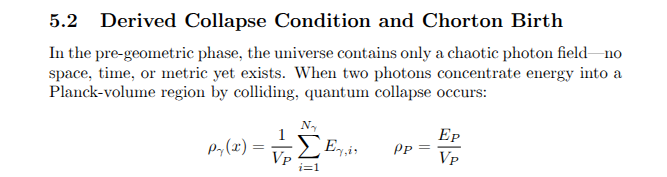
That's not the point. Conjugate pairs of the field variables must comply with the principle of microcausality. Field values at space-like separated points must commute (or anti-commute if they are fermionic) and be canonically conjugate only at points time-like separated or null. No, you're not describing spacetime as emergent; you're saying you're describing it. Saying you're doing something is not the same as doing something. You wouldn't even have photons, very much in the spirit of what @Markus Hanke told you. In order to have quanta of a field the way we understand them, you need to establish commutation rules according to local values. Otherwise you don't even have quanta (and therefore photons). You wouldn't have spin, you wouldn't have on-shell/off-shell separation, or mass, or energy, momentum, Fourier transform of the fields. Nothing makes sense in your theory as far as I can tell. You haven't bothered to define such concepts as pre-geometric substrate. Using new words as shields against legitimate criticism doesn't do the trick. I'm sorry.
-
I also have a problem with your "stationary" chortons. Re-phrasing what @swansont said: How does gravity propagate then? Gravity is known to propagate. You say, You keep saying this. What region do the photons concentrate into? You say yourself there is no space, or time, or way to measure or define distance. You also say, That's not what conjugate field observables do in QFT. You're missing a very important consistency part. But I'm not gonna tell you what it is, because if I do, you will feed my objection into your garbage-generating LLM, and it will make it look like you're making sense. So I'm not giving you any clues. Let's see if you can figure it out by yourself. Thus far, your commutation rule does not make much sense according to relativity. It's too "crude". There are many more objections, but it's impossible to be complete. Let's start with those two.

-
Yeah, ambiguous question: The age of quantum computing? It hasn't happened yet. The age of quantum mechanics? It's been going on since the 1920s Some age or other in Planck units? I don't think that's what you're asking.
-
AHA! She's quite fond of TIT for TAT, plus MUM's her word, obviously.
-
I think "likeness" means something like "analogue", very much in line with what perhaps @toucana seems to be suggesting from the Greek translation of the Septuagint: Man "handles" things, so it's a natural extrapolation to think there must be a "handler of all things". Couldn't agree more.
-
It's OK. If anything, it's flattering.
-
That was the pep-talkish part of what I said, because I thought it would lighten up your spirit a little bit. I'm glad you liked the quote. That's not me, it's C. N. Yang, as I already said. The advise that's actually genuinely mine is (again): Learn mechanics, electricity, thermodynamics, gravity, optics, quantum mechanics. Understand why all this gives rise to chemistry, biology, and the almost unending variety of the world. Keep going up the ladder to the great unifying principles: Symmetries, the principle of least action, entropy, etc. As you do this you will lose focus of many details, but you will gain the ability to synthesize. Learn your maths: Calculus, complex numbers and functions, complex calculus (really a revelation!), geometry, algebra. You don't have to be a mathematical genius, just understand it and know how to use it. The hard way is the only way.
-
What's your motivation, and why is exactly 1.58 the Hausdorff-Besicovitch dimension of time in your theory? When such values come about, it's normally because some kind of consistency condition forces it. It's not a happy coincidence, I suppose, after trial an error with infinitely many possible values.
-
I'll eagerly await the description of a scattering experiment, say electron-electron scaterring, in terms of your theory. Or perhaps the decay of a muon. In the meantime, let me respond in kind: blah, blah, blah. blah, blah, blah, blah. blah, blah. blah.
-
Yeah. I also think it's a good idea to steer the discussion in that direction: What do these primitive concepts of the theory mean and what mathematics illuminates such definitions? A couple of equations would help the thinking along. By the way, the idea that interactions come from a swarm of particles that fill the whole space is not new. Descartes' vortex theory being the prime example. These models were tried and discarded long ago for a number of reasons. I, eg, find it almost impossible to conceive that a simple scattering phenomenon can be explained by means of a swarm of subtle particles filling out space. If not, the OP could provide a simple model of a simple instance, with a parameter impact and and outgoing angle, momenta, etc, in terms of such "dust". Exactly. Bremsstrahlung, high-energy emmission, decay. Does the author have all this phenomenology well covered with their theory?
-
Again: Learn mechanics, electricity, thermodynamics, gravity, optics, quantum mechanics. Understand why all this gives rise to chemistry, biology, and the almost unending variety of the world. Keep going up the ladder to the great unifying principles: Symmetries, the principle of least action, entropy, etc. As you do this you will lose focus of many details, but you will gain the ability to synthesize. Learn your maths: Calculus, complex numbers and functions, complex calculus (really a revelation!), geometry, algebra. You don't have to be a mathematical genius, just understand it and know how to use it. The hard way is the only way. Mathematics is essential in all this business. Let me give you an example of how it's rather salient technicalities of the old ideas that lead you to new ideas rather than the other way around: When people say there are virtual particles, they're not telling you the whole truth. "Virtual particle" is a term designed to picture a piece of really sophisticated maths. Namely: The integrals that represent intermediate procesess in relativistic quantum mechanics (quantum field theory, the so-called propagator) force you to include infinitely many processes, most of which do not consistently satisfy conservation of momentum. In QFT lingo they're called "off-shell" (they violate Einstein's condition that m2c4 = E2-p2c2). It's most certainly not the case that someone thought "oh, there must be virtual particles out there" and then invented the mathematics to represent that. It might have been something like that in times of the Greeks, or the birth of modern science, etc. It's definitely not the way it works today. People invented the "grasping tool" of virtual particles in order to represent these weird (from a physical POV) intermediate integrals in scattering theory. I really hope that helps.