
QuantumT
-
Joined
-
Last visited
Posts posted by QuantumT
-
-
Thank you very much for your replies and the links.
But I get the feeling that you didn't bother to read the OP article, and might be unaware of the extensive research put into it. It's not a new attempt based on old data, but a comparison between the two models, based on recently discovered shortcomings (of CDM) and (fixed) computational mistakes.
Here's a few key excerpts.
Comparing CDM and MOND after error correction:
SpoilerWe introduced a concept known as “theoretical flexibility” to capture the underlying idea of Occam’s razor that a theory with more free parameters is consistent with a wider range of data – making it more complex. In our review, we used this concept when testing the standard cosmological model and Mond against various astronomical observations, such as the rotation of galaxies and the motions within galaxy clusters.
Each time, we gave a theoretical flexibility score between –2 and +2. A score of –2 indicates that a model makes a clear, precise prediction without peeking at the data. Conversely, +2 implies “anything goes” – theorists would have been able to fit almost any plausible observational result (because there are so many free parameters). We also rated how well each model matches the observations, with +2 indicating excellent agreement and –2 reserved for observations that clearly show the theory is wrong. We then subtract the theoretical flexibility score from that for the agreement with observations, since matching the data well is good – but being able to fit anything is bad.
A good theory would make clear predictions which are later confirmed, ideally getting a combined score of +4 in many different tests (+2 -(-2) = +4). A bad theory would get a score between 0 and -4 (-2 -(+2)= -4). Precise predictions would fail in this case – these are unlikely to work with the wrong physics.
We found an average score for the standard cosmological model of –0.25 across 32 tests, while Mond achieved an average of +1.69 across 29 tests. The scores for each theory in many different tests are shown in figures 1 and 2 below for the standard cosmological model and Mond, respectively.
Diagrams:
Spoiler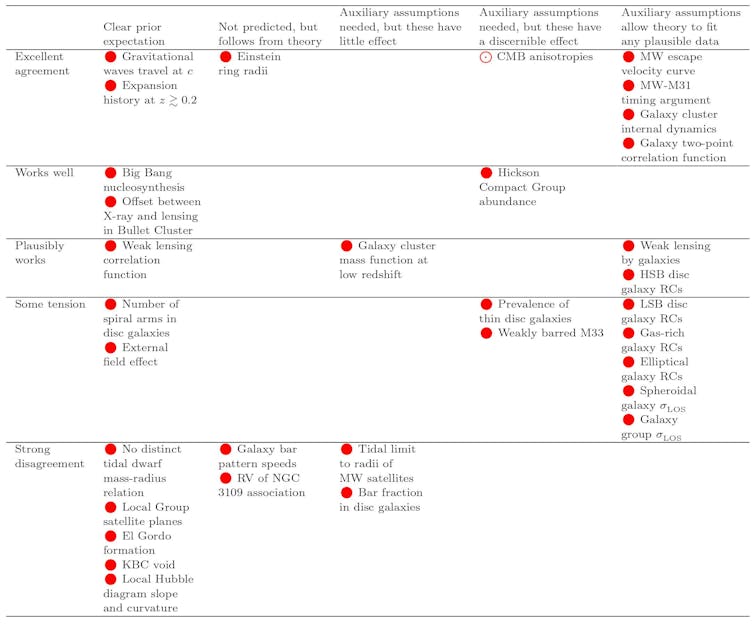
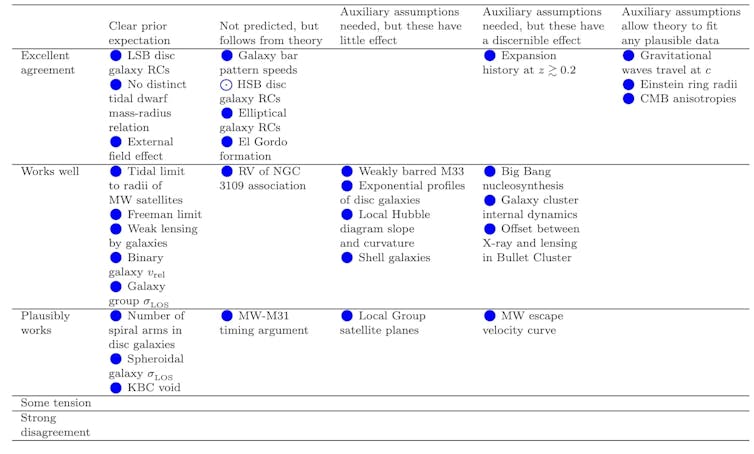
Conclusion:
SpoilerThere are many other failures of the standard cosmological model that we investigated in our review, with Mond often able to naturally explain the observations. The reason the standard cosmological model is nevertheless so popular could be down to computational mistakes or limited knowledge about its failures, some of which were discovered quite recently. It could also be due to people’s reluctance to tweak a gravity theory that has been so successful in many other areas of physics.
The huge lead of Mond over the standard cosmological model in our study led us to conclude that Mond is strongly favoured by the available observations. While we do not claim that Mond is perfect, we still think it gets the big picture correct – galaxies really do lack dark matter.
The full study:
https://www.mdpi.com/2073-8994/14/7/1331/htm
Note: Being from a not-English-speaking country I might have chosen some wrong words to describe certain things. Sorry about that.
-
-
Quote
We can model the motions of planets in the Solar System quite accurately using Newton’s laws of physics. But in the early 1970s, scientists noticed that this didn’t work for disc galaxies – stars at their outer edges, far from the gravitational force of all the matter at their centre – were moving much faster than Newton’s theory predicted.
This made physicists propose that an invisible substance called “dark matter” was providing extra gravitational pull, causing the stars to speed up – a theory that’s become hugely popular. However, in a recent review my colleagues and I suggest that observations across a vast range of scales are much better explained in an alternative theory of gravity proposed by Israeli physicist Mordehai Milgrom in 1982 called Milgromian dynamics or Mond – requiring no invisible matter.
Mond’s main postulate is that when gravity becomes very weak, as occurs at the edge of galaxies, it starts behaving differently from Newtonian physics. In this way, it is possible to explain why stars, planets and gas in the outskirts of over 150 galaxies rotate faster than expected based on just their visible mass. But Mond doesn’t merely explain such rotation curves, in many cases, it predicts them.
So, the question is: Is Mond good enough to gain consensus favor?
-
The suggestion I like the most, about the nature of DM, is also the most simple, and least mysterious: Ground state hydrogen
-
-
11 hours ago, storyteller said:
From what I understand so far about Particle Physics, strong nuclear force is what elementary particles together, such as 3 quarks to form a hadron particle, like a proton or neutron. And as you would know, protons and neutrons make up certain atoms, eg deuterium nuclei, helium nuclei, lithium nuclei, which would have existed before, although hydrogen nuclei don’t have neutron. These atoms with no electrons attached to them (ionized atoms) were formed during the Primordial Nucleosynthesis.
And from what I understand about CMBR in the Big Bang model, the CMBR occurred because electrons bonded with ionized atom nuclei, for the first time, creating electrically neutral atoms, during BB’s Recombination Epoch. The bonding causing the EM radiation, by decoupling photons, as well as leaving heat signatures everywhere in the universe, that we now view as Cosmic Microwave Background Radiation.
So, I don’t think strong nuclear forces have anything to do with CMBR.
I was referring to the split-second after the big bang, when there were only heat, radiation, quarks and electrons. My hypothesis was that the intense heat, present at that moment, turned into gluons. I was wrong. The math don't work. (Although I am not sure it our current math applies to that specific moment.)
But I'm quite sure swansont knows what he's talking about. So I must be wrong.
-
Due to the enormous distances in space, alien visitors are extremely unlikely. How would they even find us? A lucky coincidence? Nah....
Underground people?! C'mon!
To travel back in time violates the laws of nature.That only leaves one option. An option that sounds ridiculous, unless we live in a simulation...
That is why option number two got my vote. It seems like woo, but it isn't, in a simulated reality.
-
-
Existence, the universe and how nature works, is constantly on my mind. I can't help myself. I just want to learn as much as I possibly can about reality, and I will probably keep wondering about it 'till the day I die.
Sometimes I get an idea, that I've never heard about, and I think 'wow, that makes sense', so I google it to see if it's a well known theory. Sometimes it is, sometimes it's not, and sometimes I get nothing. Not even a repudiation. This is one of those. So here goes:
Could most of the heat from the big bang have turned into the strong nuclear force? (The rest would then be the CBR.)
Thank you, in advance, for taking time to consider my question.
-
3 minutes ago, beecee said:
No stupid questions. The 2D surface of the balloon represents the 3 spatial and 1 time dimension of spacetime. It is an analogy based on the BB, where all of spacetime was squeezed to within the volume of an atomic nucleus...there is no outside to speak of...no inside, no "before time" and no "before space" as we know them. Remember the BB is not a theory on how the universe/space/time started, it is a theory of the evolution of spacetime from t+10-43 seconds...before that, our models and theories fail us.
Thank you! So the universe, as a whole, has no geometry?
-
-
Quote
Scientists have developed a new kind of cryogenic computer chip capable of functioning at temperatures so cold, it approaches the theoretical limit of absolute zero.
This cryogenic system, called Gooseberry, lays the groundwork for what could be a revolution in quantum computing – enabling a new generation of machines to perform calculations with thousands of qubits or more, whereas today's most advanced devices comprise only dozens.
-
32 minutes ago, StuartLeDrew said:
How did we come from nowhere?
There is quantum fluctuation, there is zero energy universe, there is M-theory and there is conformal cyclic cosmology. Take your pick.
There are plenty of ways to come from nowhere. The universe is not necessarily limited by our need for logic.
-
1 hour ago, Ghideon said:
Wild guess and questions:
Fan spinning fast sounds like CPU is working hard. Which process is working hard? You may be able to see the program's name in the windows task manager.
Do you have any antivirus software or similar scanning the downloaded data? That software could be degrading when having many connections.I tried to remove the limit on my bittorrent, while downloading, and it showed the bittorrent client taking up to 50% of the CPU. Another 10% went to my firewall, and up to 10% went to "systeminterrupts".
qBittorrent: 40-50%
Zonealarm: 7-10%
Systeminterrupts: 5-10% -
Edited by QuantumT
20 minutes ago, StringJunky said:Can you reduce the uploading amount to the other peers? It sounds like excessive demand on your system trying service too many requests at once. Like Windows Update in its current guise downloads the update files whilst supplying your files to other PC's... it can create too much traffic for the system's specs.
My bittorrent is reduced to max 50, which often gives low DL speed. Any lasting solutions?
-
-
I've been having a persistent problem for over a year now. Every time I download something from multiple (40+) peers, my whole system starts lagging fiercely, the cooling fans run berserk and I can hardly control my mouse. It only happens when there are many connections, like in Windows Update or when I download bittorrent files/content (all legal of course!).
I've tried updating my LAN and mouse drivers many times. Doesn't help. I've also googled it countless times, but no help there either.
Is there any system files, that manages connections, that could be corrupt?
I run Windows 10 Home on a Lenovo 81HN V130 i5 laptop.
-
21 minutes ago, Phi for All said:
Expansion happened EVERYWHERE, all at once. No center, nothing to expand into.
20 minutes ago, Ghideon said:As far as I know, according to accepted models: On large scales every location will be a center of expansion. All observers will observe distant objects mode away from them.
Yes, I know. Like the surface of a balloon. But once that balloon was small. Once everything was located in a singularity.
If you look at this simulation of our universe, there is a place in the middle, where the distance to the furthest away stars is equally long in all directions. Right? -
On 12/26/2020 at 3:43 PM, Ghideon said:
That seems to be a common misunderstand of the Big Bang model. There was no point in space that Big Bang "happened" ,Big Bang is an event that took place everywhere.
Isn't there a location in the universe, that everything is moving away from? Sort of an expansion "ground zero"?
-
-
-
-
One day, Einstein has to speak at an important Science conference. On the way there, he tells his driver, who looks a bit like him:
"I'm sick of all these conferences. I always say the same things over and over!"
The driver agrees: "You're right. As your driver, I attended all of your conferences and even though I don't know anything about Science, I could give the conference in your place."
"That's a great idea!" says Einstein. "Let's switch places then!"
So they switch clothes and as soon as they arrive, the driver dressed as Einstein goes on stage and starts giving the usual speech, while the real Einstein, dressed as the car driver, attends it.
But in the crowd, there is one scientist who wants to impress everyone and thinks of a very difficult question to ask Einstein, hoping he won't be able to respond. So that scientist stands up and interrupts the conference by posing his very difficult question. The whole room goes silent, holding their breath, waiting for the response.
The driver looks at that scientist, dead in the eye, and says:
"Sir, your question is so easy to answer that I'm going to let my driver reply to it for me."
-
The only science that may support a (non divine) creator, or some degree of intelligent design, is digital physics.
Creationism and intelligent design is frowned upon by most scientists, but that is because they suggest evidence of a god.
With digital physics, God is removed from the equation.

 ,
,

Mond beats Dark Matter
in Astronomy and Cosmology
Thanks for letting me down easy. Again.
So you read the full study?